
 By Tom Kuhn, CEO, Rose Restoration
Rose Restoration has restored marble, terrazzo, concrete, and natural stone across DC, MD, and VA since 1978.
A boardroom table wears in a pattern you can map from the doorway: a band of damage in an arc around each chair position, and clean wood in between.
That pattern tells you two useful things. The damage is contact damage rather than age, and it is concentrated enough that the table almost certainly restores. Rose Restoration has restored furniture and architectural wood across DC, Maryland and Virginia since 1978. Request a free assessment or call (703) 327-7676.
The four marks on every boardroom table
Heat rings from coffee and from laptop power bricks left running through a long meeting. These sit in the finish and are among the most recoverable marks there are.
Write-through. Pen pressure through a single sheet of paper leaves impressions in a soft finish. Over years this reads as a general haze in the working zone rather than as distinct marks.
Abrasion at the edge where forearms and cuffs sit, and along the front where chairs are pushed in. On a veneered table this is the one place where wear can actually go through the veneer, because the edge is where veneer is thinnest and most often already worn.
Chemical dulling from cleaning products. Most facilities clean boardroom tables with whatever is on the cart. Ammonia and alcohol-based sprays degrade a clear coat steadily, and the effect is uniform rather than patchy, which is why it usually gets attributed to age.
The veneer question decides everything
Before scoping a table, establish whether it is solid or veneered. Most executive furniture made in the last sixty years is veneered, often over a plywood or MDF core, and quality veneer can be very thin.
This matters because refinishing removes material. A solid table tolerates repeated refinishing across decades. A veneered table has a finite number of refinishes in it, and a table that has already been taken back twice may not survive a third. Where veneer is already worn through at an edge, that area needs patching or edge banding rather than sanding.
A competent assessment establishes this first and says so. A quote that does not mention it has not looked.
On-site or workshop
Tables are one of the few wood elements where genuine choice exists, and the trade-off is real.
Workshop restoration produces the better finish. Controlled temperature and humidity, the table on its side or upside down so every surface can be worked properly, spray application rather than hand application, dust control that an occupied office cannot match. For a high-value table or one needing a full strip and restain, this is the right answer.
The costs are access and time. A large boardroom table may not fit through the door it came in through, because many are assembled in the room. It has to be dismantled, moved, restored, returned and reassembled, and the room is without a table for the duration.
On-site restoration keeps the table in the room and the room in service faster. It suits recoating, localised repair and lighter scopes, and it is the usual answer for tables that cannot be moved. It requires containment and ventilation, and it works best on a weekend.
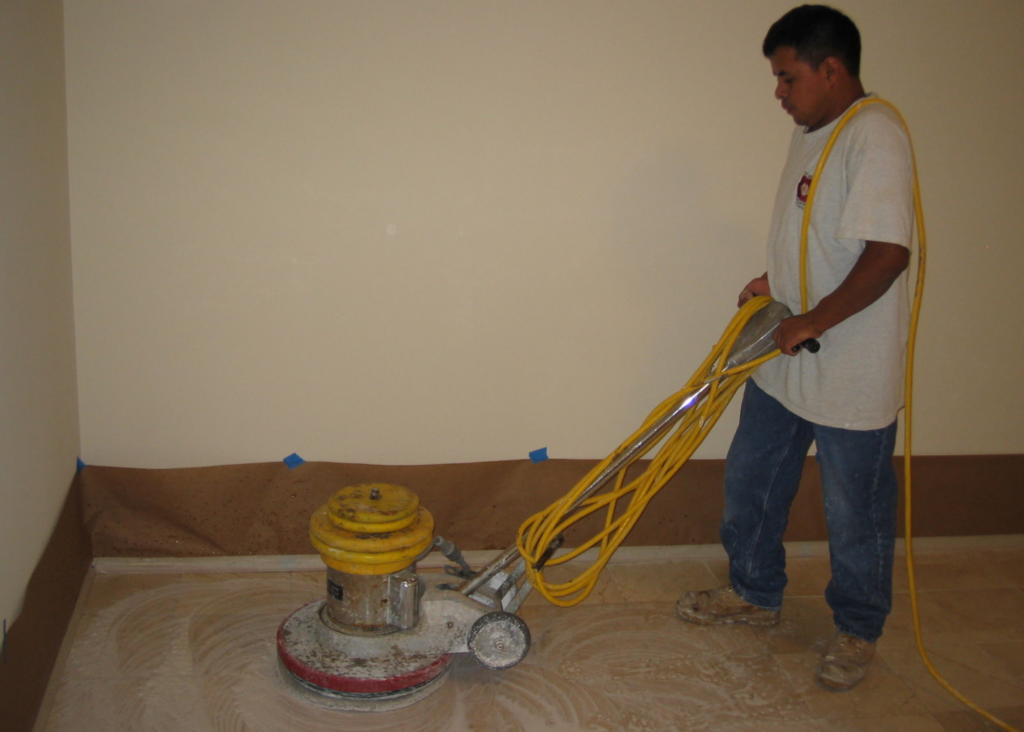
The honest rule: light damage and a recoat, do it on site. Full strip, colour change or veneer repair, take it to the shop.
What restoration costs
Published ranges for desk and table refinishing are on the wood restoration cost guide. What moves the number is size, whether the finish is being matched or changed, the complexity of any inlay or banding, and whether the piece moves.
Inlay is the item most often underestimated. A table with contrasting banding or marquetry cannot be sanded as one surface, because different species take stain differently and an aggressive pass will blur the boundary. That work is done by hand and priced accordingly.
When replacement makes sense
- Veneer worn through across a broad area, rather than at one edge.
- A swollen or delaminated core, usually from sustained water.
- Structural failure in the base or leaves that would cost more to repair than the piece is worth.
- A deliberate design change, where the room is being rebuilt around a different material.
Everything short of that restores, and for executive furniture the economics are rarely close. Replacing a large custom boardroom table means specification, lead time and installation. Restoring it means a weekend.
Frequently asked questions
Can heat rings be removed from a conference table?
Usually, and often without refinishing the whole top. A heat ring sits in the finish rather than the wood, which puts it among the most recoverable marks.
Can a veneered table be refinished?
Yes, with care, and a limited number of times. The assessment establishes how much veneer remains before any sanding starts. Where an edge is already worn through, it is patched rather than sanded.
Does the table have to leave the building?
Not for lighter scopes. Recoating and localised repair are done in place over a weekend. Full strip and restain produces a better result in the workshop.
How should it be cleaned afterwards?
With a product compatible with the finish applied, which Rose specifies in writing. Chemical dulling from cleaning sprays is the most common reason a restored table looks tired again within a few years.
Have the table looked at before the next board meeting. Rose Restoration has restored executive furniture across DC, Maryland and Virginia since 1978. Request a free on-site assessment or call 703-327-7676.
Related: Architectural wood restoration · Furniture restoration · Wood restoration cost guide · Office building restoration
Looking for something else?
Get a Free Assessment from Rose Restoration
Tell us about your marble, stone, terrazzo, or concrete and our senior technicians will recommend the right restoration approach. Family-run and trusted across Washington DC, Maryland, and Virginia since 1978.
Call (703) 327-7676 · Email info@roserestoration.com · schedule a time · or send us photos.
Restore. Don't replace.
48 years of polishing marble, terrazzo, concrete, and tile across Washington DC, Northern Virginia, and Maryland. IMF, Four Seasons, Smithsonian, and the Virginia State Capitol trust us — you can too.