| Repointing scope | Typical cost (DC metro) | Notes |
|---|---|---|
| Spot mortar / joint repair | $8–$15 / sq ft | Small areas of missing or cracked mortar. |
| Full repointing (rake & replace all mortar) | $15–$35 / sq ft | Whole wall or elevation. The common repointing scope. |
| Historic lime-mortar repointing | $25–$50 / sq ft | Period buildings. Lime mortar, matched color and joint profile. |
| Chimney repointing | $2,000–$6,000 / chimney | Varies with size, height, and access. |
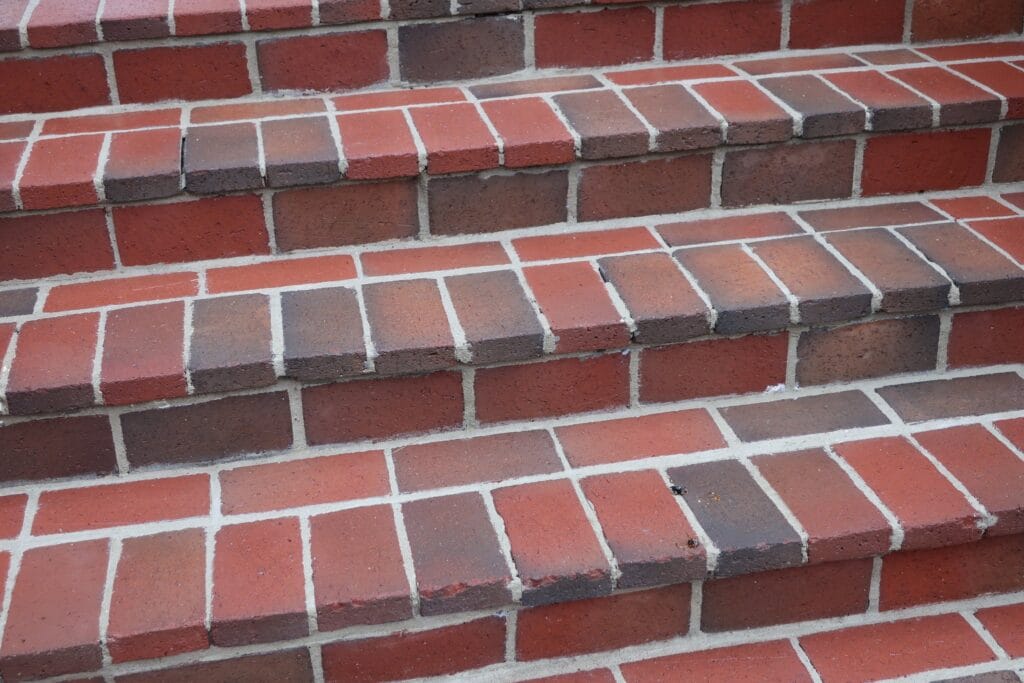
| Brick stair or stoop repointing | $1,500–$5,000 | Typical residential front steps. |
| Brick clean & seal | $4–$7 / sq ft | Often paired with repointing to finish the facade. |
These are ranges. Your surface is specific.
Send photos and we will price your actual square footage, condition, and access. Most estimates go out the same day.
How much does brick pointing (repointing) cost?
Brick pointing, also called repointing, runs $15 to $35 per square foot in the Washington DC area for full repointing, where the old mortar is raked out and replaced across a wall or elevation. By project, a chimney runs $2,000 to $6,000 and brick front steps or a stoop $1,500 to $5,000. Historic buildings that need lime mortar and a matched joint profile sit higher. Rose matches mortar color, sand and joint profile to the existing brick. Send photos for a proposal.
Masonry repointing cost depends on three main things: how much mortar needs replacing, how old and historically significant the building is, and what kind of access the work requires. This guide breaks down real 2026 repointing and masonry restoration pricing for the DC metro area.
Rose Restoration provides free on-site assessments throughout Washington DC, Maryland, and Virginia. Request one or call (703) 327-7676.
Masonry Repointing & Restoration Cost Ranges (2026)
| Scope | Typical Cost | Notes |
|---|---|---|
| Mortar joint repair (spot repair) | $8 – $15 / SF | Small areas of missing mortar |
| Full repointing (remove & replace all mortar) | $15 – $35 / SF | Historic, pre-1920s buildings typically higher |
| Historic repointing with lime mortar | $25 – $50 / SF | Lime-based mortar, period-appropriate technique |
| Brick power washing | $1 – $3 / SF | Surface cleaning only |
| Brick clean & seal | $4 – $7 / SF | Clean plus penetrating sealer |
| Stone masonry repair | $15 – $40 / SF | Varies widely by stone type and scope |
| Chimney repointing | $2,000 – $6,000 | Per chimney, depending on size and height |
| Brick stair / stoop repointing | $1,500 – $5,000 | Typical residential front steps |
| Historic building facade repointing | Contact for quote | Project-specific; depends on access, scope, preservation requirements |
How Repointing Is Priced
We quote repointing per square foot of wall, but the real cost sits in the joints inside that area, which is why estimates from other trades rarely match. What drives it is joint depth, mortar type, access and whether scaffold is needed. We specify all of these in the proposal so you can compare bids properly rather than guess at what is included.
Repointing Cost Calculator
Enter the scope and size to get a planning range built from the 2026 pricing on this page. Every masonry job is finally priced from the condition of the joints on site.
Height times width of the face being repointed. A typical row house side wall runs 400 to 800.
This is a planning range, not a quote. It uses Rose Restoration’s published 2026 ranges for the DC metro area. Joint depth, mortar match and access are only knowable on site, which is why every job is walked before it is priced.
Get a masonry assessment or call 703-327-7676
What Drives Masonry Repointing Cost
1. How Much Mortar Needs Replacing
Spot repair — replacing mortar in specific failed joints — is the most economical option. The mason matches the existing mortar, carefully removes failed sections, and repoints only what’s needed. This works well when 80%+ of the existing mortar is still sound.
Full repointing — removing all existing mortar and installing new mortar throughout — is a much bigger job. Required when the existing mortar has failed widely, when an incompatible mortar was previously used, or when the building’s historic status requires uniform treatment.
2. Age and Building Type
The single biggest driver of cost on historic buildings is mortar type. Pre-1920s buildings were built with lime-based mortar (type N or type O), which is softer than the brick. This allowed the mortar to take up building movement and weathering without damaging the brick.
Modern portland-cement mortars are harder than most historic brick — use them on a pre-1920s building and within 20–40 years you crack and spall the brick itself. Removing portland mortar from historic brick is slow, expensive, and risky work — often why historic repointing costs 2x standard repointing.
3. Access
Ground-floor repointing: straightforward. Second-floor repointing: scaffolding or lift required. Historic building facades: major access engineering, often weeks of scaffolding setup. Chimney repointing: specialized equipment, roof access, occasionally climbing.
4. Preservation Requirements
Standard buildings: no preservation oversight, straightforward work. Historic district: may require mortar color matching approval before work begins. Listed historic buildings: additional documentation, preservation office review, potentially specific methodological requirements.
5. Mortar Match
Standard modern mortar colors: ready off-the-shelf. Historic color and texture matching: requires samples, often multiple mock-ups before approval. Sand matching (visual grain of the mortar) may require sourcing from specific suppliers.
6. Brick Condition
Intact brick with just mortar failure: standard repointing. Cracked, spalling, or crumbling brick that needs to be repaired or replaced: significantly more expensive. Brick replacement units may need to be sourced from salvage to match the existing building.
7. Joint Profile
Historic buildings often have specific joint profiles — struck, raked, concave, V-joint — that need to be reproduced. Mass-market modern work typically uses concave or struck joints; historic matching may require hand-tooling specific profiles.
Why Getting the Mortar Type Right Matters
If you remember one thing from this guide: matching mortar hardness to brick hardness matters more than almost any other decision in masonry restoration.
- Type N mortar (medium strength, lime-based): for most historic brick, non-load-bearing walls, chimneys, above-grade work.
- Type O mortar (low strength, high lime): for soft pre-1900 brick, interior walls, light-duty work.
- Type S mortar (high strength, portland-based): for modern structural brickwork, foundations, load-bearing walls.
- Type M mortar (highest strength): for modern heavy masonry, foundations, structural stone work.
- Type K mortar (very soft, pure lime): for specialty historic preservation work on very old buildings.
Using type S mortar (too hard) on pre-1900 brick that was built for type O: within 30 years, the brick faces spall off because the mortar is transferring building stress into the softer brick. The damage is often worse than the original mortar failure.
This is why we spend real time on mortar matching before any repointing work begins. The quote includes mortar mixing, sample approval, and documentation if required.
Stone and Brick Repair vs Replacement
On historic masonry, restoration almost always beats replacement:
- Repointing preserves original brick. Original historic brick is denser, harder, and more weather-resistant than any modern brick. Keeping the original brick in place while refreshing the mortar produces a 50+ year repair.
- Replacement is often impossible to match. Historic brick color, size, and texture can rarely be matched with modern brick. Replacement work on historic buildings tends to look patched for decades.
- Preservation cost structure favors restoration. Historic building tax credits, preservation grants, and property assessment benefits often require restoration over replacement.
Common Projects and What They Cost
- Residential chimney repointing: $2,000–$6,000 depending on chimney size, height, and condition. Access via roof or scaffolding affects cost.
- Brick stoop / front steps repointing: $1,500–$5,000 for standard residential front stairs. Historic brownstones with period-specific mortar requirements run higher.
- Backyard brick patio restoration: $15–$25 / SF for clean + repoint + seal. Varies with condition.
- Garden wall repointing: $15–$30 / SF depending on access and brick condition.
- Commercial building facade repointing: project-specific; typically $20–$50 / SF depending on access and preservation requirements.
Tuckpointing vs. Repointing: Is There a Difference?
In common usage, tuckpointing and repointing are often used interchangeably to describe the process of removing old mortar and installing new mortar. Technically, however, tuckpointing refers to a specific decorative technique common in 18th and 19th century British and American masonry, in which a colored mortar flush with the brick face is ruled with a narrow ribbon of contrasting putty to simulate fine ashlar stonework. True tuckpointing is a specialty skill and costs more than standard repointing.
For practical purposes, when most contractors and homeowners use the term tuckpointing, they mean repointing. But if you are working on a historic property with decorative joint profiles, it is worth confirming what the contractor means and what technique they intend to use.
How to Evaluate a Repointing Contractor Proposal
A well-structured repointing proposal should specify the following elements clearly:
- The extent of work in square feet or linear feet of joint
- The mortar type and mix designation (Type S, Type N, NHL 3.5, etc.)
- The minimum removal depth and the tool or method to be used
- The joint profile to be tooled at completion
- Whether scaffold is included or billed separately
- Warranty terms and any exclusions
- The process for color matching and whether test panels will be provided
Proposals that lack these specifics make apples-to-apples comparison difficult and leave room for scope disputes during the project. A contractor who cannot or will not specify these details is a risk regardless of price.
When Repointing Is Not Enough: Recognizing Larger Problems
Repointing addresses deteriorated mortar joints. It does not address structural movement, foundation settlement, or failed flashing and waterproofing systems. If mortar joints are failing at an accelerated rate, or if the same joints continue to crack and open after repeated repointing attempts, the underlying cause is likely movement or water infiltration that is not being addressed at its source.
Signs that warrant structural evaluation rather than — or in addition to — repointing include:
- Diagonal stair-step cracking patterns in brick, indicating differential settlement
- Horizontal cracking at mortar joints in a retaining wall, indicating lateral pressure
- Bulging or bowing sections of a wall face
- Recurring joint failure in the same location after previous repointing
- Brick faces that are spalling or delaminating rather than simply having failed joints
A qualified masonry contractor will identify these issues during a site assessment and recommend the appropriate scope of work. For more on mortar selection and compatibility, see our detailed guide: Mortar Types Explained: How We Match Color, Sand, and Strength for Masonry Repointing.
Maintenance After Repointing: Protecting Your Investment
Properly executed repointing on sound masonry should last 25 to 50 years or more, depending on exposure conditions and the quality of the mortar used. A few maintenance practices significantly extend that service life:
- Keep gutters, downspouts, and flashing functioning properly to minimize water running down masonry faces
- Caulk all penetrations, window and door frames, and transitions where masonry meets dissimilar materials
- Do not apply silicone or surface sealers to masonry that is designed to breathe — particularly historic lime-based masonry
- Inspect chimney crowns annually and repair cracks before water infiltrates the flue system
- Address any vegetation growing from joints immediately; root pressure accelerates joint failure rapidly
Masonry Cost FAQ
How much does it cost to repoint a chimney?
Most residential chimneys run $2,000–$6,000 depending on size, height, access method, and mortar matching requirements. Historic chimneys with preservation oversight run higher.
How much does brick repointing cost per square foot?
$15–$35 / SF for standard repointing. $25–$50 / SF for historic lime-mortar work. Spot repair can be much less on jobs where only specific areas have failed.
How long does repointing last?
Properly executed repointing with correct mortar type should last 50+ years. Mismatched mortar type may fail in 10–20 years and cause brick damage.
Can I repoint my own chimney or stoop?
We recommend professional repointing for chimneys and stoops, even for small areas. The mortar has to match the original in type, hardness and color, the joints have to be raked to the right depth, and getting it wrong is expensive: mortar that is too hard can crack the surrounding brick.
Do you work on historic buildings?
Yes — we specialize in historic building restoration including period-appropriate lime mortars, mortar matching, and preservation-grade techniques. See our historical restoration page.
Do you offer free masonry estimates?
Yes — free on-site assessments for residential and commercial masonry projects throughout DC, MD, and VA.
Is tuckpointing the same as repointing?
In everyday contractor and homeowner usage, tuckpointing and repointing are used interchangeably to describe removing deteriorated mortar and packing fresh mortar into the joints. Technically, tuckpointing is a specific decorative technique involving a two-layer mortar finish to simulate fine ashlar work. If you are concerned about the distinction — particularly for a historic property — ask the contractor to clarify exactly what technique they are proposing.
How do I know if my masonry needs repointing?
The most reliable field test is the key scratch test: drag a key or a nail across the mortar joint. If mortar powder comes away easily and the joint surface crumbles, the mortar has lost its binding strength and repointing is warranted. Visually, look for joints that are recessed more than a quarter inch from the face of the masonry, cracking running along joint lines, or white efflorescence deposits indicating active water infiltration. If you are unsure, a professional assessment from a qualified masonry contractor will provide a clear answer.
Does repointing require a permit in Washington DC?
Standard maintenance repointing on a non-historic property in DC generally does not require a building permit. However, any masonry work on a property within a historic district — including most of Capitol Hill, Georgetown, Dupont Circle, and numerous other neighborhoods — requires a permit from the DC Historic Preservation Review Board. In Maryland and Virginia, permit requirements vary by jurisdiction and the historic designation status of the property. Rose Restoration is familiar with these requirements across the DC metro region and can advise on the permitting process as part of the project assessment. Call us at 703-327-7676.
Most of our masonry repointing happens on older Bethesda and Chevy Chase homes — 1920s and 1930s construction where the original mortar has finally given up.
Ready to Restore Your Masonry?
Request a Free Assessment → | Call: (703) 327-7676
Related Cost Guides
Related Services
Related reading
Pricing a District project? See our masonry repointing in Washington DC, covering lime mortar matching, chimneys, facades and historic brick across the District.
More answers
How much does brick repair cost?
Most brick repair is really mortar repair. Spot repair of failed joints runs $8 to $15 per square foot, full repointing $15 to $35 per square foot, and a brick clean and seal $4 to $7 per square foot. Cracked, spalling or crumbling brick that has to be repaired or replaced costs more, and on older buildings replacement brick sometimes has to come from salvage to match. Send photos and we will price the actual wall.
How much does tuckpointing cost?
When most people say tuckpointing they mean repointing: removing deteriorated mortar and installing new mortar. Priced that way, full repointing runs $15 to $35 per square foot in the DC area. True tuckpointing is a historic decorative technique, where a flush colored mortar is ruled with a narrow ribbon of contrasting putty to imitate fine joints. It is specialty work, costs more than standard repointing, and is quoted per project.
How much does it cost to repoint a stone foundation or stone wall?
Stone foundations and stone walls are repointed with a softer lime-based mortar (Type N or O) matched to the stone, rather than a hard portland mortar that can damage older masonry. Stone masonry repointing and repair runs $15 to $40 per square foot, depending on joint depth, the stone and access. Send photos and we will price the actual wall.
How much does it cost to repoint a house?
Repointing is priced by the square foot of wall face, so a whole house depends on how many walls need it. Full repointing runs $15 to $35 per square foot in the DC area, and a typical row house side wall is 400 to 800 square feet. Upper-story or scaffold access, badly eroded mortar and historic mortar matching push a job toward the top. The calculator on this page turns your wall area into a planning range.