Concrete Surface Preparation in Washington DC, Maryland & Virginia

Rose Restoration provides concrete surface preparation for Washington DC GCs and facility managers — diamond grinding, shot blasting, coating removal, moisture testing, crack repair, and CSP (concrete surface profile) prep for polished concrete, resinous flooring, epoxy coatings, and specialty overlays. Proper surface prep is the single biggest determinant of long-term floor system success.

Free in-person assessment — same-week scheduling across DC, MD & VA
Call (703) 327-7676 Request a Quote
47
Years in DC/MD/VA
30+
Technicians on staff
4.8★
118+ Google reviews
DC · MD · VA
Service area

Related Rose Restoration concrete services

Rose Restoration has delivered concrete surface preparation and related services for:

Concrete Surface Preparation in Washington DC — Quick Answers

Who does concrete surface preparation in Washington DC?

Rose Restoration provides concrete surface preparation across Washington DC, Maryland, and Northern Virginia — diamond grinding, shot blasting, coating removal, moisture testing, CSP (concrete surface profile) specification, and crack repair prior to polished concrete, resinous flooring, epoxy coatings, or specialty overlay installation. 47 years of DC-area surface prep experience. Request a walk-through.

What is CSP and why does it matter?

CSP (Concrete Surface Profile) is a numbered rating (CSP 1-9) from the International Concrete Repair Institute that quantifies the roughness of a prepared concrete surface. Different flooring systems require different CSPs: polished concrete CSP 1-2, thin-film epoxy CSP 3-4, self-leveling overlays CSP 4-5, urethane cement CSP 5-6. Specifying the wrong CSP leads to delamination, blistering, and system failure.

Why is moisture testing required before resinous flooring?

Concrete slabs release moisture vapor long after pour. Resinous coatings (epoxy, polyaspartic, urethane cement) installed over high-moisture substrates delaminate and blister. Rose Restoration performs ASTM F2170 (in-situ RH testing) or ASTM F1869 (calcium chloride testing) before every resinous installation to verify moisture is within system-specific tolerances (typically under 80% RH or 3 lbs/1000 sq ft/24hr).

How much does concrete surface preparation cost in Washington DC?

Concrete surface preparation in the DC metro typically runs $2–$5 per square foot for standard diamond grinding. Shot blasting for heavy coating removal or aggressive profile runs $3–$7/sq ft. Moisture mitigation systems (when moisture exceeds spec) add $3–$8/sq ft. Coating removal from existing painted or sealed floors runs $3–$10/sq ft depending on coating type and thickness.

Specialized Preparation Services

Bush Hammering

Bush hammering creates a textured, slip-resistant surface on concrete and natural stone by mechanically impacting the surface with a multi-point hammer tool. The result is an even, rough texture similar to natural split stone. We use bush hammering for slip-resistance on ramps, loading docks, pool decks, and exterior walkways — and as a decorative texture on concrete walls and architectural elements. Bush hammering can also be used to remove thin coatings and level minor surface irregularities.

Thin Set & Adhesive Removal

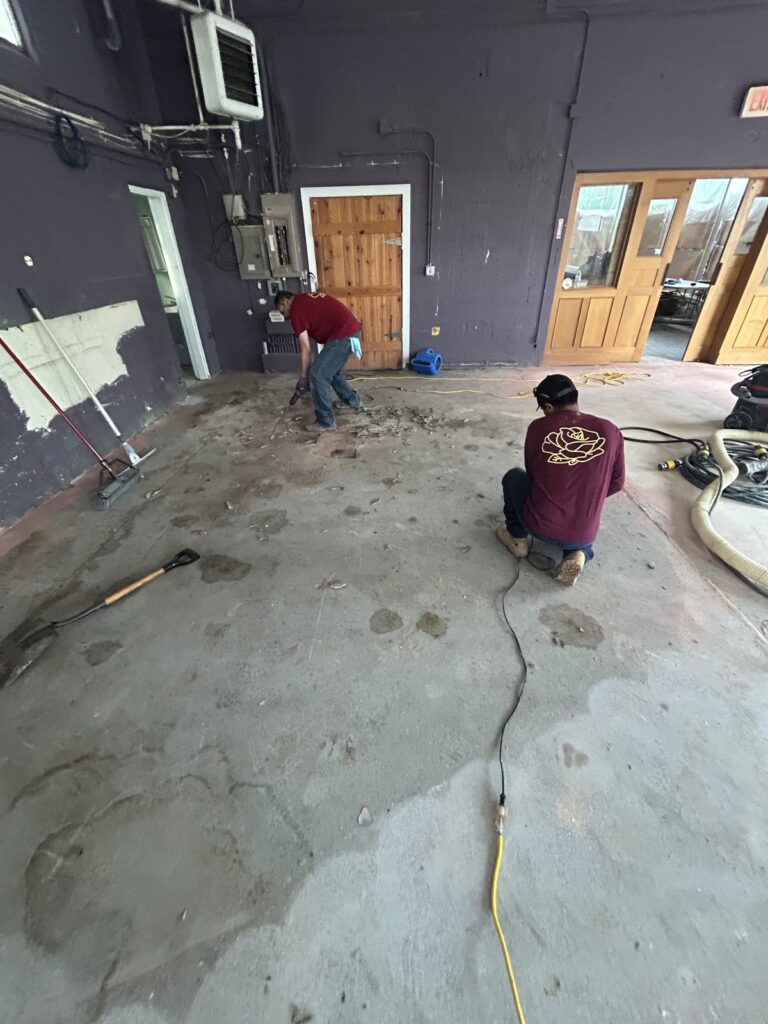
When tile, VCT, or stone has been removed, the substrate is left covered in thin set morite, adhesive, or mastic. This must be completely removed before any new floor system can be installed. We use diamond grinding, scarifying, and shot blasting to remove thin set down to clean concrete. The method depends on the adhesive type, thickness, and the requirements of the new floor system being installed over the prepared surface.

Exposed Aggregate Finishing

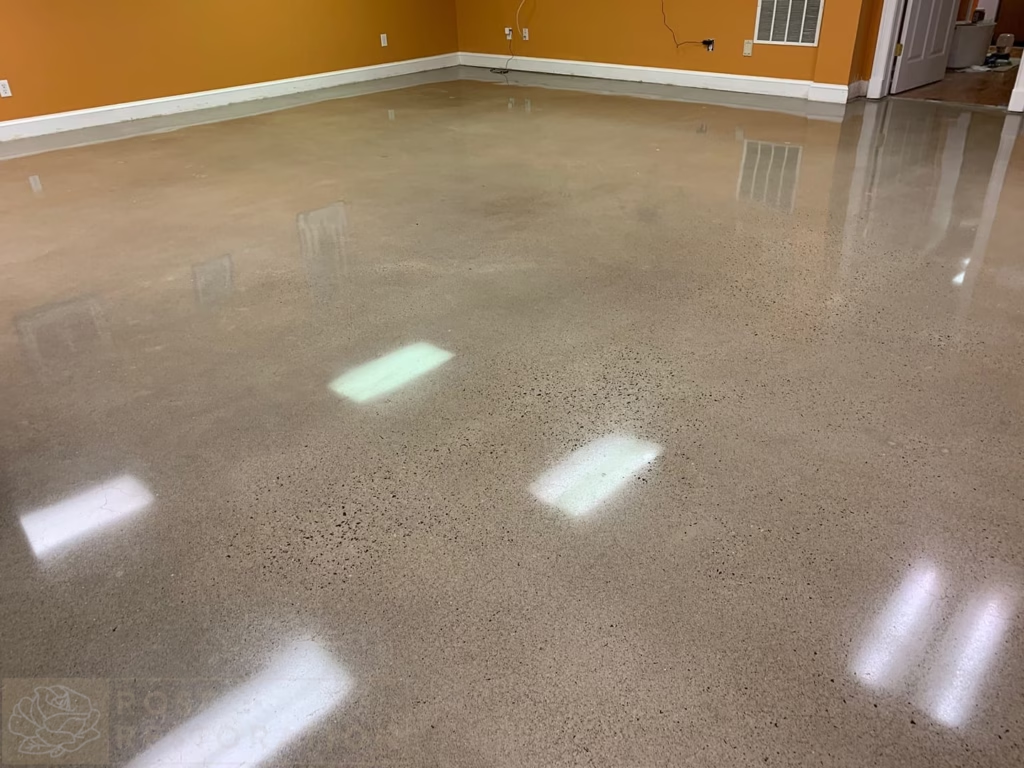
Exposed aggregate is achieved by grinding concrete deep enough to reveal the stone chips embedded in the mix. The depth of grinding determines how much aggregate is visible — from light “salt-and-pepper” exposure to full large-stone exposure. Exposed aggregate is both a preparation step for polished concrete and a finished aesthetic choice. We control the exposure level precisely to achieve the specified look while maintaining surface integrity.

Professional Surface Preparation and Cleaning Services

Every successful flooring installation, coating application, and surface restoration project depends on what happens before the finish material goes down. Surface preparation is the critical first step that determines whether a coating bonds properly, a polish develops the right profile, or an overlay adheres for the long term. Skipping or shortcutting surface prep is the single most common reason that floor coatings peel, overlays delaminate, and polished floors underperform.

Rose Restoration International provides professional surface preparation and cleaning services throughout Virginia, Maryland, and Washington, DC. With more than 40 years of industry experience and a team of over 30 skilled technicians, we have the equipment, knowledge, and manpower to prepare any substrate — concrete, stone, terrazzo, or other hard surfaces — for whatever comes next. We work on our own restoration and coating projects, and we also provide surface preparation as a standalone service for general contractors, property managers, and other trades who need a properly prepared substrate before their work can begin.

Why Surface Preparation Matters

The performance and longevity of any coating, overlay, or polished finish is directly tied to the quality of the surface preparation beneath it. Manufacturers of epoxy systems, urethane coatings, polished concrete systems, and cementitious overlays all specify minimum surface preparation requirements in their technical data sheets. Failure to meet these requirements voids warranties and virtually guarantees premature failure.

Proper surface preparation accomplishes several things simultaneously:

  • Creates mechanical bond — A profiled surface provides physical texture (peaks and valleys) for coating materials to grip. A smooth, sealed, or contaminated surface prevents adhesion.
  • Removes contaminants — Oils, grease, curing compounds, sealers, paint, adhesives, and other surface contaminants create bond-breaking barriers that must be completely removed before new materials are applied.
  • Opens the pore structure — Concrete and stone surfaces have microscopic pores that allow coatings and sealers to penetrate and lock in. Surface prep opens these pores so materials can achieve full penetration.
  • Levels and corrects the substrate — Prep work can flatten high spots, smooth rough areas, and correct minor imperfections in the substrate, resulting in a better-looking and better-performing finished floor.
  • Identifies hidden problems — The preparation process often reveals conditions that are not visible on the surface — moisture issues, cracks, hollow spots, prior repairs, and substrate defects that must be addressed before proceeding.

Surface Preparation Methods

Diamond Grinding

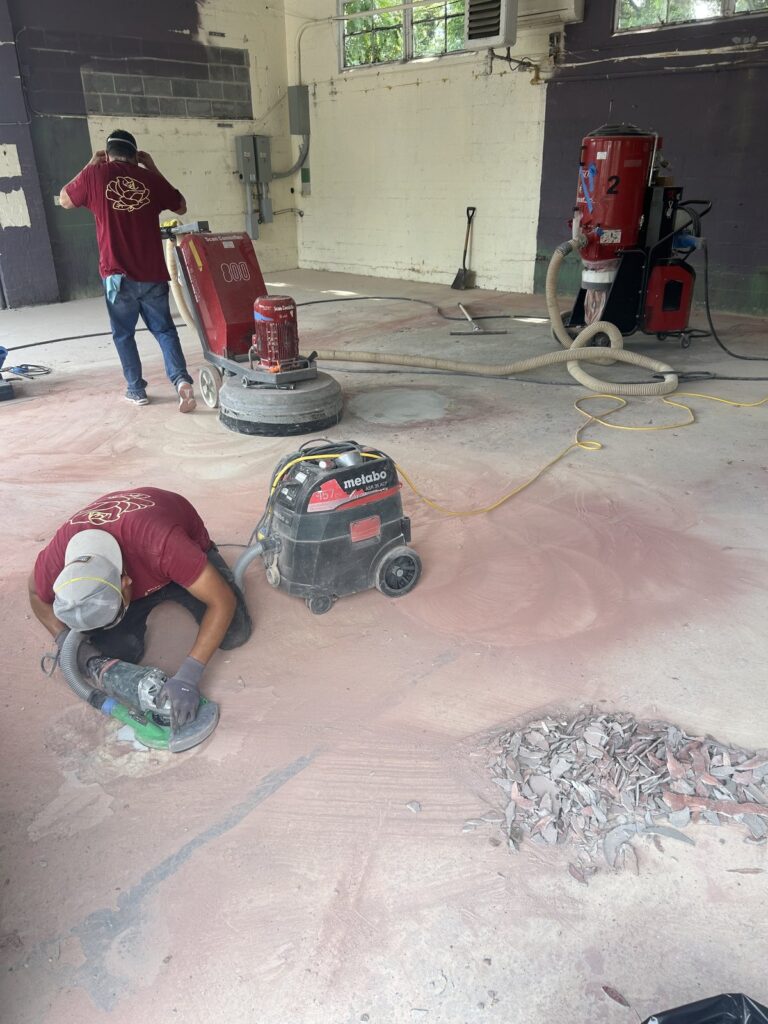
Diamond grinding uses rotating discs embedded with industrial diamonds to abrade the surface and create a uniform profile. It is the most versatile preparation method and is used for coating prep, polished concrete systems, and removing thin coatings, sealers, and surface contaminants. Grinding produces minimal dust when used with proper vacuum and dust-collection systems, making it suitable for occupied buildings and interior spaces.

We operate planetary grinders in various sizes, from small walk-behind units for tight spaces to large ride-on machines capable of processing thousands of square feet per day on open commercial floors.

Shot Blasting

Shot blasting propels steel shot at high velocity against the floor surface, simultaneously cleaning the surface and creating a defined profile. The shot and debris are captured and recycled by the machine’s vacuum system, making it a virtually dust-free process. Shot blasting is highly efficient for large open areas and is commonly specified for garage decks, warehouses, and industrial floors that require aggressive profiling before thick-build coating systems.

Shot blasting is particularly effective for removing rubber tire marks, paint lines, thin coatings, and surface laitance from concrete. The depth of profile is controlled by adjusting machine speed and shot flow rate.

Scarification

Scarifiers (also called milling machines) use rotating cutting wheels to aggressively remove material from the surface. This method is used for removing thick coatings, adhesives, trip hazards, and high spots. Scarification creates a rough, aggressive profile and is typically followed by grinding to refine the surface texture before coating application.

We use scarifiers for jobs like removing multiple layers of old floor paint in industrial facilities, eliminating carpet or vinyl adhesive residue, and correcting significant surface irregularities in concrete slabs.

Chemical Stripping

Some coatings, sealers, and contaminants respond better to chemical removal than mechanical methods. We use professional-grade stripping agents to dissolve and lift old coatings, waxes, acrylics, and sealers without damaging the underlying substrate. Chemical stripping is often the preferred method for natural stone surfaces where aggressive mechanical methods could cause damage, and for removing multi-layer coating systems where mechanical-only removal would be excessively time-consuming.

Adhesive and Coating Removal

Removing old adhesives — whether carpet glue, tile mastic, VCT adhesive, or epoxy — is one of the most common surface prep tasks we perform. Different adhesives require different removal strategies. Some respond to mechanical scraping and grinding, while others require heat, solvents, or a combination approach. Our experience across thousands of projects means we can identify adhesive types quickly and select the most efficient removal method.

Concrete Profiling (CSP)

The International Concrete Repair Institute (ICRI) established a Concrete Surface Profile (CSP) classification system ranging from CSP 1 (nearly flat, similar to fine sandpaper) through CSP 10 (very rough, similar to a heavily scarified surface). Different coating and overlay systems require different CSP levels for proper adhesion.

For example:

  • CSP 1-2 — Thin-film sealers, stains, and densifiers
  • CSP 2-3 — Thin-build epoxy and urethane coatings
  • CSP 3-5 — Self-leveling overlays and thick-build coating systems
  • CSP 5-7 — Broadcast systems, heavy-duty epoxies, and urethane cement mortars
  • CSP 7-10 — Thick cementitious overlays and polymer-modified toppings

We prepare surfaces to the specific CSP required by the coating or overlay manufacturer, ensuring that the system is installed within specification and that warranty coverage is maintained.

Moisture Testing and Substrate Evaluation

Moisture is the leading cause of coating failure on concrete substrates. Moisture vapor transmitting through a concrete slab can prevent coating adhesion, cause blistering, and lead to complete delamination. Before applying any coating or overlay system, moisture conditions must be evaluated.

We perform industry-standard moisture testing methods to assess slab moisture conditions. Testing results inform material selection — some coating systems are more moisture-tolerant than others — and determine whether a moisture mitigation system is needed before the primary coating can be applied.

Beyond moisture, we evaluate concrete hardness, existing surface conditions, prior coatings or treatments, joint conditions, crack activity, and any other factors that could affect the performance of the finished system.

Surface Preparation for Specific Systems

Prep for Epoxy and Resinous Flooring

Resinous flooring systems — including epoxy, polyurethane, polyaspartic, and urethane cement — require clean, profiled, moisture-appropriate substrates. We prepare floors for the full range of resinous flooring systems, achieving the CSP and cleanliness levels specified by each manufacturer. For high-performance systems in commercial kitchens, food processing plants, and pharmaceutical facilities, preparation requirements are especially stringent, and we have the experience to meet them.

Prep for Polished Concrete

Polished concrete begins with surface preparation, even though the polishing process itself involves progressive grinding. The initial cut must remove any existing coatings, sealers, or contaminants, flatten the surface, and expose fresh aggregate at the desired level. Our teams handle the full polished concrete process from initial surface prep through final polish and sealer application.

Prep for Overlays and Resurfacing

Cementitious and polymer-modified overlays bond to existing concrete substrates, but only if the substrate is properly profiled, clean, and structurally sound. We prepare surfaces for decorative overlays, self-leveling toppings, micro-toppings, and other resurfacing systems used in both commercial and residential applications.

Learn more about our concrete services.

Contamination Removal

Some surface preparation projects are primarily about removing contamination rather than creating a mechanical profile. We handle:

  • Oil and grease — Common in auto shops, restaurants, and industrial facilities. Oil penetration into concrete must be treated before coatings can adhere.
  • Paint and coatings — Old floor paint, line striping, overspray, and multiple-layer coating systems.
  • Curing compounds — Applied during concrete construction, curing compounds must be removed before coatings or polishing. They are often invisible but create a significant bond-breaking barrier.
  • Efflorescence and mineral deposits — Salt deposits and mineral staining caused by moisture migration through the slab.
  • Rust and metallic staining — From equipment, rebar, or metal objects stored on the floor.

Equipment and Dust Control

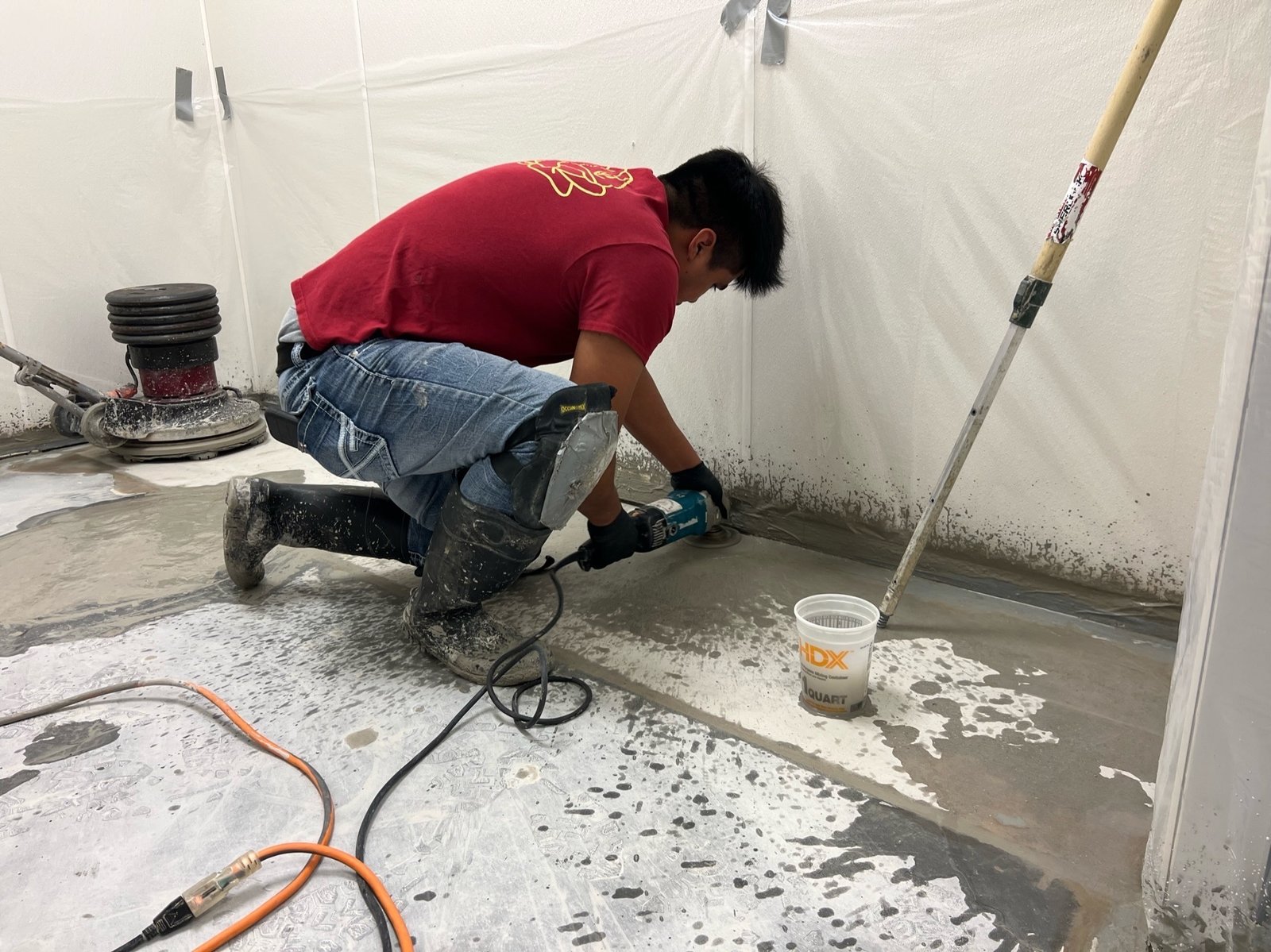
We operate a fleet of professional surface preparation equipment, from large ride-on grinders and shot blasters to compact machines for small spaces, edges, and detail work. All equipment is paired with industrial vacuum and dust-collection systems that capture airborne particulate at the source, maintaining air quality and cleanliness during the work. This is essential when working in occupied buildings, healthcare facilities, and other sensitive environments.

Frequently Asked Questions

Why did my floor coating peel, and how do I prevent it from happening again?

Coating failure is almost always caused by inadequate surface preparation, moisture issues, or contamination on the substrate at the time of application. Before recoating, the failed material must be completely removed, the substrate must be tested for moisture and contamination, and the surface must be profiled to the correct CSP for the new system. Applying a new coating over a failed one without addressing the root cause will result in the same failure repeating.

How long does surface preparation take?

The timeline depends on the size of the area, the existing surface conditions, and the preparation method required. A straightforward grind-and-clean on a clear warehouse floor can progress at several thousand square feet per day. A project involving multiple layers of old coating removal, adhesive abatement, and crack repair will take longer. We provide a project-specific estimate during the assessment phase.

Can you prepare surfaces in occupied or operating buildings?

Yes. We regularly perform surface preparation in occupied office buildings, operating retail stores, hotels, and healthcare facilities. Our equipment includes HEPA-filtered dust-collection systems, and we can install temporary barriers and negative-air systems to contain dust and fumes. We also schedule work during off-hours when necessary to minimize disruption.

Do I need surface preparation before polishing existing concrete?

Yes. Even if the end goal is a polished floor, the initial preparation steps — removing existing coatings or sealers, flattening the surface, and opening the concrete pore structure — are essential. The quality of the initial prep directly determines the clarity and consistency of the final polish.

Can you handle hazardous material removal, such as asbestos-containing adhesives?

Asbestos abatement requires specialized licensing and procedures. If we encounter or suspect asbestos-containing materials during surface preparation, we stop work and recommend testing. We coordinate with licensed abatement contractors as needed to ensure the material is handled in compliance with all applicable regulations before we proceed with preparation work.

Need a properly prepared surface for your next project? Contact Rose Restoration International or call 703-327-7676 to discuss your requirements.

Schedule Online
BBBACCREDITEDBUSINESSA+
BBB Accredited A+ Rating
ABCVIRGINIAMEMBER
ABC Virginia Member
4.8GOOGLE
4.8 Star Rating 118+ Google Reviews
LICENSED& INSURED
Licensed & Insured VA, MD, DC
Leave a Review
Call Now Schedule a Free Assessment
Call Now Get a Quote