Verified Google Review

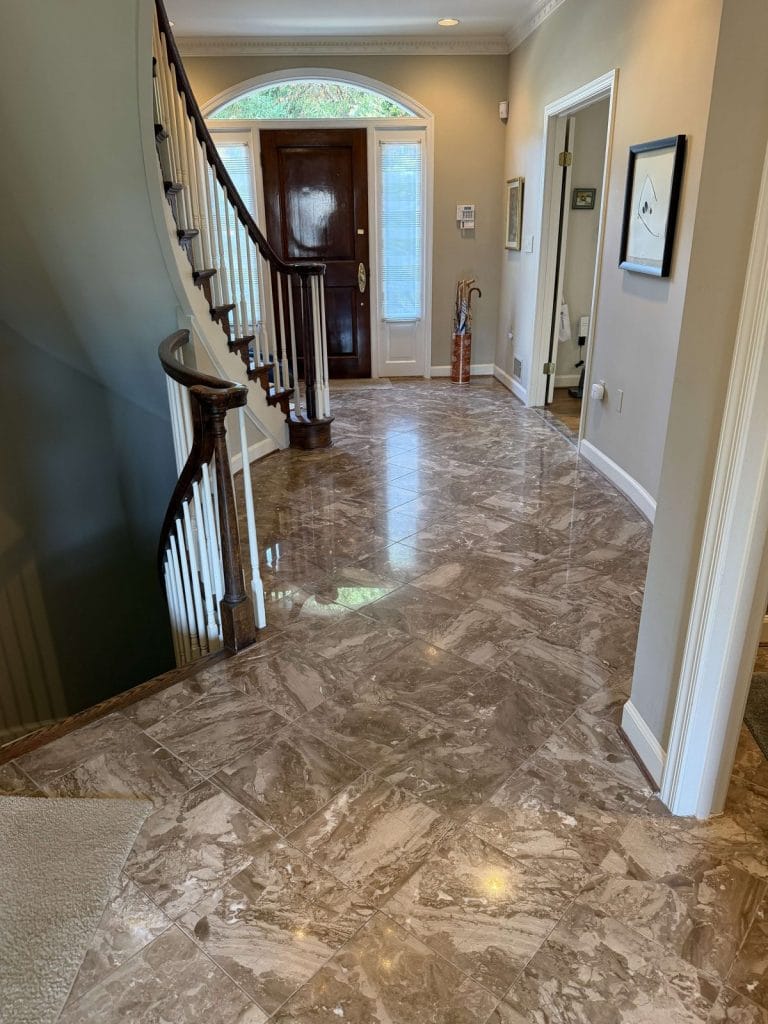
“We hired Rose Restoration to "clean up" a marble tile foyer area. Never having had marble flooring before, we had lots of questions. Justin was very knowledgeable and explained everything very patiently — honed vs polished finish, hairline cracks and what to do about them, sealer and continuing maintenance.”

— V Carney, verified residential client
· read all 117 reviews on Google →

Project: Carrara marble floor restoration in a historic Georgetown row home — diamond honing and re-polishing of approximately 380 square feet of foyer, hallway, and powder room Carrara that had accumulated 15 years of foot traffic wear, scratches, and lippage at tile transitions. 3-day restoration; whole-home stone refinish completed without removing any tile.

The project at a glance

The damage we found

The homeowner had purchased the row home two years earlier and finally decided the floors needed serious attention before hosting a holiday gathering. Fifteen years of urban Georgetown foot traffic had left visible damage:

The restoration process

  1. Site protection. Stair runners removed, antique furniture relocated to one bedroom, plastic walls erected at the kitchen and main staircase to contain dust and slurry. The homeowner’s two cats were boarded for the duration.
  2. Crack repair. The two cracked tiles were addressed first with color-matched epoxy filler and re-polished after curing. The repairs are visible only on close inspection — typical for Carrara crack repair on patterned stone.
  3. Lippage flattening. Started with 50-grit metal-bond diamond pads to flatten the worst tile-to-tile lippage. This is the most aggressive step but also the most transformative — the entire floor reads as one continuous surface afterward.
  4. Diamond honing — coarse to medium. Progressed through 100, 200, and 400 grit resin-bond pads to remove the metal-bond scratches and the original surface damage simultaneously.
  5. Diamond honing — fine. Refining passes at 800, 1500, and 3000 grit. By the end of the 3000 pass, the surface had a satin appearance.
  6. Polishing. Final polishing with chemical polishing compound applied via weighted polishing machine. Carrara polish takes patience — the white-grey background has lower light reflectivity than Calacatta, so the polish is more about clarity than mirror brightness.
  7. Grout deep clean and re-color. Existing grout cleaned with alkaline grout cleaner and high-pressure extraction, then re-colored with a penetrating grout colorant in the original light grey.
  8. Sealing. Premium impregnating sealer applied across the entire restored area. Carrara is more porous than Calacatta and benefits significantly from sealing — especially in entry areas where deicing salt residue gets tracked in during winter.

The outcome

By the end of the 3-day project, the entire ground floor read as new construction:

The homeowner hosted the holiday gathering ten days later and the floors were the talking point of the evening. She has us back annually for a maintenance polish on the entry foyer only (the highest-wear zone) — the hallway and powder room have held up beautifully without intervention.

Why this project matters for similar Carrara installations

Three takeaways for homeowners with older Carrara floors:

Cost range for similar projects

This particular project (380 sf with lippage and 2 crack repairs) came in at the upper end of the typical range.

Warranty

All Rose Restoration work is backed by our 1-year written workmanship warranty. Marble Armor installations carry an additional 10-year manufacturer-backed protection warranty against etching and staining.

Related services

Frequently asked questions

Can a Carrara floor that looks this worn really be restored, or do I need to replace it?

Almost always restored. Even badly worn 15-20 year-old Carrara floors respond well to diamond honing as long as the structural condition is sound. Replacement is only required when there is significant substrate failure or majority tile damage.

Do you have to remove the tile to fix the lippage?

No. Diamond honing flattens lippage in place. The amount of stone removed from the high tile is microscopic — typically less than 1mm — well within the depth of the original tile.

How long can I expect the restored floor to last before needing service again?

For a Georgetown foyer with normal foot traffic, expect 6-10 years before the polish dulls visibly again. Hallways and powder rooms typically hold up 10-15 years. We recommend annual sealer refresh in the entry zones.

Will the grout color match the rest of my home’s grout?

The re-colored grout will look very close to the original color. We can also tone it darker or lighter to match adjacent areas if needed.

What about the cracked tiles — will the repairs be visible?

From standing height, the repairs are invisible to a normal observer. From very close inspection (kneeling, looking at floor level), the repairs are subtly visible — typical for any color-matched stone crack repair.

How much disruption should I expect during the 3 days?

Significant. We seal off the work area with plastic walls, which means restricted access to parts of your home. We provide an end-of-day staging plan so you can use bedrooms and bathrooms without crossing the work zones. Most clients stay in the home; some prefer to stay elsewhere for the duration.

Schedule a free Carrara floor assessment

For Carrara marble floor restoration in Washington DC, Georgetown, Bethesda, McLean, or anywhere across DC, MD, and VA: call 703-327-7676 or request a free in-home assessment. Senior technicians respond within 2 business hours. Most residential Carrara floor restoration projects are quoted between $2,500 and $6,500.

Schedule Online
BBBACCREDITEDBUSINESSA+
BBB Accredited A+ Rating
ABCVIRGINIAMEMBER
ABC Virginia Member
4.8GOOGLE
4.8 Star Rating 117+ Google Reviews
LICENSED& INSURED
Licensed & Insured VA, MD, DC
Leave a Review
Call Now Schedule a Free Assessment
Call Now Get a Quote