
Quick Answer
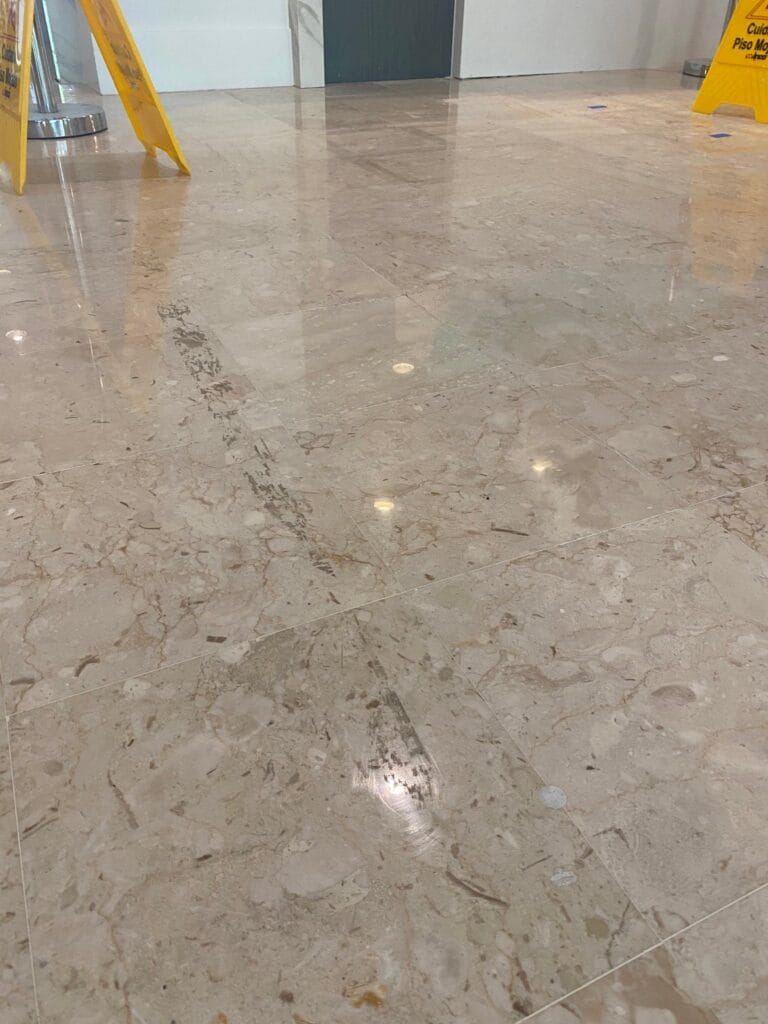
How are scratches removed from marble countertops or floors?
Scratches in marble are removed through professional diamond honing — progressive grits (200, 400, 800, 1500, 3000) refinish the surface to remove the scratched layer and restore the original finish. The amount of stone removed is microscopic (less than 1 millimeter). Spot treatment is never used because it creates visible inconsistency in finish.
A scratch on marble is physical damage — a groove cut into the surface by a knife, a sliding pot, jewelry, or grit on a shoe. Scratches are different from etches (acid surface damage) and stains (pigment penetration), and they require their own specific repair process. Most homeowners cannot remove marble scratches with off-the-shelf products. The good news: virtually any scratch can be honed out by a professional, restoring the stone to its original finish without replacing the slab.
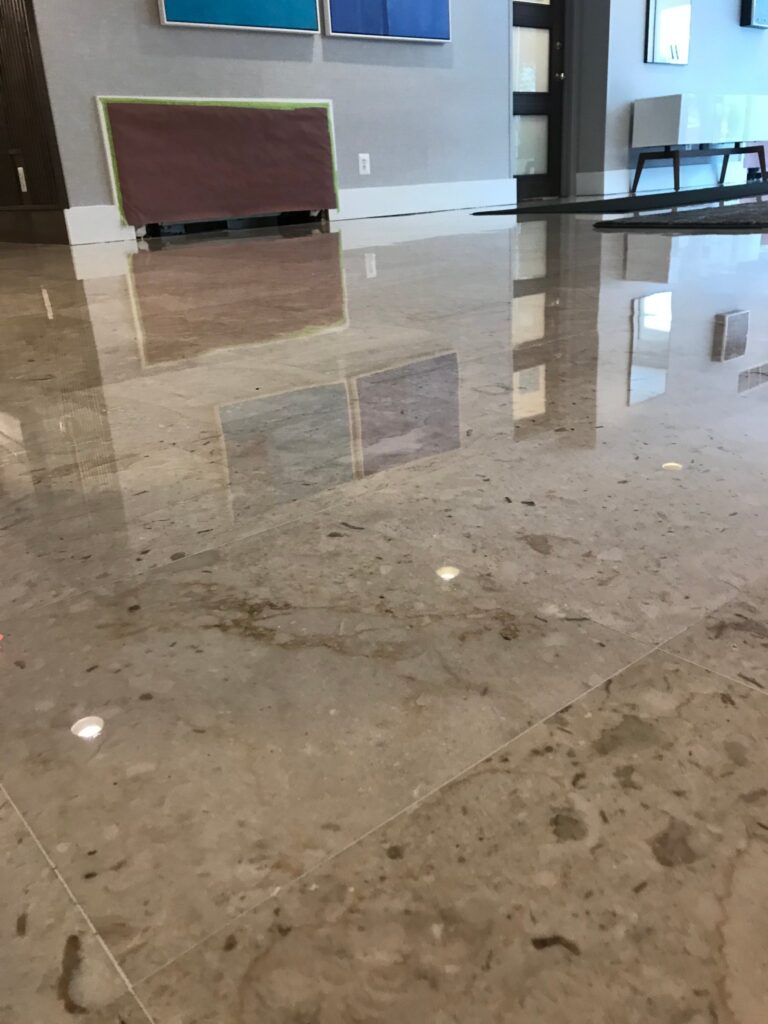
Rose Restoration removes scratches from marble countertops, vanities, floors, and commercial surfaces across DC, Maryland, and Virginia. This guide covers what causes scratches, how to identify the depth, when a scratch can be repaired, the professional repair process, and what scratch removal costs in 2026.
Identifying a marble scratch (vs. etch vs. stain)
- Scratch: a linear groove you can usually feel with a fingernail. Light scratches show as a lighter line that catches the light. Deeper scratches have visible depth and may appear darker due to dirt accumulation.
- Etch mark: a dull, frosted patch where acid attacked the polish. Not linear; usually round or irregular.
- Stain: a discoloration that lives below the surface. Smooth to the touch.
What causes scratches on marble
- Knives directly on the surface. Cutting on marble without a board is the leading cause of kitchen counter scratches.
- Sliding cookware. Cast iron and steel pots dragged across the surface, especially with grit or sugar trapped underneath.
- Jewelry. Rings, watches, bracelets sliding across vanity surfaces.
- Grit on shoes (floors). Sand and small stones tracked in act as abrasive.
- Construction debris. Drywall mud, tile shards, and cabinet hardware dropped during renovations.
- Furniture moves. Chairs, tables, decor sliding across marble floors without protection.
- Pets. Dog claws on polished marble floors leave fine scratch patterns over time.
Can you remove marble scratches yourself?
We do not recommend it. A scratch is a groove, and removing it means flattening the stone around it with diamond pads in progressive grits. Store-bought polishing compounds work at a single grit and by hand, so they tend to leave an uneven patch that is more visible than the original scratch.
That is especially true for any scratch you can feel with a fingernail, scratches on honed marble, scratches on dark marble where any finish difference shows immediately, scratches on floors, and multiple scratches across a large area, where spot repair leaves visible mismatches.
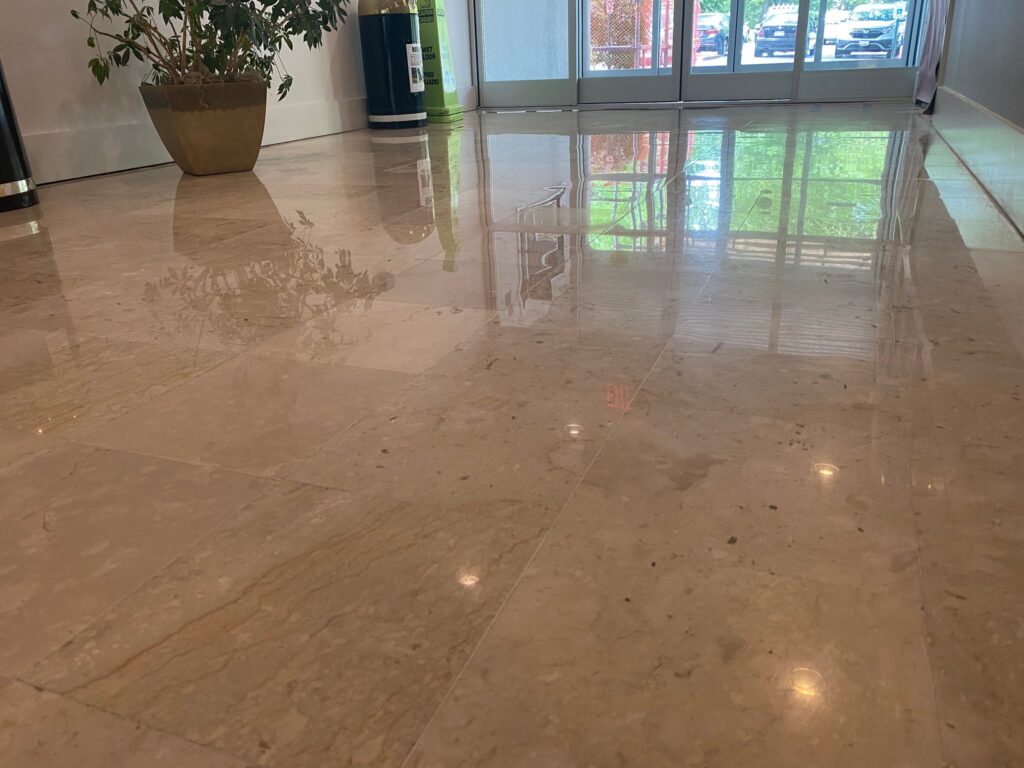
How professional marble scratch removal works
- Assessment. A senior technician evaluates scratch depth, surrounding finish, marble type, and the practical scope. For shallow surface scratches the work is concentrated; for deep scratches across an island the entire surface is honed uniformly to avoid mismatched zones.
- Diamond honing — coarse grit. The repair starts with a grit fine enough to flatten the deepest scratch. For a barely-visible scratch this might be a 200-grit diamond pad; for a deeper scratch from a knife or pot, it may start at 100 grit.
- Progressive grit work. Sequential passes through 200, 400, 800, 1500, 3000, and finer grits remove the previous grit pattern. Each pass restores more of the polish.
- Final polish. A final fine-grit pass restores the high-gloss reflection on polished marble. For honed surfaces, the process stops at the appropriate grit to maintain the matte finish.
- Sealing. A penetrating impregnator is applied to slow stain absorption. Optional Marble Armor protection if the homeowner wants to prevent both etch and stain damage going forward.
Cost: what professional scratch removal costs in 2026
- Single light scratch on a polished countertop: $400–$450 for a single visit.
- Multiple scratches, single counter / vanity: $400–$1,200 depending on count and depth.
- Full kitchen island scratch and polish refresh: $500–$1,500.
- Bathroom scratch removal (vanity + walls): $600–$2,000.
- Marble floor scratch refresh (per square foot): $5–$12/sf.
- Foyer floor scratch + polish refresh (200-400 sf): $1,500–$4,500.
- Commercial / hotel lobby scratch repair (per sf): $4–$10/sf depending on phasing requirements.
Preventing future scratches
- Always use a cutting board on marble counters. Never cut directly on the stone.
- Lift cookware instead of sliding it.
- Use felt protectors under decor, candle holders, and small appliances.
- For floors, place mats at all entries and clean grit out frequently.
- Keep furniture pads on chair and table legs. Replace them yearly.
- Walk-off mats for high-traffic commercial entrances prevent the majority of floor scratching.
- Schedule a polish refresh every 3-7 years on residential marble.
Where Rose Restoration removes marble scratches
We perform marble scratch removal across DC, Maryland, and Virginia, including Washington DC marble restoration, Arlington, Alexandria, Bethesda, McLean, Potomac, Chevy Chase, Vienna, Tysons, Reston, Loudoun County, Fairfax County, and Montgomery County. Most residential scratch removal projects are completed in a single visit.
Frequently asked questions
How deep a scratch can be removed?
Almost any scratch can be honed out — the limiting factor is how much marble surface gets removed in the process. Very deep scratches (over 1mm) require enough grinding that the surface is noticeably lower than surrounding stone. For most kitchen and bathroom scratches, depth is well within normal honing range.
Will the repaired area match the rest of the marble?
Yes. Rose hones the entire surface uniformly rather than spot-treating. The result is consistent with no visible repair line.
Can a scratch on dark marble be repaired?
Yes, but dark marble shows finish differences more readily than light marble. We typically hone the entire piece to ensure no visible patch.
How long does scratch removal take?
Most single-counter scratch removal completes in 3 to 5 hours. Floor scratch refreshes take longer — a 400 sf floor typically requires a single full day.
Is scratch removal a temporary fix?
No. Once the scratch is honed out it is gone permanently. New scratches can form from new abuse, but the original repair does not wear back through.
Do you do scratch repair on honed (matte) marble?
Yes. The honing process stops at the appropriate grit to maintain a satin finish, rather than continuing to high-gloss polish.
What about scratches on a marble shower floor or wall?
Yes. Bathroom scratch removal uses the same process. Showers also typically benefit from re-sealing during the same visit.
Can you fix a scratch on a fireplace surround that has been heat-discolored?
Yes. We address the scratch and any thermal discoloration as part of the same visit.
Schedule a free assessment
For marble scratch removal in DC, Maryland, or Virginia: call 703-327-7676 or request a quote online. Senior technicians respond within 2 business hours. Most residential scratch removal projects are quoted between $250 and $1,500.