
Quick Answer
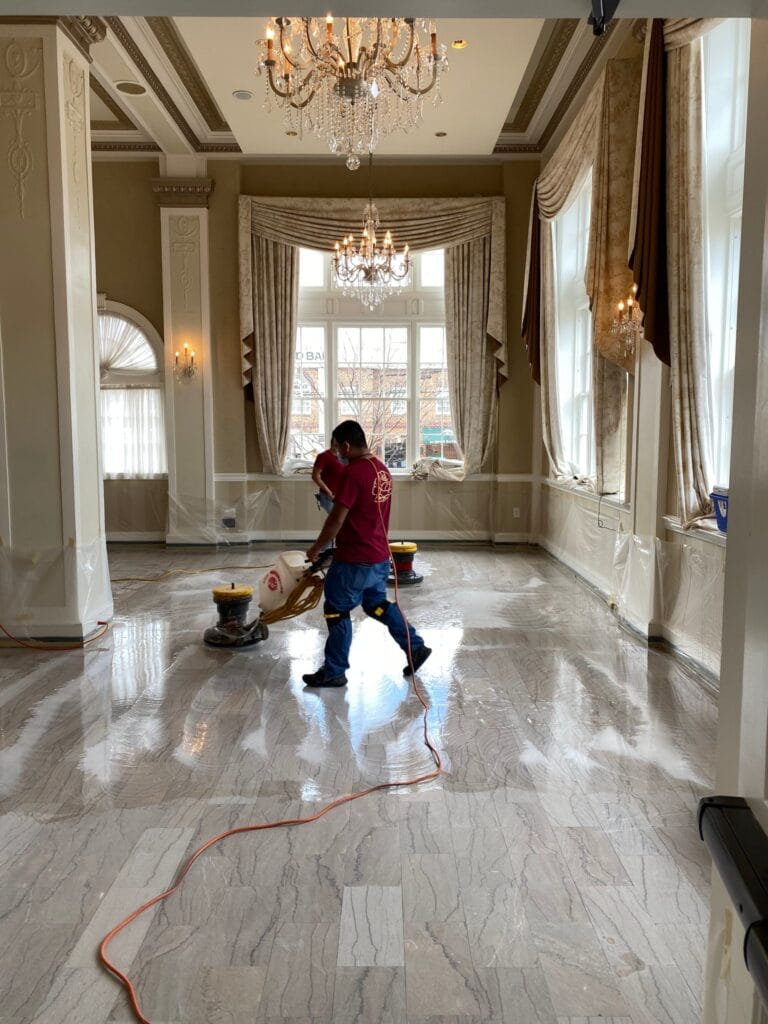
How does professional marble honing actually work?
Professional marble honing uses a weighted machine with diamond abrasive pads to refinish the stone surface in progressive grit stages. Starting at coarser grits (200-400) to remove damage, technicians progress through 800, 1500, and 3000 grit, with each pass removing the marks from the previous one. The process culminates in chemical polishing for the mirror finish.
Marble honing is the professional process of restoring or refining a marble surface using diamond abrasives. The technician sequentially works the marble with progressively finer diamond pads — starting with coarse grits to remove etching, scratches, or surface damage, then moving through finer grits to refine the surface, and finishing at either a matte (honed) or high-gloss (polished) finish. Honing is how marble surfaces are flattened, leveled, and brought back to like-new condition without removing or replacing the stone. It is the foundational technique behind nearly all marble restoration work.
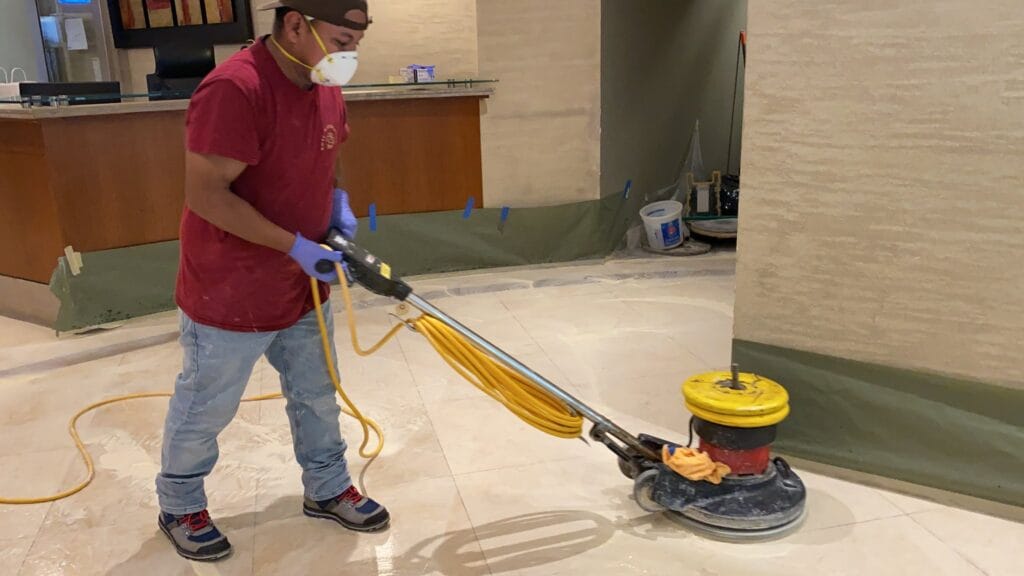
This guide explains how diamond honing works, what equipment is involved, why it produces such consistent results, and what to expect when Rose Restoration hones marble in your home.
What honing actually does
Honing removes microscopic layers of marble surface material — typically less than 1mm total even for severe damage repair. The process produces three distinct outcomes depending on how far through the grit progression we go:
- Repair (early grits): Heavy diamond pads (200-400 grit) flatten etches, scratches, and surface damage by removing the top layer of marble that contains the damage.
- Refining (middle grits): Progressively finer pads (800-1500 grit) smooth the surface and prepare it for the final finish.
- Finishing (final grits): Final pads (3000+ grit) produce the desired finish — matte (honed) or high-gloss (polished).
The result is a uniformly restored surface with no visible repair lines, scratches, etches, or worn areas. The marble looks like new because the new surface IS new — fresh marble exposed by removing the damaged layer above it.
How diamond abrasives work
Diamond is the hardest natural material — much harder than marble. Diamond abrasive pads contain industrial diamond particles bonded into a matrix (resin, metal, or hybrid). When pressed against marble and moved across the surface with water, the diamond particles abrade the marble in microscopic layers.
The grit number describes how fine the diamond particles are:
- 200 grit: Coarse — removes significant surface material; used for severe damage
- 400 grit: Medium-coarse — flattens moderate etches and scratches
- 800 grit: Medium — refines the surface after repair
- 1500 grit: Fine — produces a smooth honed finish
- 3000 grit: Very fine — used in polished marble production
- 6000-10000 grit: Ultra-fine — used for the highest mirror polishing
Each subsequent grit removes the marks left by the previous one, producing a progressively smoother and finer surface. Skipping grits creates a poor finish — every step matters.
Equipment used for marble honing
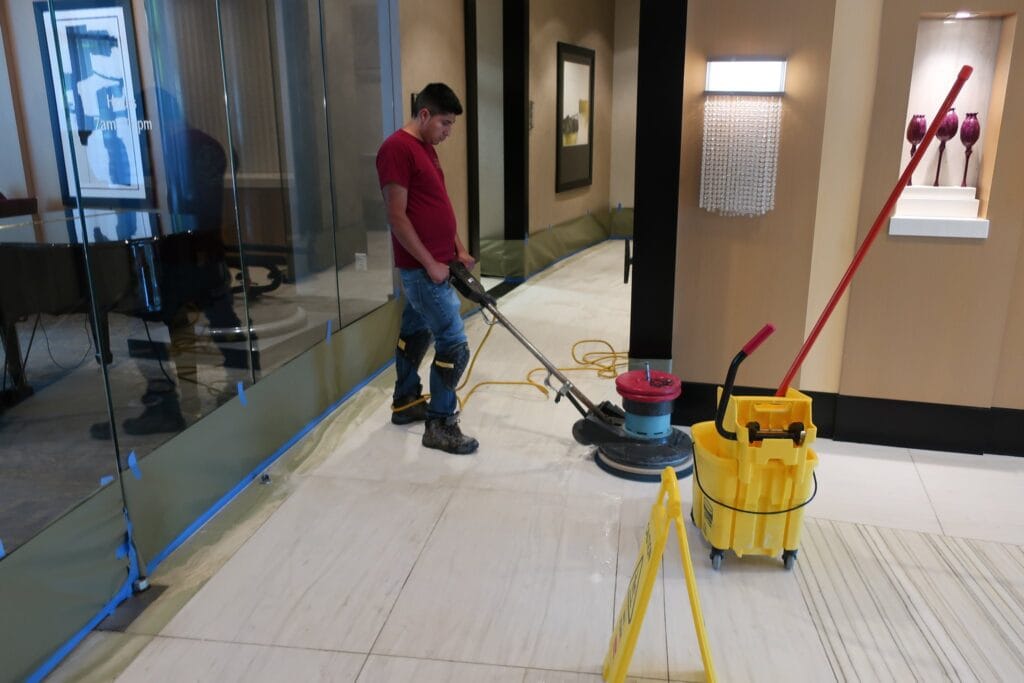
- Floor honing machines. Heavy-duty rotary or planetary machines used for floors and large countertops. The weight of the machine provides downward pressure for efficient material removal.
- Hand-held variable-speed grinders. Used for vertical surfaces (shower walls, fireplaces), edges, corners, and small countertops. Variable speed allows the technician to match the abrasive aggressiveness to the situation.
- Wet polishers. Used in the final polishing stages where high speed and water are needed for the finest finish.
- Diamond pads. The actual abrasive — color-coded by grit and bonded for either dry or wet use. We carry a full kit of grits for any project.
- Water delivery system. Most diamond honing is done wet. Water cools the diamond pads, prevents heat damage to the marble, removes slurry, and produces a cleaner cut.
- Slurry containment. Floor honing produces a slurry of marble dust and water that must be contained and cleaned. Our crews use professional vacuum and containment systems to keep the work area clean.
The honing process step by step
- Assessment. Senior technician evaluates damage type, severity, marble variety, finish (polished/honed/leathered), and surrounding installation. We identify the starting grit needed for the heaviest damage in the work area.
- Surface masking and protection. Adjacent floors, cabinetry, fixtures, and finishes are protected before any wet work begins.
- Pre-clean. Commercial pH-neutral cleaning to remove residue, soap film, prior sealer, and any contamination that would interfere with honing.
- Stain extraction. Stains are extracted via poultice before honing. Honing over a stain locks pigment in permanently.
- Repair filling (when needed). Chips, cracks, or missing material are filled with color-matched epoxy before honing — the honing process integrates the fills with the surrounding stone.
- Diamond honing — first pass. Begin with the appropriate grit for the heaviest damage. Work the surface uniformly with overlapping passes.
- Diamond honing — progression. Move through progressively finer grits, ensuring each pass fully removes the marks left by the previous pass.
- Final finish. Stop at honed (400-800 grit) or continue through polishing (3000+ grit) per the desired finish.
- Cleaning and inspection. Slurry is removed, the surface is cleaned, and the finish is inspected for uniformity. Any areas needing additional work are addressed.
- Sealing. Premium impregnating sealer to slow future stain absorption.
- Optional Marble Armor. For high-use surfaces, Marble Armor is applied as the final step.
Why honing produces such consistent results
Three reasons honing reliably produces a like-new finish:
- Marble is uniformly dense. Below the surface, the marble is essentially identical to the original installation. Removing the top layer exposes the same quality of stone that was there before any wear or damage.
- The grit progression is non-negotiable. Each grit produces a specific finish quality. Following the progression correctly always produces the same result. Skipping grits or rushing produces visibly inferior finishes — but a properly executed progression is reliable.
- Damage is shallow. Most marble damage (etches, scratches, surface staining) penetrates less than 1mm. The amount of material removed during restoration is microscopic relative to the slab thickness (usually 2-3 cm for countertops, more for floors).
What honing cannot do
- Cannot remove pigment that has soaked into the stone. Stains must be extracted via poultice BEFORE honing. Honing over a stain spreads the pigment.
- Cannot fix structural cracks. Cracks must be filled with epoxy before honing. Honing alone does not repair structural damage.
- Cannot change the marble’s color or veining. Honing reveals what’s already there — it does not add or modify pattern. A marble with a particular vein pattern will look the same after restoration; just brighter and cleaner.
- Cannot prevent future damage. Sealing and Marble Armor are separate steps that follow honing. Honing alone leaves the stone vulnerable to recurring damage.
How marble honing differs from quartzite or granite honing
Honing principles are the same across stones — diamond abrasives, grit progression, water cooling — but the specifics differ:
- Marble (Mohs 3-4): Softer; honing is faster but requires more careful pressure to avoid uneven results.
- Granite (Mohs 6-7): Harder; honing takes more time per pass and uses harder diamond pads.
- Quartzite (Mohs 7): Hardest commonly-honed stone; requires the hardest diamond pads and longest per-pass time.
- Travertine: Banded composition requires careful technique to avoid uneven removal across mineral bands.
- Limestone: Softer than marble, more porous; honing is fast but requires care to avoid over-removal.
Watch the work
Short videos from real Rose jobs. Tap to play.
Frequently asked questions
How much marble is removed during honing?
Microscopic amounts. Total material removed in a typical residential restoration is less than 1mm. Slab thickness is typically 2-3 cm or more, so multiple restorations over decades remove only a small fraction of the stone.
Will my marble be thinner after honing?
Theoretically yes, by a microscopic amount that is impossible to see or measure without precision instruments. Practically, no — your marble will look identical in thickness and feel the same.
Can marble be honed too many times?
For typical residential use, you can hone marble many times before there is any concern about thickness. Most countertops can handle 10+ professional restorations over their lifetime.
What’s the difference between honing, polishing, and grinding?
Grinding is the very coarse end of abrading marble — used primarily for floor flattening or removing major damage; uses the lowest grits (50-100). Honing is the middle process — removing damage and preparing surface; uses medium grits (200-1500). Polishing is the final stage — producing a high-gloss finish; uses fine grits (3000+) and chemical polishing pads.
Does honing produce a lot of dust?
Wet honing produces slurry, not dust. The water captures the marble particles and they wash away as a thick paste. We contain and clean the slurry as part of our process. Dry honing (used in some specialty situations) produces dust and is not used for residential interior work.
Can I hone marble myself?
The technique requires specialized equipment, training, and practice. The most common results when homeowners attempt it: uneven surface, missed grit progression that leaves a bad finish, deeper damage than was originally present. Even with good products available online, professional results require professional execution.
How long does diamond honing take?
For a typical residential countertop (30-60 sf): 2-4 hours of active honing time. For a kitchen island plus perimeter (80-120 sf): 4-8 hours. Floor honing is roughly 30-60 minutes per 100 sf of floor.
Will the honed surface match the existing edge profile?
Yes — we hone right up to and around edges, including ogee, beveled, and rounded edge profiles. Edge profiles are preserved during restoration.
Schedule a free assessment
For professional marble honing, restoration, or polishing in DC, Maryland, or Virginia: call 703-327-7676 or request a quote online. Senior technicians respond within 2 business hours.