 By Tom Kuhn, CEO, Rose Restoration
Rose Restoration has restored marble, terrazzo, concrete, and natural stone across DC, MD, and VA since 1978.
Facility managers own the floor every day the restoration contractor is not there, and the daily decisions matter more than most teams realize. The wrong cleaner etches a marble lobby in one shift. The right care spec keeps a restored floor at standard for years. This guide covers what actually damages each surface, what your janitorial team can and cannot fix, and how to build a floor-care program that protects the money your building has already spent. It reflects what Rose Restoration has learned maintaining commercial stone across DC, Maryland, and Virginia since 1978.
Know What You Are Standing On
Each surface fails differently, and the care that protects one can destroy another.
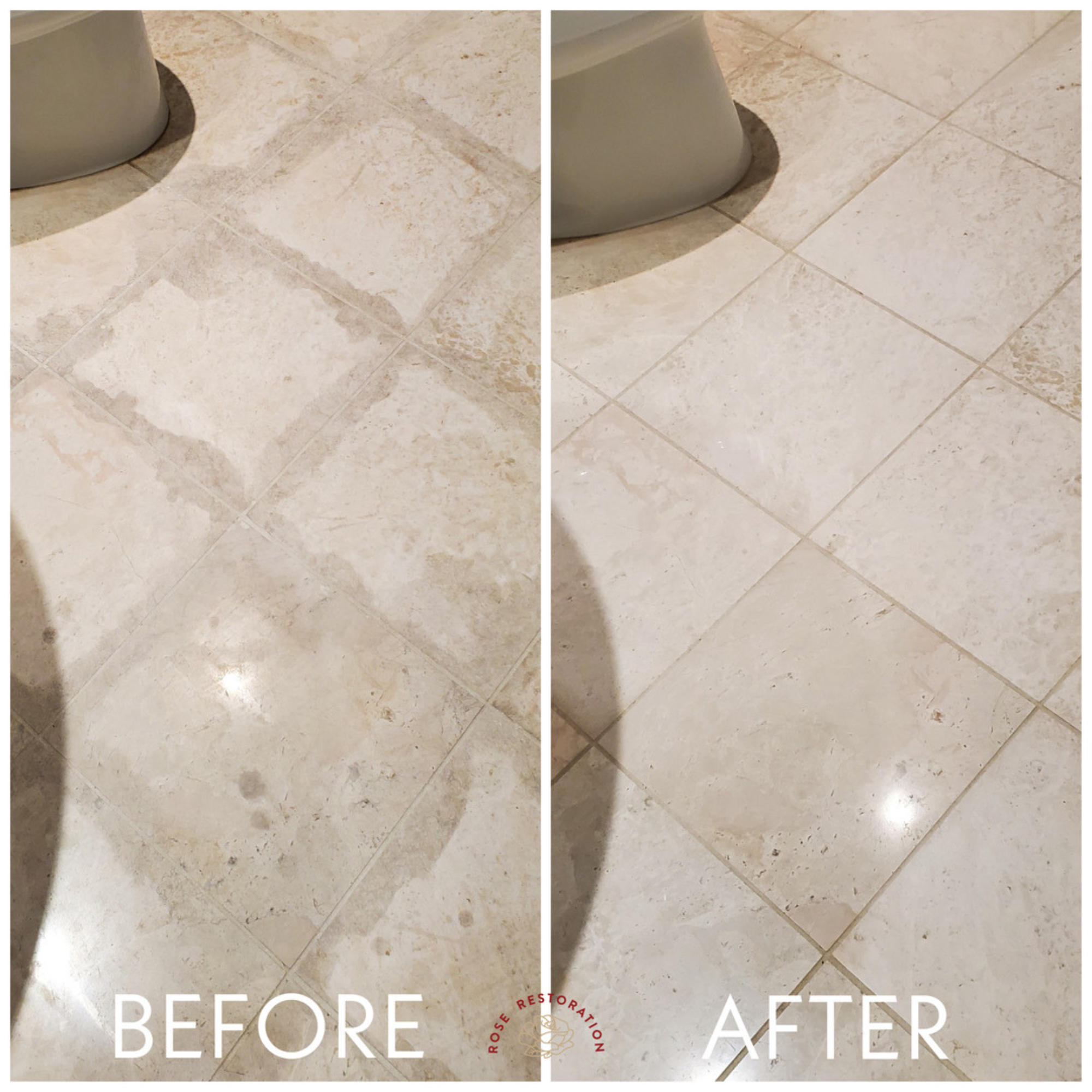
- Marble and limestone are calcium-based, which means acid is the enemy. Anything acidic, including many general-purpose cleaners, citrus, and coffee, etches the polish on contact. Etching is not a stain; it is chemical damage to the surface itself, and only honing removes it. If you read one linked page from this guide, make it the dangers of acidic cleaners.
- Granite resists acid far better but still stains through a failed sealer and dulls under abrasive grit.
- Terrazzo is the workhorse of institutional buildings. It tolerates traffic well but shows crack lines, patch mismatches, and slow dulling in the lanes. Its matrix is usually cementitious, so acids harm it too.
- Polished concrete needs the least chemistry of all, and that is the point: routine care is dust mopping and neutral cleaning, with periodic maintenance polishing by a specialist.
- Grout is the surface everyone forgets and inspectors always see. It absorbs soil steadily, and once it darkens unevenly no amount of mopping brings it back; professional cleaning and sealing does.
The Daily Rules That Preserve a Restored Floor
- Neutral pH only. One product decision prevents the most common damage we are called to repair. Every cleaner used on stone or terrazzo should say pH neutral on the label.
- Dust mop daily. Grit is an abrasive. Every footstep grinds it into the finish, and traffic-lane dulling is mostly grit damage in slow motion.
- Walk-off mats at every entry, long enough to take several steps on. Most of the sand a building fights all winter walks in the front door.
- Respond to spills as events. Blot, do not wipe, and flag anything acidic on marble or terrazzo immediately. A spill treated in minutes is janitorial; a spill discovered Monday is restoration.
- Burnish only what is meant to be burnished. High-speed pads and powders formulated for one stone can scour another. When in doubt, ask; we answer care questions for client buildings at no charge.
What Janitorial Can Fix, and What It Cannot
The boundary is simple once stated. Janitorial care removes soil from the surface. Restoration removes the surface itself, mechanically, to reach undamaged material. No mop, chemical, or pad fixes etching, scratches, traffic-lane wear, cracks, or deep staining, because none of those are dirt. When a floor stops responding to good routine care, that is the signal the problem is in the finish, not on it, and continuing to scrub adds labor cost without changing the floor.
The practical rule for your team: if it does not improve after correct cleaning, stop cleaning it harder. Escalate it.
Sheen and Traction Are a Managed Trade-Off
Finish selection is a safety decision as much as an aesthetic one. Polished stone is appropriate in many lobbies; honed finishes trade sheen for traction in wet-risk areas like entries, restrooms, and pool surrounds. The right answer is set per area, not per building, and a restoration contractor should be able to walk your floor plan and recommend finish by zone. Rose specifies finishes area by area on exactly this basis, including slip-conscious finishes in institutional and healthcare settings.
When Water Wins: Emergency Response
Floods, overflows, and construction accidents do not schedule themselves around your program. What matters in the first days: get standing water off stone quickly, ventilate, and do not seal moisture into the stone with topical products while it dries. Efflorescence, the white haze that appears as wet stone dries, is mineral salt left behind by moisture and is treatable; so are most water marks and construction damage. Call a restoration contractor before an insurance scope is finalized, because restoring stone is dramatically cheaper than the replacement line the adjuster may write by default.
Build the Floor-Care Calendar Once
The buildings that always look ready share one habit: floor care is a calendar, not a reaction. A working annual structure looks like this:
- Daily: dust mop, neutral clean, entry mats serviced.
- Weekly to monthly: machine scrub where appropriate, grout inspection in restrooms, spill-damage walk-through.
- Quarterly to monthly, by traffic: professional maintenance polishing of high-traffic stone, sealer inspection, condition report filed. This is the layer a Rose Care program provides, on an Essential (quarterly) or Signature (monthly) schedule, with a written condition report after every visit.
- As flagged: restoration of areas the condition reports show slipping, caught at the cheap stage instead of the capital stage.
The condition report is the quiet hero of the system. It gives you a documented history of every surface, which turns budget conversations with ownership from opinion into trend lines.
Working Well With a Restoration Crew
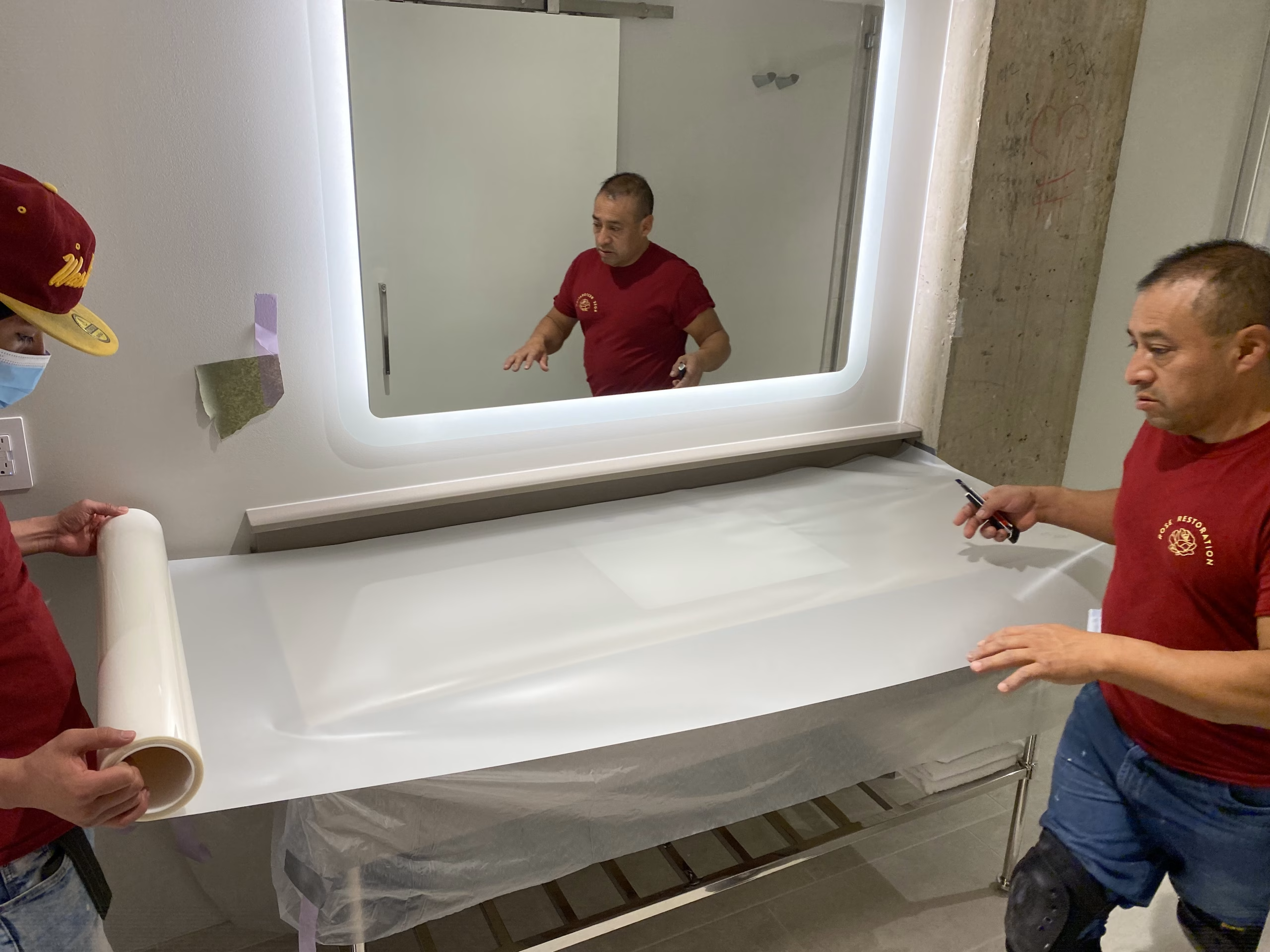
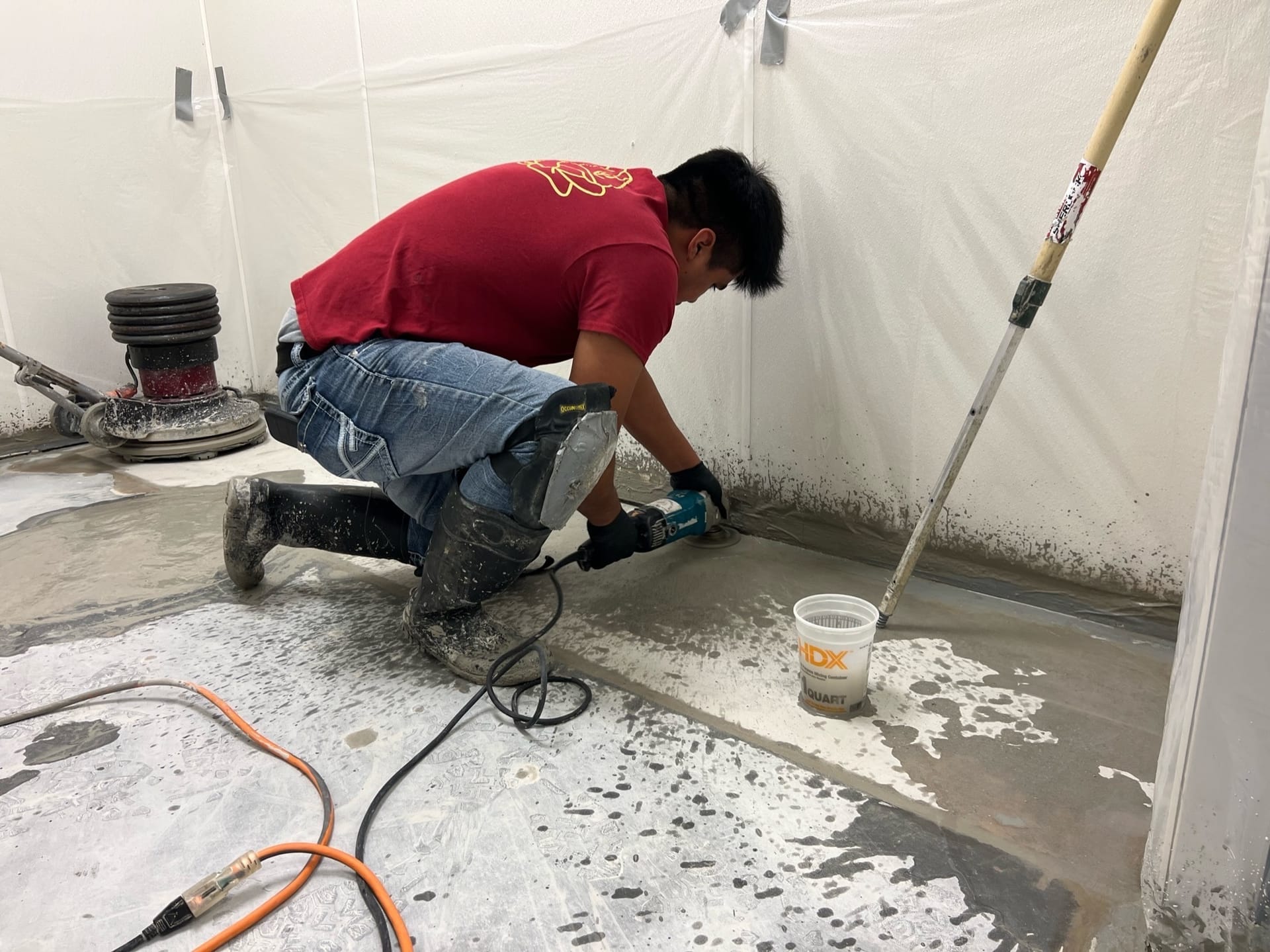
Restoration in an occupied building runs smoothest when a few things are arranged in advance: after-hours access and an escort procedure if your building requires one, water and power availability near the work area, staging space for equipment, and agreement on which paths of travel stay open each night. Give the crew lead a direct contact for the overnight window. Rose crews work overnight as standard practice, including in buildings that never close, and hand back dry, open floors by the agreed hour each morning.
Signals a Floor Needs Professional Attention
- Traffic lanes that read dull against the edges of the corridor.
- Rings and dull spots that reappear no matter how the area is cleaned. That is etching.
- Grout lines that have gone dark unevenly and stopped responding to scrubbing.
- Cracks, chips, hollow-sounding tiles, or caulk joints that have failed.
- A floor your team is spending more labor on for a worse result. Rising effort with falling outcome is a finish problem.
The Facility Manager’s Checklist
- Confirm every product used on stone and terrazzo is pH neutral. Remove the ones that are not.
- Audit entry matting: present, long enough, and serviced.
- Train the team on the escalation rule: if correct cleaning does not improve it, flag it.
- Put finish and traction on the walk-through agenda for wet-risk areas.
- File a written condition baseline for each stone surface. A free Rose assessment produces one.
- Set the professional-care layer on a calendar, quarterly or monthly by traffic, instead of waiting for a complaint.
Common Questions From Facility Managers
Our marble has dull spots that keep coming back after cleaning. Why?
Because they are not dirt. Dull rings and spots on marble are almost always etching, chemical damage from something acidic, and they sit in the finish itself. Honing and polishing removes them; cleaning cannot.
Can my janitorial team polish the stone themselves?
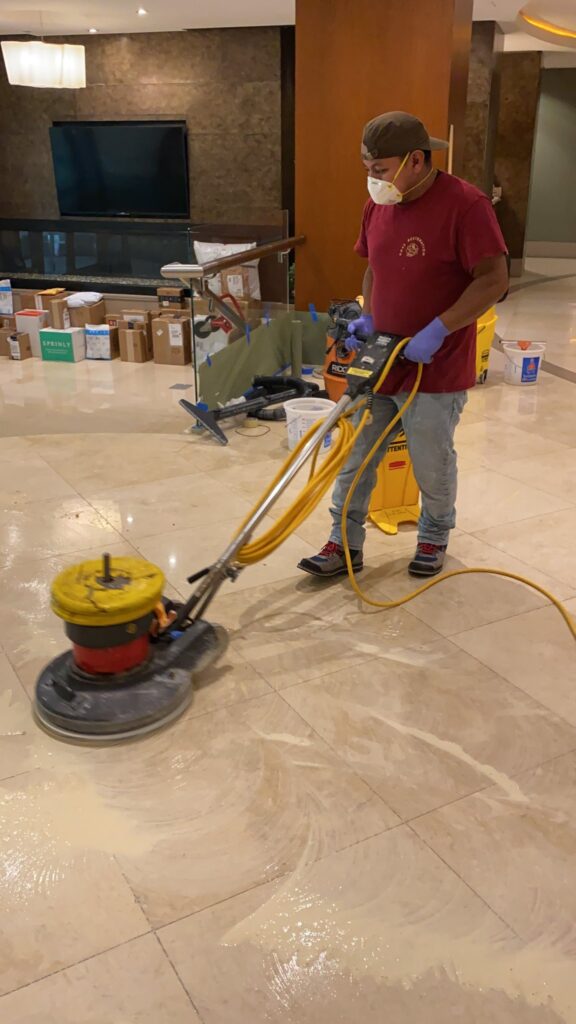
Routine burnishing programs exist, but they are stone-specific and equipment-specific, and the wrong pad or powder does cumulative damage. The reliable division of labor is janitorial for daily neutral care and a stone specialist for periodic mechanical polishing.
How fast can someone look at a problem floor?
Rose offers free in-person assessments across DC, Maryland, and Northern Virginia, and can send a same-day proposal from photos. Call (703) 327-7676 and describe what you are seeing; photos help and are welcome.
Do you work around our building’s schedule?
Yes. Overnight and off-hours work is our standard model, proven at properties that never close, including convention and hotel properties with continuous traffic.
Keep the Floor You Paid For
Rose Restoration maintains and restores commercial stone, terrazzo, and hard surfaces across Washington DC, Maryland, and Northern Virginia, with 35+ in-house technicians and maintenance programs running at some of the region’s busiest buildings. Call (703) 327-7676, request an assessment, or see how we serve facility managers specifically.