
 By Tom Kuhn, CEO, Rose Restoration
Rose Restoration has restored marble, terrazzo, concrete, and natural stone across DC, MD, and VA since 1978.
Lacquered brass fails in a way that looks like neglect and is not. A lobby door pull that was beautiful eighteen months ago develops dark blotches under an otherwise glossy surface, and no amount of polishing touches them, because the tarnish is underneath the coating rather than on it.
This is the most common architectural metal complaint Rose sees, and the fix is rarely the one people expect. Rose Restoration has restored architectural metal across DC, Maryland and Virginia since 1978. Request a free assessment or call (703) 327-7676.
What lacquer is actually doing
Brass and bronze are copper alloys, and copper oxidises on contact with air, moisture and skin. A polished brass surface left alone will darken, unevenly, within weeks in a busy lobby.
Lacquer is a clear barrier applied over freshly polished metal to keep air and moisture off it. While the barrier is intact the metal underneath stays exactly as it was on the day it was coated. That is the appeal, and it works.
The problem is that the barrier does not fail all at once. It fails in pinholes and at edges.
How it fails, in order
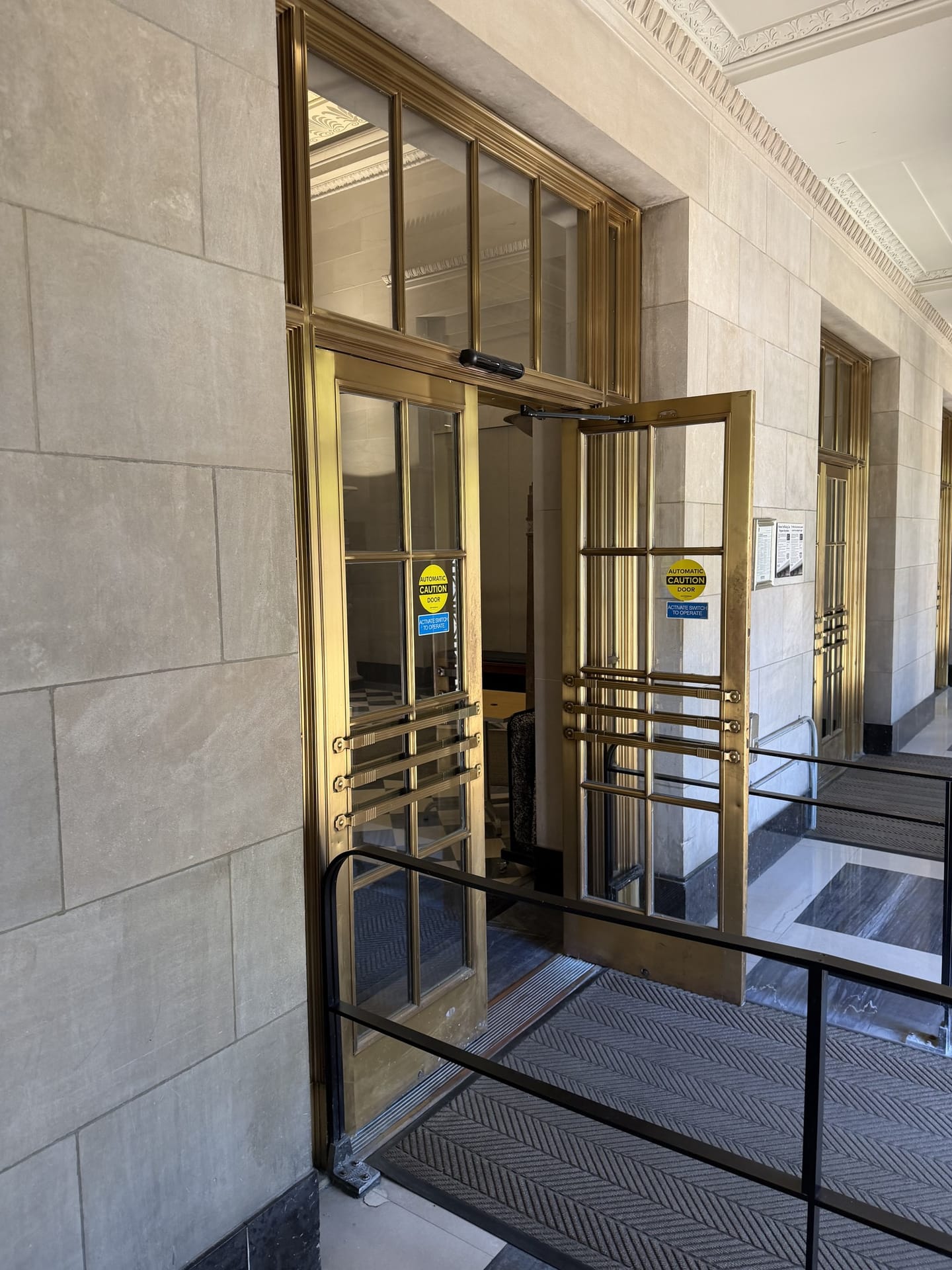
Handles fail first, and for a specific reason. Skin is slightly acidic and hands deposit salt. A door pull takes that thousands of times a week, concentrated on a small area, which breaks down the coating faster than anywhere else on the same door.
Then edges and returns. Lacquer is thinnest where a surface curves away, so the edge of a push plate or the return on a frame gives out before the flat.
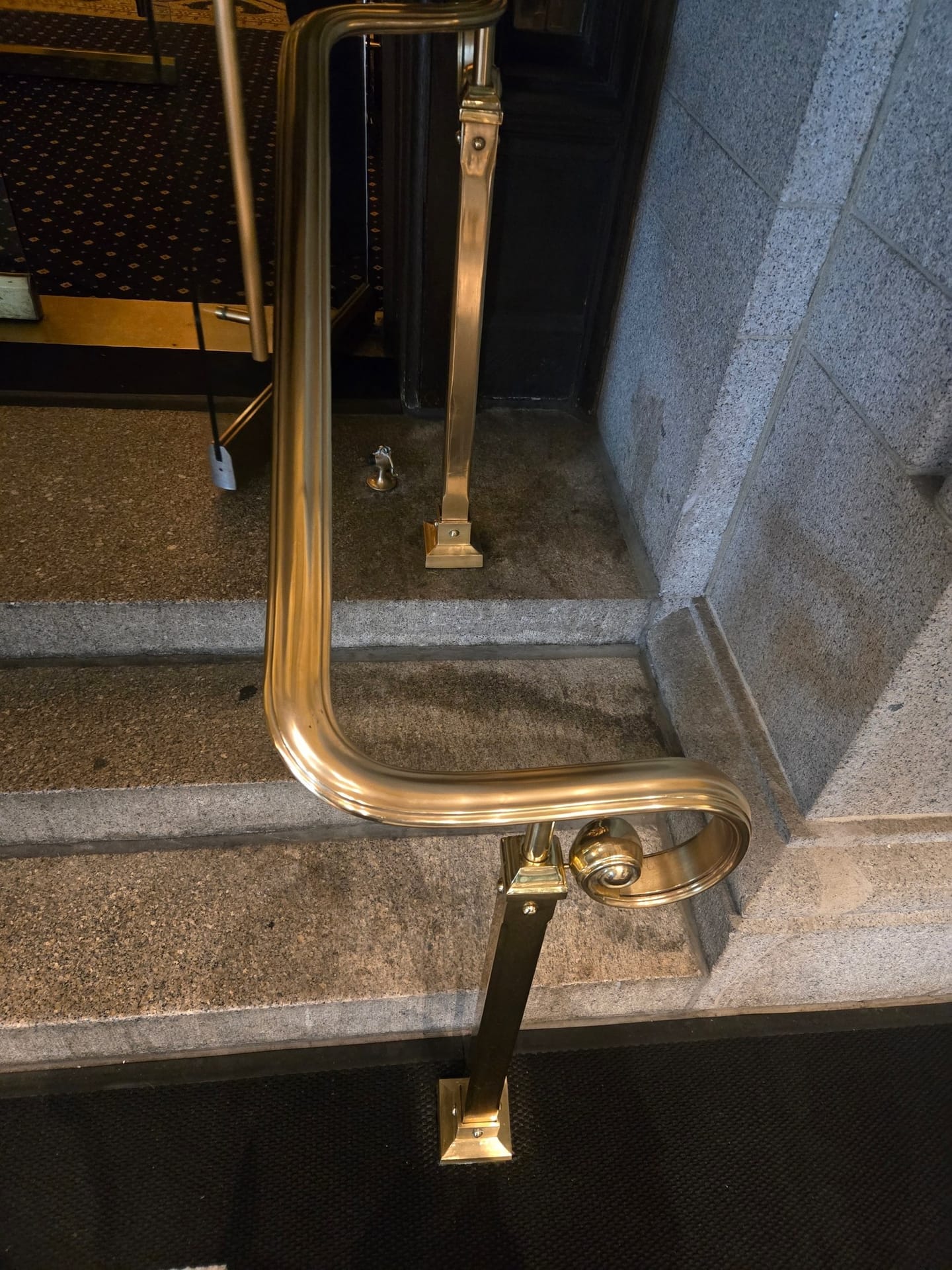
Then cleaning products do the rest. This is the one most properties control and do not. Ammonia-based glass cleaner overspray, and any abrasive or “brass polish” applied to a lacquered surface, attacks the coating directly. Brass polish on lacquered brass removes lacquer, not tarnish. It is applied with good intentions and it accelerates the failure substantially.
Once the coating is breached at any point, moisture gets under it and the metal tarnishes beneath the lacquer. That is what produces the characteristic look: dark patches trapped under a surface that still shines.
Why spot repair does not work
The instinct is to fix the blotchy area and leave the rest. It does not hold, for two reasons.
First, the tarnish under the coating cannot be reached without removing the coating. Polishing the surface polishes the lacquer.
Second, lacquer ages. A patch of fresh lacquer next to eight-year-old lacquer differs in both colour and gloss, and on a large flat panel that boundary is visible from across a lobby.
The real scope is: strip the lacquer completely, polish the metal back to an even finish, and recoat the whole element. On a door that means the whole door, not the handle.
The decision worth making deliberately: lacquered or living
Most properties inherit a lacquered finish and never revisit it. It is worth revisiting, because there are two legitimate approaches and they have different cost profiles.
Lacquered. Looks uniform and bright, requires almost no maintenance while the coating holds, and then requires a full strip and recoat on a cycle. The cost is lumpy: nothing, nothing, nothing, then a significant project. It suits properties that want a consistent look and can budget periodically.
Living, or unlacquered. The metal is left to oxidise and is maintained by regular polishing. It develops genuine patina, it never goes blotchy because there is no coating to breach, and touch-up is possible on any individual element at any time. The cost is smooth and recurring rather than lumpy. It suits historic properties, buildings where the patina is part of the character, and properties that already run a scheduled maintenance programme.
There is no universally right answer. There is a wrong one, which is running a lacquered finish with no plan for the day the lacquer fails.
What restoration involves
- Strip the existing coating chemically, across the whole element.
- Address the tarnish that formed underneath, which has usually etched the surface slightly and needs to be worked back rather than just cleaned.
- Polish to the specified finish. Mirror, satin or brushed, and on brushed finishes the grain direction has to be matched to adjacent panels or the repair reads as a different piece of metal.
- Recoat, or commit to a living finish. This is the decision above, and it is made before the strip, not after.
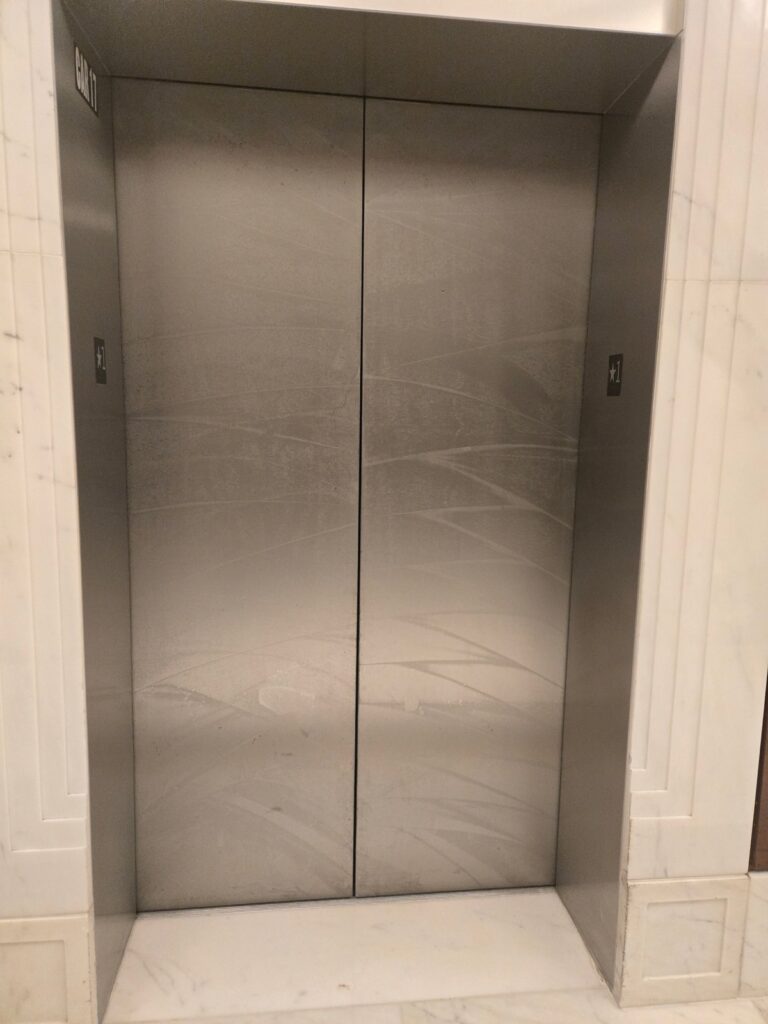
Most architectural metal work in occupied buildings runs outside business hours. Elevator cabs in particular are handled per cab with return to service by the next business day. Details are on the elevator cab restoration page.
Frequently asked questions
Why does my brass look blotchy under the shine?
The lacquer has been breached and the metal is tarnishing underneath it. Polishing the surface will not reach it. The element needs stripping and recoating.
Can we just polish the brass instead of lacquering it?
Yes, and for some properties that is the better answer. An unlacquered finish never goes blotchy and can be touched up piece by piece, but it needs scheduled polishing rather than periodic projects.
What should cleaning staff use on lacquered brass?
A damp cloth and a neutral cleaner. Never brass polish, never abrasives, and keep ammonia-based glass cleaner off it. Brass polish on a lacquered surface removes the lacquer.
How long should lacquer last?
It depends almost entirely on contact and on what is being sprayed near it. Handles and push plates will always fail first, which is why some properties lacquer the flats and run handles as a living finish deliberately.
Have the lobby metal assessed. Rose Restoration has restored brass, bronze, stainless and mixed-finish architectural metal across DC, Maryland and Virginia since 1978. Request a free on-site assessment or call 703-327-7676.
Related: Architectural metal restoration · Brass restoration · Bronze restoration · Elevator cab restoration · Metal restoration cost
Looking for something else?
Get a Free Assessment from Rose Restoration
Tell us about your marble, stone, terrazzo, or concrete and our senior technicians will recommend the right restoration approach. Family-run and trusted across Washington DC, Maryland, and Virginia since 1978.
Call (703) 327-7676 · Email info@roserestoration.com · schedule a time · or send us photos.
Restore. Don't replace.
48 years of polishing marble, terrazzo, concrete, and tile across Washington DC, Northern Virginia, and Maryland. IMF, Four Seasons, Smithsonian, and the Virginia State Capitol trust us — you can too.