Bathroom Stone & Marble Restoration in Washington DC, Maryland & Virginia
Rose Restoration is a Washington DC bathroom stone and marble restoration contractor restoring marble showers, travertine walls, limestone floors, granite vanities, stone tub decks, and tile-and-grout bathroom surfaces for homeowners across DC, Maryland, and Northern Virginia. Typical residential bathroom restoration is completed in 1-2 days in place — no demolition, no shower rebuild, no plumbing disconnect.
Trusted by DC-area homeowners and hotels for bathroom stonework
Rose Restoration has delivered bathroom stone and marble restoration and related services for:
- Residential marble floors & baths — Full-home marble care
- Countertop restoration — Vanity & tub decks
- Marble Armor countertop protection — Vanity long-term protection
- Grout cleaning & color sealing — Bathroom grout refresh
- Four Seasons Hotel Washington DC — Guest bathroom program
- Salamander Resort & Spa — Resort bathroom stone
Bathroom Stone & Marble Restoration in Washington DC — Quick Answers
Who restores marble and stone bathrooms in Washington DC?
Rose Restoration restores marble, travertine, limestone, granite, and natural-stone bathroom surfaces across Washington DC, Maryland, and Northern Virginia. Services include shower restoration, vanity polishing, tub-deck refinishing, floor polishing, etch/stain removal, and grout cleaning. Most residential bathrooms are restored in 1-2 days in place without demolition. Request a free in-home estimate.
Can a marble shower be restored instead of replaced?
Yes. Most marble and travertine showers can be fully restored without demolition or rebuild — even showers with significant etching, stains, soap-scum buildup, mildew, or dulling. The process includes deep cleaning, mildew remediation, diamond honing and polishing to remove etch and restore finish, optional color-enhancement, and sealing. Shower restoration typically saves 80-90% versus a full rebuild.
How much does bathroom stone restoration cost in Washington DC?
Bathroom stone restoration in the DC metro typically runs: vanity polishing $300-$800, shower restoration $1,500-$4,000 depending on size and condition, stone floor polishing $10-$20/sq ft, tub deck refinishing $400-$1,000, and grout cleaning/sealing $200-$800 per bathroom. Whole-bathroom refresh packages typically run $1,500-$5,000 depending on scope.
Can I restore a bathroom without demolition or closing the shower?
Yes. Rose Restoration restores bathrooms in place without demolition, plumbing disconnect, or tile replacement. Most work is dust-controlled and wet-process. The shower is typically out of service for 24-48 hours after restoration to allow sealer cure; other bathroom surfaces are usable same-day. No rebuilding of the substrate is required as long as the stone and tile remain structurally sound.
How often should marble and stone bathrooms be restored?
High-traffic residential marble bathrooms typically need professional restoration every 5-10 years, though lighter-use bathrooms can go 10-15 years. Proper daily maintenance (pH-neutral cleaners only, no vinegar or harsh chemistry, squeegeeing showers after use, re-sealing every 1-3 years) extends the interval significantly. Rose offers annual maintenance programs for ongoing care.
Bathroom Stone Restoration in Washington DC, Maryland, and Northern Virginia
Bathrooms are among the most demanding environments for natural stone. The combination of standing water, acidic personal care products, steam, and temperature cycling creates conditions that accelerate deterioration faster than almost any other interior setting. Rose Restoration specializes in the full range of bathroom stone restoration services — from marble floor honing and polishing to travertine shower wall repair, vanity refinishing, and the complete replacement of grout and caulking in wet areas. Whether you are restoring a decades-old marble bathroom in a Georgetown townhouse or refreshing a newly installed carrara vanity in a Bethesda new build, our technicians have the training and equipment to return your stone to its original condition.
Common Bathroom Stone Problems We Resolve
Marble Etching in Bathrooms
Etching is the most common form of damage to marble in bathroom environments. Unlike a scratch — which is physical surface damage — an etch is a chemical reaction between acidic substances and the calcium carbonate in marble. The acid dissolves a microscopic layer of the stone’s surface, leaving a dull, hazy mark that is visually distinct from the polished areas around it.
In bathrooms, the primary culprits are products that most homeowners do not think of as acidic: toothpaste, many liquid soaps and body washes, shaving cream, face wash, and the residue from shampoo and conditioner. Even mildly acidic products left in contact with polished marble for a few minutes can cause visible etching. Cleaning products are a second major source — tile cleaners, bathroom sprays, and anything containing vinegar, citric acid, or bleach will etch marble on contact.
Etching on marble floors, vanity tops, and shower walls can be removed through honing and polishing. The process involves abrading the stone surface with progressively finer diamond tooling to remove the damaged layer and restore a uniform surface, followed by polishing to the desired sheen. Light etching can often be addressed with a single polishing pass. Deep or extensive etching may require a full honing sequence starting at 100 or 200 grit before polishing to 800 or 1,500 grit.
Hard Water Staining and Mineral Deposits
The Washington DC area water supply has significant mineral hardness. When water evaporates on a stone surface — whether on a vanity, in a shower, or on the floor around a tub — it leaves behind calcium and magnesium deposits that build up over time into a white, chalky film or hard crust. On polished marble or travertine, these deposits obscure the surface and are impervious to standard cleaning products.
Light mineral deposits can be removed with a pH-neutral stone cleaner and mechanical scrubbing. Heavier buildup requires professional treatment using controlled-strength poultices, vapor steam, and stone-safe chemical applications that dissolve the deposits without attacking the stone. Where mineral deposits have been present long enough to begin bonding chemically with the stone surface, mechanical abrasion followed by refinishing is required.
Bathroom Marble Floor Honing and Polishing
Marble floors in bathrooms experience continuous foot traffic in wet conditions — one of the most abrasive use patterns for a polished stone. The combination of abrasive grit tracked in on feet, wet surfaces that reduce the lubrication of footwear, and the constant cleaning required in a bathroom environment produces scratching and dulling over time that no amount of conventional cleaning will address.
Floor honing and polishing is performed with planetary diamond grinders equipped with water-fed tooling heads. The process begins with a grit assessment to determine the severity of the surface damage and the starting point for abrasion. In most residential bathrooms, a sequence from 200 to 400 to 800 grit, followed by a 1,500 or 3,000 grit polishing pad, restores a full polish. For heavily scratched or etched floors, the sequence may begin at 50 or 100 grit. The work is wet, and our technicians use containment equipment to protect adjacent cabinetry, fixtures, and walls.
After polishing, marble floors in bathrooms should be sealed with a penetrating impregnating sealer to reduce the rate at which water, soap residue, and other materials penetrate the stone. Sealer does not make marble impervious — it buys time for cleanup before a stain sets. For more information about our residential marble services, visit our residential marble page.
Travertine Shower Restoration
Travertine is a porous, vuggy limestone commonly used in shower walls and floors. Its natural voids — partially or fully filled at the factory with grout or epoxy filler — are a chronic vulnerability in wet environments. Filler materials in unfilled travertine absorb moisture, discolor, and eventually hollow out, leaving depressions that harbor mold and bacteria and are difficult to clean. In filled travertine, the filler can shrink or disbond, creating open pits.
Travertine shower restoration typically involves cleaning and degreasing the surface, removing failed filler material, injecting fresh matching filler into voids, honing the surface to level filled areas flush with the surrounding stone, and polishing or honing to the desired finish. We also address grout joint failures, which are particularly problematic in showers because open grout joints allow water to penetrate behind the stone and into the substrate.
Shower Regrout and Caulking in Stone Installations
Grout and caulking in stone tile showers have a limited service life. Grout is a rigid, cement-based material that is subject to cracking as the shower substrate undergoes minor thermal and structural movement. Once cracked, grout allows water to bypass the surface and infiltrate the wall assembly behind it. In a shower that is used daily, this infiltration occurs constantly and can lead to substrate failure, mold growth, and ultimately tile disbondment and structural damage.
Caulking — the flexible sealant applied at changes of plane, such as where the wall meets the floor, and at inside corners — fails even faster than grout. Silicone and sanded caulk in shower environments typically require replacement every 3 to 7 years, depending on the product quality and water exposure. Failed or missing caulking at shower corners and transitions is one of the leading causes of water damage behind shower walls in the DC metro area.
Rose Restoration performs full shower regrout services for stone tile installations, including careful removal of existing grout without damaging stone tile edges, installation of new matching grout, and application of fresh caulking at all transitions. We use epoxy grout in applications where long-term stain resistance and waterproofing are priorities. For more information about our tile and grout services, visit our tile, grout, and caulking page.
Marble Vanity Restoration and Protection
Marble vanity tops are among the most heavily used stone surfaces in any bathroom. They are subject to daily contact with toothpaste, soap, cosmetics, and cleaning products — all of which can etch or stain marble if not wiped up promptly. Over time, even a conscientious user will accumulate a pattern of light etch marks, ring stains from soap dispensers and bottles, and dulling around the sink cutout and faucet area.
Vanity restoration involves a sequence of honing and polishing passes appropriate to the severity of the surface damage, followed by thorough cleaning and sealing. For vanities with deep staining — common around faucets where water and mineral deposits concentrate — poultice treatments may be required before or during the refinishing process to draw out subsurface contamination.
After restoration, vanity tops are an appropriate application for Marble Armor, a professional-grade nano-coating that creates a barrier against etching and staining on horizontal stone surfaces. Marble Armor is applied to countertops, vanities, tabletops, bar tops, backsplashes, and waterfall edges — surfaces where spills and contact with acidic substances are frequent. It is not applied to floors, where foot traffic would abrade the coating prematurely.
Our Bathroom Stone Restoration Process
Assessment and Diagnosis
Every bathroom stone restoration engagement begins with a thorough assessment of the existing conditions. Our technicians examine each stone surface under raking light to identify the full extent of etching, scratching, staining, and mechanical damage. We assess the condition of grout joints and caulking throughout the wet area. We inspect for evidence of water infiltration behind tile surfaces — soft or hollow-sounding sections, staining patterns that suggest subsurface moisture, and failed waterproofing at transitions.
This assessment informs a specific scope of work with realistic expectations for the outcome. Not all damage is fully reversible — a deep chip in a marble floor tile, for example, can be filled and the surface refinished, but the fill will be visible under raking light. We communicate these limitations clearly before work begins.
Surface Preparation
Before any refinishing work begins, all stone surfaces are thoroughly cleaned and degreased. Soap scum, body oils, and cleaning product residues can interfere with diamond tooling performance and prevent sealers and coatings from bonding correctly. We use pH-neutral stone cleaners and, for heavily soiled surfaces, professional-grade degreasers that are safe for natural stone.
Refinishing and Polishing
Refinishing is performed with professional diamond tooling appropriate to the surface — hand-held angle grinders for wall surfaces and vertical faces, planetary floor machines for floors, and smaller handheld machines for vanity tops. Each stage of the abrasion sequence removes the scratching and tooling marks from the previous stage, progressing toward a refined surface. The final polishing stage produces the desired sheen level, from a flat hone to a mirror polish.
Sealing and Protection
All restored stone surfaces receive a penetrating impregnating sealer appropriate to the stone type and the use environment. Shower floors and walls receive water-repellent sealers with food-grade or bathroom-grade certification. Vanity tops eligible for Marble Armor receive the nano-coating application as a final step. We provide clients with specific maintenance instructions for each treated surface.
Who Needs Bathroom Stone Restoration?
Bathroom stone restoration is appropriate for a wide range of situations:
- Homeowners preparing a property for sale who want to present bathrooms in their best possible condition
- Property owners who have lived with degraded stone for years and want to restore the investment they made at installation
- Renovation projects where existing stone will be retained but needs to be restored to integrate with new fixtures or design elements
- Rental property managers addressing accumulated wear before re-leasing a unit
- Historic home owners with original stone installations that need period-appropriate care
We serve residential and commercial clients throughout Washington DC, Montgomery County, Prince George’s County, Fairfax County, Arlington, Alexandria, and the broader Northern Virginia region. To schedule a bathroom stone assessment, call Rose Restoration at 703-327-7676.
Frequently Asked Questions
Can etching on bathroom marble be repaired without replacing the stone?
Yes, in most cases. Etching is surface damage — the acid has dissolved a thin layer of the polished surface, leaving a dull mark. Professional honing and polishing removes this damaged layer and restores a uniform polish. The process is the same regardless of whether the etch is on a floor, a vanity top, or a shower wall. The extent of the restoration sequence — how many grit stages are required — depends on the depth and severity of the etching. Light etch marks from toothpaste or soap can often be addressed in a single polishing pass. Deep etch damage from strong acid contact requires more extensive abrasion before polishing.
How long does bathroom stone restoration take?
A typical master bathroom — marble floor, marble vanity, and shower wall assessment — can be completed in one to two days for a standard residential scope. Projects that include full shower regrout, extensive stain treatment, or stone chip repair take longer. We provide timeline estimates during the assessment. Most clients can use their bathroom within 24 hours of work completion, though we recommend waiting 48 to 72 hours before saturating sealed surfaces with water.
Should I seal my bathroom marble floors?
Yes. Sealing bathroom marble floors with a quality penetrating impregnating sealer significantly extends the interval between professional refinishing and reduces the severity of staining from soap, body products, and other bathroom materials. The sealer does not make the floor impervious — it slows the penetration of liquids, buying time for cleanup. Reapplication frequency depends on the sealer product and the traffic the floor receives, typically every one to three years in a primary bathroom.
What is Marble Armor and is it appropriate for my bathroom floor?
Marble Armor is a professional nano-coating that provides etch and stain protection on marble and other calcium-based stone surfaces. It is appropriate for vanities, countertops, tabletops, bar tops, backsplashes, and waterfall edges — horizontal surfaces subject to spills and product contact. Marble Armor is not used on floors. The foot traffic on a floor surface would abrade the coating, and the product is engineered for countertop-type applications where this wear pattern is not present. For bathroom floors, a penetrating impregnating sealer is the correct protection strategy.
How do I prevent my marble bathroom from deteriorating so quickly?
The most impactful practices are consistent: wipe up toothpaste, soap, and any other product immediately after it contacts the stone rather than leaving it to sit; use pH-neutral stone-safe cleaners rather than general bathroom sprays; and keep stone surfaces dry between uses where possible. A squeegee on shower walls after each use dramatically reduces mineral deposit buildup. Reseal floors and vanity tops annually in a primary bathroom, and address any grout or caulking failures promptly before water can reach the substrate behind the stone.
Bathroom Surfaces We Restore and What Fails on Each
A bathroom is not one surface. The shower walls, the shower floor, the curb, the tub deck and the vanity top are often cut from the same slab, but they fail in different ways because each one holds water for a different length of time. Working out which surface has failed, and why, is what decides whether a bathroom needs a day of refinishing or a rebuilt joint behind the stone.
| Surface | What usually fails | What we do | Repair or replace |
|---|---|---|---|
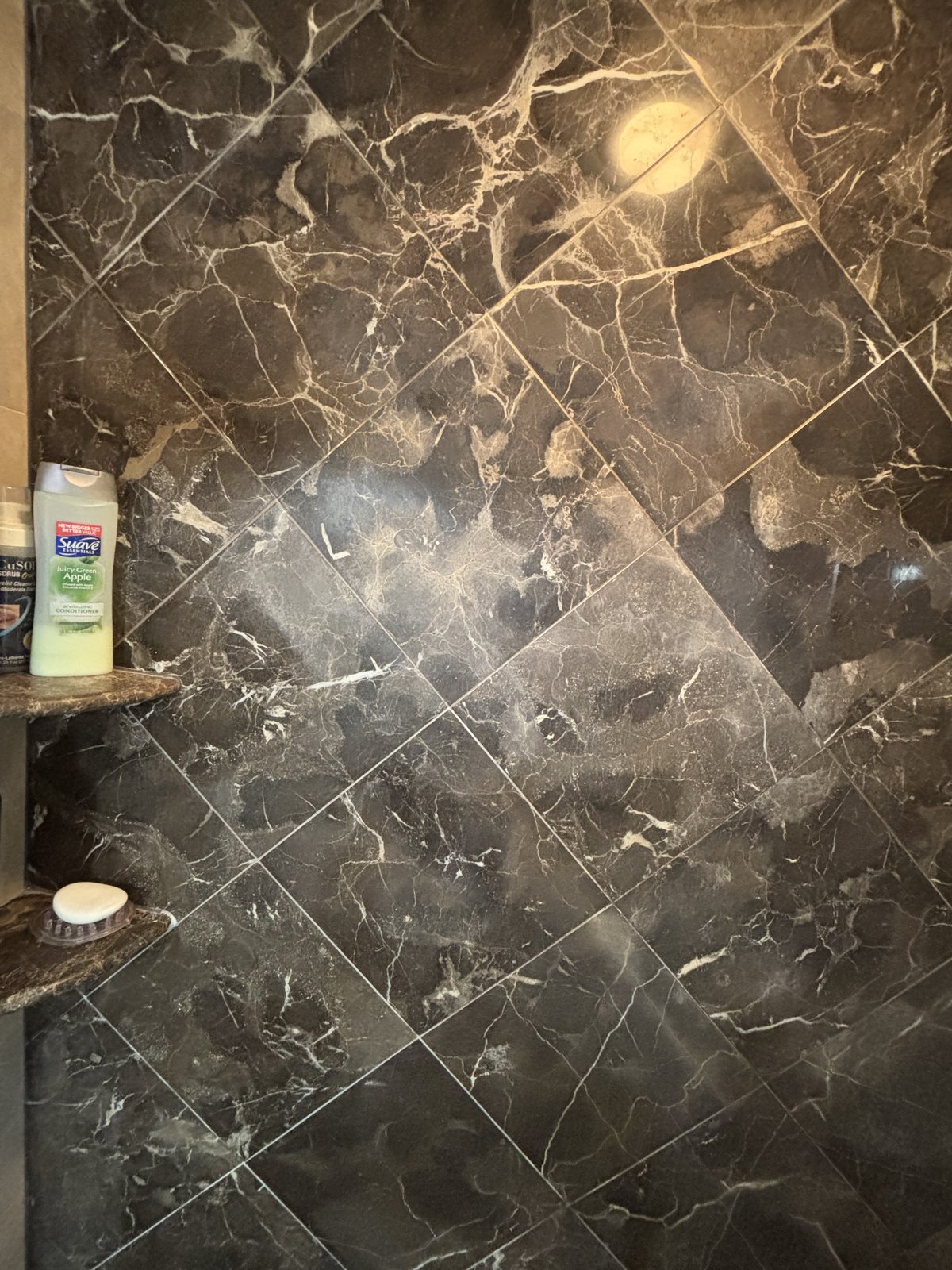
| Shower walls | Soap film and hard water scale build a grey haze over the polish. Acidic and bleach based sprays leave etch shadows concentrated at shoulder height, where they get used most. | Strip the film, hone the etching out of the vertical faces, re-polish to the original finish, then seal. | Repaired in place in nearly every case |
| Shower floor or pan | Mineral deposits fill the texture of a honed or tumbled floor, grout darkens unevenly, and the surface glazes over so it feels slicker underfoot than it did new. | Deep clean, hone back to one even finish, regrout the joints that have failed, then seal. | Repaired unless the pan itself is leaking |
| Curb and threshold | Water tracks under a failed caulk joint and breaks down the substrate behind the stone. The marble looks sound until the piece starts to move or a corner lifts. | Lift the affected stone, rebuild the substrate underneath, reset the piece and replace the joint with a flexible sealant. | Repaired, resetting the original stone where it lifts cleanly |
| Tub surround and deck | Standing water at the deck to tub joint opens the caulk line and stains the stone beneath it. The horizontal deck etches from bottles and products set down on it. | Draw out penetrating stains with a poultice, refinish the deck, and replace the perimeter joint with a color matched flexible caulk. | Repaired |
| Vanity top | Toothpaste, cosmetics and cleaning sprays etch the polish in a halo in front of each basin. Scratches collect around the faucet and at the front edge. | Hone the etched area back into the surrounding finish, re-polish the whole top so there is no patch line, then seal or apply Marble Armor. | Repaired |
| Bathroom floor | A wear path in the door line, discolored grout, and a dull band where water runs off the shower door onto the stone. | Hone and polish the full floor so the wear path disappears rather than being blended, then clean and color seal the grout. | Repaired |
Marble refinishing is priced by the square footage actually worked, generally $10 to $20 per square foot depending on the finish, the condition and the amount of hand work around fixtures. Joint and substrate repairs at a curb or tub deck are quoted separately because the scope is only known once the failed stone is lifted.
Steam Showers, Sealing, and How Often Each Surface Needs Attention
A steam shower keeps stone warm and saturated for far longer than an ordinary shower does, and that changes the maintenance picture. Moisture drives deeper into the stone and into the setting bed behind it, so three things appear earlier than they would in an enclosure that dries out between uses: a white mineral bloom on the surface as water evaporates and leaves its salts behind, caulk joints that open at every change of plane, and darkened patches where the stone has simply stayed wet.
None of that means the stone was the wrong choice. It means the sealing and joint schedule has to be shorter. We check the condition of the vapor seal and the joints before anything else, because refinishing stone that is still taking on water from behind will look right only until it dries out again.
| Surface | Typical resealing interval | What shortens it |
|---|---|---|
| Shower walls and floor | 12 to 18 months | Daily use, hard water, acidic or bleach based cleaners |
| Steam shower, all surfaces | 6 to 12 months | Continuous saturation and long dwell times |
| Tub surround and deck | 18 to 24 months | Standing water sitting at the tub joint |
| Vanity top, sealed | 12 to 24 months | Cosmetics, cleaning sprays, citrus and perfume |
| Vanity top with Marble Armor | Not resealed on a schedule | Covered under the Marble Armor terms rather than a sealer cycle |
| Bathroom floor | 2 to 3 years | Traffic, grit carried in underfoot, the wet line at the shower door |
Intervals are a starting point, not a rule. We set the actual schedule from a water absorption check on the stone itself during the assessment. If you want the detail on products and method, see natural stone cleaning and sealing, and for failed joints see grout and caulk services.
Rose Restoration works on bathroom stone across Washington DC, Maryland and Northern Virginia, in occupied homes and in hotel guestrooms. Call 703-327-7676 or send photos of the surface for an assessment.
Recent Bathroom Restoration Projects
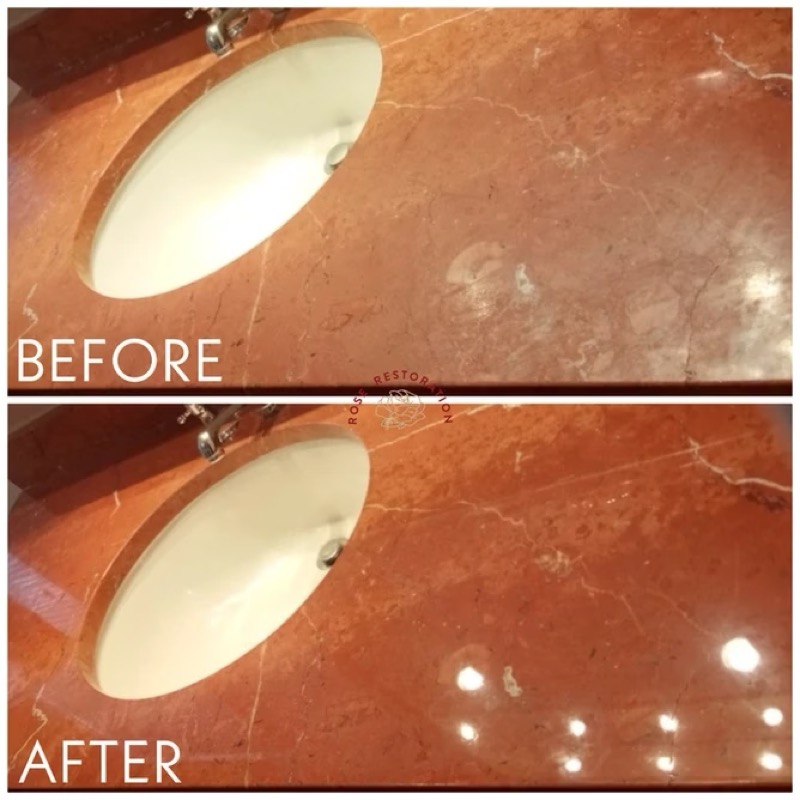
Marble vanity, before and after
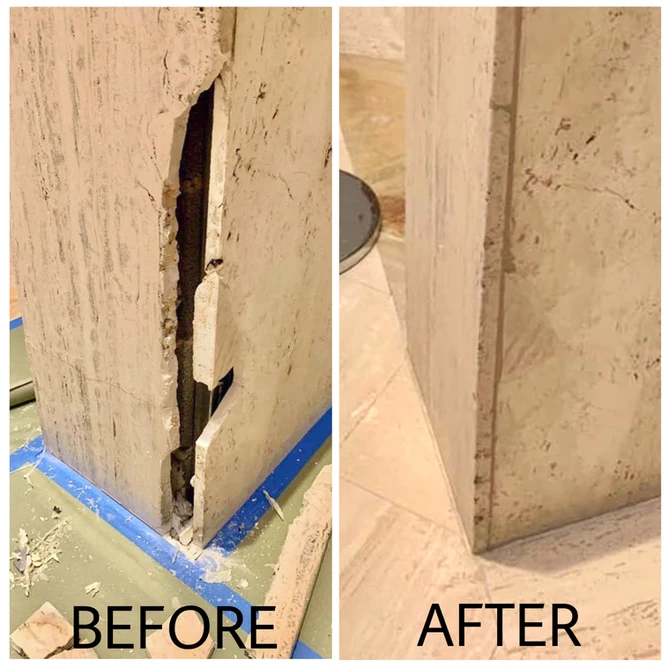
Travertine shower wall crack repair, before and after
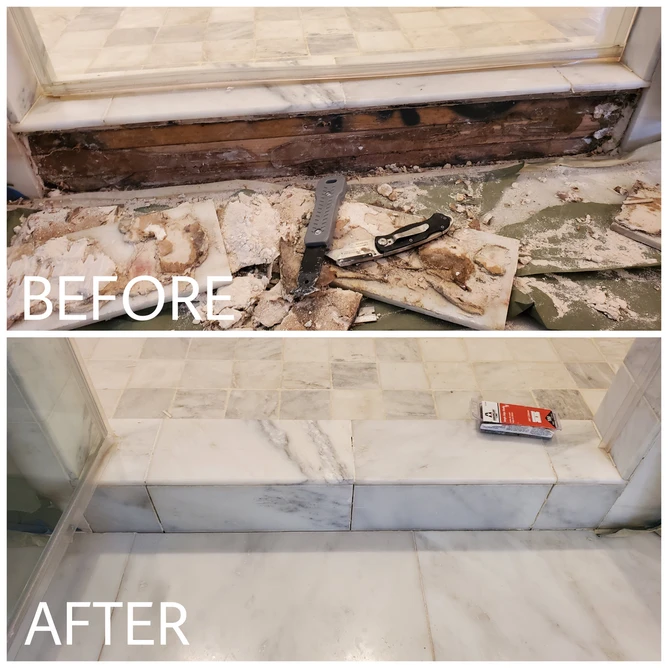
Shower threshold rebuilt after water damage, before and after
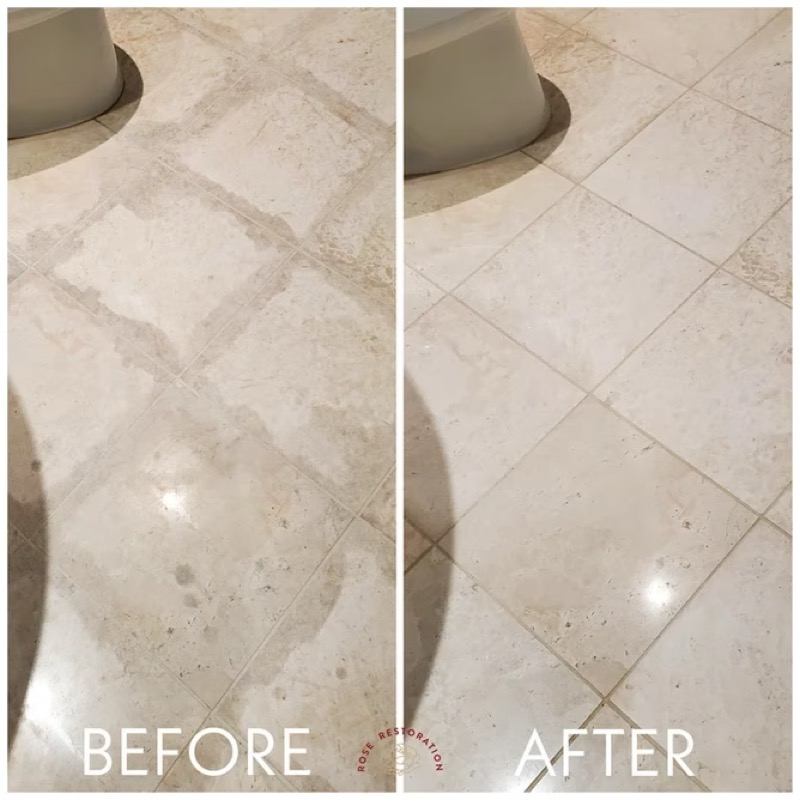
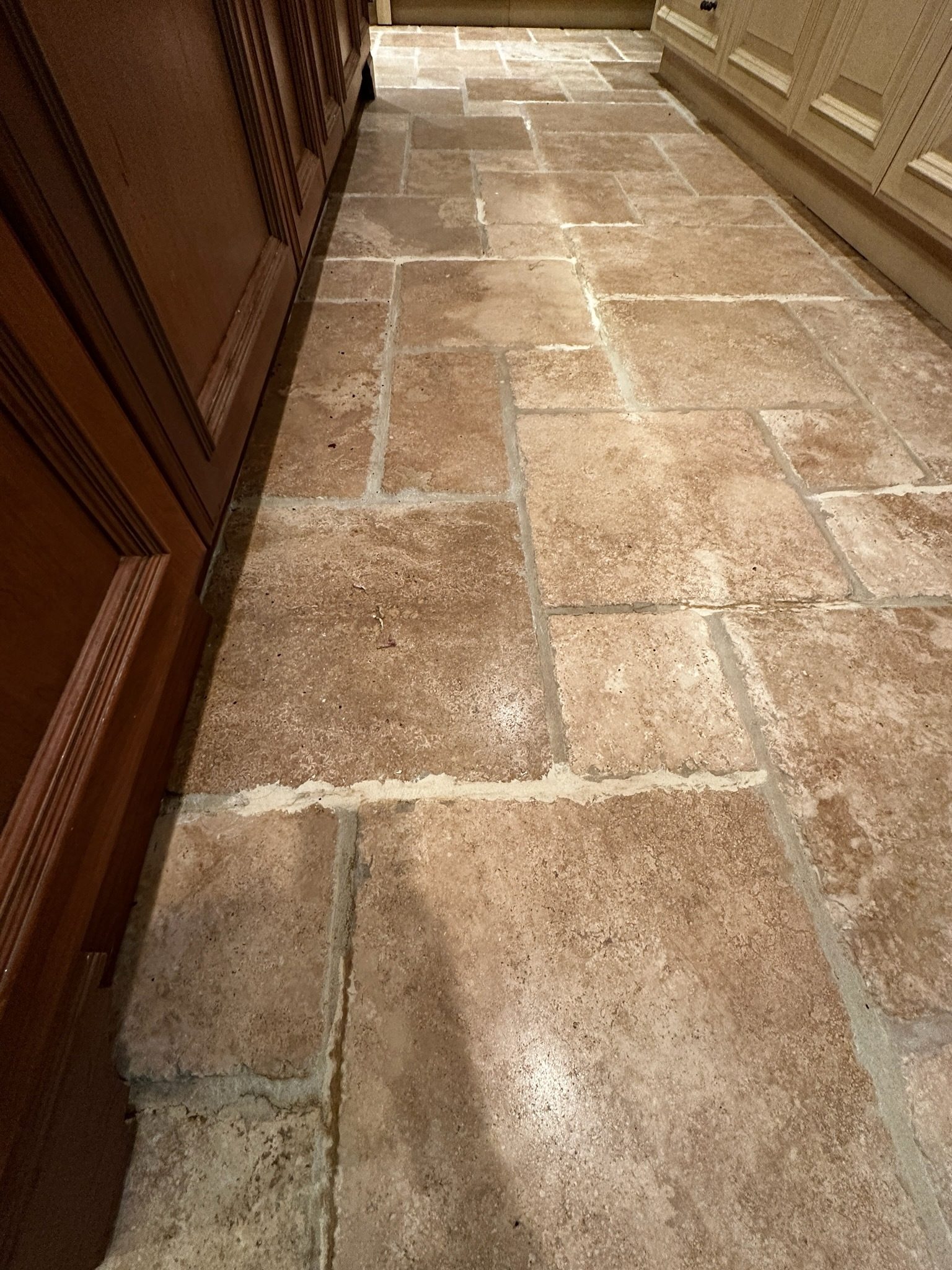
Travertine bathroom floor, before and after
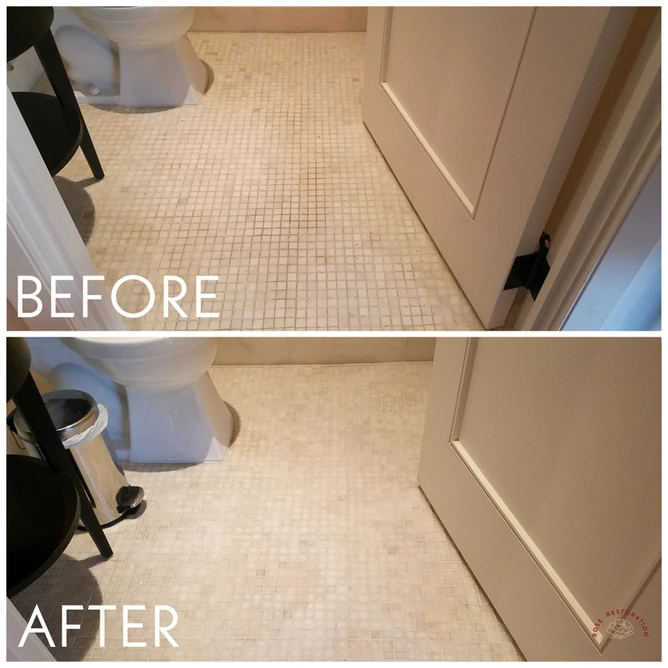
Mosaic bathroom floor grout, before and after
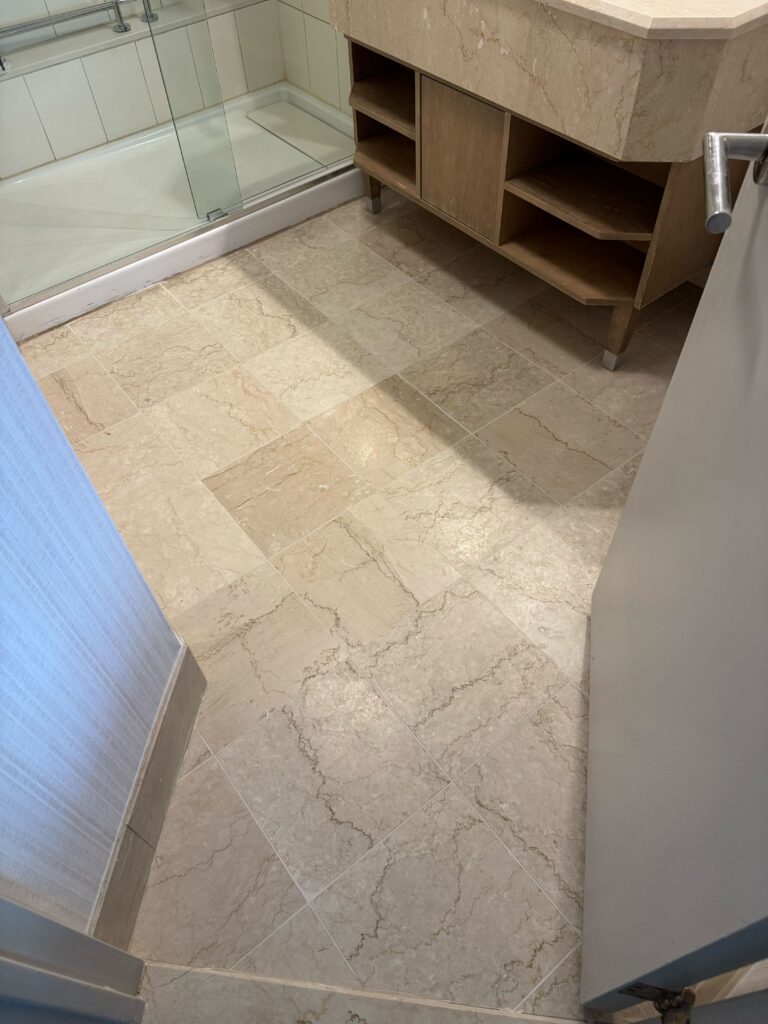
Hotel guestroom bathroom floor and vanity
Shower and Bathroom Stone Restoration
Rose Restoration restores marble, travertine, and limestone showers and bathrooms across Washington, DC, Maryland, and Northern Virginia. We remove hard water etching and soap film, refinish dull or scratched stone, repair chips, and reseal both the stone and the grout so the bathroom resists moisture and staining. Because a shower combines stone and grout, we address both in one visit. Call 703-327-7676 for a free estimate.