
Virginia State Capitol — Historic Marble Restoration
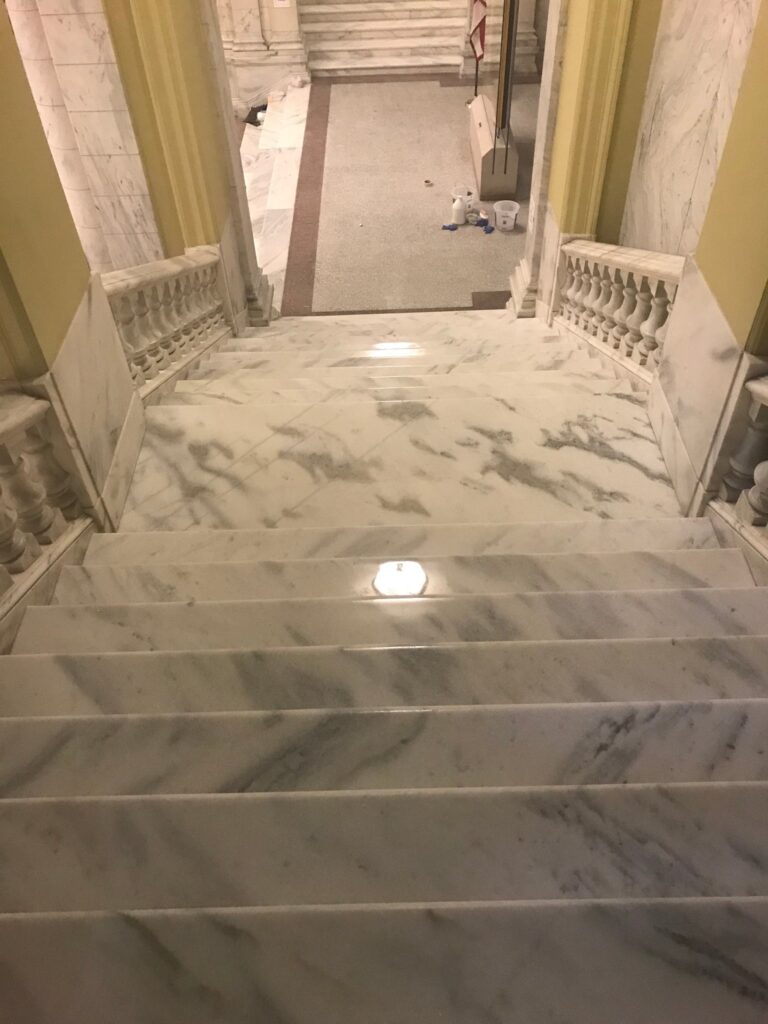
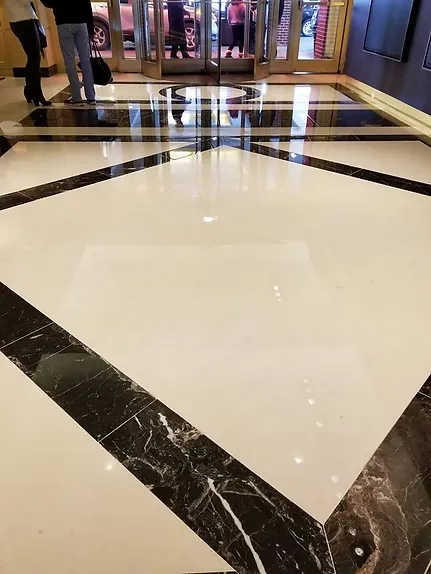
Rose Restoration has delivered historic marble and stone restoration at the Virginia State Capitol in Richmond — the Thomas Jefferson-designed 1788 state capitol, one of the oldest public buildings in the United States. Work has included historic marble restoration, preservation-appropriate stone cleaning, and coordination with state preservation requirements and public-access schedules.
Related Rose Restoration landmark and historic projects
Rose Restoration has delivered Virginia State Capitol restoration and related services for:
- Smithsonian Institution — Related historic
- Marine Barracks Washington — Related landmark
- Historical restoration — Landmark methods
- Government restoration — Federal & state
- Marble services — Historic marble
- All case studies — Project portfolio
Virginia State Capitol — Quick Answers
What did Rose Restoration do at the Virginia State Capitol?
Rose Restoration has delivered historic marble and stone restoration at the Virginia State Capitol in Richmond — a Thomas Jefferson-designed 1788 landmark. Work includes historic marble restoration, preservation-appropriate stone cleaning, and coordination with state preservation standards, public-access schedules, and the Capitol's operational requirements during legislative sessions.
Does Rose Restoration work on landmark and historic government buildings?
Yes. Rose Restoration has experience since 1978 on landmark and historic government buildings across DC, Maryland, and Virginia — including the Virginia State Capitol, the U.S. Department of the Treasury, the Smithsonian Institution, the National Gallery of Art, and Marine Barracks Washington. Work uses preservation-appropriate methods (soft washing, lime-mortar repointing, substrate-matched chemistry, test patches) under preservation review protocols.
How does Rose restore historic marble without damage?
Historic marble — particularly from pre-1900s quarries — requires specialized approach: test patches to verify methods, carefully-selected diamond tooling calibrated to avoid removing original tool marks or carved detail where historically significant, pH-neutral chemistry, and preservation-grade sealers. Rose coordinates with preservation architects and review boards on every landmark project.
The Virginia State Capitol in Richmond — designed by Thomas Jefferson, built in 1788, and one of the most architecturally significant government buildings in the United States — represents preservation work at the highest level. National Historic Landmark status, continuous use as the working seat of the Virginia General Assembly, and Jefferson’s original architectural vision all inform how restoration work happens here. Rose Restoration has provided preservation-grade surface restoration in historic government settings of this caliber.
Project type: National Historic Landmark government restoration | Material mix: Marble, stone, historic brick, metal | Location: Richmond, Virginia | Scope: Preservation-grade restoration
Why National Historic Landmark Work Is Distinct
National Historic Landmarks represent the highest designation for historic significance in the United States. Work on these buildings operates under a different set of rules than commercial or even standard historic-district restoration:
- Preservation standards compliance. The Secretary of the Interior’s Standards for the Treatment of Historic Properties govern all work. Every material, every technique, every product must align.
- Architectural significance. The building itself is the artifact. Every decision respects original design intent and materials specification.
- Minimal-intervention philosophy. Preserve original material above all. Repair when possible. Restore rather than replace.
- Reversibility. Ideally, restoration interventions should be reversible — future conservators should be able to undo our work if better methods emerge.
- Documentation. Complete pre/during/post-work photography and notes for permanent preservation files.
- Expert coordination. Working with preservation architects, conservation staff, and sometimes state historic preservation officers.
Materials in Historic Government Architecture
Marble
Historic government buildings like the Virginia State Capitol feature marble in formal rooms, legislative chambers, entry halls, staircases, and public corridors. Often original or period-appropriate replacement marble from the original quarry region. Restoration uses the gentlest effective methodology — honing depth minimized, chemistry matched to original installation era, sealer selection respecting the marble’s history.
Natural Stone Exteriors
Limestone, sandstone, and granite exterior cladding and architectural details. Historic government exteriors face weathering, pollution, efflorescence, and previous inappropriate repairs. Our approach: pH-neutral cleaning, careful mechanical restoration only where needed, appropriate breathable sealers, and documentation of all work.
Historic Brick and Masonry
Original 18th-century brick (in the Jefferson-era portions) requires pure lime-based mortars — typically Type O or specialty Type K lime putty. Using modern portland-based mortar on 18th-century brick would crack the brick within decades. Matching historic mortar color, sand, texture, and hardness is fundamental to this work.
Metal
Brass, bronze, and historic iron fittings throughout government historic buildings. Restoration respects period patina — the goal is preservation of existing character, not refinishing to new-looking. Cleaning, stabilization, and appropriate protective coatings only.
Our Preservation-Grade Process
- Pre-work assessment with preservation architect and historic preservation office. Documentation of existing conditions, identification of original vs later materials, and scope development.
- Material analysis. Mortar samples (for masonry work), stone origin identification (for stone work), historical research on original installations.
- Mock-ups. For any visible surface work, mock-ups demonstrate proposed methodology before execution on the building.
- Preservation office review. State historic preservation officer or equivalent reviews mock-ups and methodology before full-scale work.
- Execution using approved methodology with ongoing documentation.
- Conservation-grade chemistry. pH-neutral only on historic surfaces. No acidic cleaners, no aggressive strippers, no sealers with solvents that could damage historic materials.
- Reversibility consideration. Where possible, interventions designed to be reversible by future conservators.
- Post-work documentation. Complete photographic record and written notes for preservation files.
Working in Active Government Buildings
The Virginia State Capitol is a working legislative building. Restoration happens around:
- Legislative sessions. The General Assembly meets annually; major restoration happens during recess or in non-legislative spaces.
- Public tours. The building is open to visitors. Work must fit public-access schedules.
- Ceremonial events. Inaugurations, special ceremonies, and dignitary visits require coordination.
- Security. Government facility security protocols apply to all work.
- Press and public visibility. Historic capitol restoration is often a matter of public interest. Work standards, crew conduct, and site appearance all reflect the building’s significance.
Why Preservation-Grade Work Matters
The difference between standard historic work and preservation-grade work is decades of building life:
- Properly restored historic marble lasts 50+ years without needing aggressive intervention again
- Lime-mortar repointing on Jefferson-era brick should last a century with occasional touch-up
- Properly cleaned and sealed historic limestone weathers another 30–50 years
- Period-appropriate brass restoration maintains patina for generations
Inappropriate restoration — using portland mortar on soft brick, aggressive cleaners on historic marble, modern coatings on exterior stone — often damages the original materials within decades and creates expensive remediation requirements.
Why Rose Restoration for Historic Government Work
- 48 years of historic building work. Our team has restored National Register and landmark-listed buildings throughout the DC metro and mid-Atlantic region.
- Multi-material capability. Marble, stone, brick, metal, and terrazzo under one coordinated crew — which matters on multi-material historic buildings.
- Preservation methodology as default. Not a special mode for occasional jobs — it’s our standard approach to any pre-1930s building.
- Historic mortar expertise. Type N, Type O, and Type K lime mortar work done routinely. Sand and color matching.
- Documentation practices. Pre/during/post photography and written notes for preservation files.
- Preservation office coordination experience. Working with state historic preservation officers, local architectural review boards, and preservation architects.
- Security protocol familiarity. Government building access, escort, and after-hours scheduling routinely handled.
Related Historic & Government Work
- Marine Barracks Washington
- Smithsonian Institution
- IMF Headquarters
- National Gallery of Art
- Historic Building Restoration Services
- Government Building Restoration
- Masonry Restoration Services
- Marble Restoration Services
Work With Rose Restoration
Free on-site assessment for historic, government, landmark, and preservation-grade properties throughout Virginia, DC, and Maryland.
Call: (703) 327-7676 | Online: request a free assessment
historic stone restoration · government building restoration