
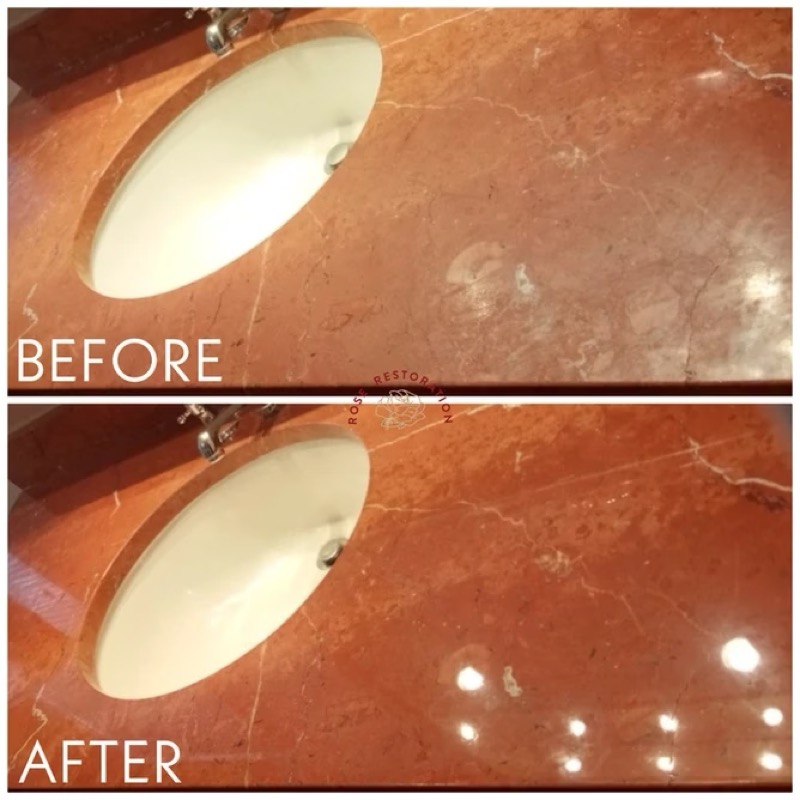
Rose Restoration — a Washington DC countertop restoration contractor — explains the critical difference between quartz (engineered) and quartzite (natural stone) countertops, and how each affects daily care, restoration, and replacement.
 By Tom Kuhn, CEO, Rose Restoration
Rose Restoration has restored marble, terrazzo, concrete, and natural stone across DC, MD, and VA since 1978.
Quartzite is a natural metamorphic rock formed when quartz-rich sandstone is buried deep in the earth and subjected to intense heat and pressure over millions of years. During this process, the individual sand grains recrystallize and fuse together into an extremely hard, interlocking matrix of quartz crystals. The result is one of the hardest and most durable natural stones available for countertops and flooring.
Quartzite is mined from quarries around the world — with major sources in Brazil, India, Norway, and the United States — and then cut into slabs and fabricated in exactly the same manner as granite or marble. Because it is a natural stone, each slab is geologically unique. The veining, color gradients, and surface variation in quartzite cannot be replicated, giving quartzite countertops a one-of-a-kind character that engineered stone cannot match.
The hardness of quartzite generally makes it more scratch-resistant than marble and comparable to granite. However, quartzite varies significantly in density and porosity depending on its mineralogy. Some varieties are extremely dense and nearly impervious to moisture; others have micro-porosity that can absorb oils and liquids if not properly sealed.
Popular quartzite varieties include Taj Mahal (warm ivory with subtle gold veining), Fantasy Brown (beige with dramatic brown and grey movement), Super White (bright white with grey veining, often mistaken for marble or dolomite), Sea Pearl, Macaubus White, and Cristallo. Pricing typically ranges from $60–$150+ per square foot installed depending on the variety, origin, and slab thickness.
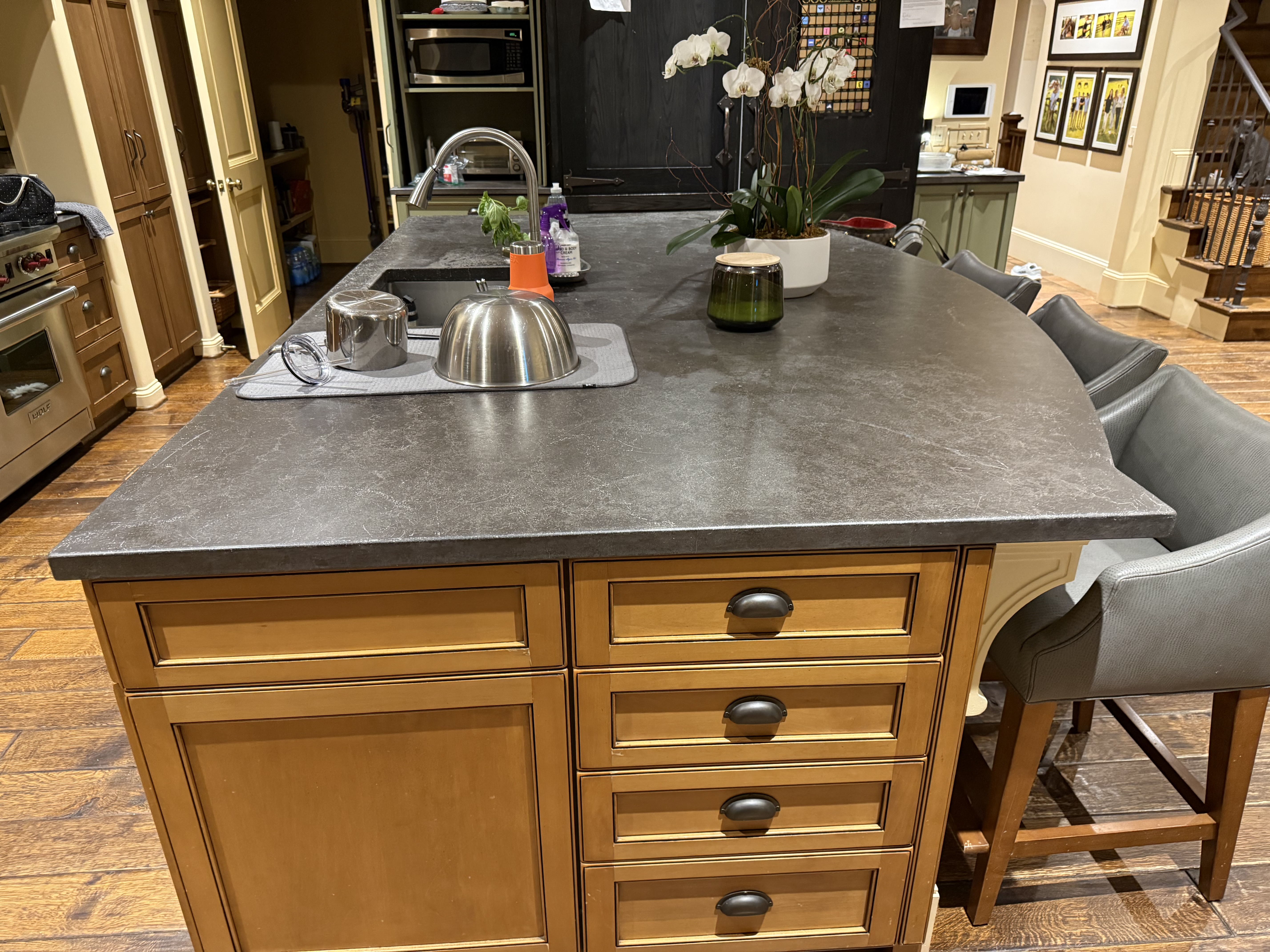
Both quartz and quartzite are excellent countertop choices for kitchens — but the right choice depends on your priorities.
Choose quartz if: You want a low-maintenance surface with no sealing, a consistent and predictable appearance, or a wide range of manufactured colors and patterns. Quartz is an excellent choice for busy families, rental properties, or homeowners who simply don’t want to think about periodic maintenance. Just be aware of its vulnerability to direct heat and UV exposure.
Choose quartzite if: You want the character and uniqueness of natural stone, the heat resistance of a stone countertop, or the prestige of a premium natural material. Quartzite’s beauty — with its organic veining and depth — is difficult to replicate in any manufactured product. True quartzite is also exceptionally durable. The trade-off is that you will likely need to seal it periodically and have it professionally maintained over its lifetime.
For homeowners in the Fairfax, VA, Northern Virginia, Maryland, and Washington DC area, Rose Restoration International provides professional quartzite sealing, stain removal, polishing, and the application of Marble Armor protective coating to keep natural stone countertops looking their best for decades. Call 703-327-7676 to schedule a consultation.
Yes — quartzite countertops can absolutely be restored when they are scratched, stained, dull, or damaged. Rose Restoration International treats quartzite with the same professional techniques we apply to marble, granite, and other premium natural stones.
Our quartzite restoration services include diamond polishing to restore gloss and remove fine scratches, stain removal using professional poultice treatments, crack and chip repair, deep cleaning, and professional sealing to protect against future staining. For maximum protection against both etching and staining, we also offer Marble Armor — a clear protective coating that prevents surface damage from acids and oils while maintaining the stone’s natural appearance.
Our residential stone restoration services are available throughout Fairfax, VA and the greater Northern Virginia, Maryland, and Washington DC region. Learn more about our residential marble and natural stone services or call us at 703-327-7676 to schedule an assessment.
Looking for something else?
Get a Free Assessment from Rose Restoration
Tell us about your marble, stone, terrazzo, or concrete and our senior technicians will recommend the right restoration approach. Family-run and trusted across Washington DC, Maryland, and Virginia since 1978.
Call (703) 327-7676 · Email info@roserestoration.com · schedule a time · or send us photos.
Restore. Don't replace.
48 years of polishing marble, terrazzo, concrete, and tile across Washington DC, Northern Virginia, and Maryland. IMF, Four Seasons, Smithsonian, and the Virginia State Capitol trust us — you can too.