
Marble 025 1000036316 | Rose Restoration

Preparing for your Project

To prepare for a stone or concrete restoration project, clear the work area of personal items, provide unobstructed access to the surfaces being restored, and plan for some dust and noise \u2014 though professional restoration crews use containment systems to minimize both. The more accessible the work area, the more efficiently the crew can work, and the better the results you can expect.<\/p>

At Rose Restoration International, we have been guiding homeowners and commercial clients through the restoration process for over 40 years. Based in Fairfax, VA, and serving the entire Virginia, Maryland, and Washington DC metro area, we have refined our preparation and communication process so clients always know what to expect \u2014 before, during, and after every project. If you have questions before your appointment, call us at 703-327-7676<\/a>.<\/p>

Before the Project \u2014 What to Do

A little preparation on your end goes a long way toward making the restoration process smooth and efficient. Here is what we recommend doing before our crew arrives:<\/p>

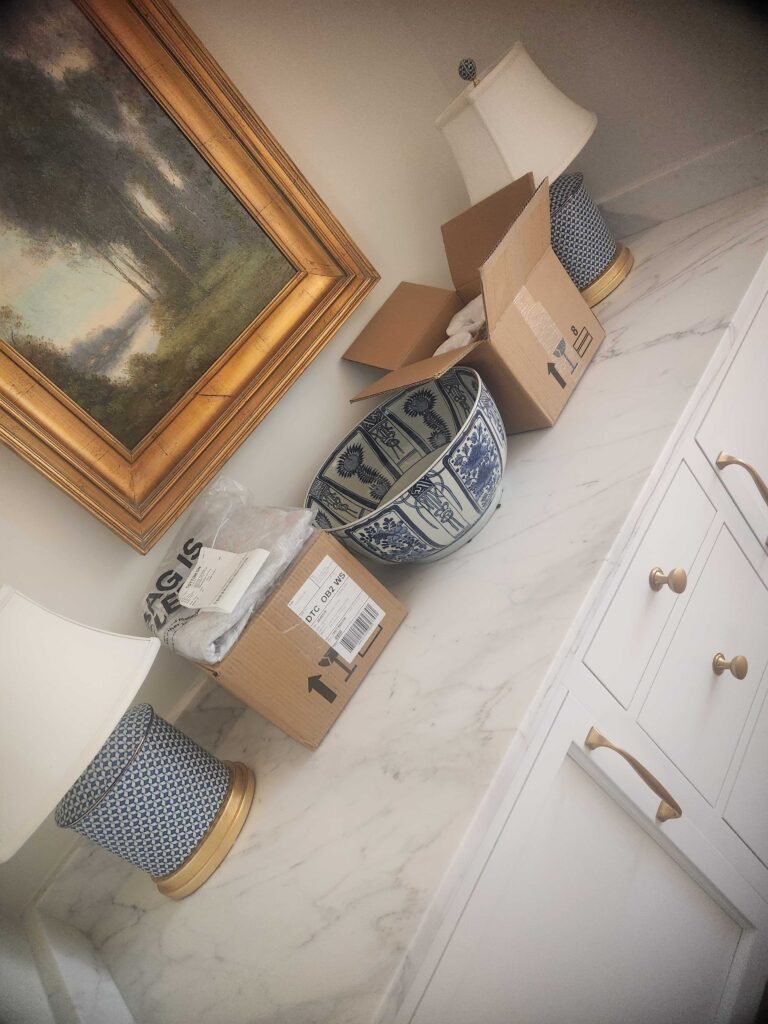
  • Clear countertops and nearby surfaces.<\/strong> Remove small appliances, decorative items, dishes, and anything stored on or near the surfaces being restored. Even items a few feet away can be affected by dust or water mist.<\/li>
  • Move furniture if possible.<\/strong> For floor restorations, move furniture to an adjacent room or hallway. Our crew can assist with heavier pieces, but the more cleared ahead of time, the faster the project can begin.<\/li>
  • Secure pets and children.<\/strong> Restoration equipment is loud and can startle animals. Keep pets in a closed room or arrange for them to be elsewhere during the work hours. The same applies to young children who may be frightened by the noise or drawn to the equipment.<\/li>
  • Discuss parking and access with the crew coordinator.<\/strong> Our technicians often arrive with a van or truck carrying heavy equipment. Make sure there is adequate parking or loading zone access near your entrance.<\/li>
  • Confirm the project timeline and scope.<\/strong> Review the written estimate you received and confirm the number of days the project is expected to take. If anything has changed \u2014 new stains appeared, you want to add surfaces \u2014 contact us before the appointment day so we can adjust accordingly.<\/li>
  • Communicate any special concerns.<\/strong> If you have a sealer preference, a sensitivity to chemical odors, or a family member who works from home and needs quiet hours, let us know in advance so we can plan around your needs.<\/li><\/ul>

    Taking these steps ahead of time helps our technicians get started immediately upon arrival and minimizes disruption to your household or business operations.<\/p>

What to Expect During Stone Restoration

Stone restoration \u2014 whether marble, granite, limestone, travertine, or slate \u2014 involves a series of mechanical and chemical processes that transform dull, scratched, or etched surfaces back to their original beauty. Here is a realistic picture of what the process looks and sounds like.<\/p>

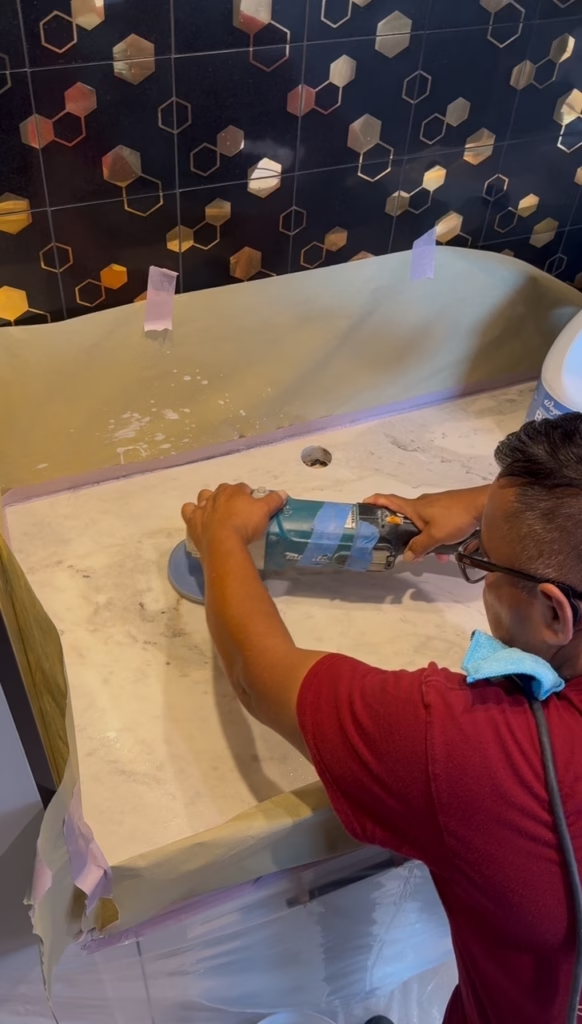
Equipment.<\/strong> Our technicians use professional-grade planetary grinders and polishers equipped with diamond abrasive pads. These machines range from small handheld units for countertops and stair treads to large walk-behind floor polishers for expansive stone floors. You will hear a consistent motorized hum throughout the process.<\/p>

Dust containment.<\/strong> Stone grinding and honing produce fine silica dust. We use HEPA vacuums attached directly to grinding heads and set up containment barriers where needed to prevent dust migration into adjacent rooms. Our crews follow safe silica dust protocols in compliance with OSHA standards. Clients with respiratory sensitivities should plan to be in a separate area of the home.<\/p>

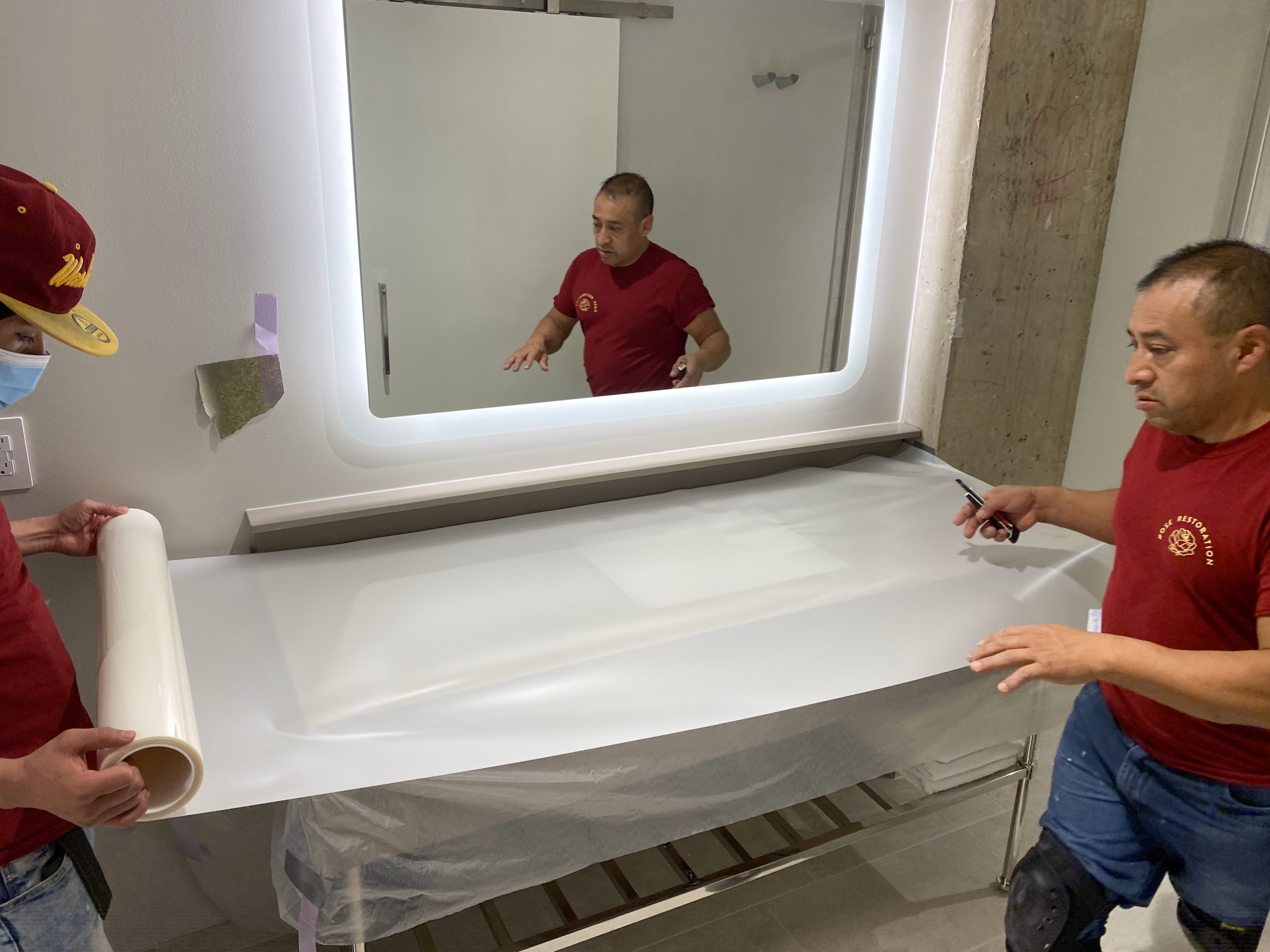
Water use.<\/strong> Wet polishing methods are used on many stone types to reduce heat and improve the quality of the polish. Towels and a wet-dry vacuum are used to manage slurry and water throughout the process. The floor will be cleaned thoroughly at project completion.<\/p>

Crew size and working hours.<\/strong> Most residential stone restoration projects are handled by a two-person crew. We work standard business hours and always confirm the schedule with the client in advance. We do not leave surfaces unprotected overnight.<\/p>

Sealer application.<\/strong> Most stone restoration projects conclude with a sealer application. The sealer requires a cure time before foot traffic is allowed, which we will communicate clearly before we leave the site.<\/p>

What to Expect During Concrete Restoration

Concrete restoration shares many characteristics with stone restoration but involves heavier equipment and additional considerations, particularly for commercial projects.<\/p>

Equipment scale.<\/strong> Concrete grinding and polishing uses industrial-grade planetary grinders with diamond tooling that is much more aggressive than stone polishing pads. Walk-behind machines that can weigh several hundred pounds are standard for floor work. These require adequate doorway clearance and may need to be brought in through garage access or freight entrances in commercial buildings.<\/p>

Dust containment.<\/strong> Concrete produces significant silica dust during the grinding phase. We use industrial HEPA dust collection systems connected to all grinding heads and establish containment zones with plastic sheeting for commercial projects. Residential concrete work \u2014 basement floors, patios, garages \u2014 typically requires temporary vacating of adjacent rooms.<\/p>

Curing times.<\/strong> Concrete densifiers and sealers require longer curing times than stone sealers. Depending on the product and environmental conditions, foot traffic may need to be restricted for 4-24 hours, and vehicle traffic for 48-72 hours on garage or driveway work.<\/p>

Phased work in commercial settings.<\/strong> Large commercial concrete floors are typically restored in sections so that portions of the space remain usable during the project. We work with facility managers to develop a phasing plan that minimizes operational disruption. Call 703-327-7676<\/a> to discuss your commercial concrete needs.<\/p>

Timeline Expectations by Project Type

One of the most common questions we receive is: how long will this take? The honest answer depends on the surface type, the square footage, the condition of the material, and the finish level requested. Here are general benchmarks based on our 47 years of experience:<\/p>

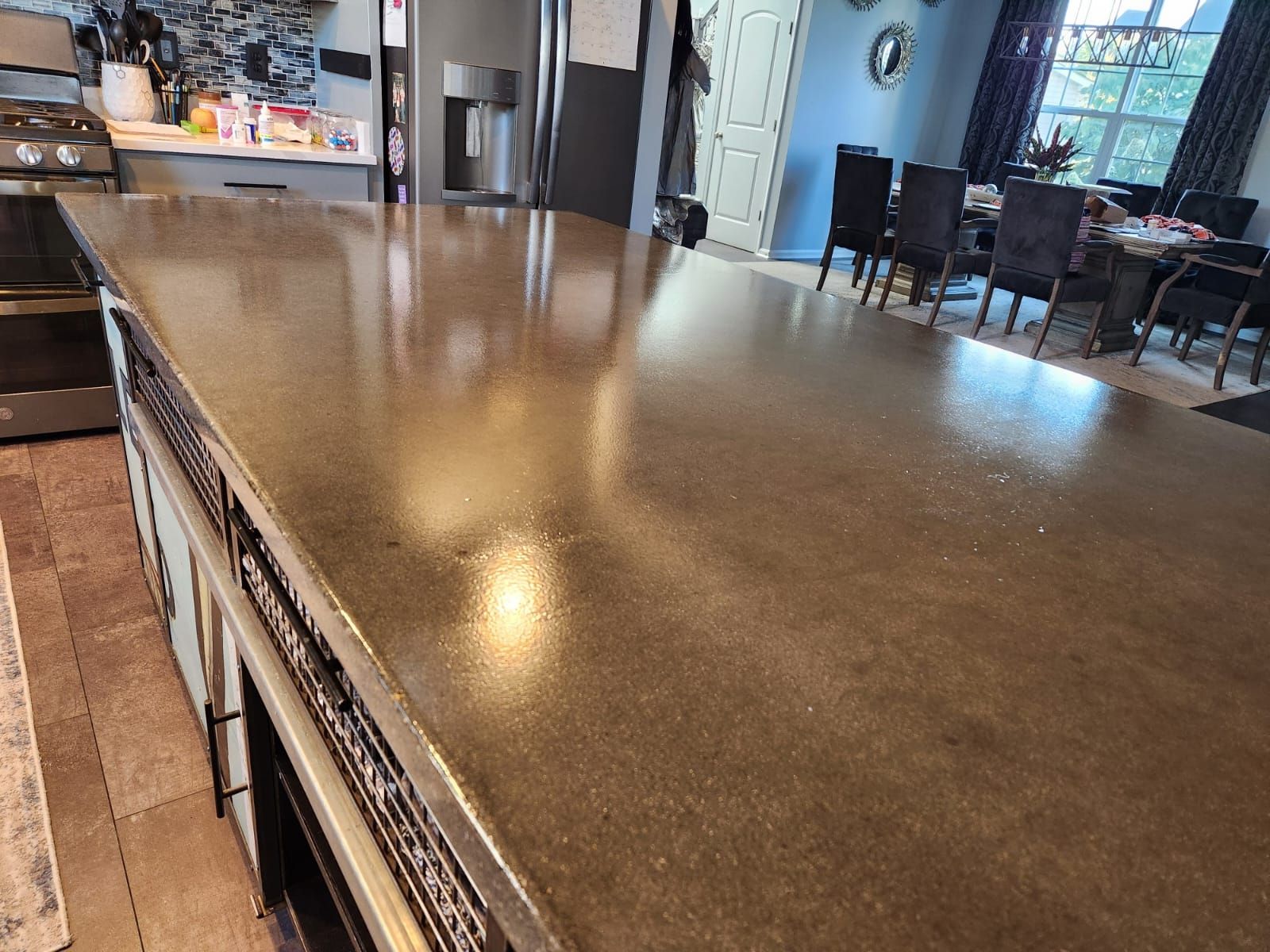
  • Countertops (stone or solid surface):<\/strong> Most countertop restorations \u2014 including honing, polishing, and sealing \u2014 are completed in a single day. Extensive chip repair or multiple material types in one kitchen may extend to a second day.<\/li>
  • Residential stone floors (under 500 sq ft):<\/strong> Typically 1 to 2 days, depending on the condition of the stone and the number of process steps required (grinding, honing, polishing, sealing).<\/li>
  • Residential stone floors (500-1,500 sq ft):<\/strong> Generally 2 to 3 days for a complete restoration. Heavily damaged or neglected stone may add a day.<\/li>
  • Commercial stone floors:<\/strong> Small lobbies and entry areas can often be completed in 1 to 3 days. Large commercial floors \u2014 hotel lobbies, government buildings, office atriums \u2014 are typically phased over 1 to 2 weeks to maintain access.<\/li>
  • Terrazzo floors:<\/strong> Terrazzo restoration is a multi-step process. Plan for 3 to 5 days on a typical residential floor and longer for commercial terrazzo.<\/li>
  • Concrete floor grinding and polishing:<\/strong> A 1,000 sq ft basement or garage floor typically takes 2 to 3 days from start to sealed finish.<\/li><\/ul>

    We will give you a specific timeline estimate during your consultation. We hold to those estimates unless we discover unexpected subsurface conditions.<\/p>

After the Project \u2014 Care Instructions and Maintenance

Choosing the Right Stone Restoration Contractor

Not all stone restoration companies are equal. The DC metro area has seen an increase in general handymen and flooring contractors offering stone polishing as an add-on service \u2014 often with inadequate equipment and limited experience. Here is what to look for when choosing a qualified restoration contractor:<\/p>

Specialized equipment.<\/strong> Professional stone restoration requires planetary grinders, diamond tooling in multiple grits, and HEPA-equipped dust collection. A contractor using a random-orbit polisher and a bag of powder compounds is not performing the same service as a trained stone restoration specialist with a full equipment inventory.<\/p>

Verifiable experience.<\/strong> Ask how long the company has been doing stone restoration specifically \u2014 not just flooring or general contracting. Ask for references from similar projects (same stone type, similar scope). Rose Restoration International has 47 years of documented work across the DC metro area and a long list of repeat commercial and residential clients who can speak to our consistency.<\/p>

Written estimates and clear scope.<\/strong> A reputable contractor will provide a written estimate that specifies the scope of work, the number of process steps, the sealer to be applied, and the payment terms. Verbal estimates with no documentation leave you with no recourse if the work does not meet expectations.<\/p>

Insurance and licensing.<\/strong> Verify that the contractor carries general liability insurance and, where required, a valid contractor’s license. Stone restoration involves equipment that can damage adjacent surfaces if not properly operated, and insurance protects you in the event of an accident.<\/p>

Post-project support.<\/strong> The relationship should not end when the crew leaves. A good restoration contractor will answer questions about aftercare, recommend maintenance schedules, and be available if you notice any issues in the days following the project. Call us at 703-327-7676<\/a> \u2014 we stand behind every project we complete.<\/p>

Frequently Asked Questions \u2014 Stone and Concrete Restoration Preparation

How long does a typical stone restoration project take?

Most residential countertop restorations are completed in one day. Residential floor restorations typically take 1 to 3 days depending on square footage and condition. Commercial projects may be phased over 1 to 2 weeks to maintain access to the space.<\/p>

Do I need to leave my home during the restoration?

For most residential projects, you do not need to vacate your home entirely. However, we recommend staying out of the immediate work area during active grinding and polishing. Clients with respiratory sensitivities or young children should plan to spend part of the day elsewhere.<\/p>

How much dust will there be?

Our crews use HEPA vacuum systems attached directly to the grinding equipment, which captures most dust at the source. Some fine particulate can migrate, particularly in open floor plans, so we recommend removing or covering sensitive electronics and soft furnishings near the work area.<\/p>

Do I need to move all my furniture before the crew arrives?

For floor restorations, yes \u2014 clearing the area as much as possible before our crew arrives speeds up the process and reduces the risk of damage to your belongings. Our crew can assist with heavy pieces that cannot be moved beforehand. For countertop work, simply clear the counter surfaces and nearby cabinets.<\/p>

What aftercare products should I use on restored stone?

Use only pH-neutral, stone-safe cleaning products. Avoid vinegar, bleach, citrus-based cleaners, and anything labeled as a ‘heavy-duty’ or ‘grease-cutting’ cleaner, as these are often acidic or alkaline enough to damage stone surfaces or strip sealers. We can recommend specific products during your project completion walkthrough.<\/p>

Updated for 2026

Related Rose Restoration Resources

Since this article was first published, Rose Restoration has expanded our published library with detailed case studies, an industry glossary, and topic-specific service pages. The most relevant resources for this article:

For project consultation: 703-327-7676 or info@roserestoration.com.

Liam
Written by

Liam

Administration and IT. Keeps systems, tooling, and internal operations running across the Rose team.

Rose Restoration International

Restore. Don't replace.

47 years of polishing marble, terrazzo, concrete, and tile across Washington DC, Northern Virginia, and Maryland. IMF, Four Seasons, Smithsonian, and the Virginia State Capitol trust us — you can too.

2 Responses

  1. To the roserestoration webmaster, You always provide key takeaways and summaries.

Schedule Online
BBBACCREDITEDBUSINESSA+
BBB Accredited A+ Rating
ABCVIRGINIAMEMBER
ABC Virginia Member
4.8GOOGLE
4.8 Star Rating 118+ Google Reviews
LICENSED& INSURED
Licensed & Insured VA, MD, DC
Leave a Review