
Quick Answer
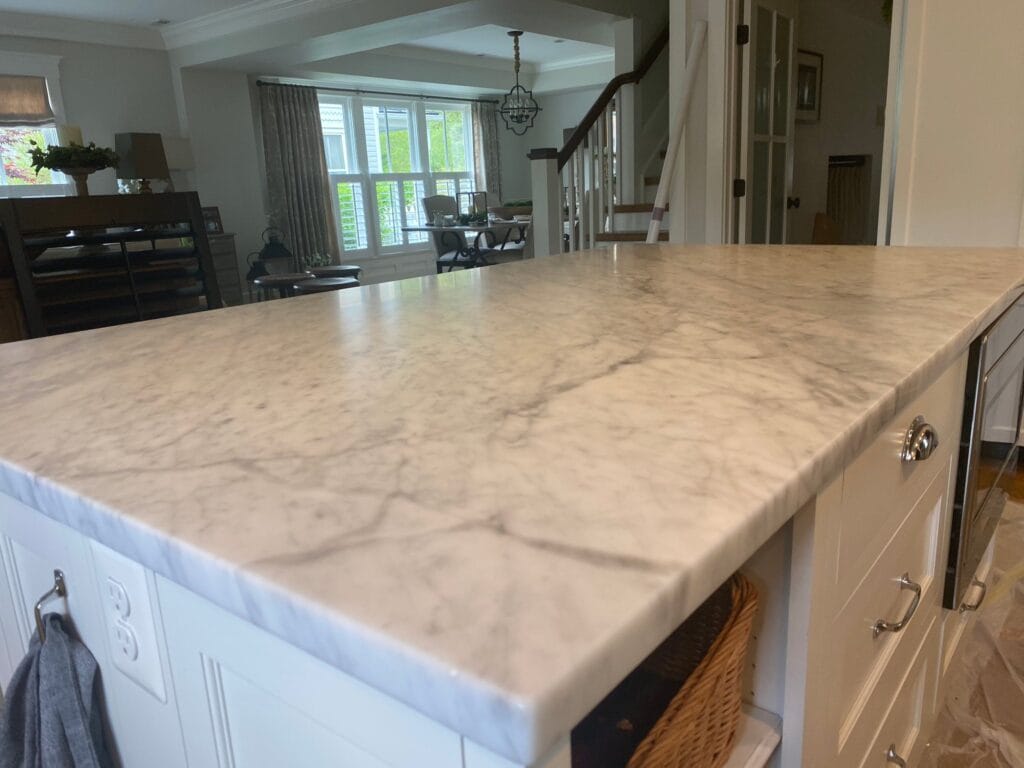
Marble or granite countertops — which is better?
Granite is more durable than marble — harder, less porous, and not vulnerable to acid etching. Marble offers more luxurious appearance but requires more careful care to prevent etching from acidic spills. For high-use kitchens, granite or quartzite is more practical; for visual impact in bathrooms and dining rooms, marble is often preferred. Marble Armor protection makes marble more practical for kitchens.
Marble and granite are both natural stone, but they behave very differently as kitchen and bathroom countertops. Marble is softer, more porous, and visually distinctive — it etches and stains more readily but offers a luxury aesthetic that engineered stone cannot replicate. Granite is harder, denser, and more forgiving — it resists everyday damage well but has a busier, more variable visual character. The right choice depends on how you cook, what you value visually, and how much maintenance you are willing to commit to.
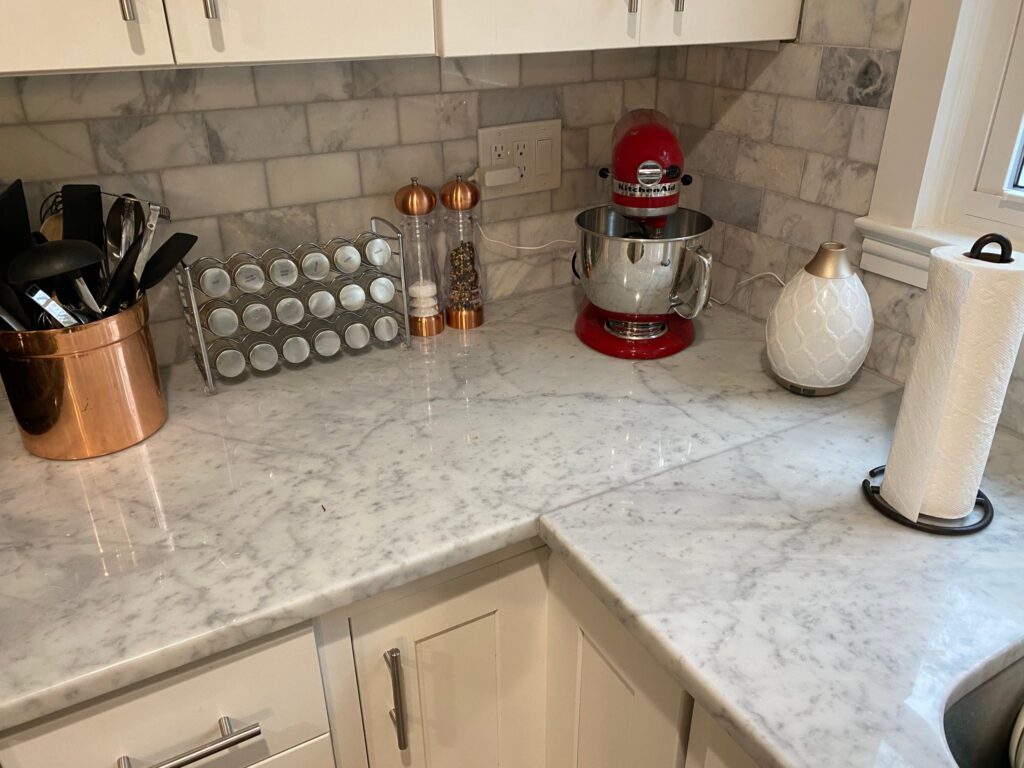
Rose Restoration restores both marble and granite countertops across DC, Maryland, and Virginia. We see thousands of homeowner kitchens — and the choice between marble and granite is the most common question we get asked. This guide walks through how each stone performs across the dimensions that actually matter: durability, appearance, cost, lifespan, and ongoing maintenance.
Quick comparison
| Factor | Marble | Granite |
|---|---|---|
| Hardness (Mohs scale) | 3 to 4 | 6 to 7 |
| Etches from acid? | Yes — within seconds | Rarely; only strong acids |
| Stains? | Yes if unsealed; less so if Marble Armor applied | Yes if unsealed; less prone than marble |
| Heat resistance | Good but vulnerable to thermal shock | Excellent |
| Scratch resistance | Lower — knives leave marks | Higher — forgives sliding cookware |
| Visual character | Veined, calmer, classic luxury aesthetic | Busier, speckled, more variable patterns |
| Color range | Whites, grays, soft tones, dramatic veining | Black, brown, green, blue, red, white, yellow |
| Cost (slab + install) | $60-$200/sf | $50-$150/sf |
| Sealing schedule | 1-2 years | 2-3 years (some varieties 5+) |
| Lifespan with care | Indefinite — restores beautifully | Indefinite — extremely durable |
| Best for | Bathrooms, low-traffic kitchens, baking countertops, fireplace surrounds | High-traffic kitchens, families with kids, outdoor BBQ counters |
Hardness and damage resistance
Granite measures 6 to 7 on the Mohs hardness scale. It is harder than steel knives, harder than most ceramic, and resists scratches from everyday kitchen use. Dropping a heavy pot can chip an edge, and very strong acids (battery acid, some aggressive cleaners) can etch dense granite — but for the kind of damage homeowners actually inflict on countertops daily, granite is far more forgiving.
Marble measures 3 to 4 on Mohs. It is softer than knives, softer than glass, and softer than the silica grit that gets tracked into kitchens on shoes. It scratches more readily, etches from any acid (lemon juice, wine, vinegar, tomato sauce, coffee), and shows wear patterns over time. For homeowners who actively cook with citrus, mix vinaigrettes on the counter, leave coffee mugs to ring, or have small kids — marble requires more care.
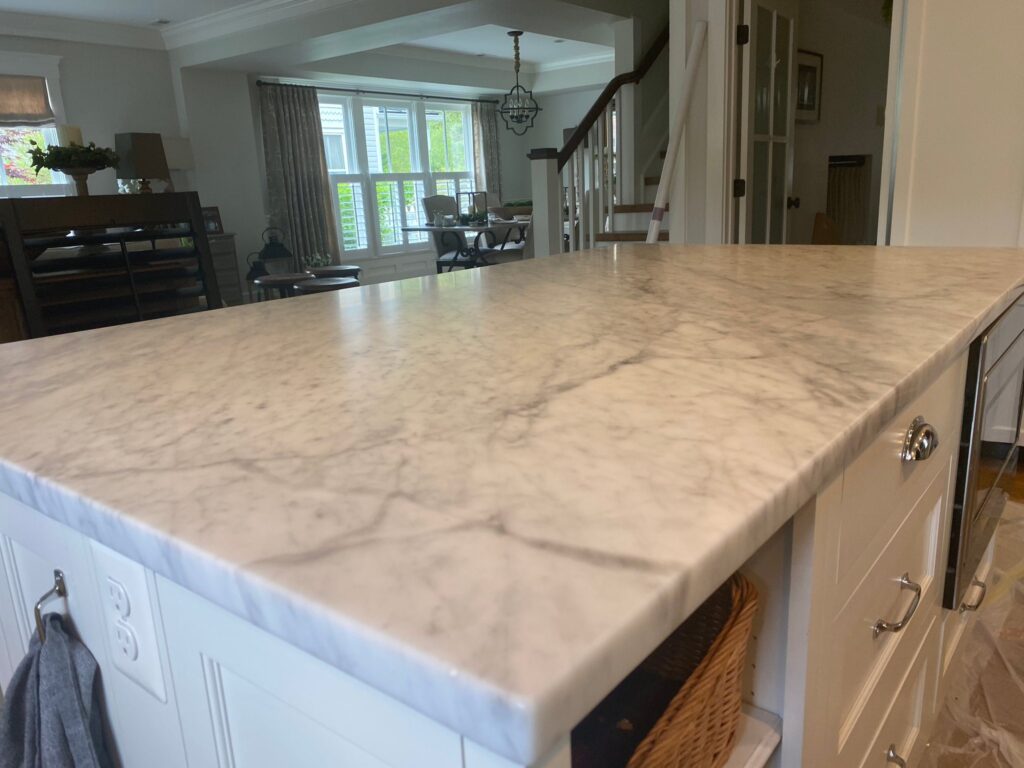
This does not mean marble is a bad choice. It means marble is a stone that ages with character. Many homeowners specifically want that — a marble counter that develops its own patina over decades, getting polished or honed every 5-10 years. Others want a counter that still looks new in 20 years; for them, granite is the answer.
Visual character
Marble has the calmer, classier visual identity. The aesthetic is built around veining — patterns of contrasting color running through a base field. Carrara is the most familiar (gray on white), Calacatta is more dramatic (gold and gray on white), Statuario is the high-end choice (subtle veining, very white field). Marble looks luxurious in a way granite usually does not.
Granite has more variation slab-to-slab and a busier visual character. The pattern is granular — you see individual mineral grains rather than veins. Granites span a much broader color range than marble: blacks, deep greens, blues, reds, browns, complex multi-color blends. Some granites have dramatic personality (Blue Bahia, Volga Blue, certain leathered finishes); others are deliberately calm.
For a kitchen that wants to feel restrained and timeless, marble usually wins. For a kitchen that wants more visual energy or coordinates with bold color, granite has more options.
Heat and thermal stress
Both stones tolerate hot pans better than engineered quartz, which is bonded with resins that can soften under high heat. That said, dropping a 500°F pan directly on cold marble can cause thermal stress cracks at edges or near unsupported overhangs. Granite tolerates the same shock with a smaller risk profile.
For homeowners who routinely move pans straight from oven to counter — granite is a better choice. For those who use trivets anyway, marble handles normal cooking heat fine.
Maintenance and ongoing care
Both stones need sealing periodically:
- Marble: re-seal every 1 to 2 years. Use only pH-neutral stone cleaners. Wipe acidic spills immediately. Consider Marble Armor for kitchen marble — it is the only product that actually prevents etching.
- Granite: re-seal every 2 to 3 years (some dense varieties go 5+). Use pH-neutral stone cleaners. Granite sealing details.
For damage repair:
- Marble: etches removed via diamond honing + polish; stains removed via poultice; scratches honed out; cracks vacuum-injected with epoxy.
- Granite: chips repaired with color-matched epoxy; stains via poultice; cracks via injection. See granite chip repair.
Cost over the lifetime of the countertop
Initial costs are roughly similar — marble runs slightly higher than granite for premium varieties, but the overlap is large. Where the lifetime cost diverges:
- Marble lifetime cost is higher in maintenance — more frequent sealing, occasional etch / stain restoration, possible Marble Armor application. A typical 25-year residential cost might be $5,000-$15,000 in maintenance for a luxury kitchen.
- Granite lifetime cost is lower — less frequent sealing, less restoration. A typical 25-year cost might be $1,500-$5,000.
Both stones can last indefinitely with proper care. Both restore beautifully. Neither typically needs replacement before 30+ years if maintained.
Which to choose, by use case
- Master bathroom vanity: Marble. Lower acid exposure, classic look, restores beautifully if it does etch.
- Luxury kitchen, no kids, careful homeowner: Marble (with or without Marble Armor depending on cooking style).
- Family kitchen with active cooking, kids, busy countertops: Granite.
- Baking countertop or pastry station: Marble. Stays cooler than granite, ideal for working dough.
- Outdoor BBQ counter: Granite. Marble does not handle UV and freeze-thaw well.
- Bar top or dining island that sees wine and acidic drinks: Granite or marble with Marble Armor.
- Fireplace surround: Marble. Heat resistance differs little; aesthetic strongly favors marble.
- Commercial restaurant counter: Granite or quartzite. Marble is rarely worth the maintenance burden in commercial use.
Where Rose Restoration restores marble and granite
We restore both materials across DC, Maryland, and Virginia, including Washington DC and DC granite, Arlington, Alexandria, Bethesda, McLean, Potomac, Chevy Chase, Vienna, Tysons, Reston, Loudoun County, Fairfax County, and Montgomery County. Whether your countertop is marble, granite, or a combination across rooms, the same crew handles both.
Frequently asked questions
Is granite or marble better for a kitchen countertop?
Granite is more forgiving of everyday use — fewer etches, fewer scratches, less maintenance. Marble offers a more luxurious aesthetic but requires more careful use and more frequent sealing. For most active family kitchens, granite is the lower-maintenance choice. For kitchens where aesthetics outweigh ease of care, marble is worth the trade-off.
Does marble etch from water?
Plain water does not etch marble. Mineral content in hard water can leave deposits that combine etching and staining over long exposure (around faucets and shower edges). Acidic foods and drinks etch marble within seconds.
Will granite stain?
Yes if unsealed and given time. Oils, red wine, and pigmented liquids can stain granite if left on the surface for extended periods. Sealing reduces but does not eliminate this risk.
Can marble be made as durable as granite with sealer or protection?
Sealer reduces staining but does not prevent etching. Marble Armor — a topical composite film — does prevent etching and gives marble effective behavior similar to a non-porous surface. With Marble Armor, kitchen marble performs like granite for most everyday use.
How long does each stone last?
Both can last indefinitely with proper care. The difference is maintenance frequency, not ultimate lifespan. Properly maintained marble and granite countertops routinely last 50+ years.
Which stone is more expensive to install?
Premium marbles (Calacatta, Statuario, Crema Marfil) tend to be more expensive than common granites. Premium granites (Blue Bahia, exotic Brazilians) can be more expensive than mid-range marbles. The categories overlap significantly.
Can I mix marble and granite in the same kitchen?
Yes — many homeowners use marble on the island for visual impact and granite on the perimeter for durability. Or marble on the baking station, granite around the cooktop. This is a common and successful approach.
Does marble or granite hold up better in a bathroom?
Both work well in bathrooms. Marble is the more traditional bathroom choice and acid exposure is lower than in a kitchen. Granite is also fine. The decision is usually aesthetic.
If I already have marble and regret it, can it be made more durable?
Yes. Restore the surface, then apply Marble Armor across the high-use zones. The result behaves similarly to a non-porous surface for everyday cooking and entertaining. Marble Armor details.
Schedule a free assessment
For marble or granite restoration, sealing, or evaluation in DC, Maryland, or Virginia: call 703-327-7676 or request a quote online. Senior technicians respond within 2 business hours.