
Quick Answer
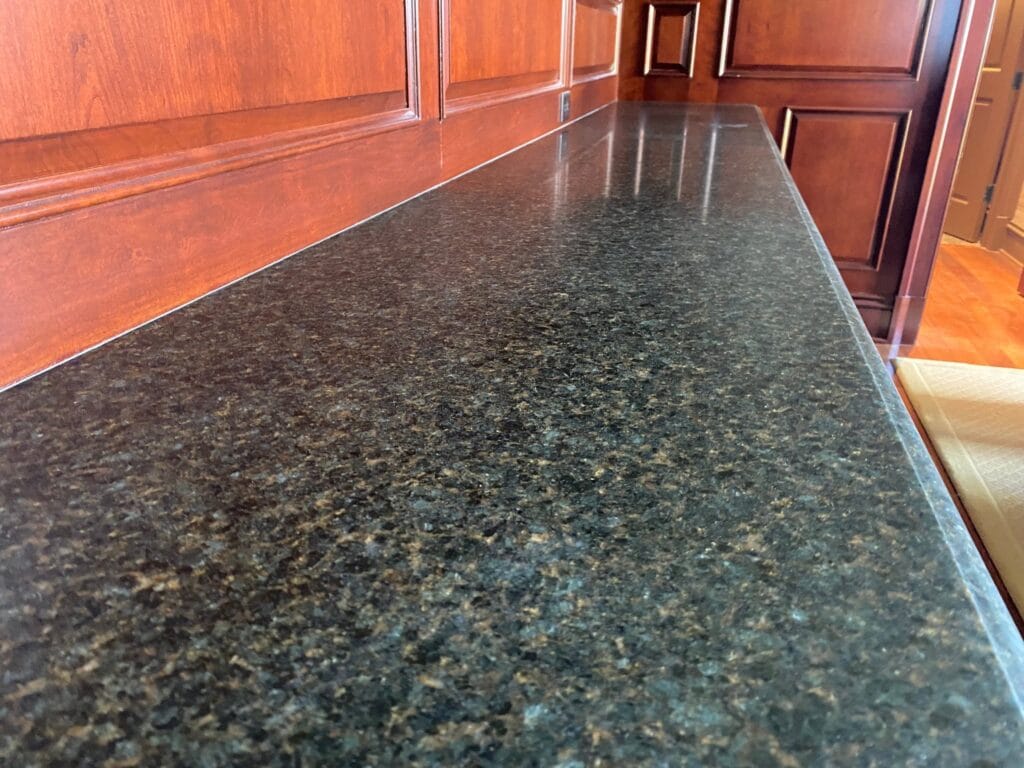
How often should granite countertops be sealed?
For typical residential use, granite countertops should be re-sealed every 3-5 years with a premium impregnating sealer. Heavy-use prep zones (around the sink and cooktop) may need annual touch-ups. Water beading on the surface indicates intact sealer; water absorbing into the stone (darkening it) means it is time to re-seal.
Granite countertop sealing is the application of an impregnating sealer that penetrates the porous structure of granite and reduces the rate at which liquids — oils, wines, food acids, water — soak into the stone. Sealing does not make granite waterproof or stain-proof. It buys time: a sealed counter gives you minutes to wipe up a spill before staining; an unsealed counter may stain within seconds. Most granite countertops need to be re-sealed every 1 to 5 years depending on use, the granite variety, and the quality of the original sealer.
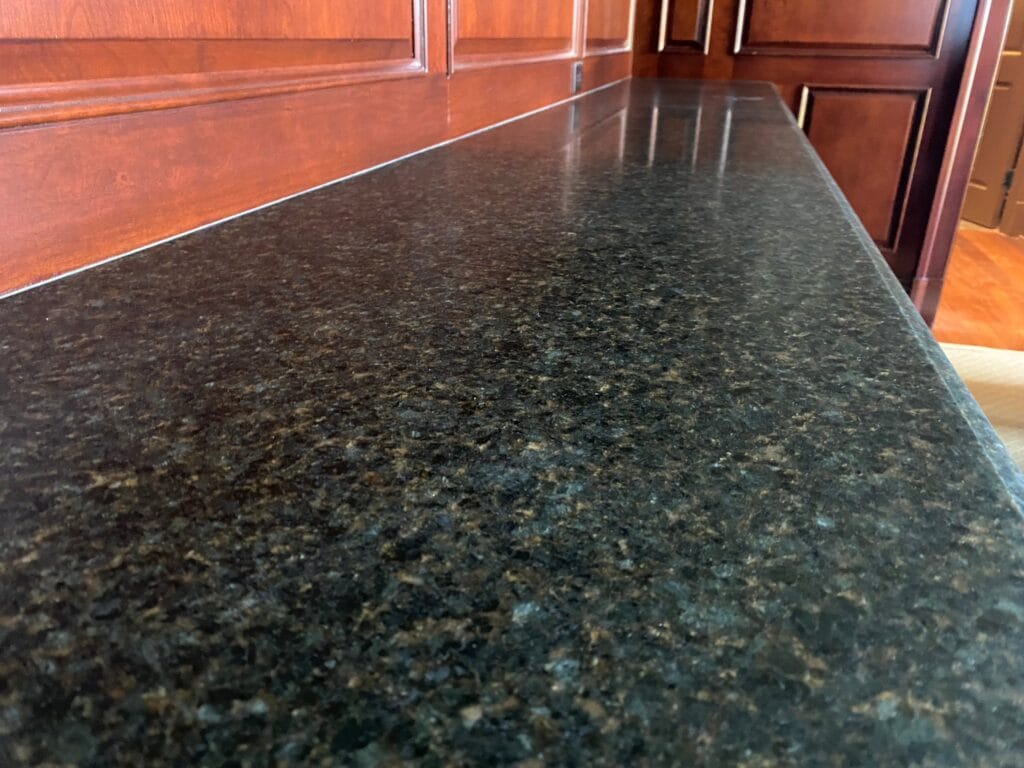
Rose Restoration provides professional granite sealing across DC, Maryland, and Virginia — for homeowners who want it done right, for newly installed granite that came without sealer, and for property managers handling commercial or hospitality installations. This guide covers when granite needs to be sealed, how the process works, and what professional sealing costs in 2026.
Why granite needs to be sealed
Granite is a natural igneous rock made of quartz, feldspar, mica, and other minerals. The minerals form a crystalline structure with microscopic pores between grains. Different granite varieties have very different porosity — some dense black granites are nearly impervious, while many white and lighter granites are surprisingly absorbent. When liquid contacts the surface:
- It moves into the pores by capillary action
- Pigmented or oily liquids leave behind their pigment / oil after the carrier evaporates
- The result is a stain — discoloration that lives below the surface
An impregnating sealer fills the pores with a hydrophobic and oleophobic agent. Liquid still contacts the surface but cannot soak in for some period of time — usually 5 to 30 minutes depending on sealer quality. That is the window to wipe spills before they stain.
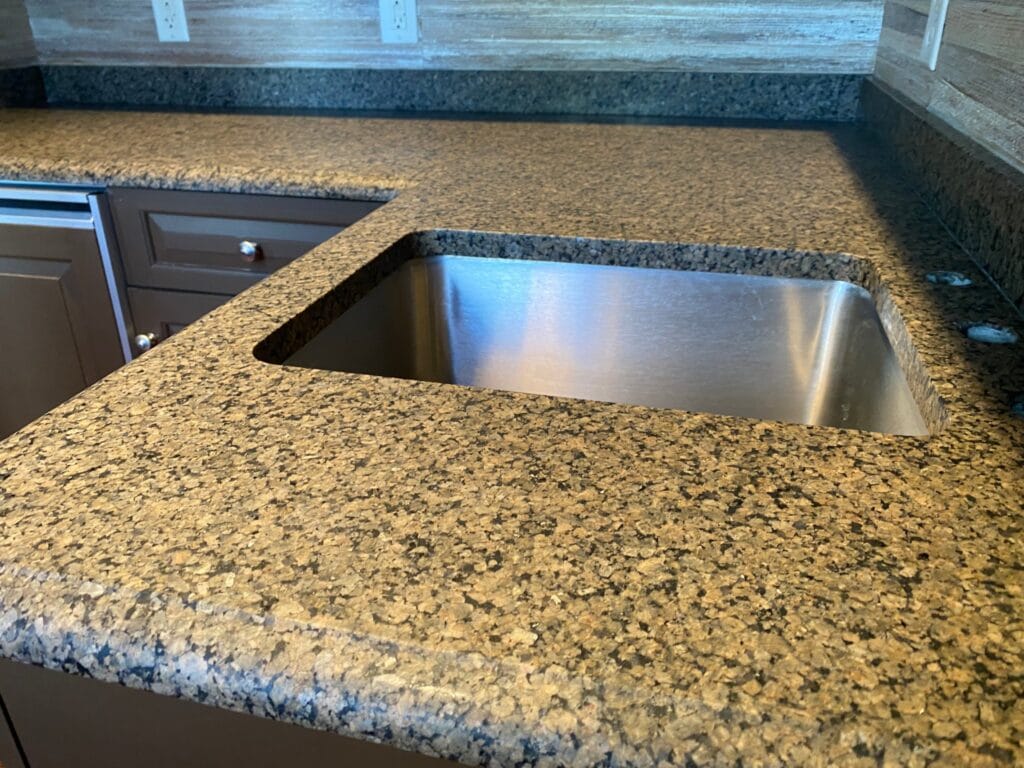
How to test whether your granite needs sealing
Three simple tests, no equipment required:
- Water bead test. Drop a small puddle of water on the granite. Wait 10 minutes.
- If the water still beads at the surface, the sealer is intact.
- If the water has flattened or absorbed, the sealer has worn off and re-sealing is needed.
Repeat in several locations — sealer wears off faster around faucets, in front of cooktops, and in high-use prep areas.
A second test: drop a few drops of cooking oil. Oils are smaller molecules than water and penetrate first. If the oil sinks in within 5 minutes, the granite is significantly under-sealed.
How often granite countertops need to be re-sealed
Sealing frequency depends on stone variety and use:
- Dense, dark granites (Absolute Black, Cambrian Black, dense Brazilians): may go 5+ years between sealings; some never visibly need it.
- Mid-density granites (most common kitchen choices — Uba Tuba, Verde Butterfly, Santa Cecilia): 2-3 years.
- Lighter, more porous granites (Kashmir White, White Ice, lighter Brazilian whites): 1-2 years; sometimes more often in heavy-use kitchens.
- Outdoor granite (BBQ counters, pool surrounds): 1-2 years; harder to keep sealed due to UV degradation.
- Commercial high-use granite (restaurant, hotel bar): 6-18 months.
Why most homeowner sealing attempts disappoint
Hardware-store sealers and the technique guides on the bottle look simple, but the typical homeowner job goes wrong on a handful of details that matter:
- The pre-clean is incomplete. Most kitchens have invisible buildup — soap film, cooking oil residue, prior sealer that didn’t fully cure, or trace polish from the original installer. Sealer applied over residue forms a thin, weak film that fails within months.
- Existing stains get sealed in. A faint oil ring around the cooktop, a coffee stain that’s lightened but not gone, a watermark near the faucet — these get locked under the new sealer and become permanent.
- The wrong sealer chemistry is used. Solvent-based, water-based, hybrid, fluoropolymer, oleophobic-rated — different granites respond very differently. The “good for all stone” supermarket bottles work poorly on dense granites and burn through too fast on porous ones.
- Excess sealer is left on the surface. Impregnating sealer that dries on top of the stone forms a hazy film that’s hard to remove without abrasive work. This is the most common DIY failure we get called to fix.
- Coverage is uneven. The high-use zones — sink edge, cooktop perimeter, leading edge of the island — need heavier application. A single uniform pass leaves the very areas that fail first under-protected.
- Cure time gets cut short. The label says 24 hours; the family needs the kitchen back. Premature water exposure compromises the bond.
The visible result of a bad sealing job often takes 6-18 months to appear: stains that didn’t happen before, a slightly hazy finish near the prep zones, oil rings that won’t wipe off. By that point the only fix is to strip the failed sealer and start over.
What professional granite sealing includes
- Pre-clean. Commercial-grade pH-neutral cleaning that addresses built-up residue, soap film, prior sealer, and any stains or etches that need attention before sealing.
- Surface assessment. A technician evaluates the granite for stains, etches, or chip damage that should be addressed first. Sealing over an unrepaired stain locks the stain in place — we identify and resolve those issues as part of the visit.
- Sealer selection. Different granites take different sealer chemistries best — solvent-based for dense granites, water-based for porous, fluoropolymer hybrid for kitchen high-use. Our kit includes 4-6 sealer options matched to the specific stone.
- Application by zone. High-use areas (around the sink, near the cooktop, on the leading edge) get heavier application; lower-use areas standard.
- Cure management. Proper dwell time, complete excess wipe-off, additional coats where needed, and verified cure before water contact.
- Documented finish. Photos and a water-bead-test verification documenting the result, plus the date for next recommended re-seal.
Cost: what professional granite sealing costs in 2026
- Single residential kitchen counter (50-80 sf): $300–$650.
- Kitchen with island and perimeter (80-150 sf): $400–$900.
- Kitchen + bathroom + bar package: $700–$1,400.
- Whole-home granite sealing (multiple rooms): $900–$2,200.
- Commercial granite (restaurant, hotel bar — per sf): $4–$10/sf.
- Outdoor granite sealing (BBQ, pool surround): $400–$1,200.
Most projects include a written report with the water-bead test result, recommendations for ongoing care, and the date for next recommended re-seal.
What sealing does NOT do
Common misconceptions worth correcting:
- Sealer does not prevent etching. On marble, this matters a lot. On granite, etching is much less common but possible with strong acids — sealer does not prevent that damage.
- Sealer does not make granite stain-proof. It slows absorption. A wine spill left for an hour will still stain; the sealer just gives you a window to wipe it.
- Sealer does not fix existing stains. Sealing over a stain seals the stain in. Stain removal must come first.
- Sealer does not last forever. Plan on re-sealing per the schedule above; “lifetime” sealer claims are usually overstated.
- Sealer does not change the appearance of granite when properly applied. If sealer dries on the surface improperly, it can leave streaks or hazing — but a clean professional application is invisible.
Where Rose Restoration seals granite countertops
We perform granite sealing across DC, Maryland, and Virginia, including Washington DC granite restoration, Arlington, Alexandria, Bethesda, McLean, Potomac, Chevy Chase, Vienna, Tysons, Reston, Loudoun County, Fairfax County, and Montgomery County. Most residential granite sealing projects complete in a single 2-3 hour visit. Send photos and we can review them and send a proposal the same day.
Frequently asked questions
How often should I re-seal my granite countertops?
For most residential kitchens, every 2-3 years. Use the water-bead test to know whether your specific granite still has intact sealer. Some dense granites can go 5+ years; some lighter porous varieties need annual sealing.
Will sealing change the look of my granite?
A properly applied modern impregnating sealer is invisible — it does not darken, gloss, or alter the appearance of the stone in any way. If sealer is left on the surface and dries, it can create haze; that is a sign of improper application, not the sealer itself.
Does sealing prevent staining completely?
No. Sealer slows absorption — typically gives 15-30 minutes before a spill stains. Wipe spills promptly even on freshly-sealed granite. For stain-prone surfaces with lots of acidic exposure, consider Marble Armor (also works on quartzite and limestone, plus marble).
What if my granite already has stains?
Stain removal comes first — sealing over an existing stain seals the stain in. Rose includes stain assessment with every sealing visit and will recommend remediation if needed.
Does outdoor granite need different sealer?
Yes. Outdoor sealers are formulated for UV stability and freeze-thaw resistance. Indoor sealers will degrade under sun exposure within months.
Can I use the same sealer on quartz countertops?
Quartz (engineered stone) does not need sealing because it is non-porous by manufacture. Sealing it is unnecessary and may leave residue. Rose does not seal quartz.
Is sealing required after restoration work like chip or stain repair?
Yes — sealing is included as part of any chip, stain, or scratch repair we perform. The repair area and surrounding zone are sealed at no extra cost.
What about the DIY sealer kits at the hardware store?
Hardware-store kits are designed for general use and rarely match the specific chemistry your granite actually responds to. The most common outcomes we see when called to repair a DIY job: hazy film from over-application, missed prep work that caused early failure, or sealing over existing stains that are now permanent. The savings on the kit get spent and then some on the remediation.
Schedule a free assessment
For granite countertop sealing in DC, Maryland, or Virginia: call 703-327-7676 or request a quote online. Senior technicians respond within 2 business hours. Most residential granite sealing projects are quoted between $300 and $900.