
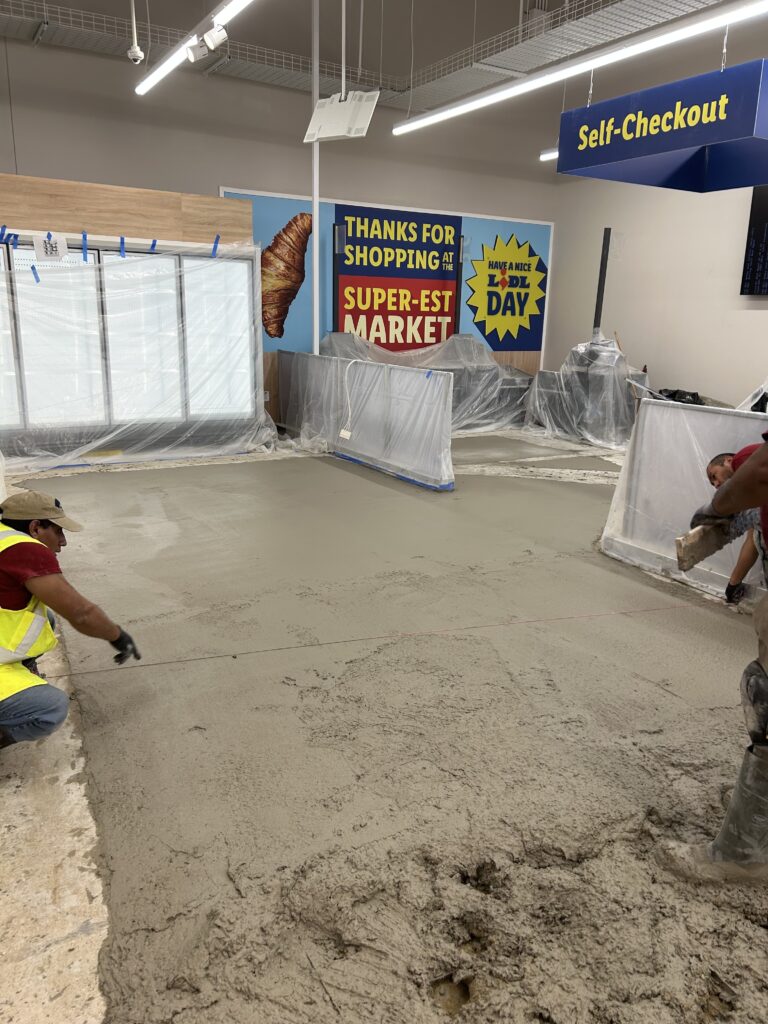
Concrete is the most widely used building material on earth — and for good reason. It is durable, versatile, and capable of lasting for decades. But even the most well-poured slab eventually shows its age. Cracks appear after ground movement or temperature cycling. Surfaces begin to dust and chalk under foot traffic. Stains from oil, rust, and chemicals accumulate. Coatings peel. What was once a clean, functional floor or patio becomes an eyesore or, worse, a safety hazard.
For most property owners, the instinct is to assume that replacement is the only option. In reality, professional concrete restoration — the process of repairing, resurfacing, and refinishing existing concrete — can return a slab to like-new condition at a fraction of replacement cost, with far less disruption, and often with a better-looking result than the original pour.
Rose Restoration has provided concrete floor restoration and surface treatment services to homeowners and commercial property managers across Northern Virginia, Maryland, and Washington DC for 47 years. We work on everything from residential garage floors and basement slabs to large-scale commercial warehouses, government facilities, and occupied office buildings.
This guide explains what concrete restoration actually involves, how the process works, what options are available for different property types, and what clients should realistically expect from start to finish — including timelines, surface preparation, and the difference between systems like polished concrete, epoxy, and grind-and-seal.
Whether you are a homeowner dealing with a deteriorating garage slab or a facilities manager evaluating a multi-phase commercial project, this is your comprehensive reference for making an informed decision about concrete repair and resurfacing.
What Is Concrete Restoration?
Concrete restoration is the broad term for a range of professional services that repair, strengthen, and refinish existing concrete surfaces without removing and replacing the slab. The goal is to address both structural deficiencies and cosmetic deterioration, returning the concrete to a functional, safe, and visually appealing state.
The specific work involved varies by project, but a full-service concrete contractor like Rose Restoration typically draws on some or all of the following techniques:
- Crack repair: Filling and stabilizing cracks using epoxy injection, polyurethane foam, or rigid polyurea fillers depending on crack width, depth, and whether movement is ongoing.
- Surface grinding: Using industrial diamond grinders to remove damaged surface layers, level high spots, open the concrete pores for better coating adhesion, or prepare for polishing.
- Concrete polishing: A multi-step diamond grinding and honing process that produces a glossy, durable, low-maintenance surface. Polished concrete is increasingly popular in both residential and commercial environments.
- Staining and densification: Chemical densifiers harden and dustproof the surface from within; reactive or non-reactive stains add color and character to otherwise plain gray concrete.
- Coating application: Epoxy, polyurethane, and polyaspartic coatings provide protective, decorative finishes. Each has different properties relating to chemical resistance, UV stability, and build thickness.
- Joint filling and repair: Control and expansion joints are cleaned and re-filled to prevent moisture infiltration, trip hazards, and further cracking.
- Overlay and microtopping installation: Cementitious or polymer-modified overlays can be applied over damaged or uneven concrete to provide a fresh, uniform surface without removing the original slab.
It is important to understand that concrete restoration is not purely cosmetic. Structural repairs — particularly crack stabilization, joint work, and surface hardening — directly affect the long-term performance of the slab. Skipping structural work and going straight to a decorative coating is a common mistake that leads to premature coating failure and recurring problems. A qualified concrete restoration contractor always addresses the substrate before applying any finish system.
Common Signs Your Concrete Needs Restoration
Knowing when your concrete needs professional attention is the first step toward preventing minor issues from becoming major structural problems. Here are the most common warning signs that indicate it is time to call a concrete restoration specialist:
- Surface dusting and chalking: Fine gray powder accumulates on the surface and on anything resting on it. This indicates surface carbonation or a weak surface layer that is progressively deteriorating. Left untreated, it will continue to worsen under traffic.
- Hairline to structural cracks: Hairline cracks may be cosmetic, but wider cracks — especially those that are uneven in height (indicating vertical movement) — can allow water intrusion, freeze-thaw damage, and progressive slab failure. All cracks should be evaluated by a professional.
- Spalling and flaking: Chunks or layers of concrete popping off the surface. Often caused by freeze-thaw cycles, rebar corrosion, or improper curing during the original pour. Spalling exposes the aggregate and accelerates further deterioration.
- Staining from oil, rust, or chemicals: Petroleum stains from vehicles, rust from steel equipment, and chemical spills penetrate porous concrete and are difficult to remove without professional-grade degreasers and surface preparation equipment.
- Uneven or rough surface: High spots, rough texture, and aggregate exposure create trip hazards and make the floor difficult to clean. Surface grinding can address all three issues.
- Worn or peeling coatings: Epoxy and other coatings that are bubbling, peeling, or delaminating indicate adhesion failure, often caused by moisture vapor transmission or inadequate surface preparation during the original installation.
- Efflorescence: The white, powdery mineral deposits that form on concrete surfaces are caused by water carrying soluble salts to the surface. They indicate a moisture issue that should be addressed before any coating or sealing work.
- Trip hazards at joints: Settled or heaved concrete at control joints is a liability issue, particularly in commercial settings. Joint grinding and stabilization can eliminate the hazard without full slab replacement.
If you are seeing one or more of these issues, a free on-site assessment from Rose Restoration can help you understand what is happening beneath the surface and what restoration approach makes the most sense for your property.
Residential Concrete Restoration
For homeowners, concrete restoration most commonly involves garage floors, basement slabs, interior living areas, and outdoor surfaces like patios and pool decks. Each application has its own set of challenges and finish options — and each comes with questions about disruption to daily life during the work.
Garage floors are the most common residential concrete project. Years of vehicle traffic, oil drips, salt and moisture tracked in from outside, and seasonal temperature extremes leave most garage slabs stained, dusted, and sometimes cracked. The most popular finishes are epoxy flake systems, which provide a bright, slip-resistant, easy-to-clean surface, and polished concrete, which delivers a sleek, low-maintenance finish. Both require proper surface preparation — diamond grinding at minimum — to achieve lasting adhesion.
Basement slabs present unique considerations: moisture vapor emission from below-grade concrete can cause coatings to delaminate if not properly addressed. Rose Restoration performs moisture testing before specifying any coating system for basement environments. Options range from penetrating sealers to full epoxy builds depending on moisture levels and the homeowner’s goals.
Interior concrete floors in open-plan homes and renovated spaces are increasingly popular as a design choice. Polished concrete and stained concrete can transform a plain gray slab into a sophisticated architectural feature. Learn more about boosting home value with residential concrete restoration, including garage floors, interior surfaces, and concrete countertops.
Patios and pool decks require systems that can handle outdoor UV exposure, moisture, and freeze-thaw cycling. Concrete overlays with slip-resistant textures and UV-stable sealers are common choices for these surfaces.
Homeowners often ask about living in the house during work. In most cases, the answer is yes — with some planning. Garage projects typically do not require vacating the home. Basement and interior projects may require moving furniture and appliances and staying off the floor for 24–72 hours during curing. Our team coordinates directly with homeowners to minimize disruption and to protect adjacent surfaces from dust and debris. We use dust containment equipment on all grinding operations.
Commercial and Institutional Concrete Restoration
Commercial and institutional concrete restoration involves a different set of priorities than residential work. Office buildings, retail centers, schools, government facilities, warehouses, and manufacturing plants all present unique scheduling, safety, and logistical challenges that require a contractor with deep experience in occupied and semi-occupied commercial environments.
Rose Restoration has provided commercial concrete polishing and floor restoration services to a wide range of clients across the DC metro area, including federal government buildings, hospital facilities, retail chains, and industrial manufacturers. Key considerations for commercial projects include:
- Off-hours and overnight work: Many commercial clients cannot afford to close their facility or displace employees during business hours. Rose Restoration routinely performs concrete restoration work overnight, on weekends, and in phased shifts to accommodate operational schedules. Read more about why overnight work is essential for high-traffic facilities.
- Phased scheduling: Large commercial floors are often divided into zones that are completed sequentially, allowing other areas to remain in use throughout the project. Our project managers develop detailed phasing plans in coordination with building managers before work begins.
- Dust containment in occupied buildings: Concrete grinding produces fine particulate dust that must be controlled, particularly in buildings with occupied adjacent spaces. We use HEPA-filtered vacuum systems directly attached to grinding equipment to capture dust at the source.
- Safety and compliance: Commercial projects on government, healthcare, and institutional properties require strict adherence to safety protocols, insurance requirements, and sometimes security clearance procedures. Rose Restoration is fully licensed, bonded, and insured, and our team is experienced working within the requirements of managed commercial environments.
- Coordination with building management: We work closely with property managers and facility directors to schedule deliveries, manage access, and ensure that our work does not conflict with other trades or tenant operations.
For commercial property managers evaluating concrete floor restoration, the total cost of ownership is often a decisive factor. Polished concrete, for example, eliminates the ongoing cost of floor wax and high-speed buffing, and its hard, dense surface is resistant to tire marks, chemical spills, and heavy forklift traffic. Over a 10–15 year period, a polished concrete floor often costs less to maintain than vinyl tile, carpet, or a painted floor coating.
The Concrete Restoration Process: What to Expect Step by Step
Understanding what actually happens during a concrete restoration project helps clients set realistic expectations for timeline, access requirements, and results. Here is a step-by-step walkthrough of how Rose Restoration approaches a typical project — from the first site visit to final walk-through.
Step 1: Assessment and Scope Definition
Every project begins with an on-site assessment. Our team inspects the slab for cracks, delamination, moisture issues, existing coatings, and surface hardness using specialized tools including a Moh’s hardness pick and moisture meter. We document conditions and discuss the client’s goals — functional durability, aesthetics, budget, timeline — before recommending a specific scope of work. This step is provided at no charge.
Step 2: Surface Preparation
This is the most critical phase of any concrete restoration project and the step most often shortchanged by inexperienced contractors. Learn more about concrete floor grinding and surface preparation and why it is the foundation of every durable floor system. Depending on existing conditions, surface preparation may include diamond grinding to remove old coatings or damaged surface layers, shot blasting to profile the surface for coating adhesion, scarifying for heavy coating removal, or adhesive and mastic removal. Proper surface prep ensures that whatever finish system follows will bond correctly and perform as expected.
Step 3: Structural Repairs
Before any finish work begins, we address all structural deficiencies: cracks are filled or injected based on their classification (dormant vs. active), control joints are cleaned and re-filled with appropriate joint filler, spalled areas are patched with polymer-modified mortars, and any high or low spots are addressed. Skipping this step leads to telegraphing defects in the finish and eventual coating failure.
Step 4: Surface Treatment
This phase varies significantly depending on the chosen system. For polished concrete, it involves a progressive sequence of diamond tooling — typically 6 to 10 passes moving from coarse to fine grits — along with densifier application. For stained concrete, it includes the application of reactive or non-reactive stains followed by sealing. For coating systems, it includes primer application and build coats.
Step 5: Coating or Sealing (If Applicable)
Epoxy, polyurethane, and polyaspartic coatings are applied in multiple layers with specified recoat windows to ensure inter-coat adhesion. Broadcasted aggregate (in flake or quartz systems) is applied between coats for texture and slip resistance. Curing times vary by product and temperature: most systems require 24 hours before light foot traffic and 72 hours before vehicle traffic.
Step 6: Final Inspection and Protection
On project completion, our team performs a final walk-through with the client to review the finished surface and address any questions about maintenance. We provide written care instructions for every system we install. For commercial clients, we also provide a post-project report documenting what was done, products used, and any warranty terms.
Concrete Restoration Options at a Glance
Not every concrete surface requires the same treatment. The right restoration system depends on the environment, the condition of the existing slab, the aesthetic goals, and the long-term maintenance expectations. Here is a brief overview of the primary finish systems Rose Restoration installs:
- Polished concrete: A multi-step diamond grinding and honing process that produces a glass-like surface ranging from satin to high-gloss. No coatings — the shine comes from the densified and refined concrete itself. Extremely durable, low-maintenance, and suitable for both residential and commercial interiors. Compare options in our guide: polished concrete vs. grind and seal — what’s the difference?
- Grind and seal: The concrete is ground flat and smooth, then sealed with a penetrating or topical sealer. More economical than full polishing, and appropriate where a clean, utilitarian finish is the goal rather than high sheen. Also used for exterior slabs.
- Epoxy floor systems: Two-component epoxy coatings provide a hard, chemical-resistant surface ideal for garages, warehouses, commercial kitchens, and manufacturing environments. Available in solid color, quartz broadcast, and decorative flake systems. See our overview of epoxy floor systems and urethane cement flooring for commercial environments.
- Concrete staining and densification: Reactive acid stains and water-based non-reactive stains add permanent color to concrete without a surface coating. Combined with chemical densifiers, stained concrete becomes harder, denser, and easier to clean than raw concrete. Read more about concrete staining and densification for long-term performance.
- Microtoppings and overlays: Thin-set cementitious or polymer-modified overlays applied over existing concrete to create a fresh, uniform surface. Useful when the existing slab is too damaged, stained, or uneven for polishing or coating but replacement is not warranted. Microtoppings can be colored, textured, and sealed to achieve a wide range of looks.
During the assessment phase, Rose Restoration will walk you through which systems are appropriate for your specific substrate and application — and what the realistic pros, cons, and maintenance requirements of each option are for your environment.
How Long Does Concrete Restoration Take?
One of the most common questions we receive is: how long will this take? The honest answer is that timelines depend on the size of the area, the condition of the existing slab, the chosen restoration system, and curing requirements. Here are general guidelines:
- Residential garage floor (typical 2-car, 400–500 sq ft): 1–3 days. Day 1 is surface preparation and structural repairs; day 2 is coating application; day 3 may be a topcoat or final inspection. Most garages are back in service within 72 hours.
- Basement or interior residential slab: 2–5 days depending on size and chosen system. Polished concrete takes longer than a single-coat sealer due to the number of diamond tooling passes required.
- Commercial lobby or retail space: 1–2 weeks for a phased project, often performed overnight or on weekends to keep the space operational during business hours.
- Warehouse or large commercial floor: Timelines scale with square footage. A 20,000 sq ft warehouse floor might take 1–2 weeks; a 100,000 sq ft distribution center could require 4–6 weeks of phased work.
Key factors that affect timeline include slab hardness (harder concrete takes more grinding passes), the number and severity of cracks requiring repair, the number of coats in the specified system, and temperature and humidity during curing. Rose Restoration provides a detailed project schedule with every proposal so clients can plan accordingly.
Why DC Metro Area Clients Choose Rose Restoration for Concrete Work
Northern Virginia, Maryland, and Washington DC homeowners and property managers have a lot of choices when it comes to concrete contractors. Here is why clients consistently choose Rose Restoration for concrete restoration work:
- 47 years of specialty restoration experience: Rose Restoration has been serving the DC metro area since the 1980s. Our experience spans residential, commercial, governmental, and institutional projects of every scale.
- Full in-house capabilities: We do not subcontract our concrete work. Our trained crews own and operate the diamond grinding equipment, shot blast machines, polishing systems, and coating application tools. This means consistent quality control and no markup on subcontracted labor.
- Comprehensive system range: Whether you need a simple garage sealer, a high-sheen polished concrete floor for a commercial lobby, or a chemical-resistant urethane cement floor for a commercial kitchen, Rose Restoration has the system and the experience to deliver it correctly.
- Residential and commercial expertise: Many concrete contractors specialize in one or the other. Rose Restoration has deep experience in both, which means we understand both the homeowner’s desire for minimal disruption and the commercial client’s need for phased scheduling and off-hours work.
- Free on-site assessments: We provide no-cost, no-obligation site assessments throughout Northern Virginia, Maryland, and Washington DC. Our estimators take the time to explain what they are seeing and why they are recommending what they recommend.
To schedule a free concrete assessment or discuss a project, call Rose Restoration at (703) 327-7676 or visit our contact page. We serve clients throughout Fairfax, Arlington, Alexandria, McLean, Vienna, Reston, Bethesda, Silver Spring, and the greater DC metro area.
Related: Learn more about our concrete polishing services for residential and commercial clients in Washington DC, Maryland, and Northern Virginia.
Related: Learn more about our residential concrete restoration for residential and commercial clients in Washington DC, Maryland, and Northern Virginia.
Frequently Asked Questions
Below are answers to the questions we hear most often from clients considering concrete restoration for the first time.
How much does concrete restoration cost?
Concrete restoration pricing varies widely based on the size of the area, the condition of the existing slab, and the finish system chosen. As a general reference, residential garage floor systems (epoxy flake or polished concrete) typically range from $3 to $8 per square foot installed. Commercial polished concrete for a large warehouse floor may come in lower per square foot due to economies of scale, while a high-specification decorative system in a retail environment may run higher. The best way to get accurate pricing is an on-site assessment — Rose Restoration provides free estimates throughout Northern Virginia, Maryland, and Washington DC. Call (703) 327-7676 to schedule.
Can cracked concrete be repaired without replacing the slab?
In most cases, yes. Hairline cracks and moderate structural cracks can be stabilized and filled using epoxy injection, polyurea crack fillers, or rigid polyurethane depending on the crack type and whether movement is ongoing. Even significantly cracked slabs can often be restored rather than replaced — provided the underlying subbase is stable and there is no active heaving. Rose Restoration assesses every crack during the site evaluation to determine the appropriate repair method and whether the crack represents a structural risk that warrants additional investigation.
What is the difference between concrete restoration and concrete replacement?
Concrete replacement involves removing the existing slab entirely and pouring a new one — a process that is costly, time-consuming, and highly disruptive. Concrete restoration repairs and refinishes the existing slab, preserving the structural investment already in place. Restoration is appropriate when the slab itself is structurally sound but has surface deterioration, staining, cracks, or worn coatings. Replacement becomes necessary when the slab has failed structurally — significant heaving, widespread delamination, or subbase failure. In our experience, the majority of slabs that clients initially believe need replacement can actually be successfully restored at 30–60% of replacement cost.
Is polished concrete good for residential homes?
Yes — polished concrete has become increasingly popular in residential interiors, particularly in open-plan homes, basement living areas, and high-end renovations. It is durable, easy to clean, hypoallergenic (no carpet fibers to trap dust and allergens), and can be enhanced with stains and dyes for a sophisticated look. The main considerations for residential polished concrete are the hardness of the existing slab (some slabs grind more beautifully than others), moisture levels in below-grade applications, and comfort underfoot (concrete is harder than wood or carpet, though radiant heat systems integrate well with polished concrete floors). Rose Restoration can show you samples and discuss what polished concrete would look like in your specific space.
How long does a restored concrete floor last?
A properly restored and maintained concrete floor can last decades. Polished concrete and grind-and-seal systems, when maintained correctly, routinely perform for 10–20 years before any significant re-treatment is needed. Epoxy and polyurethane coating systems typically have a functional lifespan of 5–15 years depending on traffic levels, UV exposure, and maintenance practices. The key variables are the quality of the original surface preparation, the quality of the products used, and ongoing maintenance. Rose Restoration provides written care instructions with every project and offers re-maintenance services as needed.
Can you restore concrete in an occupied building?
Yes — this is something Rose Restoration does routinely for commercial clients across Northern Virginia, Maryland, and Washington DC. Occupied building work requires careful planning: dust containment systems on all grinding equipment, phased work schedules that keep sections of the floor accessible at all times, and off-hours or overnight shifts when air quality or noise levels are a concern. We have extensive experience coordinating with building managers and tenants to complete concrete restoration projects with minimal disruption to ongoing operations. Call (703) 327-7676 to discuss the specific requirements for your building.
Does Rose Restoration provide concrete restoration near me?
Rose Restoration serves clients throughout the DC metro area, including Fairfax County, Arlington, Alexandria, McLean, Vienna, Reston, Herndon, Sterling, Leesburg, Prince William County, Montgomery County MD, Prince George’s County MD, Bethesda, Rockville, Silver Spring, and Washington DC. If you are unsure whether your location falls within our service area, call us at (703) 327-7676 or submit a request through our contact page and we will get back to you promptly.
Schedule a Free Concrete Assessment
Whether you are a homeowner dealing with a deteriorating garage slab or a commercial property manager planning a multi-phase floor restoration across an active facility, Rose Restoration has the experience, equipment, and systems to deliver exceptional results. We serve clients throughout Northern Virginia, Maryland, and Washington DC and provide free on-site assessments with no obligation.
Do not let cracked, stained, or worn concrete degrade the look and safety of your property. Concrete restoration is almost always faster, less expensive, and less disruptive than replacement — and the results can exceed what the original pour ever looked like.
Call Rose Restoration at (703) 327-7676 or click below to request your free concrete assessment. Our team will come to your site, evaluate your slab, and walk you through your options in plain language — no pressure, no jargon.
Get a Free Assessment from Rose Restoration
Tell us about your marble, stone, terrazzo, or concrete and our senior technicians will recommend the right restoration approach. Family-run and trusted across Washington DC, Maryland, and Virginia since 1978.
Call (703) 327-7676 · Email info@roserestoration.com · or send us photos.

Restore. Don't replace.
47 years of polishing marble, terrazzo, concrete, and tile across Washington DC, Northern Virginia, and Maryland. IMF, Four Seasons, Smithsonian, and the Virginia State Capitol trust us — you can too.