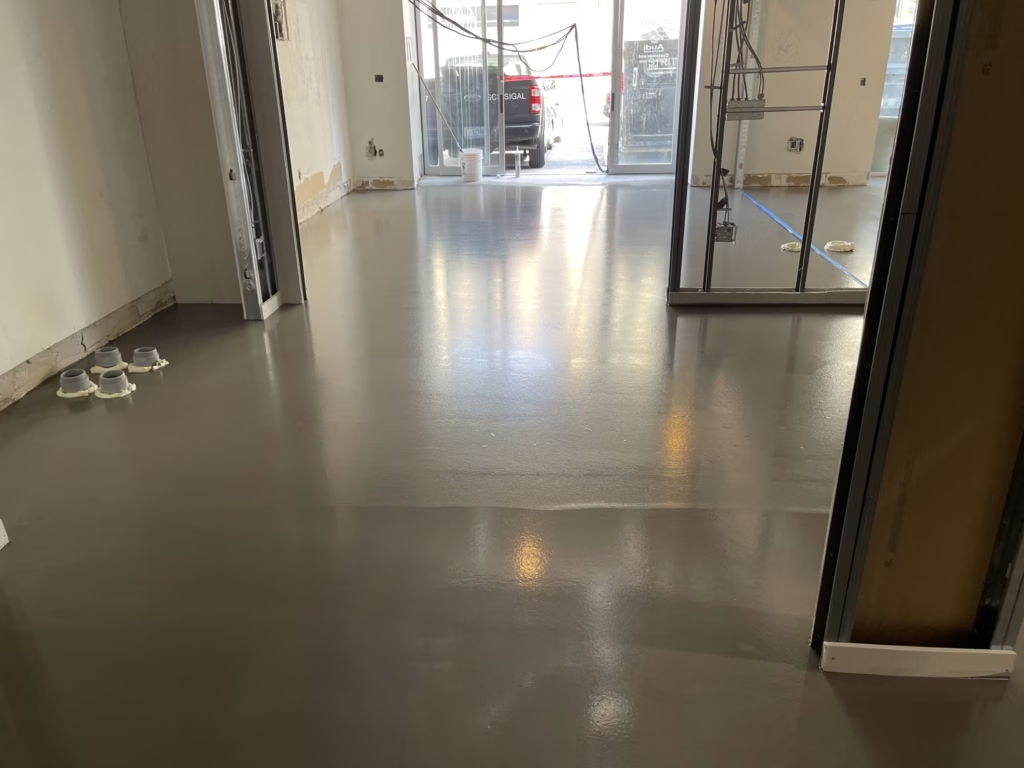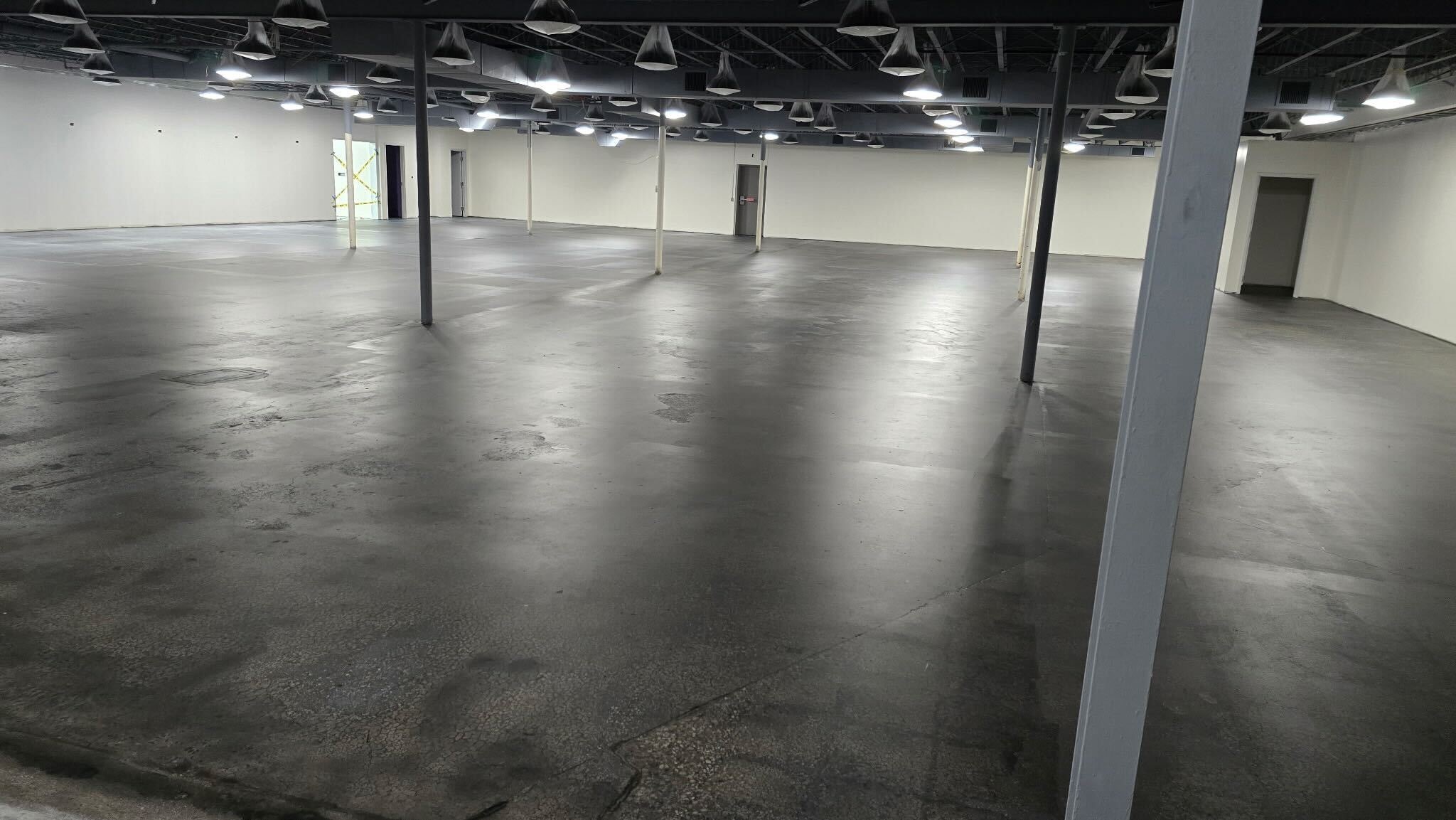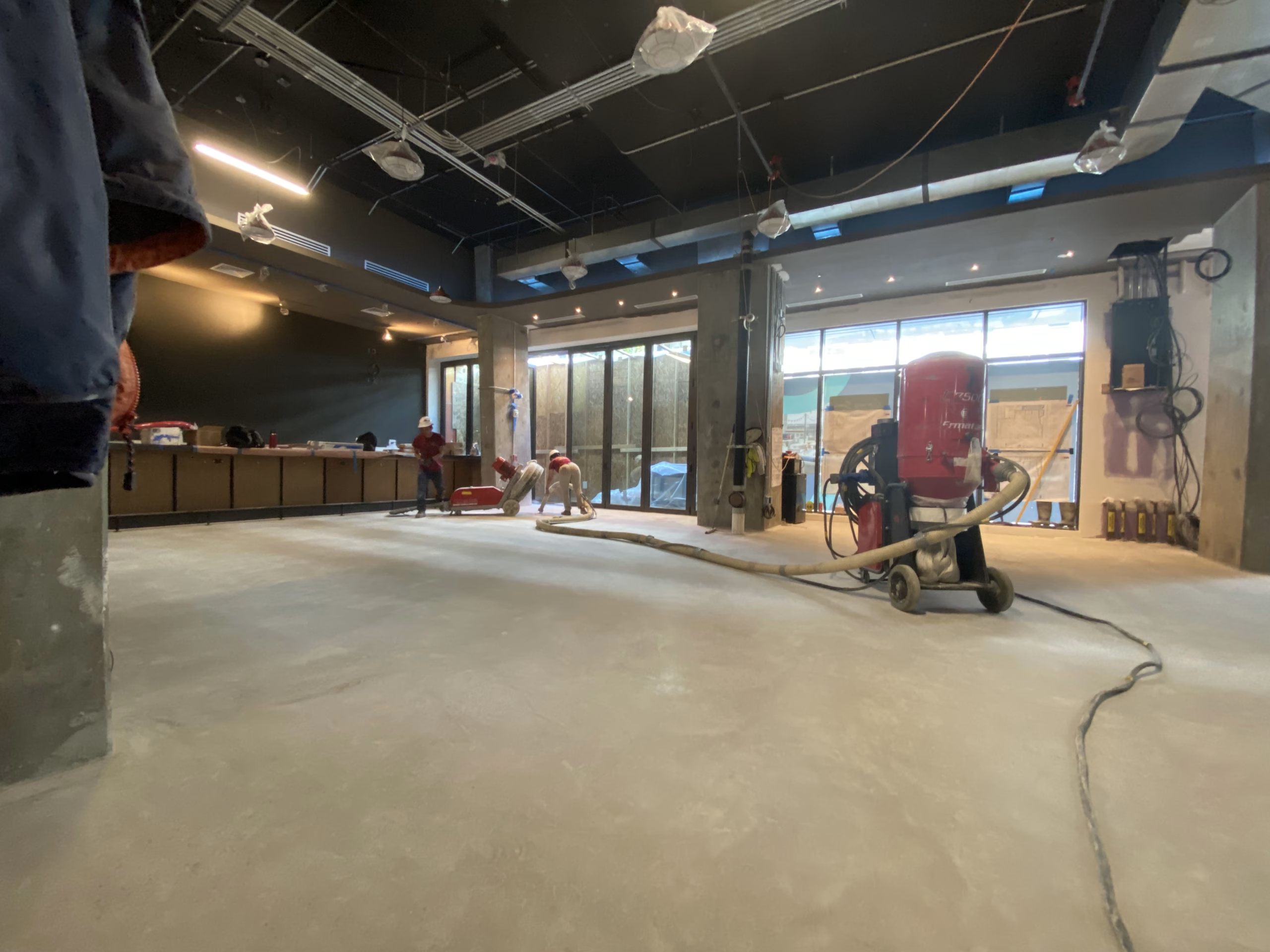
Rose Restoration installs polishable concrete overlays and underlayments in Washington DC — self-leveling topping systems, decorative overlays, and thin-film polishable finishes over damaged or aesthetically-unacceptable existing slabs. Overlays provide a fresh, polishable surface without full concrete tear-out and replacement, typically running $8–$20 per sq ft depending on system.

Free in-person assessment — same-week scheduling across DC, MD & VA
Call (703) 327-7676 Request a Quote
40+
Years in DC/MD/VA
30+
Technicians on staff
4.8★
117+ Google reviews
DC · MD · VA
Service area

Related Rose Restoration concrete services

Rose Restoration has delivered polishable concrete overlays and underlayments and related services for:

Polishable Concrete Overlays in Washington DC — Quick Answers

Who installs polishable concrete overlays in Washington DC?

Rose Restoration installs polishable concrete overlays and underlayments across Washington DC, Maryland, and Northern Virginia — self-leveling topping systems, decorative overlays, and thin-film polishable finishes. Overlays are used when the existing concrete slab is structurally sound but aesthetically unacceptable (pitting, staining, non-polishable aggregate). 40+ years of concrete experience. Request a quote.

What is the difference between a polishable overlay and microtopping?

A polishable overlay is typically 3/8" to 3/4" thick, self-leveling, and designed to be diamond-polished as a finished floor. A microtopping is a thinner (1/16" to 1/8") decorative skim coat applied for appearance, often over existing concrete or overlay. Both are installed over prepared substrates but serve different durability and aesthetic purposes.

How much does a polishable concrete overlay cost in Washington DC?

Polishable concrete overlays in the DC metro typically run $8–$20 per square foot installed (including prep, overlay material, polishing, and sealer). Thin microtopping runs $6–$12/sq ft. Decorative stamped or troweled overlays run $10–$18/sq ft. Pricing depends on substrate condition, overlay thickness, finish level, and decorative options.

When should I choose an overlay instead of tearing out and repouring?

Overlays are ideal when: the existing slab is structurally sound but cosmetically unacceptable (pitting, staining, patchwork, non-polishable aggregate mix); tear-out is cost-prohibitive or impossible due to schedule; floor thickness cannot increase significantly; or historic preservation requires preserving original substrate. Tear-out is typically required when: the slab has moved, lifted, or cracked structurally; drainage or levelness must dramatically change.

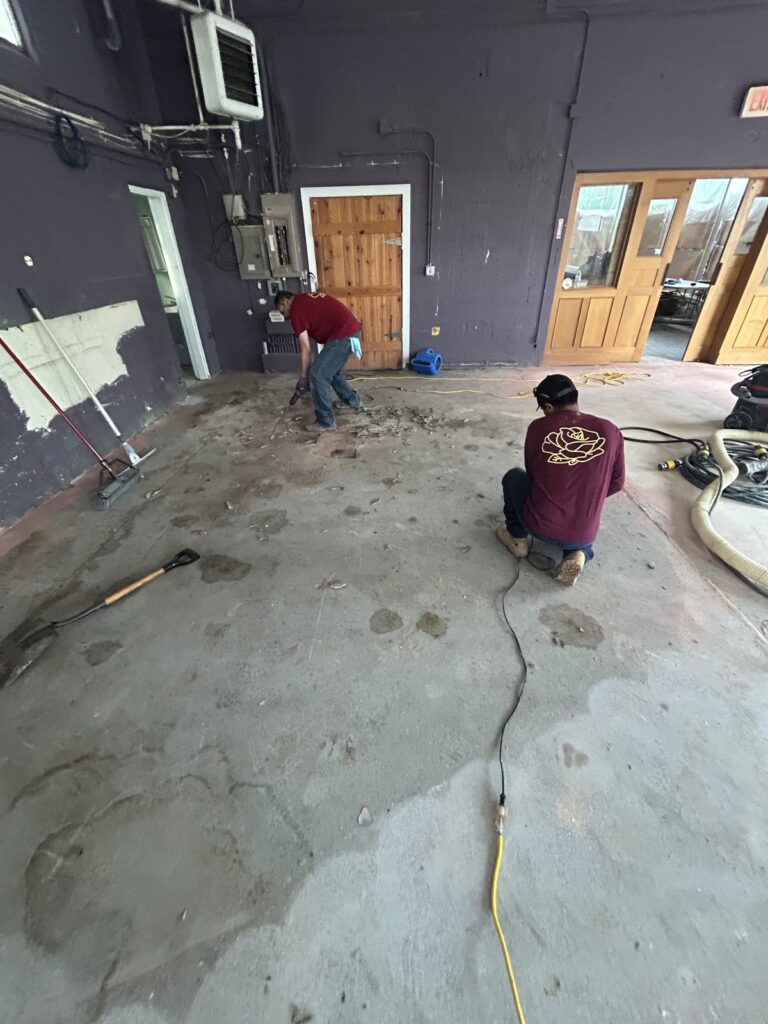
Concrete Overlay And Underlayment

Rose Restoration provides expert concrete overlay and underlayment services that enhance both the functionality and aesthetics of your concrete surfaces. With advanced techniques and durable materials, our skilled team ensures every application meets the highest standards of quality, strength, and longevity.

Whether you’re looking to rejuvenate worn-out concrete floors, add decorative finishes, or prepare a stable foundation for new flooring, Rose Restoration delivers solutions that combine durability with design flexibility.

Concrete-overlay-pour5-2-1024x683 — Rose Restoration

Concrete Overlays

Concrete overlays are a cost-effective way to transform and rejuvenate existing concrete. Instead of replacing damaged or outdated flooring, we apply premium concrete floor overlays that restore durability while upgrading appearance.

Overlays can be customized with a wide range of colors, textures, and finishes—from smooth modern looks to more decorative patterns. Designed to resist peeling, chipping, and wear, our overlays provide a fresh, durable surface that extends the life of your flooring.

These overlays are ideal for:

  • Indoor flooring upgrades in offices, showrooms, and basements.

  • Outdoor spaces like patios, walkways, and driveways.

  • Commercial concrete resurfacing projects where aesthetics and performance must align.

For property managers and homeowners searching for “concrete resurfacing near me”, Rose Restoration provides long-lasting, beautiful results without the cost of full replacement.

Decorative Overlays

Our decorative concrete overlays combine beauty and performance, mimicking the appearance of natural stone, brick, or slate while delivering the strength of modern materials. Available in a variety of colors, stamped patterns, and textured finishes, these overlays offer nearly limitless design options.

Decorative overlays are perfect for:

  • Patios and pool decks looking for stylish upgrades.

  • Driveways needing resurfacing with added curb appeal.

  • Interior concrete floors where decorative finishes enhance brand identity or home design.

These solutions not only improve aesthetics but also add durability and protection, making them a valuable, cost-effective investment. For clients comparing stamped concrete overlays vs full concrete replacement, overlays deliver exceptional value with quicker installation and less disruption.

Pavement with red paving stones.
Photo Jul 13 2023 10 08 14 AM scaled — Rose Restoration

Concrete Underlays

A strong, level foundation is critical for flooring success. Our concrete underlayment installation services provide smooth, durable bases for a wide variety of flooring materials including tile, hardwood, carpet, and resilient flooring.

Benefits of our concrete underlays include:

  • Correcting uneven or damaged subfloors.

  • Enhancing load-bearing capacity.

  • Improving durability and longevity of the final flooring system.

Whether for a residential remodel or a large-scale commercial project, our underlayment process ensures flawless performance. For contractors needing concrete floor leveling and preparation, Rose Restoration is the reliable partner to deliver precision and lasting quality.

Complete Concrete Overlay & Underlayment Solutions

From concrete resurfacing and decorative overlays to floor leveling and underlay preparation, Rose Restoration provides end-to-end solutions for enhancing concrete performance and appearance. Serving Washington D.C., Virginia, Maryland, and beyond, we deliver results that improve durability, design, and value.

For property managers, homeowners, and contractors searching for “concrete overlay services near me” or professional concrete underlay installers, Rose Restoration is the trusted name for quality, performance, and style.

Why Choose Rose Restoration?

Rose Restoration Offers Professional Natural Stone, Concrete, Wood, Metal, And Terrazzo Restoration Services. There Are Several Reasons Why You Should Choose Us.

Time in Business: Rose Restoration has over 40 years of industry leadership and experience in the field of stone and concrete restoration. Our long-standing presence in the industry highlights the depth of expertise and reliability we have earned over the years. Showing ourselves as a trusted leader in the field, consistently delivering superior results, and earning the confidence of our clients.

Stone Professionals: Our restoration team is composed of knowledgeable technicians who are skilled in approaching various stone restoration challenges. We have the experience to handle different types of stones and are adept at finding safe and efficient ways to manage projects.

Personalized Scopes: We provide personalized scopes to our clients. Rose Restoration offers a range of services, including stone, wood, and metal restoration, one-time projects, and maintenance services. We take pride in maintaining and restoring commercial spaces and have the resources to handle projects of different scales. Whatever your stone needs, we are here to help.

Polishable Overlays and Underlayments for Commercial and Residential Concrete

Not every concrete slab is a candidate for direct polishing, coating, or tile installation. Decades of wear, poor original pours, surface damage, and height mismatches between adjoining spaces can make the existing substrate unsuitable for finishing. That is where concrete overlays and underlayments become essential. Rose Restoration International installs polishable overlay systems, decorative overlays, and precision underlayments throughout Virginia, Maryland, and the Washington, DC metro area, giving property owners and facility managers a cost-effective alternative to full slab replacement.

With more than 40 years of hands-on experience in concrete restoration, our crews understand the chemistry, surface preparation, and installation techniques that determine whether an overlay will perform for decades or fail within months. Every project begins with a thorough evaluation of the existing slab and a clear recommendation on the right system for your goals, timeline, and budget.

When Overlays Are the Right Solution

A concrete overlay is a cementitious or polymer-modified layer applied over an existing slab to create a new, finished surface. Overlays are not a universal fix, but they solve a specific set of problems more efficiently than demolition and replacement:

  • Damaged or deteriorated slabs — Spalling, scaling, pitting, and surface erosion can make a slab look terrible without compromising its structural integrity. An overlay resurfaces the floor without the cost, noise, and downtime of tear-out.
  • Height transitions — When adjoining rooms or zones sit at different elevations, a self-leveling overlay can feather from one height to another, eliminating trip hazards and creating smooth transitions for wheeled traffic.
  • Coating and flooring preparation — Resinous coatings, tile, and luxury vinyl systems require a flat, sound substrate. Overlays correct waviness, low spots, and surface defects that would telegraph through the finished floor.
  • Aesthetic upgrades — Existing concrete that is structurally sound but visually unappealing can receive a decorative overlay to achieve the look of polished concrete, natural stone, or custom patterns.
  • Contaminated surfaces — Slabs with deep oil contamination, old adhesive residue, or incompatible coatings can be encapsulated under a properly bonded overlay rather than subjected to aggressive grinding or chemical stripping.

We evaluate every slab before recommending an overlay. If the concrete has active structural cracking, ongoing moisture issues, or insufficient load-bearing capacity, those problems must be addressed first. An overlay applied over a failing substrate will itself fail.

Self-Leveling vs. Trowel-Applied Overlays

The two primary overlay categories differ in application method, thickness range, and best-use scenarios:

Self-Leveling Overlays

Self-leveling compounds are mixed to a fluid consistency and poured onto a prepared slab, where they flow and settle to a flat plane under gravity. They are ideal for correcting unevenness across large areas and are commonly used to prepare substrates for polishing, coating, or finished flooring installation. Typical thicknesses range from 1/4 inch to 1 inch or more, depending on the product system. Self-leveling overlays are fast to install, often covering thousands of square feet in a single day, and they cure quickly enough to receive foot traffic or subsequent work within hours.

Trowel-Applied Overlays

Trowel-applied systems use a thicker, more workable mix that installers spread and finish by hand or with power trowels. These overlays offer greater control over thickness and texture, making them suitable for decorative applications, sloped surfaces, and areas where feathering to a thin edge is required. Trowel-applied overlays can also achieve stamped, broomed, or textured finishes that self-leveling products cannot.

Choosing between the two depends on the condition of the existing slab, the desired finish, and the project timeline. In many commercial projects, we use self-leveling compounds for large open areas and trowel-applied materials at transitions, edges, and detail work.

Polishable Overlay Systems

A polishable overlay is a specialized cementitious topping designed to be ground and polished with diamond tooling after curing, producing a finished surface that looks and performs like traditional polished concrete. These systems have transformed what is possible on damaged, uneven, or previously coated slabs that could never achieve a quality polish on their own.

How the Process Works

The installation of a polishable overlay follows a precise sequence:

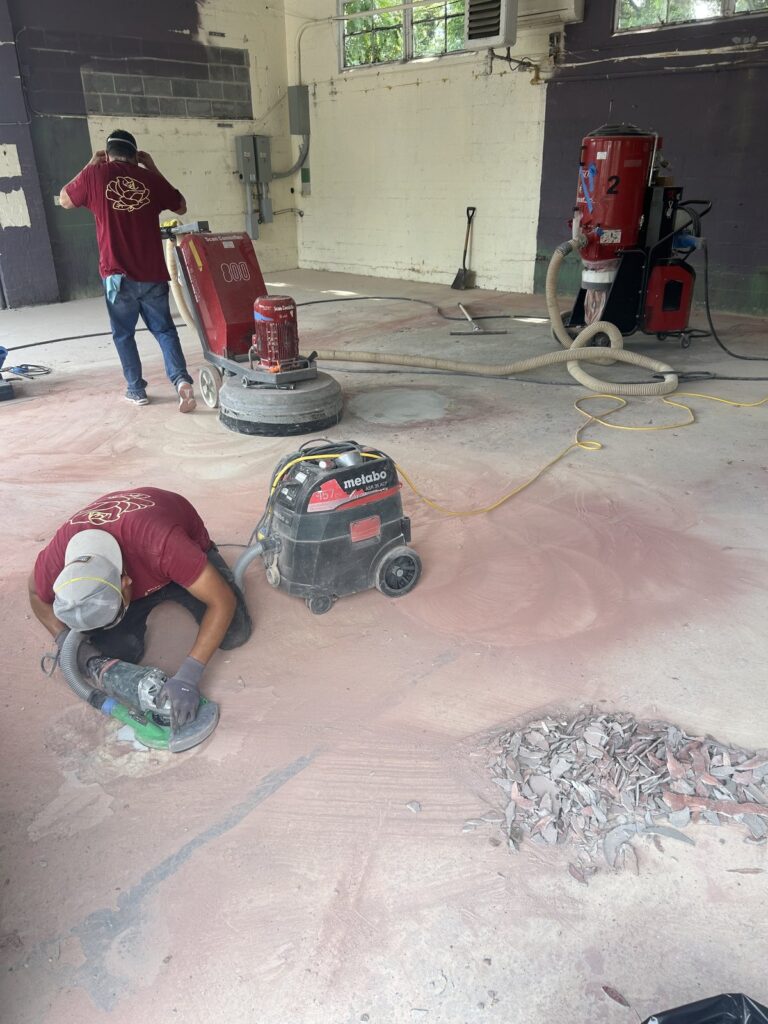
  • Surface preparation — The existing slab is mechanically profiled using diamond grinding or shot blasting to create a clean, open-pored surface that the overlay can bond to. All coatings, sealers, adhesives, and contaminants are removed.
  • Primer application — A bonding primer or slurry coat is applied to maximize adhesion between the old concrete and the new overlay.
  • Overlay placement — The polishable overlay material is mixed and placed at the manufacturer-specified thickness, typically between 1/4 inch and 3/4 inch. The material is screeded or gauge-raked to achieve uniform coverage.
  • Curing — The overlay cures for the time specified by the manufacturer, usually 24 to 72 hours before grinding can begin.
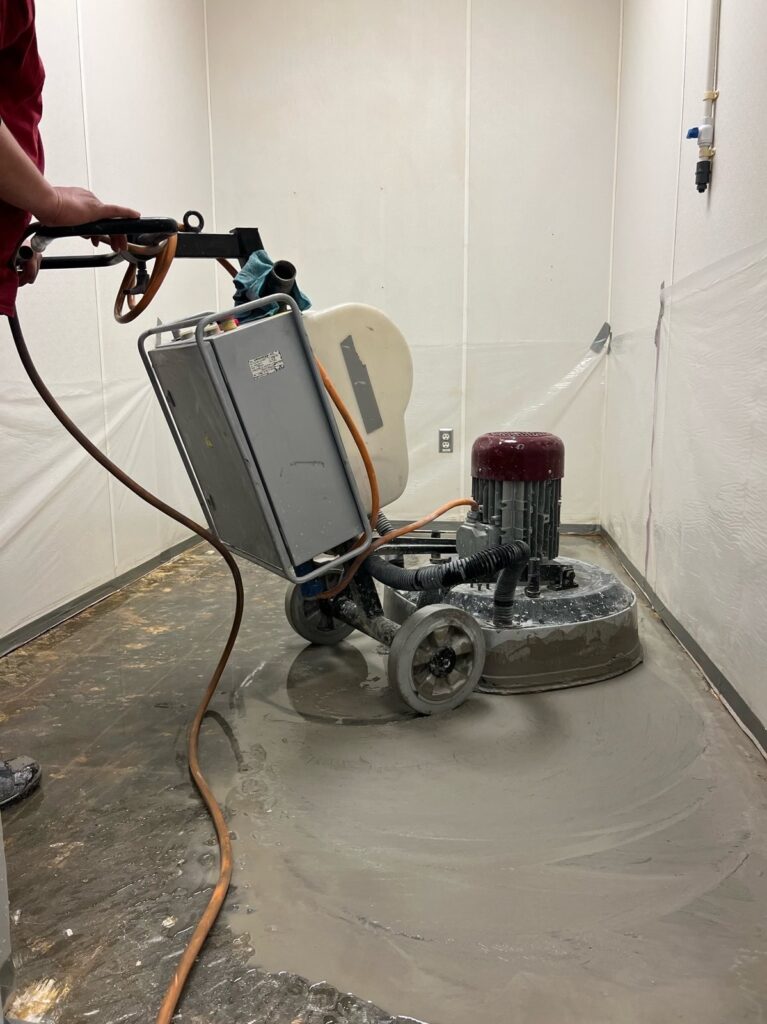
  • Diamond grinding and polishing — The cured overlay is processed through the same progressive diamond grinding and honing steps used on conventional polished concrete, starting with coarse metal-bond diamonds and progressing through finer resin-bond pads to achieve the desired sheen level.
  • Densifier and sealer — A lithium-based densifier is applied to harden the surface, followed by a guard or sealer to protect against staining.

The result is a polished floor with the refined appearance of ground concrete, installed over a slab that may have been in poor condition. Polishable overlays are increasingly popular in retail spaces, restaurants, office lobbies, and residential lofts where the polished concrete aesthetic is desired but the existing slab cannot deliver it.

Decorative Overlay Options

Beyond polishing, overlays open the door to a range of decorative treatments that transform plain or damaged concrete into a design feature:

  • Stamped overlays — Texture mats are pressed into a freshly applied overlay to replicate the appearance of brick, slate, cobblestone, or other natural materials. Stamped overlays are popular for patios, pool decks, entryways, and commercial walkways.
  • Stenciled patterns — Stencils are laid on the prepared surface before the overlay is applied, creating geometric, tile-like, or custom patterns with crisp lines and multiple color zones.
  • Integral color and broadcast systems — Pigments can be mixed directly into the overlay material for consistent through-body color. Alternatively, colored quartz, vinyl flake, or metallic pigments can be broadcast into the wet surface for texture and visual depth.
  • Micro-toppings — Ultra-thin overlays applied at 1/16 inch or less create a smooth, contemporary finish that can be dyed, stained, or sealed in a variety of colors. Micro-toppings are commonly used in residential interiors and boutique commercial spaces.

Underlayments for Resinous Flooring and Tile

While overlays provide a finished or near-finished surface, underlayments serve as a hidden preparatory layer beneath the final flooring system. A properly selected and installed underlayment is critical for the long-term performance of resinous flooring systems, tile, luxury vinyl, and carpet.

Underlayments correct flatness deficiencies, eliminate voids and low spots, and provide a uniform substrate that prevents finished flooring from cracking, debonding, or telegraphing imperfections. In commercial and hospitality settings, where thousands of square feet must meet strict flatness tolerances, underlayment work is often the difference between a flooring installation that lasts and one that requires early replacement.

Moisture Testing and Bond Testing

Two critical assessments must be performed before any overlay or underlayment is installed:

Moisture Testing

Excess moisture vapor rising through a concrete slab will destroy the bond of an overlay and can cause blistering, delamination, and mold growth beneath the finished surface. We perform quantitative moisture testing using calcium chloride and relative humidity probe methods to determine whether the slab falls within acceptable limits for the chosen overlay system. If moisture levels are too high, mitigation strategies such as moisture-vapor barriers or reactive primers must be employed before the overlay is placed.

Bond Testing

The strength of the bond between an overlay and the existing slab determines everything. We conduct adhesion pull tests on prepared areas to verify that the surface profile and primer system will achieve the bond strength required by the overlay manufacturer. If bond test results are marginal, we adjust the preparation method — switching from grinding to shot blasting, for example, or adding a secondary primer coat — until the bond meets specification.

Thickness Considerations

Overlay thickness affects performance, cost, and compatibility with the surrounding environment. Thin overlays (1/16 to 1/4 inch) are suitable for cosmetic resurfacing of sound slabs but cannot correct significant flatness issues or deep damage. Medium overlays (1/4 to 3/4 inch) handle most correction and polishing applications. Thick overlays (3/4 inch and above) are reserved for severe flatness corrections, structural topping applications, and situations where the finished floor height must meet a specific elevation. Every additional fraction of an inch adds material cost and weight, so we specify the minimum thickness necessary to achieve the project goals.

Commercial vs. Residential Applications

The overlay systems we install in a hotel lobby are not the same as those we place in a residential basement. Commercial environments demand higher compressive strength, greater abrasion resistance, and faster cure times to minimize business disruption. Residential projects prioritize aesthetic flexibility and cost efficiency. Our team selects the right product system for each setting, drawing on decades of experience as a full-service concrete contractor working across both markets.

Frequently Asked Questions

How long does a polishable overlay last?

A properly installed polishable overlay on a sound substrate can last 20 years or more with routine maintenance. Longevity depends on traffic levels, maintenance practices, and the quality of the original installation, including surface preparation, material selection, and curing conditions.

Can you apply an overlay over existing tile or coatings?

In most cases, existing tile, coatings, and adhesives must be removed before an overlay is applied. Overlays bond to prepared concrete, not to intermediate layers that may themselves fail. There are limited exceptions with certain primer systems, but removal is the standard approach for long-term performance.

How thick does an overlay need to be to be polished?

Most polishable overlay manufacturers specify a minimum installed thickness of 1/4 inch to allow for the material removed during the diamond grinding and polishing process. Thinner applications may not leave enough material to achieve a full polish without grinding through to the substrate below.

How long before the space can be used after overlay installation?

Light foot traffic is typically possible within 24 hours. Full grinding and polishing operations usually begin at 48 to 72 hours after placement, depending on the product. Total project timelines vary based on the area size and the number of polishing steps required, but most commercial spaces are returned to service within one to two weeks.

What does a concrete overlay cost compared to slab replacement?

Overlay systems typically cost a fraction of full slab demolition and replacement when you factor in removal, disposal, rebar work, new concrete placement, and curing time. The exact savings depend on the project scope, slab condition, and chosen overlay system. Contact us for a project-specific evaluation and estimate.

Start Your Overlay or Underlayment Project

Whether you need to rescue a damaged slab, prepare a substrate for high-performance flooring, or achieve a polished concrete finish where one was not previously possible, Rose Restoration International has the expertise and field-tested systems to deliver lasting results. Call us at 703-327-7676 or request a consultation to discuss your project with our team.

Schedule Online
BBBACCREDITEDBUSINESSA+
BBB Accredited A+ Rating
ABCVIRGINIAMEMBER
ABC Virginia Member
4.8GOOGLE
4.8 Star Rating 117+ Google Reviews
LICENSED& INSURED
Licensed & Insured VA, MD, DC
Leave a Review
Call Now Schedule a Free Assessment
Call Now Get a Quote