
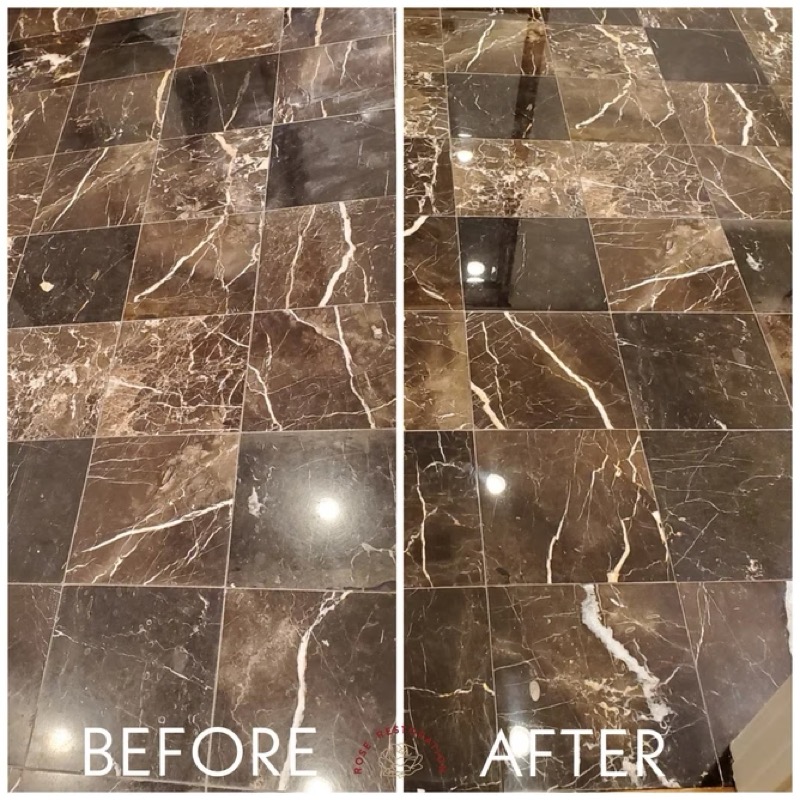
Quick answer: Marble etches because acidic substances chemically dissolve the calcium carbonate that marble is made of. Vinegar, lemon juice, wine, coffee, tomato, and most kitchen cleaners do this on contact, leaving dull, rough spots where the polished surface used to be. Etching is a chemical reaction, not a stain — cleaning won’t remove it. Light etching can be polished out by a stone restoration professional. Heavy etching usually requires honing and re-polishing the affected area. Below: why etching happens, the cleaners that cause it, what to do if your marble has already etched, and how to prevent it from happening again.
What Is an Etch Mark on Marble?
An etch mark is a dull, rough patch on a marble surface caused by acid contact. The acid chemically dissolves a microscopic layer of the marble, removing the polished finish and leaving the underlying stone exposed. Under the right light, an etch mark looks like a hazy spot or a watermark that won’t wipe away.
Etch marks are different from stains. A stain is a colored substance absorbed into the stone (like red wine or coffee that soaked in). An etch is physical damage — the surface of the stone has been removed. You can clean a stain with the right poultice. You cannot clean an etch out, because there’s nothing on the surface to clean. The damage IS the missing surface layer.
Why Marble Reacts with Acid
Marble is metamorphosed limestone. Both are made primarily of calcium carbonate (CaCO3). When calcium carbonate contacts an acid, a chemical reaction releases carbon dioxide gas and dissolves the calcium into the acid solution. You can see this reaction happen in real time — tiny bubbles fizz on the marble surface when an acid is applied. The bubbles are CO2. The dissolved layer is what causes the etch.
This is the same reaction that erodes limestone caves and dissolves marble statues exposed to acid rain over centuries. In a kitchen, the reaction happens in seconds. A drop of lemon juice that sits on a polished marble counter for 30 seconds will leave a permanent dull spot.
The Substances That Etch Marble
Anything with a pH below about 5 will etch marble on contact. Common kitchen and household substances:
- Lemon juice, lime juice, orange juice (citric acid)
- Vinegar (white, apple cider, balsamic)
- Wine (especially red)
- Coffee
- Tea (less aggressive but still acidic)
- Tomato sauce, ketchup, salsa
- Mustard, hot sauce, soy sauce
- Sparkling water and soft drinks (carbonic acid)
- Most salad dressings
- Many “all-purpose” household cleaners
- Bleach-based products (variable, but many cause etching)
- Granite cleaners used on marble (most contain acids inappropriate for marble)
- Magic Eraser and abrasive cleaning pads (cause physical etching, not chemical)
- Perfumes, cosmetics, and many bath products (variable, but common etching agents in bathrooms)
The pattern: acid + calcium carbonate = dissolved surface = etch mark. The strength of the acid and the contact time determine how deep the etch goes.
Can Etch Marks Be Fixed?
Yes — etch marks are restorable. The fix depends on how deep the etching goes:
- Very light etching (you can feel it but barely see it under most lighting): a marble polishing powder, applied with a damp cloth and rubbed in a circular motion for 1–2 minutes, can sometimes restore the polish. This is the closest thing to a DIY solution that actually works.
- Light to moderate etching (visible dull spots, smooth to the touch): professional spot repair. We hand-hone the affected area with progressive diamond abrasives (typically 200, 400, 800, 1500, 3000 grit) and re-polish to match the surrounding finish. Spot repairs are typically priced at $400–$900 per affected area.
- Heavy etching or many spots: full surface refinish. We hand-hone and re-polish the entire counter, vanity, or floor surface so the finish is uniform. Pricing is per square foot ($10–$18 per sq ft for full restoration).
- Deep, textured etching (you can feel pitting or roughness): the surface has been physically eroded. We can usually still restore it, but more material removal is required. Sometimes a finish change is recommended — for instance, going from polished to honed if the polish can’t be re-established without excessive thinning.
For Rose Restoration’s specific etch mark removal services, see our dedicated etch mark removal page.
How to Prevent Marble from Etching Again
Penetrating sealers do not prevent etching. Sealers fill the marble’s pores to slow stain absorption, but they don’t put a chemical barrier on the surface. Acid still reaches the marble through any sealer.
The only durable etch prevention is a topical protective coating. The leading product is Marble Armor, a thin protective film that physically shields the marble from acid contact. Once installed, water, wine, lemon juice, vinegar, and other common kitchen acids can sit on the surface without etching the marble underneath.
Marble Armor carries a 10-year manufacturer-backed warranty against acid etching and staining. For households with kids, frequent entertaining, or kitchens that see heavy daily use, it typically pays back within 3–5 years compared to repeat restoration cycles.
Behavioral prevention helps too: keep acidic foods on cutting boards, wipe spills immediately, never use vinegar or lemon as cleaning agents on stone, and use only stone-safe pH-neutral cleaners. But behavior alone fails sooner or later in any active kitchen — protective coating is the only fix-it-once solution.
Frequently Asked Questions
Is etching the same as a stain?
No. A stain is a colored substance absorbed into the stone — you can sometimes pull it out with a poultice. Etching is physical damage to the surface that no cleaning will remove. The fix for etching is restoration, not cleaning.
Can I polish out an etch mark myself?
For very light etches on polished marble, marble polishing powder (Tenax Marbles Plus or similar) applied with a damp cloth can sometimes work. For anything more than that — visible dull spots, multiple etches, or roughness you can feel — professional restoration is the durable answer. Aggressive DIY attempts usually make the area worse before they get better.
Will sealing my marble prevent etching?
No. Penetrating sealers slow stain absorption but don’t block acid contact. The only durable etch prevention is a topical protective coating like Marble Armor.
How much does etch mark removal cost?
Light etch removal can be priced as spot work ($400–$900 per affected area). Multiple etches or a full surface refinish is priced per square foot ($10–$18/sqft, $2,400 minimum). Free in-home assessment included.
Does honed marble etch the same as polished marble?
Honed marble (matte finish) etches but the etches are less visible because there’s no polished surrounding surface to contrast with. The chemical reaction still removes calcium carbonate, but the visual effect is subtler. Many homeowners with heavy-use kitchens choose honed marble specifically to hide etching.
Can you restore marble that’s been heavily etched for years?
Yes — we restore marble that’s been used and abused for decades. We’ve restored marble at the Four Seasons DC, the IMF, embassies, and luxury homes throughout DC, Maryland, and Northern Virginia. As long as the slab itself is structurally sound, the surface can be restored.
Schedule a free assessment or send photos for a same-day budget range. Phone (703) 327-7676.
Related: Etch mark removal services · Marble Armor protection · Cleaners that damage marble · Marble stain removal · Honed vs polished marble
Looking for something else?
Get a Free Assessment from Rose Restoration
Tell us about your marble, stone, terrazzo, or concrete and our senior technicians will recommend the right restoration approach. Family-run and trusted across Washington DC, Maryland, and Virginia since 1978.
Call (703) 327-7676 · Email info@roserestoration.com · or send us photos.

Restore. Don't replace.
47 years of polishing marble, terrazzo, concrete, and tile across Washington DC, Northern Virginia, and Maryland. IMF, Four Seasons, Smithsonian, and the Virginia State Capitol trust us — you can too.