
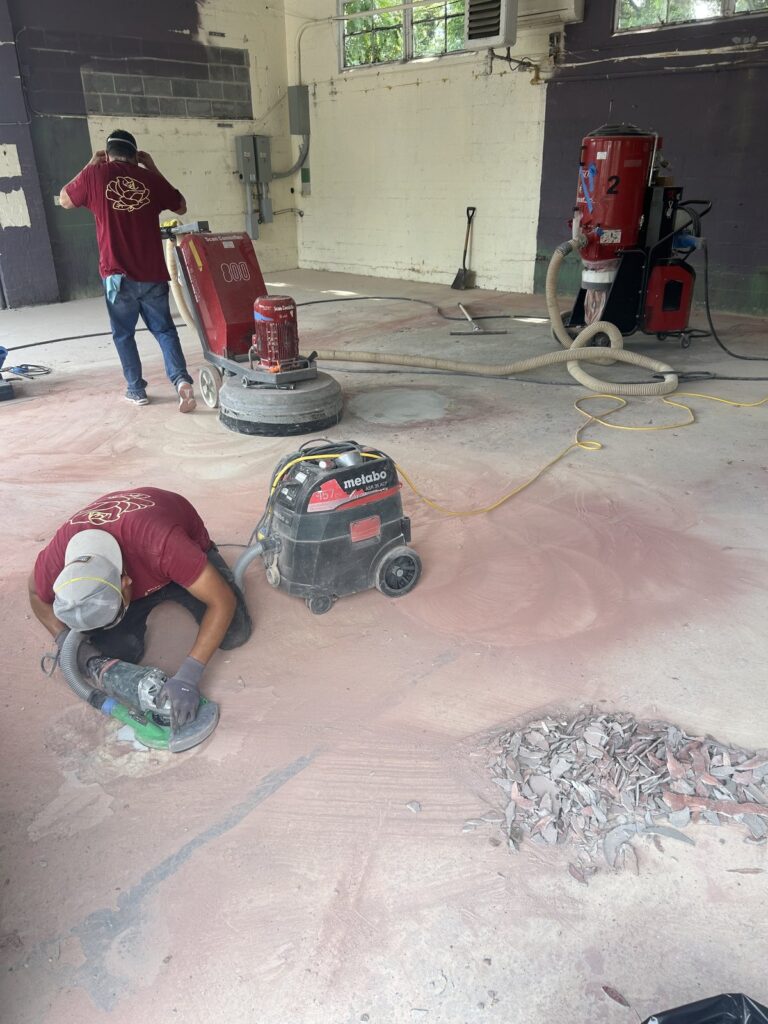
Walk into any new retail build-out in the DC metro area and there is a good chance you are walking on polished concrete. Five years ago, that same space would have had VCT, ceramic tile, or carpet. The shift is not a coincidence and it is not purely aesthetic. Retail operators are choosing polished concrete because the economics work, the maintenance profile is superior, and the design flexibility has caught up with — and in many cases surpassed — traditional flooring options.
We have been polishing concrete for commercial clients across Virginia, Maryland, and DC for decades. What has changed recently is not the process, which has been refined over years, but the market’s understanding of what polished concrete can deliver as a finished retail floor.
Why Retail Is Moving to Polished Concrete
The retail environment has changed fundamentally. Stores are competing with online shopping, which means the physical space has to deliver an experience that a screen cannot. Clean, modern aesthetics matter. But so does the bottom line. Polished concrete delivers on both.
The Aesthetic Shift
The industrial-chic look that started in restaurants and boutiques has moved mainstream. National retailers, grocery chains, home improvement stores, and even luxury brands are using polished concrete as their primary floor finish. The material reads as honest, modern, and intentional. It complements merchandise rather than competing with it, and it photographs well — an increasingly important consideration in the age of social media marketing.
The Economic Reality
For a new retail build-out, polished concrete eliminates the cost of a separate flooring material entirely. The concrete slab is already there — it was poured as part of the building’s structure. Polishing that existing slab costs $3 to $8 per square foot, compared to $4 to $10 for quality VCT (installed), $8 to $15 for ceramic tile, or $6 to $12 for commercial carpet. For a 10,000-square-foot retail space, polished concrete can save $20,000 to $70,000 on initial flooring costs alone.
For existing retail spaces with worn or damaged flooring, grinding down to the concrete slab and polishing is often less expensive than removing the old flooring and installing new material on top.
Design Options: More Than Just Gray
The biggest misconception about polished concrete is that it only comes in one look: plain gray. In reality, the design options are extensive and continue to expand.
Aggregate Exposure Levels
The appearance of polished concrete changes dramatically based on how deeply the surface is ground. There are three standard levels:
- Cream polish: Minimal grinding that retains the smooth surface of the original pour. Clean, uniform appearance with minimal visible aggregate. Ideal for minimalist retail environments.
- Salt and pepper: Medium grinding that exposes fine aggregate particles. Creates a subtle texture and visual interest. The most popular choice for general retail.
- Full aggregate exposure: Deep grinding that reveals the larger stone chips in the concrete mix. Creates a terrazzo-like appearance with significant visual character. Works well for high-end retail and restaurants.
Staining and Dyeing
Concrete stains and dyes allow virtually unlimited color options. Acid stains react chemically with the concrete to produce rich, variegated earth tones — ambers, browns, and blue-greens. Water-based stains and dyes offer a broader color palette and more uniform coverage. Both can be combined with polishing for a finished floor that looks nothing like what most people imagine when they hear “concrete.”
We have installed polished concrete floors in retail spaces ranging from warm terracotta tones to deep charcoal to vibrant brand-specific colors. The design is limited only by the client’s vision.
Scoring and Patterns
Decorative scoring — cutting shallow lines into the concrete surface — adds geometric patterns, borders, logos, or wayfinding elements. Scoring can simulate tile grout lines, create custom medallions, or divide large floor areas into distinct zones. Combined with multiple stain colors, scoring allows polished concrete to mimic the appearance of high-end tile or natural stone at a fraction of the cost.
Metallic and Specialty Epoxies
For retail environments that demand maximum visual impact, metallic epoxy overlays create dramatic, three-dimensional effects. These coatings use metallic pigments suspended in epoxy that swirl and shimmer as the material self-levels. The result is unique to every installation. We recommend these for feature areas — entry vestibules, display zones, or accent sections — rather than entire floor plans, as the visual intensity works best in moderation.
Durability: Built for Retail Traffic
Retail floors take enormous punishment. Shopping carts, pallet jacks, high heels, spills, tracked-in grit, heavy foot traffic, and constant cleaning. Polished concrete handles all of it.
The polishing process densifies the concrete surface through a chemical hardening treatment that makes it resistant to abrasion and staining. A properly polished and maintained concrete floor in a retail environment will maintain its appearance for 10 to 20 years before needing re-polishing — far longer than any alternative flooring material.
Polished concrete is also inherently slip-resistant when treated with appropriate sealers. The coefficient of friction meets or exceeds OSHA and ADA requirements for commercial spaces. For grocery and food retail, where spills are inevitable, polished concrete with proper sealer actually outperforms tile, which becomes dangerous when wet grout lines reduce traction.
Maintenance: Where the Real Savings Show Up
The maintenance profile of polished concrete is where the ROI case becomes overwhelming.
VCT requires regular stripping and waxing — typically 4 to 6 times per year for high-traffic retail, at $0.50 to $1.00 per square foot per cycle. Annual maintenance cost for a 10,000-square-foot store: $20,000 to $60,000. Over 10 years, that is $200,000 to $600,000 in maintenance alone, plus at least one full replacement.
Polished concrete requires daily dust mopping, periodic wet mopping with a pH-neutral cleaner, and re-application of a maintenance sealer once or twice per year. Annual maintenance cost for the same 10,000-square-foot store: $2,000 to $5,000. Over 10 years: $20,000 to $50,000, with no replacement needed.
The math is not close. Polished concrete’s total cost of ownership over a 10-year period is typically 60 to 80 percent less than VCT and 40 to 60 percent less than ceramic tile.
ROI Comparison: Polished Concrete vs. Alternatives
For a retail property manager evaluating flooring options, here is a realistic 10-year cost comparison for a 10,000-square-foot space:
- Polished concrete: $50,000 to $80,000 installed, $20,000 to $50,000 maintenance. Total: $70,000 to $130,000.
- VCT: $40,000 to $100,000 installed (plus one replacement at year 8-10), $200,000 to $600,000 maintenance. Total: $280,000 to $800,000.
- Ceramic tile: $80,000 to $150,000 installed, $50,000 to $100,000 maintenance and repairs. Total: $130,000 to $250,000.
- Commercial carpet: $60,000 to $120,000 installed (plus one replacement), $80,000 to $150,000 maintenance. Total: $200,000 to $390,000.
These numbers reflect our experience with commercial projects in the DC metropolitan market. Your specific costs will vary based on slab condition, access constraints, and design complexity. But the relative economics consistently favor polished concrete.
What to Consider Before Choosing Polished Concrete
Slab Condition
Not every concrete slab is a good candidate for polishing. The slab needs to be structurally sound and relatively level. Significant cracking, spalling, or moisture issues need to be addressed before polishing. A qualified concrete polishing contractor will evaluate the slab condition and give you an honest assessment of what is achievable.
Moisture Testing
Concrete that has excessive moisture vapor transmission can cause problems with densifiers and sealers. Moisture testing should be performed on any slab being considered for polishing, especially in older buildings or those with below-grade retail space.
Acoustic Considerations
Polished concrete is a hard, reflective surface. In retail environments where noise is a concern — restaurants, music stores, or spaces with high ceilings — acoustic treatment of walls and ceilings may be necessary to compensate for the floor’s reflective properties.
Temperature
Concrete feels cooler underfoot than carpet or VCT. For retail environments where customers may be standing for extended periods — jewelry counters, checkout lines — consider integrating anti-fatigue mats in those specific areas rather than changing the floor specification for the entire space.
The Bottom Line for Retail Decision-Makers
Polished concrete is not the right choice for every retail space. But for the majority of retail applications, it delivers the best combination of aesthetics, durability, maintenance efficiency, and total cost of ownership. The design options have expanded to the point where polished concrete can achieve virtually any look a retailer wants. And the long-term economics are not a close contest.
If you are planning a new retail build-out, renovating an existing space, or simply tired of the annual stripping-and-waxing cycle, polished concrete deserves a serious look.
Contact Rose Restoration International for a slab evaluation and polished concrete proposal for your retail space.
We polish concrete for retail tenants across the region, including high-traffic storefronts in Arlington where same-night turnaround is the difference between a project that ships and one that drags.
Get a Free Assessment from Rose Restoration
Tell us about your marble, stone, terrazzo, or concrete and our senior technicians will recommend the right restoration approach. Family-run and trusted across Washington DC, Maryland, and Virginia since 1978.
Call (703) 327-7676 · Email info@roserestoration.com · or send us photos.

Restore. Don't replace.
47 years of polishing marble, terrazzo, concrete, and tile across Washington DC, Northern Virginia, and Maryland. IMF, Four Seasons, Smithsonian, and the Virginia State Capitol trust us — you can too.