Verified Google Review
“I highly recommend Rose Restoration for residential granite restoration. My 16 year old black granite countertops were dull and chipped. Several companies said they could not repair the chips. Rose Restoration did, and the result was excellent.”
— Crystal, verified residential client
· read all 117 reviews on Google →
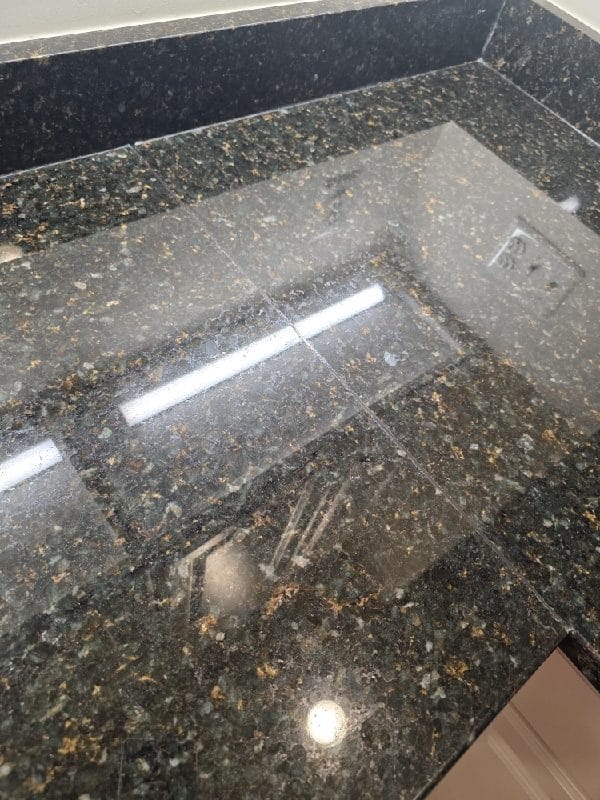
Project: Granite countertop seam re-fill and edge repair in a Bethesda, MD kitchen — failed seam at the L-corner of a Black Galaxy granite kitchen counter, plus 3 chipped edges across the perimeter, all repaired in a single visit. The seam had cracked open over 8 years and was collecting water and food debris.
The project at a glance
- Location: Bethesda, Maryland
- Stone: Black Galaxy granite, polished finish
- Surface: 64 sf perimeter counter with one L-corner seam
- Age of installation: 8 years
- Damage: Failed seam at L-corner (visible gap, debris collection), 3 chipped edges (one near sink, two on island)
- Project span: Single 1-day visit (4 hours on-site)
- Crew: 1 senior technician + 1 mid-level
The damage we found
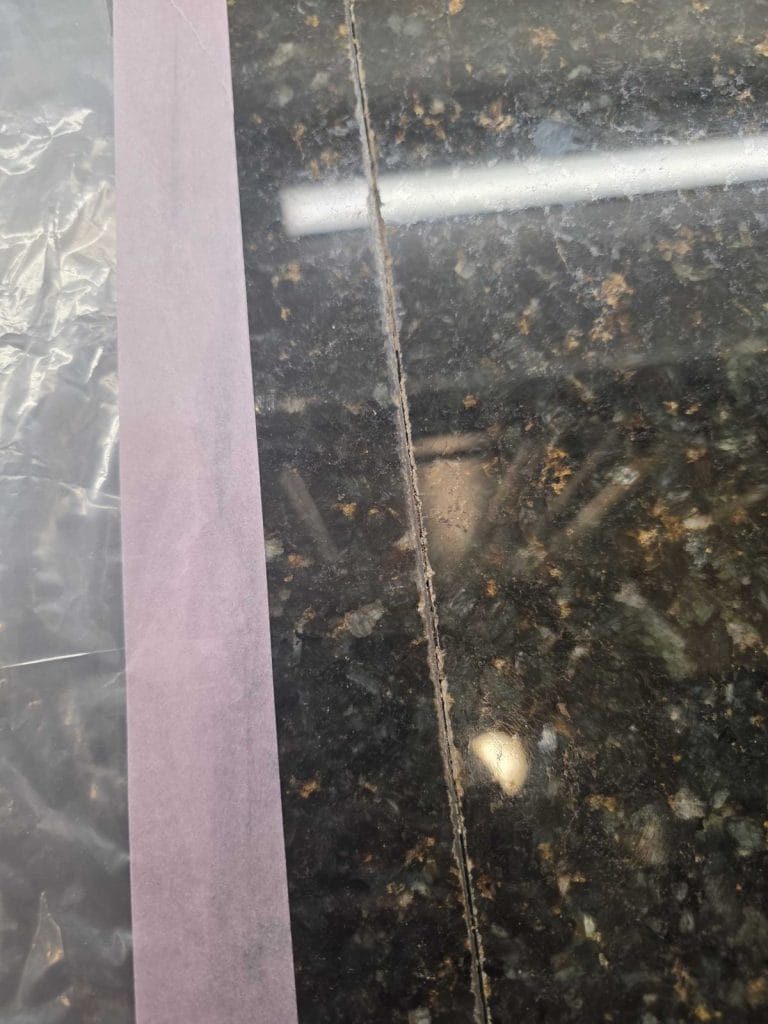
The homeowner had noticed water collecting in a faint line at the L-corner of the perimeter counter and food debris accumulating in a way that wouldn’t wipe away. Closer inspection in good light revealed the original seam filler had failed.
- Failed seam: The original epoxy seam filler had cracked, separated from the stone on one side, and partially fallen out. The visible gap was about 0.5mm wide and 18 inches long across the L-corner. The exposed substrate was visible — a yellowish silicone/adhesive layer.
- Edge chip near sink: A 6mm chip on the front edge of the counter near the sink, likely from a dropped pot or pan over the years. Chip was clean (no missing fragments).
- Two island edge chips: Both small (3-4mm) chips on the prep side of the island, likely from cabinet door hardware contact when doors were opened forcefully.
- Surface itself was in good condition: The Black Galaxy polish was uniform, no etching (granite doesn’t etch), no staining. The stone was healthy — only the seam and edges needed attention.
The restoration process
- Site protection. Adjacent walnut cabinetry and the integrated stainless sink were masked off. Coffee maker, knife block, and small appliances were relocated.
- Old seam removal. The failed epoxy filler was carefully removed using thin diamond blades and dental-style hand tools. We removed every trace of old filler and substrate adhesive — a clean cavity is essential for the new fill to bond properly.
- Cavity preparation. The cavity was cleaned with acetone and dried completely. Any moisture under the new filler causes long-term failure — we use compressed air and 15-minute dry time before fill.
- Color-matched seam fill. Black Galaxy is one of the easier granites to color-match (very deep black with metallic flecks). We mixed the epoxy with deep black pigment and a touch of mica for the metallic sparkle. Filled the seam slightly proud of the surface.
- Edge chip repairs. All three chips received the same color-matched epoxy treatment. Each chip was cleaned, prepped with acetone, and filled slightly proud.
- Cure and shape. 30-minute initial cure, then razor-blade trim of the proud filler down to surface level. Final shaping with progressively finer abrasives.
- Polishing. The repaired seam and chip areas were polished to match the surrounding granite finish using black-marble/granite polishing compounds. Black Galaxy’s metallic flecks make the polish slightly more dramatic than other dark granites.
- Site cleanup and inspection. Final clean of the entire counter area. Walked the homeowner through every repair under good light.
The outcome
By the end of the 4-hour visit:
- L-corner seam fully sealed; no visible gap; no debris collection point
- All 3 edge chips repaired and invisible from standing height
- Repaired areas polished to match surrounding granite
- Counter ready for normal use within 2 hours of repair
- Estimated repair lifespan: 10+ years if not subjected to seam stress
The homeowner’s primary feedback: “I forgot the seam was even there.” That’s the goal of a successful seam repair.
Why this project matters for similar granite installations
Three takeaways for homeowners with older granite installations:
- Seams fail eventually — usually 5-10 years. Original epoxy seam fillers degrade from heat cycles (under-counter dishwashers), moisture, and substrate movement. A failing seam is not a sign of bad installation — it’s normal aging.
- Catch failed seams early. A small visible gap is easy and cheap to repair. An ignored failed seam allows water under the counter, which can damage the substrate, the cabinet box, or even cause mold issues. If you see a gap, address it within a few months.
- Granite chips are repairable, but the color match matters. Even uniform-looking granites like Black Galaxy benefit from a senior technician’s color-mixing experience. The mica/metallic component is what makes Black Galaxy “feel right” after repair.
Cost range for similar projects
- Granite seam repair (per seam): $250–$500
- Edge chip repair (per chip): $125–$250
- Combined visit (seam + 2-3 chips): $500–$900 typical
This particular project (1 seam + 3 chips) came in at the typical range.
Warranty
All Rose Restoration work is backed by our 1-year written workmanship warranty.
Related services
- Granite chip repair — full chip repair process
- Granite restoration in Bethesda, MD — Rose’s Bethesda service area
- Granite countertop sealing — for sealer maintenance
- Marble crack repair — similar process for marble cracks
- Brown Fantasy granite restoration — exotic granite specialty
Frequently asked questions
How long does a granite seam repair last?
A properly executed seam repair (clean cavity, color-matched epoxy, full polish) lasts 10+ years under normal kitchen use. The most common failure cause is heat cycling from under-counter dishwashers — if there’s a dishwasher directly below the seam, expect somewhat shorter lifespan.
Can you replace just one section of granite if the damage is severe?
For a single failed section near a seam, replacement is sometimes possible if the original quarry/lot is identifiable. In most 8+ year-old installs, the original lot is no longer available, and we recommend repair over partial replacement (which would likely be visibly different stone).
How do I know if my seam is failing vs. just looking different over time?
A healthy seam should be barely visible and structurally continuous with the surrounding stone. If you can: see a clear line, fit a knife edge into it, or notice debris collecting in it — the seam is failing and should be repaired.
Is granite chip repair structural or just cosmetic?
Both. Color-matched epoxy bonds chemically to the surrounding granite and restores both the look and the structural integrity of the edge. The repaired area is approximately as strong as the original stone.
Why don’t you just replace the whole counter when there’s seam failure?
Cost and disruption. A typical kitchen counter replacement is $4,000-$10,000+ and 1-3 weeks of downtime. A seam + chip repair is $500-$900 and 4 hours. For most clients, repair is the right answer unless the underlying stone is failing structurally.
Schedule a free granite seam assessment
For granite seam and chip repair in Bethesda, Potomac, Chevy Chase, or anywhere across DC, MD, and VA: call 703-327-7676 or request a free in-home assessment. Senior technicians respond within 2 business hours. Most granite seam and chip repair projects are quoted between $400 and $1,000.