
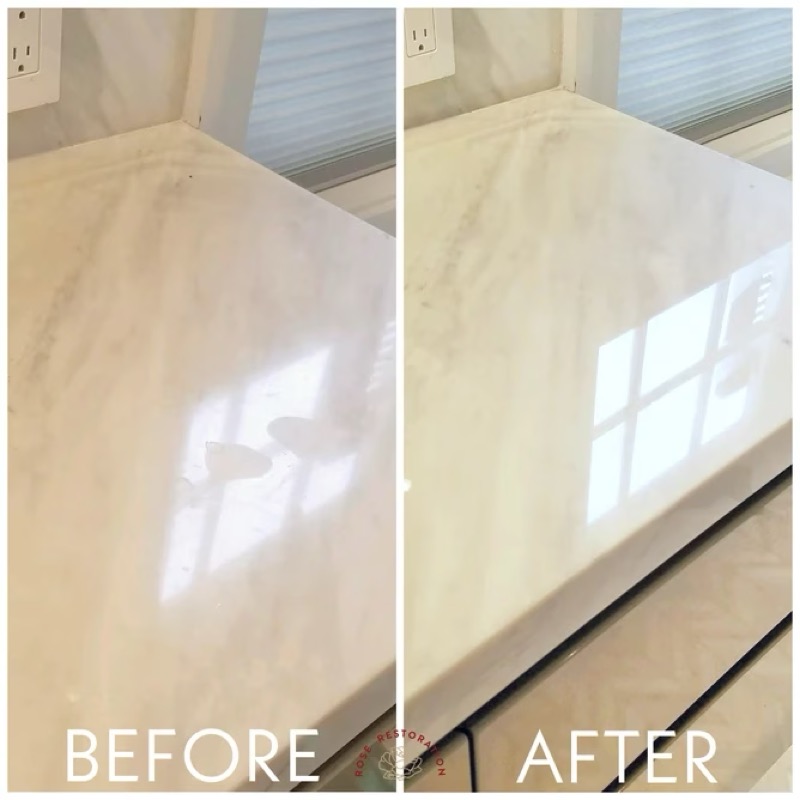
Rose Restoration — a Washington DC marble restoration contractor — explains how to remove stains from marble using poultice applications, and why different stain types require different chemistry.
 By Tom Kuhn, CEO, Rose Restoration
Rose Restoration has restored marble, terrazzo, concrete, and natural stone across DC, MD, and VA since 1978.
A ring under the wine glass. A dull patch where the lemon rolled. An oil halo that won’t lift. Marble is the surface most people own that betrays every spill the fastest — and the surface where a quick search for an “etch marble remover” usually leads to a kitchen-cabinet experiment that makes the damage worse, not better. Before you reach for the baking soda or pull up another DIY blog, there are three things worth knowing.
First, does marble stain? Yes — but not in the way most surfaces do. Second, what most people call a stain is often an etch — and they are completely different problems. Third, the right fix depends on which one you’re actually looking at. This guide walks you through the difference, why most home methods fail, and what professional marble restoration actually does to bring the surface back.
Stain or etch? Why most “marble stain” problems aren’t stains at all
Marble is calcium carbonate. That single fact explains almost every problem people see on a marble surface. Calcium carbonate is mildly porous, which lets liquids soak in (a true stain) — and chemically reactive with anything acidic, which dissolves the polished surface and leaves a dull mark (an etch). Knowing which one you have changes everything about how it gets fixed.
- A stain is a discoloration inside the stone. Coffee rings, oil halos, ink bleeds, and rust marks are typical. The stone is still smooth — it just looks darker, yellow, brown, or pink in that spot.
- An etch is a chemical burn on the polished surface. Lemon juice, vinegar, wine, tomato sauce, and most household cleaners dissolve a thin layer of the polish. The stain is in the finish, not the stone, and shows up as a dull or rough patch — often light-colored or whitish, even on dark marble.
The simple field test: run a wet finger over the mark. If it feels rougher than the surrounding stone, or lighter when wet, it’s almost always etched marble. If it feels smooth and looks darker than the stone around it, you’re dealing with a stain.
The most common stain and etch types we see on residential marble
Most of the marble jobs Rose Restoration takes on across DC, Maryland, and Virginia fall into one of these categories:
- Oil-based stains — cooking oil, salad dressing, butter, lotion, lipstick. They penetrate fast on unsealed marble and leave a yellow or darkened halo.
- Organic stains — coffee, tea, red wine, fruit juice, leafy greens. These typically show as brown or pink rings.
- Water rings — minerals from hard water leave a white deposit; trapped moisture under a glass leaves a darker ghost.
- Rust stains — from a metal can, bottle, or planter base sitting on wet marble. Pink, orange, or rust-colored, and the hardest stain to remove.
- Ink and dye stains — pen marks, hair dye, food coloring. Vivid color, fast penetration, deep set.
- Etch marks — the chemical burns described above. Lemon juice and vinegar are the most common offenders in kitchens; perfume, hair products, and toothpaste are the usual suspects in bathrooms.
If you’re not sure what you have, take a clear photo with side lighting and we’ll tell you in writing what we’d recommend — no charge, no obligation.
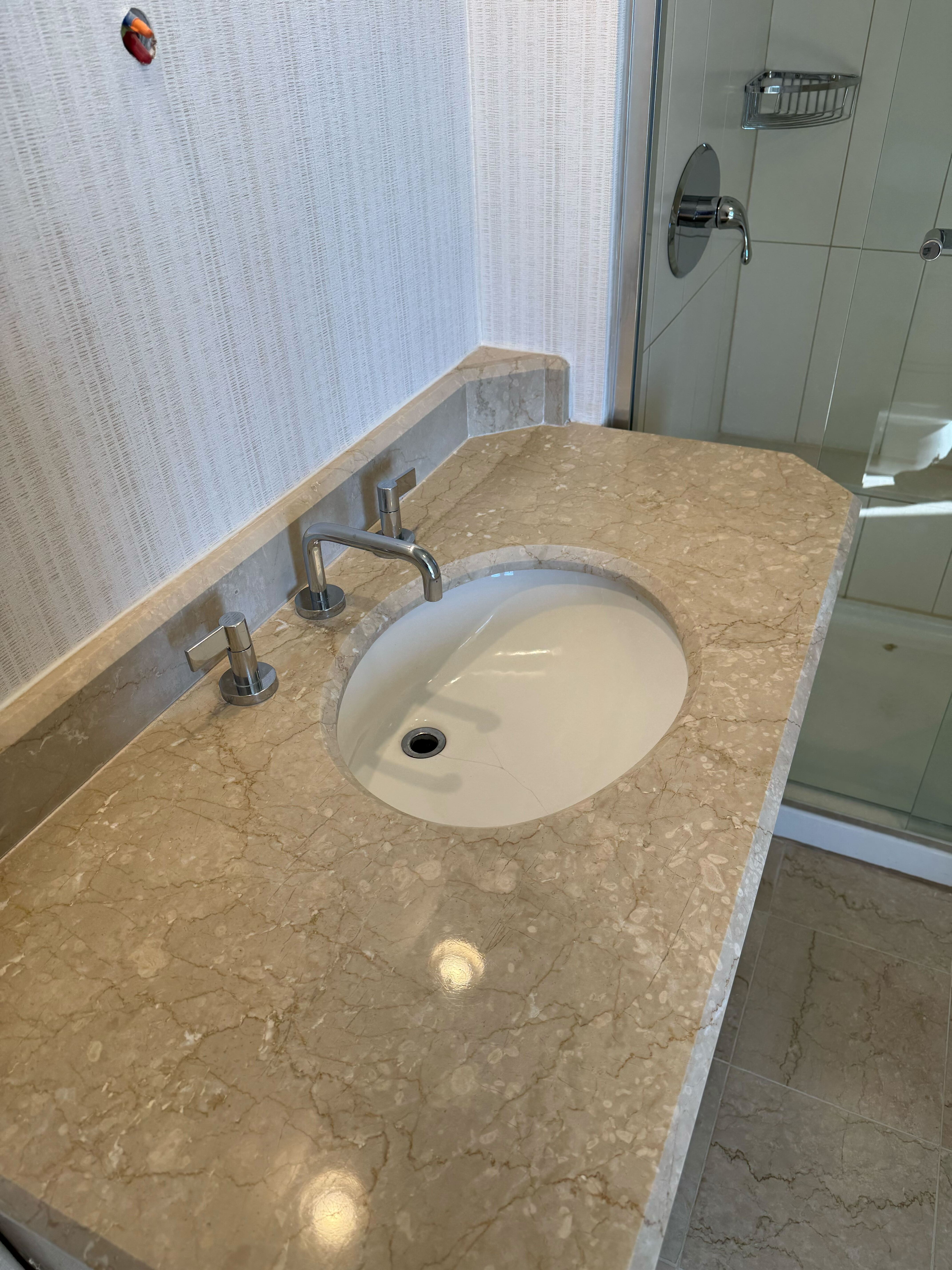
What NOT to do when you find a stain or etch on marble
Before getting to the fix, the fastest way to make a small marble problem into an expensive one is to follow the wrong advice. The internet is full of confidently-written “etch marble remover” recipes that ignore what marble actually is. Among the worst:
- Don’t use vinegar, lemon juice, or any acidic cleaner. These caused the etch in the first place; rubbing more on it makes the dull patch wider and deeper.
- Don’t use baking soda paste on a polished etch. Baking soda is a mild abrasive — it scratches the polish further and leaves a ring of haze around the original etch.
- Don’t reach for bleach on an organic stain. Bleach can lighten a stain, but it can also strip impregnating sealers and leave the stone more vulnerable to the next spill.
- Don’t use “marble polish” or wax products from a hardware store. They build up, yellow over time, and bond to dirt — and they have to be stripped before any real restoration can begin.
- Don’t sand or rub it. Even with the finest pad, removing material from polished marble without proper diamond pads, water management, and a flat plane creates a low spot that catches every light angle in the room.
The pattern in every one of those is the same: a household method that “works” on countertops in general makes things worse on marble specifically because marble’s chemistry and finish don’t tolerate it.
How professional marble restoration actually removes stains and etches
Restoration is a craft, and the steps look very different depending on whether the problem is a stain (inside the stone) or an etch (on the finish). Here is the framework Rose’s technicians use on a typical residential marble job.
For real stains — drawing the discoloration out of the stone
A stain that has soaked into the marble is removed with a poultice — a paste of an absorbent material (like diatomaceous earth, baby powder, or commercial poultice powder) mixed with the chemical that breaks down the specific stain type. The paste is applied thick, covered, and allowed to dry slowly over 24 to 48 hours. As it dries, it pulls the stain back out of the stone the same way it went in. Rust stains often need multiple poultice cycles. Old organic stains may need a hydrogen peroxide poultice followed by a clear-water rinse cycle to neutralize.
The exact chemistry — alkaline, acidic, oxidizing, solvent — has to match the stain. The wrong agent either does nothing or sets the stain permanently. This is why store-bought “marble stain remover” products produce mixed results: a single bottle can’t cover oil, organic, rust, and ink chemistry at the same time.
For etches — restoring the polish
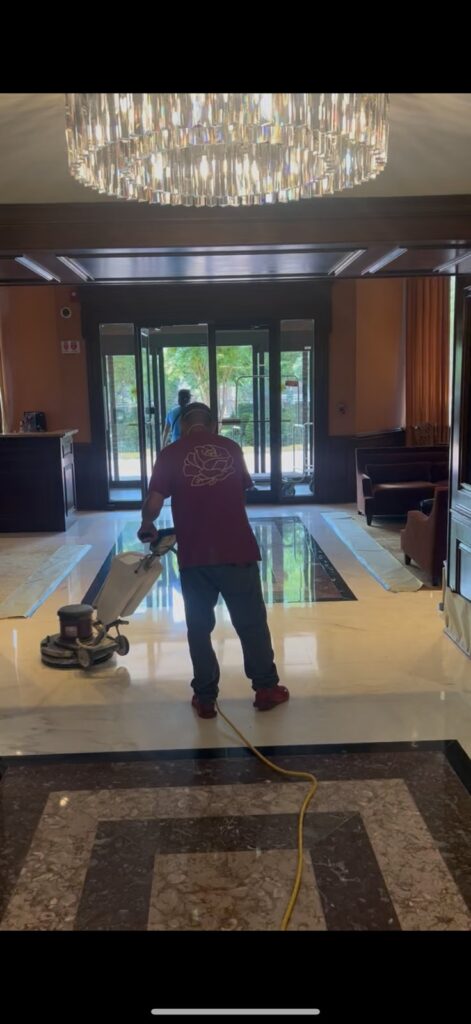
An etched marble surface has to be re-honed and re-polished. Rose’s process uses progressively finer diamond pads — typically 50, 100, 200, 400, 800, 1500, 3000 grit — wet, on a planetary floor machine for floors or a variable-speed rotary tool for countertops, vanities, and tables. The dull patch is leveled flush with the surrounding stone, then re-polished to match the original finish (honed, satin, or high-gloss polished). On a localized etch, this is a “spot polish.” On a heavily-etched countertop or floor, it becomes a full re-hone and re-polish of the whole slab or panel — which actually leaves the surface looking better than it did before the etch happened, because every old wear mark gets erased in the same pass.
If you’ve been told the only fix for etched marble is to replace the slab, that’s almost never true. We’ve restored marble that homeowners and contractors had already written off as scrap.
See the difference: marble stain protection in action
The video below shows what red wine, coffee, and oil look like on protected versus unprotected white marble. It’s the simplest way to understand why even perfectly restored marble benefits from a professional protective coating — and why Rose’s Marble Armor system has changed how a lot of our clients think about owning marble in a real, lived-in kitchen or bathroom.
Permanent stain protection: why we recommend Marble Armor for high-use marble
Traditional marble sealers are impregnators — they soak into the pore structure and reduce how fast a liquid can penetrate. They help with stains, but they do nothing to prevent etching, because they don’t change the surface chemistry. They also wear off and need reapplication every one to three years.
Rose Restoration installs Marble Armor, a durable, optically-clear surface coating that creates a true chemical barrier on top of the stone. It blocks acids before they reach the marble, holds up to daily kitchen use, and carries a 10-year warranty. For high-use kitchen islands, vanities, and bar tops where a homeowner has already been told “you can’t have marble there,” Marble Armor is what makes marble actually livable.
Marble Armor is installed only after the stone is fully restored — etches polished out, stains drawn, surface cleaned and prepped. So a typical Rose engagement that starts with a stained or etched countertop ends with the stone restored to original beauty and protected against the next spill at the same visit.
What marble restoration costs in DC, Maryland, and Virginia
Stain extraction and spot etch repair start around $450 per visit for a single problem area. Full vanity restorations typically run $850 to $1,400. Kitchen islands and full kitchen counters fall between $1,800 and $4,500 depending on size, finish, and how much etching has accumulated. Floor restoration is priced per square foot. We publish a full breakdown in our restoration cost guides and our marble restoration cost guide.
What we won’t do is quote you a price from a photo without enough context. The honest answer for almost every marble surface is: send us clear photos, and we’ll tell you what’s actually going on, whether it can be fixed in a single visit or needs a fuller restoration, and what it will cost. Send photos here.
The bottom line on stained or etched marble
If your marble has a mark, do three things in this order. First, identify whether you’re looking at a stain or an etch using the wet-finger test above. Second, leave it alone — don’t experiment with household products before a professional has seen it, because most kitchen-pantry remedies make a $400 problem into a $1,500 problem. Third, send a photo. We’ll tell you in writing what we’d do, what it costs, and whether you should be thinking about Marble Armor protection at the same time.
Rose Restoration has been restoring marble across Washington DC, Bethesda, Arlington, McLean, and the surrounding region since 1978. Every workmanship we deliver carries a one-year written warranty, and Marble Armor installations carry a 10-year warranty.
Have a stain or etch on your marble?
Send us a photo at roserestoration.com/send-photos or call 703-327-7676. We’ll tell you in writing what’s wrong, what we’d do, and what it costs — usually within one business day.
Looking for something else?
Get a Free Assessment from Rose Restoration
Tell us about your marble, stone, terrazzo, or concrete and our senior technicians will recommend the right restoration approach. Family-run and trusted across Washington DC, Maryland, and Virginia since 1978.
Call (703) 327-7676 · Email info@roserestoration.com · schedule a time · or send us photos.
Restore. Don't replace.
48 years of polishing marble, terrazzo, concrete, and tile across Washington DC, Northern Virginia, and Maryland. IMF, Four Seasons, Smithsonian, and the Virginia State Capitol trust us — you can too.