
Rose Restoration — a Washington DC stone restoration contractor — explains how poultice stain removers work, when to use them, and which chemistry to match to which stain type on marble, granite, limestone, travertine, and other natural stone.
| Stain type | Active chemistry | Absorbent base | Dwell time |
|---|---|---|---|
| Oil / grease | Mineral spirits, acetone, or methylene chloride | Diatomaceous earth or kaolin clay | 24–48 hrs, may need 2–3 cycles |
| Wine, coffee, tea | Hydrogen peroxide (12% cream developer) | Flour + peroxide or paper towels | 24 hrs, usually 1 cycle |
| Food / organic | Hydrogen peroxide | Flour or paper towels | 24 hrs |
| Mold / mildew | Alkaline cleaner or dilute bleach (3:1 water) | Paper towels | 24 hrs + ventilate |
| Rust / iron | Iron-specific rust remover | Kaolin clay | 24–48 hrs, may need 3–5 cycles |
| Ink, marker | Organic solvent or specialized ink remover | Diatomaceous earth | 24 hrs |
| Water / hard water | Hydrogen peroxide or pH-neutral | Paper towels | 12–24 hrs |
 By Tom Kuhn, CEO, Rose Restoration
Rose Restoration has restored marble, terrazzo, concrete, and natural stone across DC, MD, and VA since 1978.
A poultice is a paste applied to natural stone to draw out deep stains that regular cleaning cannot remove. It works by keeping a chemical agent in contact with the stain long enough for absorption — typically 24–48 hours under plastic wrap. The chemical breaks the bond between the staining substance and the stone’s pore structure, and the absorbent carrier material in the poultice wicks the stain upward and out as it dries. When done correctly, a poultice can remove stains that have penetrated deeply into marble, travertine, limestone, and other porous stone. It is one of the most effective DIY stone stain removal tools available, but it requires patience — there are no shortcuts. Rose Restoration International has used professional-grade poultice treatments on natural stone throughout Northern Virginia, Maryland, and Washington DC since 1978.
When this is a job for a professional
Routine cleaning is maintenance and you should do it. Anything that has changed the surface itself is not cleaning, it is refinishing, and it needs diamond abrasives and a trained hand. Call before you try to fix these:
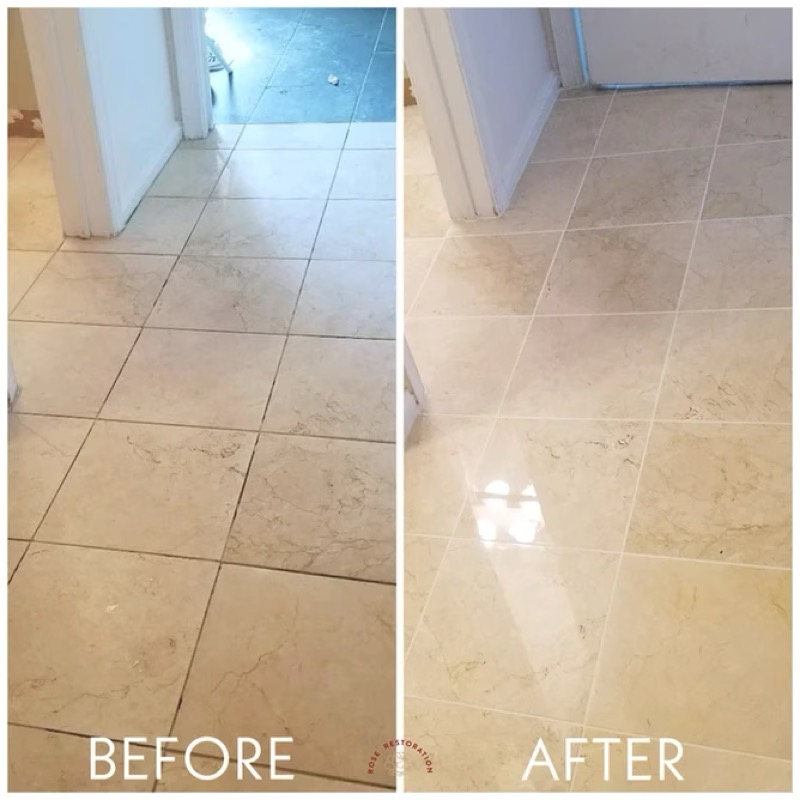
A poultice is the right tool for a stain that has soaked into the stone and the wrong one for etching, which is damage to the surface itself. Where a stain has gone deep, professional marble stain removal applies the same chemistry under controlled dwell times.
- Etch marks, meaning dull spots where something acidic sat on the stone
- Scratches you can feel with a fingernail
- Stains that have soaked in rather than sitting on top
- Cloudiness across a whole floor rather than in one spot
- Any damage on a surface you cannot afford to make worse
Attempting these with consumer products usually deepens the damage and increases what the repair costs. Send us photos first and we will tell you honestly whether it is a maintenance job or a restoration job: send photos or call 703-327-7676.
What Is a Stone Poultice?
A stone poultice is a paste-like mixture that combines an absorbent carrier material (such as baking soda, diatomaceous earth, or kaolin clay) with a chemical agent (such as hydrogen peroxide, acetone, or a rust remover) selected to target the specific type of stain. The mixture is spread over the stain at a thickness of about ¼ inch, covered tightly with plastic wrap, and left in place for 24–48 hours.
How it works — the absorption principle:
Natural stone is porous. When a liquid stains stone, it penetrates into the pore structure and cannot be removed by surface cleaning alone. A poultice works because the chemical agent re-dissolves or breaks the staining compound, while the wet absorbent carrier creates a moisture gradient that pulls the dissolved stain upward through the stone pores and into the poultice as it dries. Think of it as reversing the staining process.
When to use a poultice:
- When a stain does not respond to pH-neutral stone cleaner
- When the stain has been present for more than a few days and has had time to penetrate deeply
- When you can identify the type of stain (oil, organic, rust) and select the appropriate chemical agent
- On relatively small, discrete stain areas (a few inches to a few square feet)
A poultice is not appropriate for etching (the dull, rough areas caused by acid contact with marble or limestone — that is a different problem requiring polishing, not stain removal).
Types of Stains and Which Poultice to Use
Choosing the right chemical agent is the most important decision in the poultice process. Using the wrong agent will not remove the stain and may cause additional damage. Identify the stain type before mixing anything.
Organic Stains (coffee, tea, wine, food, leaves, mildew)
Organic stains are caused by plant-based and biological materials. They typically appear as brownish, tan, or pinkish discoloration. The appropriate chemical agent is hydrogen peroxide (12% or higher concentration), sometimes combined with a few drops of household ammonia for stubborn stains. Mix with baking soda or diatomaceous earth to form a paste. Do not use hydrogen peroxide on dark stones — it can lighten or bleach them. This formula is best suited to white and light-colored marble, limestone, and travertine.
Oil-Based Stains (cooking oil, grease, cosmetics, tar)
Oil-based stains appear as dark, greasy patches that may be slightly shiny. The appropriate solvent is acetone (nail polish remover) or mineral spirits. Mix with diatomaceous earth or kaolin clay. Acetone evaporates quickly, so work in small batches and apply plastic wrap immediately. Acetone is safe for most natural stone, but do a small test area on an inconspicuous spot first.
Rust Stains (iron, metal objects, water with high iron content)
Rust stains are orange, brown, or reddish-orange. They come from iron-containing materials left on the stone — planters, metal furniture, cans — or from iron-rich water. The appropriate chemical is a commercial rust remover formulated for use on stone (Iron Out or a product labeled safe for marble). Mix with diatomaceous earth or kaolin clay. Rust stains are among the most difficult to remove completely, especially if old.
Water Spots and White Haze — Usually Not a Stain
White spots, haze, or dull areas on marble are most often etching — damage to the stone surface caused by acid contact (citrus juice, vinegar, wine, cleaning products). Etching is a physical change to the stone surface, not a stain, and it cannot be removed with a poultice. It requires mechanical re-polishing. Learn more about the difference in our guide to how to fix etched, dull, or stained marble.
How to Make and Apply a Marble Poultice: Step by Step
Follow these six steps carefully. Rushing or skipping steps is the most common reason poultice treatments fail.
- Step 1 — Identify the stain type
Determine whether the stain is organic, oil-based, or rust (see section above). If you are not sure, start with hydrogen peroxide on light stone or acetone on any stone — these are the two most versatile options for unknown stains. - Step 2 — Wet the stained area
Lightly dampen the stained stone with distilled water before applying the poultice. A slightly wet surface helps the chemical agent penetrate rather than just sitting on the surface. - Step 3 — Mix the poultice
Combine the chemical agent with the absorbent carrier material in a non-metallic bowl. Stir until you reach a thick paste consistency — similar to peanut butter or thick spackle. It should hold its shape without running. Too wet and it will drip off vertical surfaces; too dry and it will not maintain contact with the stone. - Step 4 — Apply ¼ inch thick and extend beyond the stain
Spread the poultice over the stain with a plastic or wooden spatula to a thickness of about ¼ inch (6 mm). Extend the poultice an inch or two beyond the edges of the visible stain, as the stain may extend further than it appears on the surface. - Step 5 — Cover with plastic wrap and tape edges
Press a sheet of plastic wrap over the poultice and tape all edges securely to the stone with painter’s tape. The plastic wrap slows evaporation, which forces the chemical agent to dwell in the stone longer before the poultice dries out. Leave in place for 24–48 hours. Do not rush this step. - Step 6 — Remove, rinse, and evaluate
Remove the plastic wrap and allow the poultice to dry completely if it is not already dry (it will turn lighter in color as it dries). Remove the dried poultice with a plastic scraper, then rinse the area thoroughly with distilled water and dry with a clean cloth. Evaluate the result. A second application may be needed for deep or old stains.
Poultice Materials and Where to Find Them
You do not need specialty stone supplies for most poultice treatments. The required materials are commonly available:
- Baking soda — An excellent absorbent carrier for organic stains when combined with hydrogen peroxide. Available at any grocery store.
- Diatomaceous earth — A finely ground mineral powder with high absorbency. The best all-purpose carrier material for poultices. Available at hardware stores, garden centers, and online.
- Kaolin clay (china clay) — A fine white clay used in professional stone care. Available from stone supply houses and online retailers. Slightly better than diatomaceous earth for oil stains.
- Hydrogen peroxide (12% or higher) — Available at beauty supply stores (labeled as ’40 volume developer’) or online. The 3% drug store concentration is often too weak for deep organic stains.
- Acetone — Available at hardware stores and home centers (look in the paint thinner section). Use in a ventilated area.
- Plastic wrap and painter’s tape — Available everywhere.
- Commercial rust remover for stone — Available at stone supply houses and some hardware stores. Verify the label states it is safe for marble or natural stone before purchasing.
When a Poultice Won’t Work — And When to Call a Professional
A poultice is a powerful tool, but it has limitations. Save yourself time and avoid potential damage by recognizing these situations:
- Old, deeply set stains — Stains that have been in the stone for years have often undergone chemical changes that make them very difficult or impossible to remove with DIY poultice treatments. Professional-grade compounds and equipment can sometimes achieve results that consumer products cannot, but even professionals cannot guarantee removal of every old stain.
- Etching — As noted above, dull, rough, or whitish areas on marble and limestone that result from acid contact are not stains. They are physical damage to the stone surface that requires mechanical re-polishing. A poultice will do nothing for etching.
- Large areas — Poultices work well for discrete, contained stain areas. Trying to poultice a large stained section (several square feet or an entire floor) is impractical for DIY and may produce uneven results.
- Multiple stain types — If you are not sure what caused the stain, or if there appear to be multiple stain types overlapping, professional assessment is advisable. Using the wrong chemical can set a stain permanently or damage the stone surface.
- High-value or irreplaceable stone — If the stone is antique, rare, or part of a significant architectural feature, do not experiment with DIY treatment. Call a professional.
If you are not confident about the stain type, if multiple attempts have not produced results, or if the stone is valuable, our residential marble restoration service includes professional stain removal assessment. Contact us to discuss your situation.
Frequently Asked Questions About Stone Poultices
How long should I leave a poultice on marble?
24–48 hours is the standard dwell time, covered with plastic wrap. Leaving it longer — up to 72 hours for stubborn stains — rarely causes harm but does not always improve results. Do not remove it prematurely. The poultice must dry completely to pull the stain out; removing a wet poultice can redeposit the stain.
How many times do I need to apply a poultice?
Deep or old stains often require 2–3 applications before they are fully removed or reduced to an acceptable level. Apply a fresh poultice after each 24-hour cycle and evaluate the result after each application. Most stains show significant improvement after the first or second application.
Will a poultice damage my stone?
When the correct chemical agent is used for the stain type, a poultice will not damage natural stone. The primary risks are using the wrong chemical (e.g., hydrogen peroxide on dark stone causing bleaching, or an acidic rust remover causing etching on marble) or using a highly concentrated solvent that attacks the stone surface. Always test on an inconspicuous area first.
Does a poultice work on granite?
Yes, though granite is less porous than marble and limestone, so stains do not penetrate as deeply and are sometimes easier to remove. The same chemical agent selection principles apply. Hydrogen peroxide is generally safe on light granite; test first on dark granite.
When should I call a professional instead of DIY?
Call a professional if: the stain does not respond after 2–3 DIY attempts, the stain covers a large area, you are not sure whether you are dealing with a stain or etching, the stone is high-value or irreplaceable, or you see any signs of structural deterioration. Rose Restoration International serves Northern Virginia, Maryland, and DC — call 703-327-7676.
A stone poultice is one of the most effective tools for DIY stain removal from natural stone — but success depends on correctly identifying the stain type, using the right chemical agent, and giving the poultice adequate dwell time. When DIY is not enough, or when you want professional results from the start, Rose Restoration International is here to help.
We have restored marble, limestone, travertine, and other natural stone surfaces in homes and commercial properties throughout Northern Virginia, Maryland, and Washington DC since 1978. Our stone restoration specialists assess stains accurately, select the appropriate treatment chemistry, and restore your stone to the condition you expect — without guesswork or unnecessary damage. Call us at 703-327-7676 or request a free estimate online. We serve Fairfax, Arlington, Alexandria, McLean, and the broader DC metro area.
Request a Free Stone Restoration Estimate
Looking for something else?
Related from Rose Restoration: residential stone restoration services · free stone care guide
Rose Restoration — local service areas
For professional stone stain removal, Rose Restoration serves: Marble restoration in Washington, DC · Alexandria, VA · natural stone restoration.
Get a Free Assessment from Rose Restoration
Tell us about your marble, stone, terrazzo, or concrete and our senior technicians will recommend the right restoration approach. Family-run and trusted across Washington DC, Maryland, and Virginia since 1978.
Call (703) 327-7676 · Email info@roserestoration.com · schedule a time · or send us photos.
Restore. Don't replace.
48 years of polishing marble, terrazzo, concrete, and tile across Washington DC, Northern Virginia, and Maryland. IMF, Four Seasons, Smithsonian, and the Virginia State Capitol trust us — you can too.