
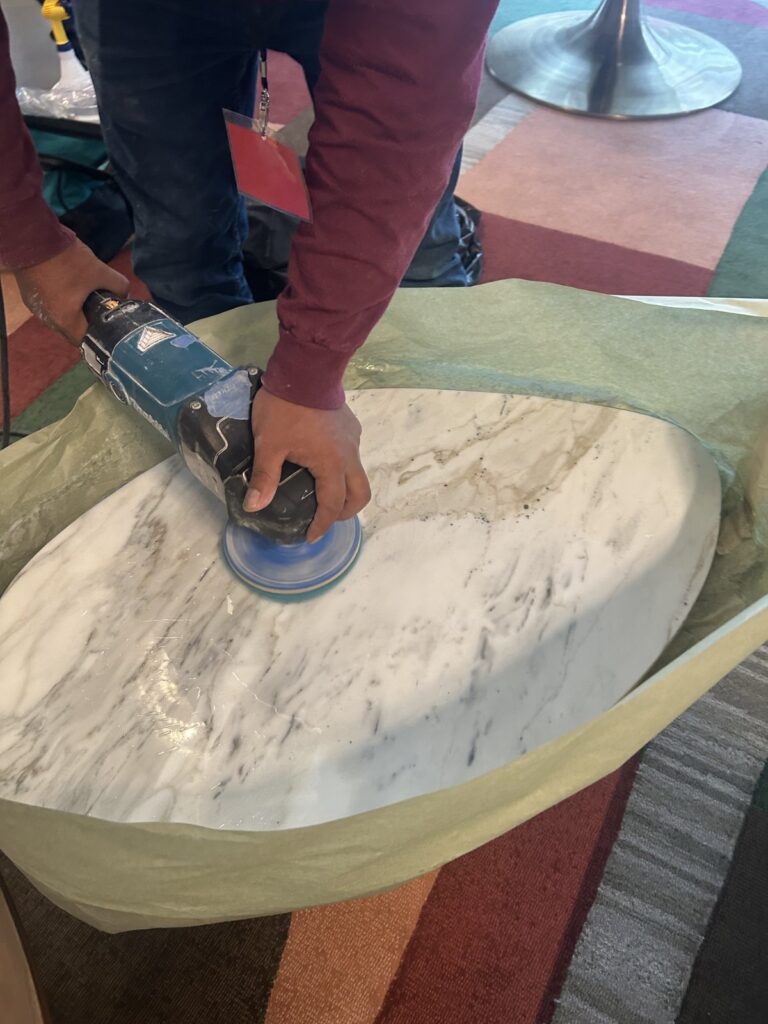
The Complete Hotel Stone Maintenance Program Guide: Scheduling, Budgeting, and Vendor Selection for Property Managers
Natural stone floors define the guest experience in hospitality properties. Marble lobbies, granite corridors, terrazzo ballrooms, and limestone restroom surrounds communicate a standard of care that guests register within seconds of arrival. But these surfaces operate under conditions that would be unrecognizable to a residential homeowner: thousands of daily foot passes, luggage cart traffic, chemical exposure from cleaning products and spills, and 24/7 operational demands that make daytime maintenance nearly impossible.
A structured hotel stone maintenance program is the difference between a property that sustains its design intent for decades and one that cycles through expensive restoration projects every few years. This guide covers everything property managers and directors of engineering need to build, budget, and manage that program: maintenance schedules by frequency, cost frameworks by stone type, the operational case for overnight service, area-by-area considerations, protective treatments, vendor evaluation criteria, and the financial math that makes proactive maintenance the clear winner over reactive repair.
Why Hotel Stone Maintenance Requires a Structured Program
Hotel marble takes more abuse in a single month than residential marble takes in an entire year. The variables are compounding: abrasive grit carried in on thousands of shoes acts like sandpaper with every step. Luggage carts concentrate enormous pressure on small contact points, creating micro-fractures and scratches along predictable routes. Acidic spills from coffee, wine, and citrus drinks etch polished marble on contact. And housekeeping chemicals that are not pH-neutral cause cumulative surface damage that only becomes visible after months of use.
Without a systematic maintenance schedule, these forces produce a predictable deterioration pattern: dull wear paths from entrance to front desk, scratched elevator thresholds, etched restroom vanities, and stained grout lines that make even recently installed stone look neglected. By the time the damage is visible to guests or flagged in a brand audit, the property is facing a full restoration project rather than a routine maintenance visit.
Properties that invest in ongoing maintenance programs spend 60 to 70 percent less on stone care over a 10-year period compared to properties that wait until floors look bad. The math is straightforward, and the operational benefits extend well beyond cost savings.
Hotel Stone Maintenance Schedule: Daily Through Annual
A comprehensive hotel stone maintenance program operates across five timeframes. Each serves a distinct purpose, and none substitutes for the others.
Daily Maintenance (In-House Housekeeping)
- Dust mop all stone surfaces with clean, dry microfiber pads before the building opens and again during midday if traffic is heavy. This removes the abrasive grit that causes micro-scratches when walked on. It is the single most impactful daily maintenance task for any stone floor.
- Spot-clean spills immediately. Coffee, juice, wine, and soda are acidic and begin etching polished marble within minutes. Blot (do not wipe) and clean with a pH-neutral stone cleaner. Keep blotting cloths and approved cleaner accessible to front desk and bell staff.
- Use only pH-neutral cleaners. Eliminate all acidic, alkaline, or abrasive cleaning products from your housekeeping arsenal for stone areas. Products containing vinegar, bleach, ammonia, or citrus destroy stone finishes over time. Train staff on this requirement and verify compliance regularly.
- Inspect and replace walk-off mats at every entrance. A 12- to 15-foot run of quality walk-off matting captures 80 to 90 percent of incoming grit and moisture. A saturated or debris-filled mat is worse than no mat at all.
Weekly Maintenance (In-House)
- Damp mop all lobby and corridor stone floors with a pH-neutral stone cleaner diluted per manufacturer instructions. Use clean water and change it frequently to avoid redepositing grit.
- Inspect high-traffic areas for developing wear patterns, etching, or scratches. Early detection allows for targeted professional maintenance before damage spreads.
- Clean grout lines in tiled areas to prevent discoloration and water infiltration.
- Wipe elevator thresholds after each housekeeping cleaning round.
- Check entrance areas for salt and de-icing chemical damage during winter months.
Monthly Maintenance (Professional or In-House)
- Spray buff or burnish high-traffic areas to maintain gloss. This light maintenance polishing addresses minor wear before it becomes visible to guests.
- Deep clean grout and stone in restroom areas.
- Professional elevator panel cleaning (brass, stainless, and stone surrounds).
- Inspect elevator surrounds and thresholds for chips or cracks.
- Review and restock cleaning supplies to ensure only approved products are in use.
Quarterly Maintenance (Professional)
- Complete lobby and elevator landing diamond honing and re-polish to address accumulated traffic wear.
- Deep grout cleaning and color sealing in guest restrooms and public areas.
- Metal polishing for brass fixtures, handrails, and elevator trim.
- Guest room vanity etching correction (quarterly timing works well for addressing accumulated chemical damage from toiletries and cleaning products).
- Crack and chip repair on high-traffic stone surfaces.
- Detailed before-and-after documentation for your maintenance records.
Annual Maintenance (Professional)
- Comprehensive stone condition assessment covering all public areas: lobby, corridors, restrooms, ballrooms, meeting rooms, and exterior stone.
- Full resealing with an impregnating (penetrating) sealer across all stone surfaces. Sealer effectiveness diminishes over time, especially in high-traffic zones.
- Deep restoration of high-wear areas: elevator thresholds, main lobby traffic lanes, front desk surrounds.
- Lippage correction where structural settling has created uneven tile edges.
- Grout replacement in areas where grout has cracked, failed, or deteriorated beyond cleaning.
Properties with exceptionally high foot traffic, such as convention hotels, resort lobbies, and casino floors, may need monthly professional service in their highest-traffic zones rather than quarterly.
Maintenance Considerations by Hotel Area
Not every stone surface in a hotel property has the same maintenance profile. Traffic volume, exposure type, and guest visibility vary significantly by area.
Lobby and Entrance
The highest-traffic, highest-visibility surface in the property. Lobby floors see the most concentrated foot traffic and the most grit exposure from exterior entrances. Wear paths develop along predictable routes: entrance to front desk, front desk to elevators, entrance to restaurant. These zones need the most frequent professional attention. Walk-off mats at every exterior door are non-negotiable.
Elevator Landings and Thresholds
Nearly universal damage points in stone-floored hotels. Carts, luggage dollies, and heavy suitcases cross thresholds dozens of times daily. This concentrated traffic combined with metal threshold strips creates accelerated wear in confined areas. Thresholds often need professional attention more frequently than surrounding floor areas.
Guest Room Bathrooms and Vanities
Chemical etching is the primary issue. Perfume, cologne, hair products, toothpaste, and cleaning chemicals all react with marble vanity surfaces. Guests do not realize these products permanently dull marble. Quarterly professional polishing corrects accumulated damage. For high-occupancy properties, Marble Armor treatment on vanity surfaces can reduce polishing frequency from quarterly to annually.
Restrooms and Public Areas
Grout condition is the primary maintenance concern. Stone may look acceptable while deteriorating grout makes the entire space appear neglected. Monthly deep cleaning of grout lines and quarterly color sealing maintain appearance. Full grout replacement on an as-needed basis during annual assessments.
Ballrooms and Meeting Rooms
Lower daily traffic than lobbies, but event setup and teardown (tables, chairs, staging equipment) creates concentrated impact damage. Pre- and post-event inspections, combined with annual professional polishing, are typically sufficient. Protective floor runners during heavy setup are recommended.
Pool, Spa, and Exterior Stone
Chlorine, sunscreen, pool chemicals, and weather exposure require more aggressive sealing schedules. Without proper sealing and regular maintenance, pool area stone deteriorates rapidly. Semi-annual sealer reapplication is common for pool-adjacent surfaces.
The Case for Overnight Scheduling
Most professional hotel stone maintenance work occurs between 10 PM and 6 AM. During business hours, lobbies are too active for floor polishing, and the equipment required, including high-speed buffers, diamond polishing pads, and wet vacuums, creates noise and conditions that are incompatible with guest operations.
Effective overnight hotel work goes beyond stone care technique. Crews must coordinate with front desk and security staff, understand emergency protocols, recognize late arrival timing, and complete all work before morning shifts begin. Contractors lacking hotel-specific overnight experience struggle with logistics regardless of their technical skill.
A phased overnight approach is most effective. Rather than addressing the entire property in a single night, experienced contractors work in sections: main lobby entrance one night, elevator lobby the following night, restaurant corridor the following week. This allows thorough completion of each area while minimizing disruption and keeping the lobby operational throughout the program.
Dust containment and sound management are critical in guest-occupied buildings. Professional overnight crews use dust barriers, walk-off mats, and wet extraction methods to prevent polishing dust from migrating to guest areas. Equipment selection matters: some polishing machines operate significantly quieter than others.
Marble Armor: Reducing Maintenance Frequency on High-Exposure Surfaces
Traditional penetrating sealers protect against staining by preventing liquid absorption, but they do not prevent etching. A sealed marble vanity will still etch when cologne or coffee contacts the surface. For hotel surfaces that face daily acid exposure, including vanities, bar tops, reception desks, and restaurant tables, this creates a cycle of damage and quarterly polishing that never ends.
Marble Armor addresses this by bonding molecularly with the stone, creating a surface that resists both staining and etching. Hotel vanities treated with Marble Armor withstand chemical exposure that would etch and dull untreated marble.
The operational impact is significant: properties using Marble Armor typically reduce polishing frequency on treated surfaces from quarterly to annually or less. At $10 to $35 per square foot, Marble Armor pays for itself within one to two polishing cycles compared to the labor cost of repeated quarterly restoration. For high-occupancy room vanities, bar tops, and reception desks, it represents the best long-term value in hotel stone protection.
Budgeting Your Hotel Stone Maintenance Program
The financial comparison between proactive maintenance and reactive restoration is the strongest argument for a structured program.
Proactive vs. Reactive: The 10-Year Comparison
| Approach | Cost Per Sq Ft | 5,000 SF Lobby (10 Years) | Appearance |
|---|---|---|---|
| Proactive annual maintenance | $2 – $5/SF/year | $100,000 – $250,000 | Consistently excellent |
| Reactive restoration every 3-5 years | $8 – $15+/SF per event | $80,000 – $250,000+ | Deteriorates between restorations |
| Full stone replacement | $25 – $60+/SF | $125,000 – $300,000+ | Weeks of guest disruption |
Hotels that invest in quarterly or monthly maintenance programs spend 60 to 75 percent less over a five-year period compared to properties that wait until restoration is unavoidable, while maintaining a consistently pristine appearance every day of the year.
Annual Maintenance Costs by Stone Type
- Marble: $1.50 – $3.00 per square foot annually. The most maintenance-intensive natural stone due to its softness and acid sensitivity.
- Granite: $0.75 – $1.50 per square foot annually. Harder and more resistant to scratching and etching, requiring less frequent professional intervention.
- Terrazzo: $1.00 – $2.00 per square foot annually. Exceptionally durable, but still requires periodic diamond polishing to maintain reflective clarity.
- Limestone: $2.00 – $3.50 per square foot annually. Similar acid sensitivity to marble with additional porosity concerns.
Program Structure Options
- Monthly retainer: Most common for full-service hotels. Spreads costs evenly with 2 to 4 scheduled visits monthly. Provides the most consistent appearance and the most predictable budgeting.
- Quarterly intensive: 30 to 40 percent less expensive than monthly programs. Concentrates professional work into quarterly sessions. Requires stronger in-house daily and weekly maintenance between visits.
- Annual contract with on-call service: Best suited for seasonal properties or those with lower daily traffic. Includes 1 to 2 comprehensive visits annually plus on-call emergency service for pre-event prep or damage response.
Building Your Budget
- Inventory all stone surfaces by type, location, and square footage.
- Assess traffic patterns and identify high-wear zones that need more frequent attention.
- Establish baseline condition through a professional stone assessment.
- Apply per-square-foot rates by stone type to calculate annual professional maintenance costs.
- Add 10 to 15 percent contingency for unexpected needs: pre-event emergency polishing, spill damage, seasonal salt damage.
Common Maintenance Mistakes That Cost Hotels Money
After maintaining hotel lobbies across the Washington DC metro area for 47 years, we see the same mistakes repeatedly:
- Using generic floor cleaners. Products containing acids, ammonia, or abrasives destroy stone finishes over time. The cumulative damage from months of incorrect product use often requires a full restoration to correct.
- Skipping the sealer. Unsealed stone absorbs stains from spills, luggage wheels, and foot traffic. Annual resealing is a fraction of the cost of stain removal.
- Buffing instead of polishing. Floor buffers with incorrect pads can scratch and dull stone surfaces. Professional diamond polishing restores the stone itself; buffing with the wrong equipment just makes it worse.
- Applying topical coatings. Crystallizers, waxes, and acrylic coatings create a temporary shine by coating the surface rather than restoring the stone. They wear off quickly, yellow over time, and make future professional restoration more difficult because the coatings must be stripped first.
- Waiting too long between professional visits. Once wear patterns are visible to guests, the damage requires significantly more work to correct. Proactive maintenance addresses wear before it becomes visible.
- Ignoring grout lines. Dirty or crumbling grout makes even well-maintained stone look neglected and allows water infiltration that damages stone from below.
How to Evaluate a Hotel Stone Maintenance Vendor
Not every stone restoration contractor has the infrastructure, experience, or operational discipline to serve hotel properties. Here is what to evaluate:
- Overnight capability: Dedicated overnight crews with hotel-specific experience, not merely a willingness to work late. Ask specifically about how many occupied hotel properties they maintain with overnight service currently.
- Phased scheduling: Ability to plan multi-week maintenance programs addressing different property areas on different nights, minimizing disruption and respecting housekeeping schedules.
- Dust containment systems: Professional contractors use specialized equipment preventing polishing residue from reaching guest areas. Ask about specific systems and methods used.
- Consistent crew assignment: The same crews every visit learn your property, know security protocols, and deliver predictable results. High crew turnover is a warning sign.
- SLA specifics: Effective contracts specify response times, appearance standards (objective metrics such as gloss meter readings, not subjective judgments), defined scope boundaries, material specifications, and monthly/quarterly reporting with photographic documentation.
- Hotel references: Ask for references from hotel property managers or directors of engineering you can speak with directly. Ask about quality, schedule adherence, cleanliness during work, and how floors have held up.
- Insurance and compliance: General liability, workers’ compensation, and the ability to provide additional insured status for your property’s risk management requirements.
Red flags: contractors lacking overnight experience, unable to provide hotel references, offering inconsistent crews or subcontracting to unknown parties, quoting prices without seeing the property in person, or not offering structured maintenance programs with ongoing service.
Frequently Asked Questions
How often should hotel marble be professionally polished?
Most hotel lobbies benefit from quarterly professional diamond honing and polishing to address accumulated traffic wear, with monthly buffing maintaining surfaces between full polish cycles. High-wear areas like elevator thresholds may need more frequent attention. Properties using Marble Armor on treated surfaces can often extend polishing intervals significantly.
How much does a hotel stone maintenance program cost?
Annual costs vary by stone type ($0.75 to $3.50 per square foot), service frequency, and property size. A 5,000-square-foot marble lobby on a monthly retainer program typically runs $6,000 to $15,000 annually. The most accurate approach is a free on-site assessment where a professional evaluates your specific conditions and develops a customized scope and quote.
Can maintenance work be done without disturbing hotel guests?
Yes. Professional hotel stone maintenance is performed during overnight hours, typically between 10 PM and 6 AM, using dust containment systems that prevent residue from reaching guest areas. Experienced crews coordinate with front desk and security staff and work in phased sections to minimize any impact on guest operations.
What is the difference between sealing and Marble Armor?
Traditional penetrating sealers protect against staining by preventing liquid absorption into the stone’s pores. However, they do not prevent etching from acidic contact. Marble Armor bonds molecularly with the stone to resist both staining and etching, making it ideal for high-exposure surfaces like vanities, bar tops, and reception desks where acidic contact is frequent.
How long does a full hotel lobby restoration take?
A typical hotel lobby can be completed within one to two weeks when working in overnight phases to keep the lobby operational. Smaller projects or lobbies in better condition may take less time. The purpose of a maintenance program is to avoid reaching the point where a full restoration is necessary.
Should we have our janitorial team handle stone polishing in-house?
Daily maintenance (dust mopping, spot cleaning, damp mopping) should absolutely be handled by in-house staff. However, diamond honing and polishing require professional-grade weighted floor machines, a full range of diamond abrasives, and trained operators. Improper technique can gouge marble, create uneven surfaces, or remove more material than necessary. The cost per year of professionally maintained appearance is almost always lower than in-house attempts that produce inconsistent results and risk permanent damage.
Build Your Hotel’s Maintenance Program
If your hotel’s stone surfaces are showing signs of wear, or if you want to prevent that from happening, a structured maintenance program is the most cost-effective investment you can make. Rose Restoration works with luxury hotels, boutique properties, and hospitality groups throughout Virginia, Maryland, and Washington DC. We design customized maintenance programs based on your property’s specific stone and metal surfaces, traffic patterns, and brand requirements.
Contact us at (703) 327-7676 to schedule a free property assessment and receive a customized maintenance plan for your hotel.
This is how most of our DC hospitality marble clients structure their stone maintenance — a flat annual program rather than reactive call-outs after etching is already visible to guests.
Get a Free Assessment from Rose Restoration
Tell us about your marble, stone, terrazzo, or concrete and our senior technicians will recommend the right restoration approach. Family-run and trusted across Washington DC, Maryland, and Virginia since 1978.
Call (703) 327-7676 · Email info@roserestoration.com · or send us photos.

Restore. Don't replace.
47 years of polishing marble, terrazzo, concrete, and tile across Washington DC, Northern Virginia, and Maryland. IMF, Four Seasons, Smithsonian, and the Virginia State Capitol trust us — you can too.
Watch the Process
Real Rose Restoration projects on video — no stock footage, no staged demonstrations.