
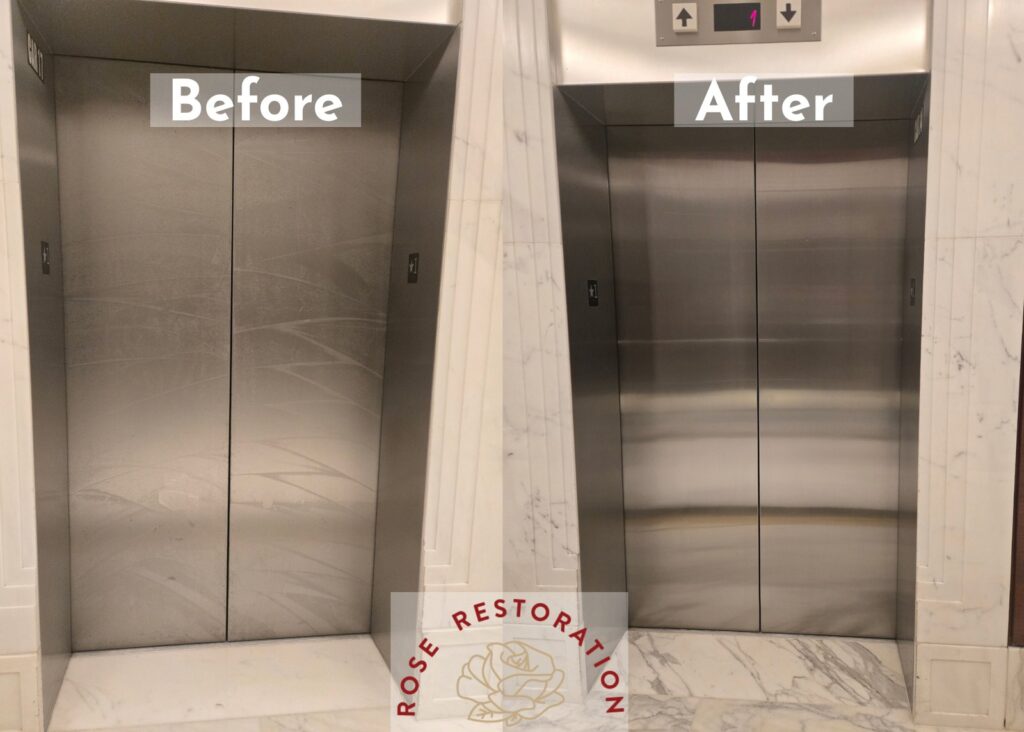
Commercial metal polishing restores brass, bronze, stainless steel, and aluminum surfaces in corporate buildings — including elevator interiors, lobby fixtures, handrails, door hardware, and signage — to their original luster without replacement. Tarnish, oxidation, scratches, and surface corrosion are a normal consequence of daily use in high-traffic environments, but they do not mean the metal needs to be removed. Professional restoration returns these surfaces to like-new condition at a fraction of replacement cost, often with minimal disruption to building operations. Rose Restoration International has provided commercial metal polishing and restoration services to corporate buildings, hotels, government facilities, and mixed-use properties throughout Northern Virginia, Maryland, and Washington DC for more than 40 years.
Why Corporate Buildings Need Metal Restoration
First impressions matter in corporate real estate. Visitors, clients, and tenants form an opinion of a building within seconds of entering the lobby. Tarnished brass elevator doors, oxidized bronze handrails, or scratched stainless steel wall panels communicate neglect — even if the rest of the building is meticulously maintained.
Beyond aesthetics, metal surfaces in commercial buildings are significant capital assets. Original brass and bronze architectural features in older buildings are increasingly difficult and expensive to replicate. Allowing them to deteriorate through neglect, or replacing them with inferior materials, diminishes the character and value of the property.
Tenant satisfaction is directly tied to the perceived quality of shared spaces. Property managers who invest in regular metal maintenance report higher tenant retention rates and fewer complaints about building appearance. Proactive restoration also avoids the much higher cost of emergency repairs or full replacement when deterioration is allowed to progress unchecked.
Elevator interiors, in particular, see more physical contact per square foot than almost any surface in a building. Without periodic professional polishing and re-lacquering, the metal surfaces in a busy elevator can go from pristine to obviously worn in as little as 12–18 months.
Common Metal Surfaces in Commercial Buildings
Corporate buildings contain a wide range of metal surfaces that benefit from professional restoration. The most common include:
- Elevator interiors — Wall panels, doors, door frames, cab ceilings, handrails, and control panels in brass, bronze, stainless steel, and brushed aluminum.
- Lobby fixtures — Ornamental metalwork, light fixture housings, reception desk trim, column cladding, and decorative grilles.
- Handrails and balustrades — Stairwell and mezzanine railings in brass, bronze, stainless, and aluminum experience constant hand contact and wear.
- Door hardware and frames — Push plates, pull handles, kick plates, and door frames at building entrances and throughout common areas.
- Escalator trim — Side panels, balustrades, and trim pieces on escalators in multi-level buildings.
- Building signage — Dimensional metal lettering, directory plaques, and wayfinding signs in lobby and common areas.
- Mailboxes and postal fixtures — Common in mixed-use and residential tower lobbies.
Learn more about our full range of capabilities on our metal restoration service page. If it is metal and it is tarnished, corroded, or scratched, we can almost certainly restore it.
Types of Metal We Restore
Different metals tarnish and corrode by different mechanisms, and each requires a tailored restoration approach. Our technicians are trained to identify the alloy and surface condition before selecting the appropriate process.
- Brass — A copper-zinc alloy that tarnishes to a dull brown or develops green patina (verdigris) in humid environments. Polishing removes the oxide layer and restores the warm yellow luster. Clear lacquer is applied to slow future tarnishing.
- Bronze — A copper-tin alloy with a slightly darker, redder tone than brass. Architectural bronze is extremely durable but develops a patina over time. We restore both naturally patinated bronze (preserving intentional aged looks) and polished bronze where high luster is desired.
- Stainless steel — Resistant to corrosion but susceptible to scratches, smudges, and surface marring. Restoration involves scratch removal, grain re-establishment (brush or mirror finish), and protective coating application.
- Aluminum — Lightweight and common in modern buildings. Oxidizes to a dull gray. Anodized finishes can be restored with the right abrasive sequence and sealers.
- Copper — Develops green or black patina rapidly. We restore copper to bright finish or to a controlled patina depending on the design intent.
- Nickel and chrome — Common in hardware and plumbing fixtures. Pitting and dullness from water mineral deposits are typical failure modes.
The Metal Restoration Process
Professional metal restoration is a systematic process. Cutting corners at any stage produces inferior results that fail quickly. Our standard process includes:
- Assessment — We inspect the metal type, surface finish, extent of tarnish or corrosion, existing coatings, and any physical damage. This determines the appropriate abrasive sequence and chemical treatments.
- Stripping existing lacquer or coatings — Most architectural metals are factory-lacquered. Old lacquer must be chemically stripped before polishing, or the polishing compounds will be trapped under degraded coating layers.
- Cleaning and degreasing — Surface contamination (oil, dirt, mineral deposits) is removed with appropriate solvents and cleaners before abrasive work begins.
- Polishing and buffing — A progression of abrasive compounds, from coarser cutting compounds down to fine finishing compounds and rouge, removes oxidation, scratches, and surface imperfections and restores luster.
- Protective coating application — Once the desired finish is achieved, a clear lacquer or wax is applied to protect the surface and extend the time between future restorations. Lacquer is appropriate for most indoor architectural metals. Wax is used where lacquer is impractical.
We protect surrounding surfaces before starting any work and clean up thoroughly upon completion. Our crews are trained to work in occupied buildings with minimal disruption to tenants and building operations.
Elevator Interior Restoration
Elevator interior restoration is the single most requested commercial metal service we provide. Elevator cabs are the most heavily trafficked metal surfaces in any multi-story building — every tenant, visitor, and delivery person passes through them dozens of times per day.
The typical elevator restoration project involves stripping old lacquer from brass or bronze panels, polishing all metal surfaces to the original finish specification, and applying fresh lacquer. In many cases, we also address scratches in stainless steel walls, refinish wood or laminate panels, and clean or replace lighting.
Restoration vs replacement — Replacing an elevator interior is an expensive and disruptive project that can run $15,000–$50,000 per cab depending on the building and design. Professional restoration of the existing metalwork typically costs 10–25% of replacement and produces results that are visually indistinguishable from new. For buildings with original architectural brass or bronze that is no longer available in the current market, restoration is the only way to preserve the original character.
Scheduling — Elevator restoration can typically be scheduled in off-peak hours (early morning, evenings, weekends) to minimize inconvenience. A single-cab project usually requires one to two days of work. We coordinate directly with building management to establish a schedule that works for the building’s operations and tenants.
Maintenance Programs for Commercial Metal
The most cost-effective way to manage commercial metal surfaces is through a scheduled preventive maintenance program rather than reactive restoration when surfaces become visibly deteriorated. Think of it the same way you think about HVAC maintenance or window cleaning — a small recurring cost prevents a large corrective cost.
We offer quarterly and semi-annual maintenance programs for commercial properties that include cleaning, re-waxing or touch-up lacquering of high-touch metal surfaces, minor scratch removal, and condition reporting. Regular maintenance visits:
- Extend the time between full restoration projects by 2–3x compared to buildings that only call when surfaces look bad
- Keep surfaces consistently presentable throughout the year for tenants, visitors, and prospective tenants
- Allow early identification of developing problems — hairline scratches, lacquer lifting at edges, early-stage pitting — before they require expensive full treatment
- Provide a predictable annual maintenance budget that can be built into operating expenses rather than absorbed as an unplanned capital cost
- Reduce the total lifetime cost of metal maintenance across the building
Many of our commercial clients have been on maintenance programs with us for 10, 15, and even 20+ years. Long-term relationships allow our technicians to understand the unique characteristics of each building’s metal surfaces and provide consistently excellent results. We document condition with photos at each visit so building management always has a clear record of what has been done and what the surfaces looked like over time.
Contact us at 703-327-7676 to discuss a maintenance program for your property. We serve commercial buildings throughout Northern Virginia, Maryland, and Washington DC.
What to Expect During a Commercial Metal Restoration Project
If you have never hired a professional metal restoration company before, here is a brief overview of what the process looks like from initial contact through project completion:
- Initial consultation and estimate — A Rose Restoration estimator visits the property, inspects all metal surfaces, identifies the alloy types and finish conditions, and discusses your goals and scheduling constraints. We provide a detailed written estimate that covers scope, timeline, and cost. There is no charge for estimates.
- Scheduling — We work with building management to schedule work during hours that minimize disruption. Elevator restoration is typically scheduled in off-peak blocks. Lobby metalwork can often be done in phases to keep the space functional throughout the project.
- Surface protection — Before work begins, adjacent surfaces — flooring, walls, glass, woodwork — are protected with drop cloths and masking. We treat your building with the same care we would want in our own.
- Restoration work — Our technicians perform the full restoration sequence: stripping, cleaning, polishing, and coating. Work areas are kept clean and organized throughout.
- Final inspection and sign-off — We walk through the completed work with your building manager or facilities director before considering the job complete. If anything is not right, we fix it. Period.
Our reputation over 47 years in the DC metro area is built on doing exactly what we say we will do, on the schedule we committed to, at the price we quoted. No surprises, no hidden charges, no excuses. References from long-term commercial clients in Northern Virginia, Maryland, and Washington DC are available upon request.
Frequently Asked Questions About Commercial Metal Polishing
How much does commercial metal polishing cost?
Cost depends on the type and quantity of metal, the extent of tarnish and corrosion, and the level of finish required. A single elevator cab restoration typically runs $2,500–$6,000. Lobby metalwork projects vary widely. We provide detailed written estimates at no charge — call 703-327-7676.
How long does elevator interior restoration take?
A typical elevator cab — polishing all brass or bronze panels, re-lacquering, and cleaning ancillary surfaces — takes one to two working days. We can often schedule work in off-peak hours to minimize elevator downtime.
Can you work in an occupied building?
Yes. The majority of our commercial work is performed in fully occupied buildings. Our crews are professional, clean up thoroughly each day, and coordinate with building management to minimize disruption. We have experience working around security protocols, tenant schedules, and building operations.
How often should commercial metal be professionally restored?
It depends on traffic levels and the effectiveness of routine cleaning by building staff. Most high-traffic elevator cabs benefit from full restoration every 3–5 years combined with annual maintenance visits. Lobby fixtures in lower-traffic areas may only need attention every 5–10 years. A maintenance program is the most cost-effective approach.
Do you serve the Northern Virginia and DC area?
Yes. Rose Restoration International has been serving corporate buildings, government facilities, hotels, and commercial properties throughout Northern Virginia, Maryland, and Washington DC for more than 40 years. Our headquarters is in Fairfax, VA. Call 703-327-7676 or contact us online.
The metal surfaces in your corporate building are part of your brand. Tarnished, scratched, or neglected metal tells visitors and tenants that quality is not a priority. Professional restoration by Rose Restoration International delivers results that protect your investment, impress your tenants, and extend the life of irreplaceable architectural features.
We have served Northern Virginia, Maryland, and Washington DC for more than 40 years. Our estimators understand commercial buildings, work around your schedule, and provide transparent pricing. Call us at 703-327-7676 or request an estimate online.
Request a Commercial Metal Polishing Estimate

Restore. Don't replace.
47 years of polishing marble, terrazzo, concrete, and tile across Washington DC, Northern Virginia, and Maryland. IMF, Four Seasons, Smithsonian, and the Virginia State Capitol trust us — you can too.