
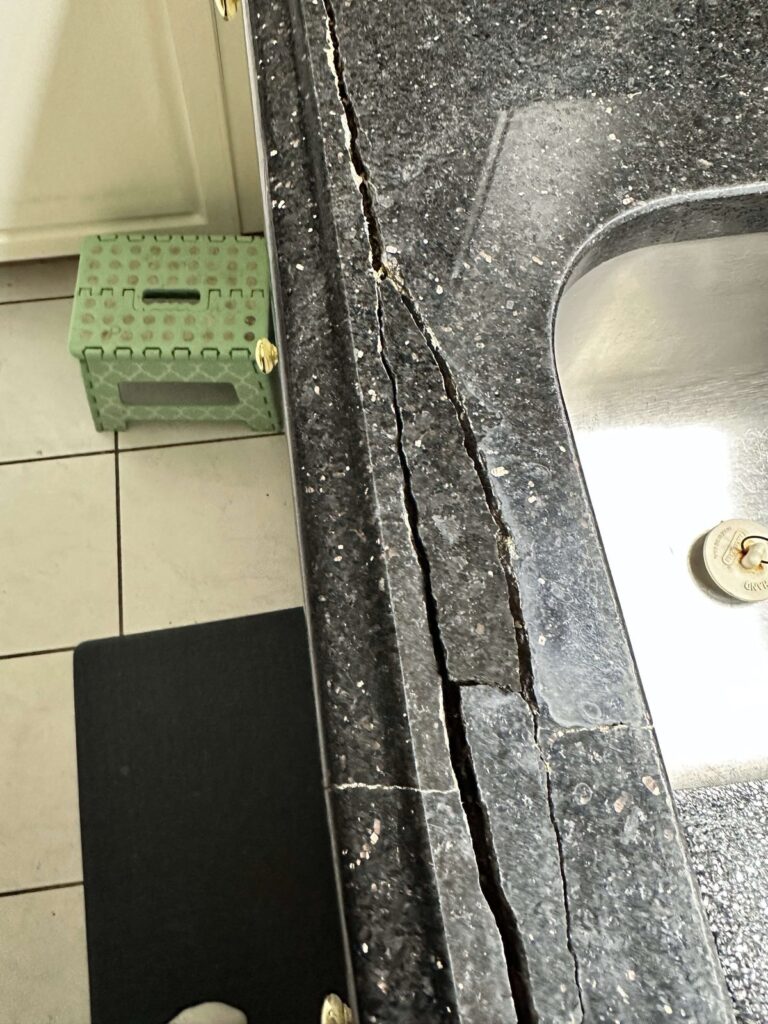
Rose Restoration — a Washington DC natural stone restoration contractor — compares marble and granite countertops: durability, etching behavior, cost, maintenance, and which stone is right for kitchens, bathrooms, bars, and commercial hospitality.
| Comparison | Marble | Granite |
|---|---|---|
| Stone family | Metamorphic (transformed limestone) | Igneous (cooled magma) |
| Hardness (Mohs) | 3–5 (soft) | 6–7 (hard) |
| Acid sensitivity | Etches from any acidic substance | Acid-resistant (sealer can be stripped) |
| Stain resistance | Lower — more porous | Higher — less porous (with sealer) |
| Visual character | Dramatic veining, classical, elegant | Crystal pattern, natural, organic |
| Price ($/sq ft installed) | $30–$200+ | $30–$150+ |
| Best for | Low-use formal areas, baths, foyers, bars (with protection) | High-use kitchens, outdoor, heavy-traffic counters |
| Restoration cost | $300–$1,500/project (countertop) | $300–$1,500/project (countertop) |
| Sealer interval | Every 1–3 years | Every 1–5 years |
 By Tom Kuhn, CEO, Rose Restoration
Rose Restoration has restored marble, terrazzo, concrete, and natural stone across DC, MD, and VA since 1978.
Choosing between marble and granite is one of the most common decisions homeowners face when designing a kitchen or bathroom. Both are natural stones with genuine beauty and serious durability — but they behave very differently in real-world use. This guide breaks down every meaningful difference: hardness, porosity, stain and etch resistance, maintenance requirements, restoration costs, and aesthetics. After 48 years of restoring both stones across Virginia, Maryland, and Washington DC, the Rose Restoration team has a clear-eyed view of what each stone demands — and delivers.
Marble vs. Granite — The Key Differences
Marble and granite look somewhat similar to the untrained eye, but they are geologically and chemically distinct materials.
Whichever stone is in the kitchen, the surfaces around it usually need the same attention. Our kitchen stone restoration service handles countertops, islands, backsplashes and floors together.
Whichever stone is in your kitchen, damage to it is usually repairable in place. Countertop repair and refinishing covers marble, granite, quartz and solid surface, matched to the material.
Marble is a metamorphic rock formed when limestone is subjected to intense heat and pressure. Its primary mineral is calcium carbonate — the same compound found in chalk and eggshells. That calcium carbonate content is what gives marble its luminous, crystalline appearance and its characteristic veining. It is also why marble reacts to acid.
Granite is an igneous rock formed as molten magma slowly cools deep in the earth. It is primarily composed of quartz, feldspar, and mica. Because it contains no calcium carbonate, granite does not react to acids in any meaningful way under normal household conditions.
On the Mohs hardness scale (a 1–10 measure of scratch resistance), marble scores 3–4 while granite scores 6–7. This single difference drives most of the practical implications discussed in this guide.
Both stones are porous to some degree, but granite is significantly less so. Its tightly interlocked crystal structure limits liquid penetration. Marble’s softer, more open structure absorbs liquids more readily — which is why sealing frequency differs dramatically between the two.
Durability and Scratch Resistance
Granite’s hardness (6–7 Mohs) puts it in the same range as steel files and hardened glass. Under normal kitchen use — cutting boards, cookware, utensils — granite is nearly impossible to scratch. You would need a diamond or tungsten carbide tool to leave a deliberate mark.
Marble, at 3–4 Mohs, is softer than a steel knife blade. Over time, everyday kitchen use can produce fine scratches and a gradual loss of polish — particularly on countertop edges and around sink cutouts where contact is highest. In a kitchen with heavy daily use, marble will show more wear than granite over the same period.
That said, both stones share a common vulnerability: chipping at edges from sharp impacts. Drop a heavy cast iron pan on a granite edge and you can chip it just as easily as marble. Edge profile matters — bullnose and eased edges are more forgiving than sharp mitered corners on either stone.
For kitchens where practicality is the priority, granite handles daily use with noticeably less visible wear. For low-traffic kitchens or applications where the surface is treated with care, marble holds up well.
Stain Resistance
Both marble and granite benefit from sealing, but they start from different baselines.
Granite’s low porosity means liquids bead up rather than soaking in. Even unsealed granite can resist staining for a surprising amount of time with prompt cleanup. Properly sealed granite resists oils, wine, coffee, and most household liquids effectively.
Marble is more absorbent. Without proper sealing, spilled olive oil, red wine, or coffee can penetrate the surface within minutes and leave a stain that requires professional honing to remove. With proper sealing, marble’s stain resistance improves substantially — but it demands a shorter re-sealing interval and more attentive day-to-day care.
Granite should be sealed every 1–3 years depending on use. A simple water test tells you when it’s time: pour a small amount of water on the surface. If it beads up, the seal is intact. If it absorbs, reseal.
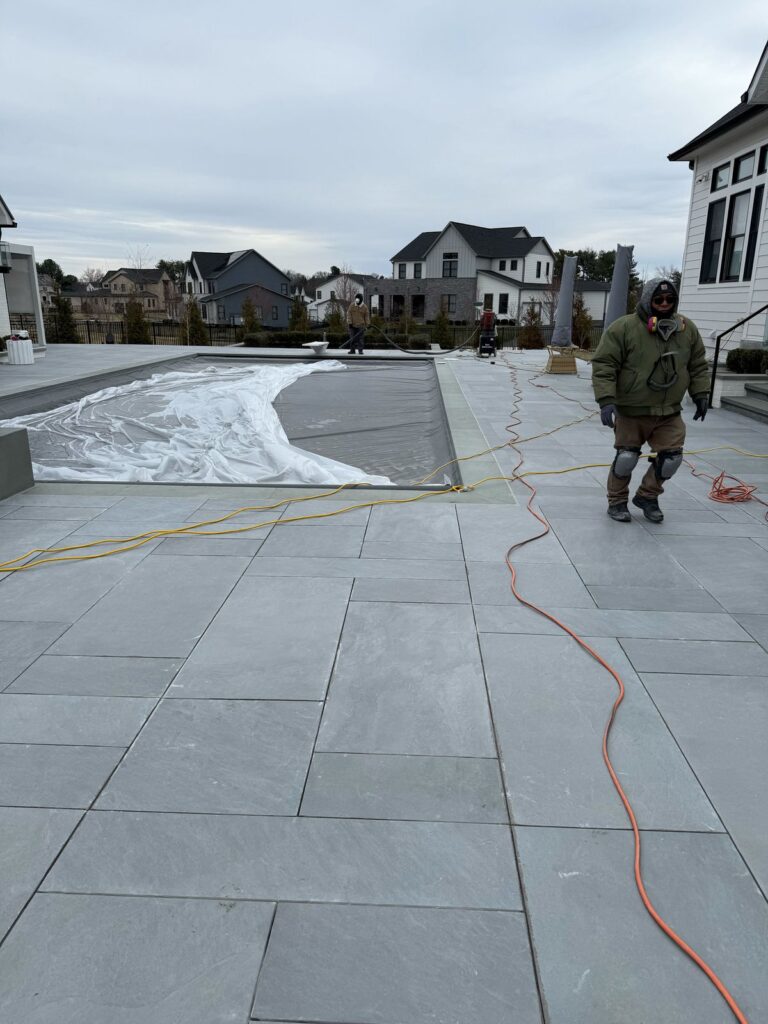
Marble should be sealed every 6–12 months in kitchen applications. The combination of more frequent sealing plus careful daily maintenance keeps marble stain-resistant — but the margin for error is smaller.
Etching — The Marble Factor
This is the single most important difference between marble and granite for kitchen use, and the factor that surprises most new marble owners.
Etching is not a stain. It is chemical damage. When an acidic substance contacts marble, it reacts with the calcium carbonate and dissolves a microscopic layer of the surface. The result is a dull, slightly rough mark that looks lighter than the surrounding stone. Etching can happen in seconds and penetrates below the sealed layer — sealing does not prevent etching.
Common culprits in kitchens: lemon juice, vinegar, wine, tomato sauce, citrus-based cleaners, salad dressing, coffee, and even some sparkling waters. Any pH below roughly 7 will etch marble to some degree.
Granite does not etch. You can pour lemon juice directly on granite and wipe it clean with no surface damage. This makes granite inherently more forgiving in the kitchen.
For homeowners who love marble in kitchens, etching is the primary reason periodic restoration becomes necessary. A professional honing and polishing service can remove etch marks completely — but most kitchen marble countertops will need this every 3–5 years under regular use.
One modern solution worth noting: Marble Armor, a thin protective film applied by trained technicians, physically shields the stone surface from both acid contact and staining. It effectively prevents etching and can extend time between restorations dramatically. Rose Restoration applies Marble Armor throughout the DC metro area — learn more here.
Maintenance Requirements
Granite maintenance:
- Seal every 1–3 years (simple DIY process)
- Clean with a pH-neutral stone cleaner or mild dish soap and water
- Wipe spills promptly
- Avoid abrasive scrub pads that can dull the polish over time
- Professional restoration rarely needed — perhaps every 10+ years if at all
Marble maintenance:
- Seal every 6–12 months in kitchen applications
- pH-neutral cleaner only — never vinegar, bleach, citrus-based products, or “all-purpose” cleaners
- Use cutting boards, trivets, and coasters without exception
- Wipe spills — especially acidic ones — immediately
- Expect periodic professional honing (every 3–5 years for kitchen countertops)
- Consider Marble Armor for etch prevention
The gap in maintenance effort is real. Granite is genuinely low-maintenance in a way that marble is not. But many homeowners find marble’s aesthetic so compelling that the additional care is worthwhile — especially when they understand what’s required before installation.
Restoration Cost Comparison
Both marble and granite can be professionally restored rather than replaced — and the cost savings are substantial in both cases.
Marble restoration typically runs 0–0 per square foot for honing and polishing. For kitchen countertops under regular use, this may be needed every 3–5 years to address etching, light scratches, and dull spots. A standard 40–50 SF kitchen countertop runs 00–,000 per restoration.
Granite restoration also runs 0–0 per square foot when needed — but it’s needed far less often. Many granite countertops go 10+ years without requiring professional restoration beyond routine sealing.
In both cases, restoration costs 70–90% less than full stone replacement, which typically runs 5–50+ per square foot installed. Restoration also avoids the disruption, construction waste, and design risk of replacement.
For detailed pricing on marble specifically, see our guide: Marble Restoration Cost: What to Expect in VA, MD & DC.
Appearance and Design
This is where personal preference dominates — and where marble has a genuine advantage for many designers and homeowners.
Marble is defined by its veining: flowing lines of mineral deposits that create a sense of movement, depth, and organic beauty. The calcium carbonate gives marble a translucency that other stones lack — light penetrates slightly into the surface rather than simply reflecting off it, creating a warm luminosity that photographs struggle to capture. Marble has been the stone of choice for palaces, sculptures, and luxury interiors for millennia.
Granite has a speckled, mottled pattern created by its interlocking crystal structure. The visual effect is more uniform and “busy” compared to marble’s linear veining. Granite comes in an extraordinary range of colors — from near-white to deep black, with blues, greens, reds, and golds — and many granite slabs are genuinely striking. But the aesthetic is different from marble’s: bolder and more dramatic rather than refined and classical.
Both stones come in hundreds of varieties with wildly different appearances. White Carrara marble looks nothing like Verde Alpi. Black Galaxy granite looks nothing like White Ice. Choosing the right slab requires seeing the actual material rather than relying on generic descriptions.
Interior designers working on luxury residential projects frequently specify marble for primary surfaces — kitchen islands, master bathroom vanities, fireplace surrounds — precisely because its aesthetic is unmatched. Granite tends to be specified where performance is the priority.
Which Is Better for Kitchens?
Honest answer: granite wins on practicality for most kitchen applications. It does not etch, requires less frequent sealing, and handles daily cooking use without the same level of vigilance that marble demands.
Marble wins on aesthetics — no other stone delivers the same warmth, veining, and visual depth.
If you choose marble for a kitchen, go in with full knowledge of what’s required:
- Use cutting boards and trivets without exception
- Wipe acidic spills immediately
- Seal every 6–12 months
- Budget for professional restoration every 3–5 years
- Consider Marble Armor to significantly reduce etch risk
Many homeowners with marble kitchens love their stone after 10–20 years — they’ve accepted the maintenance trade-off and find the beauty worth it. Others regret choosing marble for a busy kitchen with kids and heavy cooking. Know your household before deciding.
Marble Armor can genuinely bridge this gap. With the film in place, marble becomes dramatically more resistant to etching and staining — approaching granite-level protection while maintaining marble’s appearance. It is worth serious consideration for anyone who wants marble in a kitchen but worries about maintenance.
Which Is Better for Bathrooms?
Bathrooms change the calculus significantly in marble’s favor. The primary threats shift away from cooking acids and toward:
- Hard water (mineral deposits, not acid etching)
- Personal care products (shampoo, conditioner, body wash — mostly pH-neutral to mildly acidic)
- Soap scum
- Occasional toothpaste (mildly abrasive)
None of these are as immediately damaging as the acids present in kitchen use. Marble is the classic bathroom stone for good reason — its beauty suits the space, and the maintenance demands in a bathroom are far more manageable than in a kitchen.
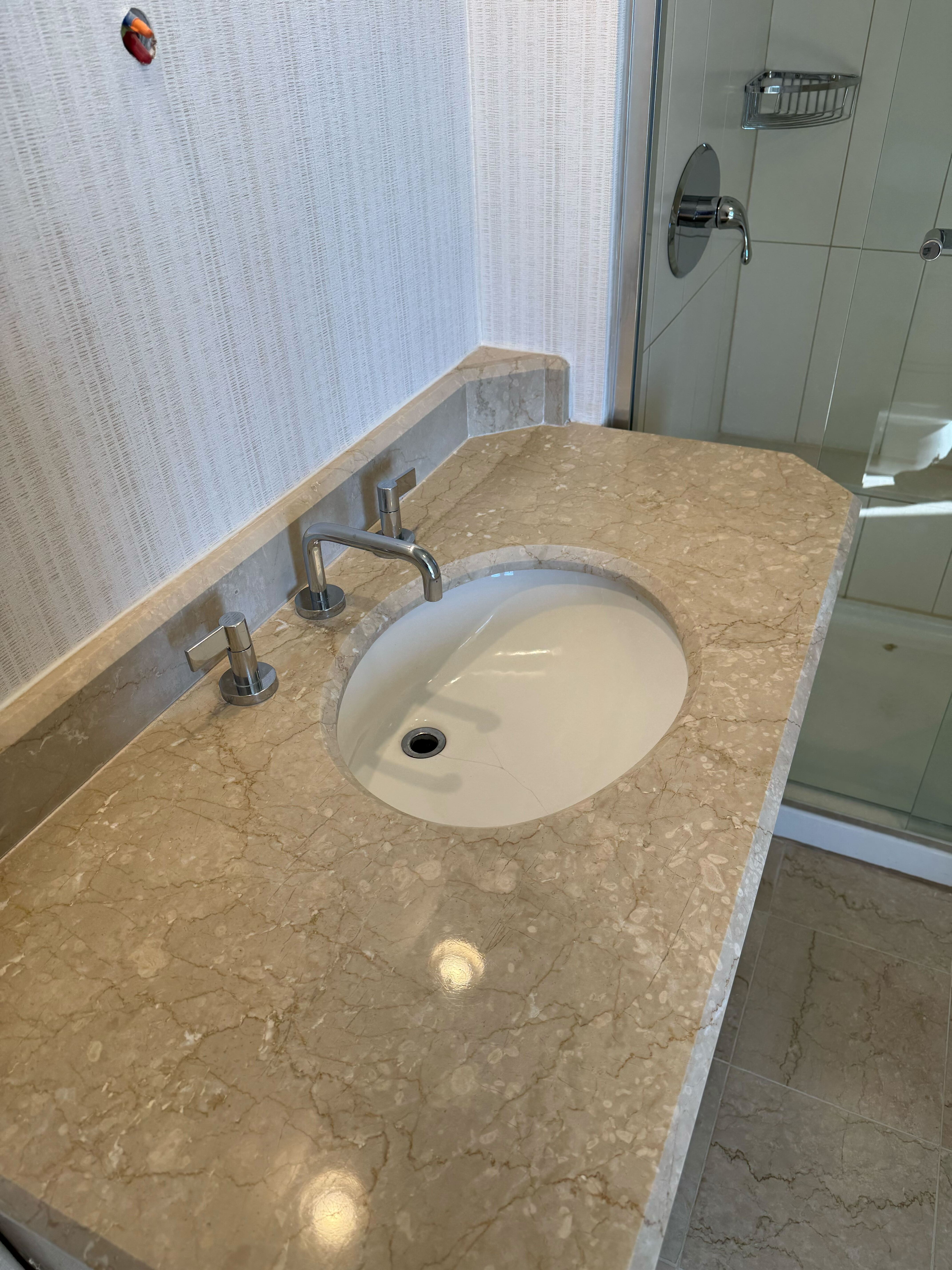
Granite works well in bathrooms too, and offers the same low-maintenance profile it provides everywhere. For bathroom vanity tops specifically, both stones are excellent choices. For bathroom floors, honed marble provides a classic look with good slip resistance. For shower walls, proper installation and sealing are critical for either stone.
Our recommendation: if aesthetics are paramount in a bathroom, marble is hard to beat. If you want the easiest possible maintenance in every room of the house, granite is more consistent.
Frequently Asked Questions
Is marble or granite more expensive?
Installed costs are broadly similar, though there is enormous range within each category. Entry-level granite can run 0–0 per square foot installed; premium marbles like Calacatta Gold or Statuario can exceed 00 per square foot. Mid-range options in both categories tend to land in the 0–20 per square foot installed range. Total cost of ownership favors granite when you account for more frequent marble restoration cycles — though that gap narrows significantly if Marble Armor is applied.
Can you make marble as durable as granite?
Not permanently, but Marble Armor comes close for the surfaces it protects. The film prevents etching and significantly reduces staining by physically isolating the stone from contact with food, liquids, and acids. It does not alter marble’s appearance and can be re-applied when worn. For scratch resistance, no coating changes the underlying Mohs hardness — marble will always be softer than granite. With proper care, however, marble can look excellent for decades.
How often does marble need to be sealed?
In kitchen applications: every 6–12 months. In bathrooms: every 1–2 years. In low-traffic applications like fireplace surrounds or decorative pieces: every 2–3 years. Sealing is a simple DIY process with products available at most home improvement stores — apply, let it penetrate, wipe off excess. A professional can seal during a restoration visit as well.
Can etched marble be repaired?
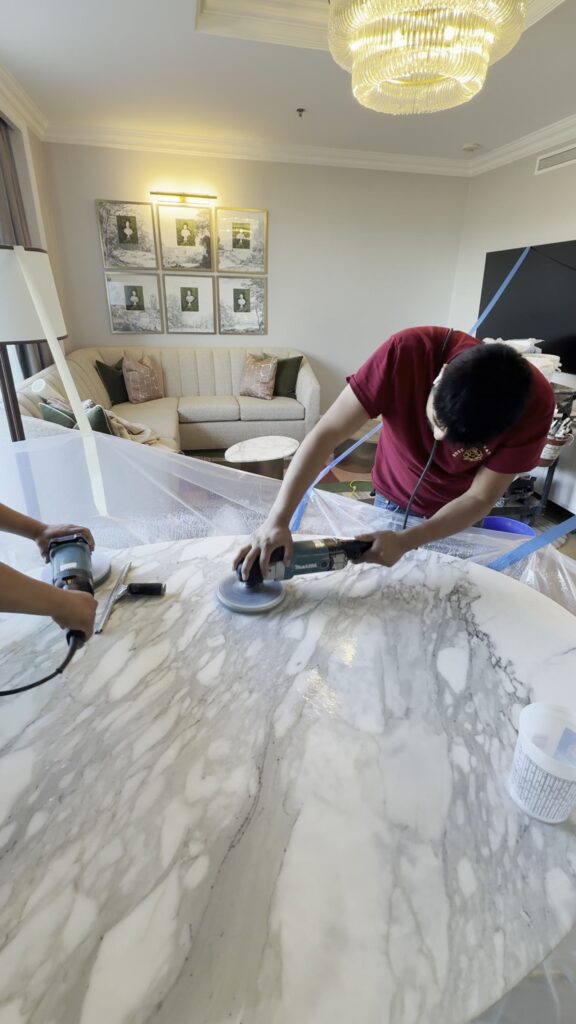
Yes — completely, by a professional stone restoration company. Etching is surface damage to the polish layer, and it can be removed through a process of honing (light abrasive grinding to level the surface) followed by polishing (progressive refinement to restore gloss). The result is marble that looks as good as new. Minor etching can sometimes be addressed with a DIY marble polishing compound, but significant etching or widespread dullness requires professional equipment. Rose Restoration removes etch marks throughout VA, MD, and DC.
Which stone is better for resale value?
Both marble and granite are widely considered premium upgrades that add value relative to laminate or tile. In the current market, marble — particularly white marble with dramatic veining — tends to photograph more impressively and attract more buyer attention in luxury home listings. Granite has a reputation for durability that appeals to practical buyers. In either case, condition at time of sale matters more than stone type: dull, etched, stained marble will underperform pristine granite, and vice versa. Professional restoration before listing is a high-ROI investment for either stone.
Do you restore both marble and granite?
Yes. Rose Restoration has been restoring both marble and granite countertops, floors, and surfaces since 1978 across Virginia, Maryland, and Washington DC. We restore marble through honing, polishing, crack repair, stain removal, and Marble Armor application. We restore granite through chip filling, scratch removal, polishing, and sealing. Both services are available for residential and commercial properties.
Get Expert Advice on Your Stone
Rose Restoration has been working with marble and granite — in kitchens, bathrooms, commercial lobbies, and historic buildings — since 1978. We’ve seen how both stones perform over decades of real use, and we give homeowners honest assessments rather than telling them what they want to hear.
If you’re deciding between marble and granite for an upcoming project, or if you have existing stone that needs restoration, we’re happy to help. We serve the full DC metro area including Northern Virginia, Maryland, and Washington DC.
Call us at (703) 327-7676 or request a free assessment online. We’ll evaluate your stone, explain your options honestly, and give you a written proposal with no pressure.
For homeowners in Washington DC kitchens choosing between marble and granite countertops, the decision affects daily care more than it affects appearance.
Looking for something else?
Get a Free Assessment from Rose Restoration
Tell us about your marble, stone, terrazzo, or concrete and our senior technicians will recommend the right restoration approach. Family-run and trusted across Washington DC, Maryland, and Virginia since 1978.
Call (703) 327-7676 · Email info@roserestoration.com · schedule a time · or send us photos.
Restore. Don't replace.
48 years of polishing marble, terrazzo, concrete, and tile across Washington DC, Northern Virginia, and Maryland. IMF, Four Seasons, Smithsonian, and the Virginia State Capitol trust us — you can too.
Watch the Process
Real Rose Restoration projects on video — no stock footage, no staged demonstrations.