

Polishable overlays and underlayments are thin cementitious toppings applied over existing concrete to create a new, smooth surface that can be polished, stained, or sealed — transforming damaged or uneven slabs without demolition. They range from 1/16 inch to 1/2 inch thick and bond directly to the existing concrete substrate, making them one of the most versatile and cost-effective solutions available in modern concrete restoration.
At Rose Restoration International, we have spent more than 40 years helping property owners across Fairfax, VA and the greater Virginia, Maryland, and Washington, D.C. region transform worn, stained, and uneven concrete floors into beautiful, high-performance surfaces — without the mess, expense, or disruption of full slab replacement. Whether you need a flat, stable base for new flooring or a decorative finish that becomes the floor itself, overlays and underlayments are often the smartest path forward.
This guide explains exactly what these systems are, when to use them, how they are installed, and what options are available to you as a property owner or general contractor in our service area.
What Are Concrete Underlayments?
Concrete underlayments — also called self-leveling underlayments (SLU) or floor leveling compounds — are pourable, cementitious products designed to create a flat, smooth substrate before another flooring material is installed on top. They are not intended to be a finished surface; their job is to eliminate dips, humps, cracks, and surface irregularities that would otherwise telegraph through tile, carpet, luxury vinyl plank, or coatings.
Self-leveling underlayments work because of their low viscosity and carefully engineered flow characteristics. When mixed to the correct consistency and poured onto a properly primed slab, they spread naturally under gravity, filling low spots and creating a plane that is flat to within 3/16 inch over ten feet — the tolerance required by most tile and stone manufacturers.
Common applications include:
- Smoothing old concrete slabs before large-format tile installation
- Correcting out-of-level floors in commercial tenant build-outs
- Encapsulating radiant heating cables or pipes in concrete
- Resurfacing deteriorated industrial floors before applying protective coatings
- Preparing uneven substrates for polished concrete or decorative overlay systems
Underlayments typically range from feather-edge thickness up to about 1.5 inches in a single pour, though deeper fills require multiple lifts or the use of aggregate. They cure quickly — many products allow foot traffic in two to four hours and flooring installation within 24 hours — minimizing project downtime. In commercial environments, that speed is often as important as the technical performance.
It is critical to understand that underlayments require a properly prepared, clean, and primed substrate to achieve adhesion. On slabs with contamination, structural cracks, or moisture vapor issues, additional steps must be taken before pouring — a detail that inexperienced contractors often skip, leading to delamination failures months or years later.
What Are Polishable Overlays?
Polishable overlays are a step beyond underlayments. Rather than serving as a hidden base, they become the finished floor. These polymer-modified cementitious materials are designed with the hardness and surface quality necessary to accept diamond grinding and polishing — the same multi-step process used to produce a high-gloss polished concrete floor directly on a slab.
The result is a floor that looks and performs like polished concrete, but is essentially new from the surface down. This is enormously valuable when the existing slab has problems that cannot be corrected through grinding alone: deep pitting, widespread surface contamination, old adhesive residue, or color variation from previous repairs.
Microtoppings vs. thicker polishable overlays:
At the thinner end of the spectrum, microtoppings are polymer-cement coatings applied at 1/16 inch or less. They are primarily decorative and are best suited for surfaces that are already flat and in good structural condition. Microtoppings excel in residential interiors, retail, and hospitality environments where a seamless, contemporary look is the goal and the substrate just needs a cosmetic refresh.
Thicker polishable overlays — typically 1/8 inch to 1/4 inch — offer more latitude. They can bridge minor surface defects, provide a more uniform base for polishing, and accept integral color more consistently. At 1/4 inch to 1/2 inch, overlays can correct moderate surface irregularities and are sometimes used as a combined leveling-and-finishing solution on challenging slabs.
All polishable overlays require diamond grinding and polishing after cure, typically progressing through the same sequence of resin- and metal-bond tooling used on conventional concrete. The finished surface can range from a low-sheen matte to a mirror-like 3,000-grit gloss, and can accept reactive chemical stains, dyes, or densifiers just like native concrete.
When to Use an Overlay Instead of Polishing the Existing Slab
Not every concrete slab is a good candidate for direct polishing. Grinding and polishing work by removing successive layers of the concrete surface to expose aggregate and create a dense, reflective plane — but that process requires a slab with sufficient surface quality to produce acceptable results. When the slab cannot meet that standard, an overlay is the right answer.
Indicators that an overlay is the better choice:
- Severe surface damage: Deep pitting, spalling, or scaling that would require removing too much material through grinding, weakening the slab or creating low spots
- Widespread adhesive residue: Old VCT adhesive, carpet glue, or epoxy coatings that cannot be fully removed by shot blasting or diamond grinding
- Uneven or out-of-flat substrate: Slabs with waves, dips, or humps that exceed the tolerance for direct polishing — an overlay combined with self-leveling technique corrects the plane
- Inconsistent aggregate exposure: Slabs where the aggregate distribution is uneven, producing a blotchy or unappealing appearance when polished
- Color uniformity requirement: Projects where the owner requires a specific, consistent color that cannot be reliably achieved through staining the existing slab
- Previously polished slab that has been re-coated: Slabs where multiple layers of coatings or stains have obscured the original surface and created a contaminated zone that cannot be economically removed
In each of these scenarios, attempting to polish the existing surface directly would produce a substandard result. An overlay effectively gives the project a fresh start at a fraction of the cost of slab replacement.
Overlay Installation Process
A successful overlay installation is as much about preparation as it is about the overlay material itself. At Rose Restoration International, our concrete contractor team follows a disciplined, multi-step process that ensures the overlay bonds properly, cures without defects, and polishes to the specified finish.
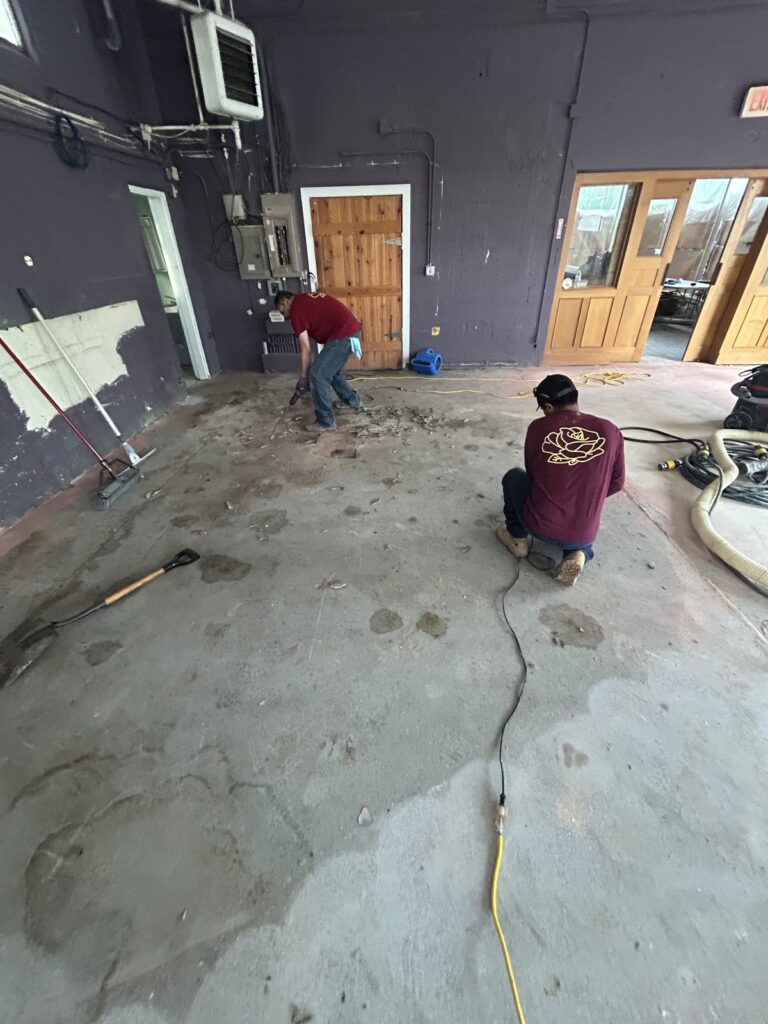
Step 1 — Surface Preparation: The existing slab is shot blasted or diamond ground to remove all contaminants, coatings, and laitance, opening the concrete pores and creating a mechanical profile (typically ICRI CSP 3-4) for the overlay to bond to. Any cracks are chased, cleaned, and filled with appropriate repair mortars. Active moisture or vapor issues are addressed at this stage.
Step 2 — Priming: A penetrating epoxy or acrylic primer is applied and allowed to reach the proper tack before overlay placement. This primer bridges the surface, prevents the substrate from drawing water out of the overlay mix too rapidly, and significantly improves bond strength.
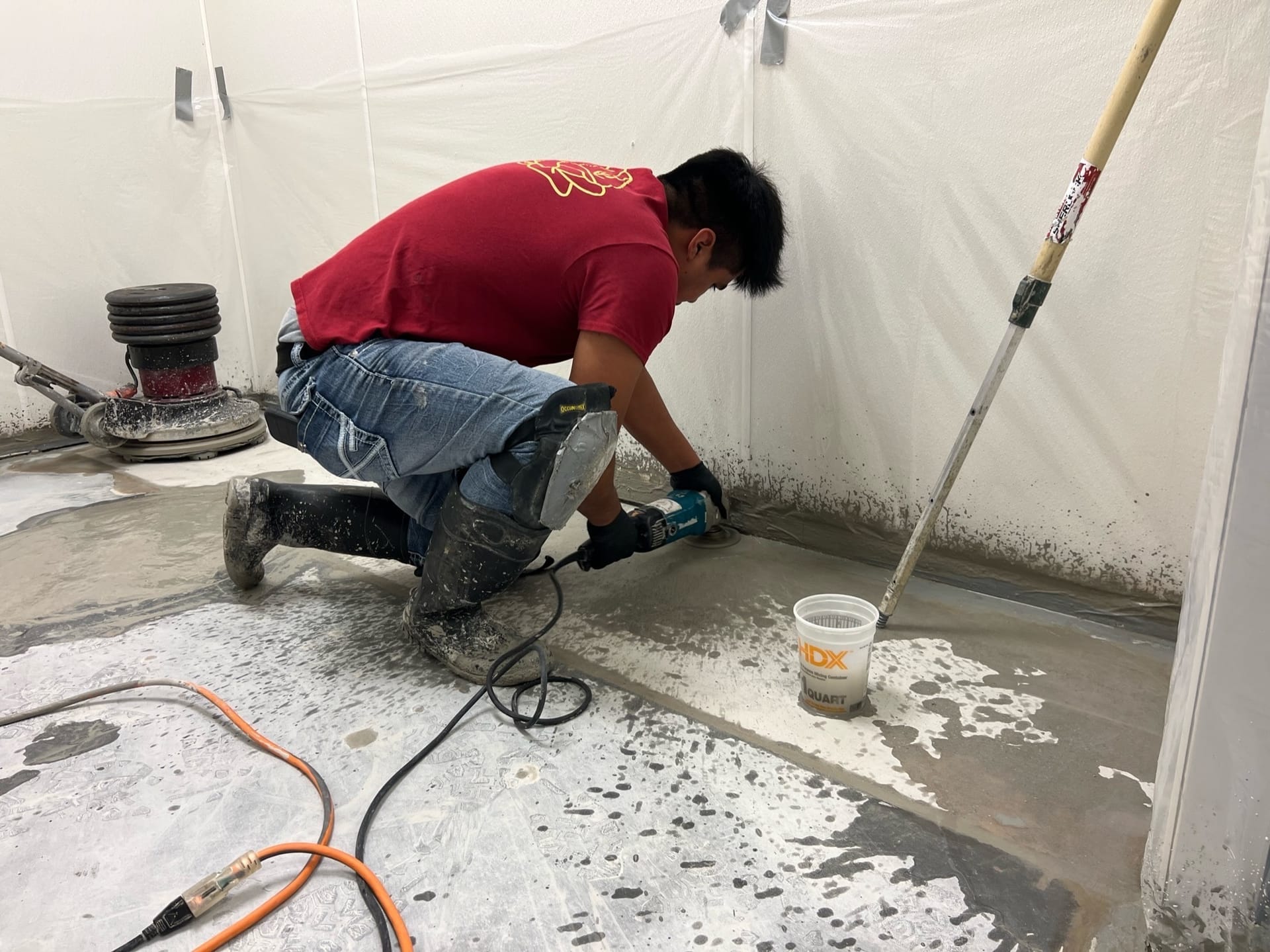
Step 3 — Overlay Placement: Depending on the system, the overlay is poured and spread with a gauge rake for self-leveling products, or applied with a trowel or squeegee for hand-applied systems. Multiple lifts may be required for thicker applications. Integral color is typically batched into the mix at this stage.
Step 4 — Curing: The overlay is protected from traffic, direct sunlight, wind, and extreme temperatures during the initial cure period — typically 24 to 72 hours depending on the product and ambient conditions.
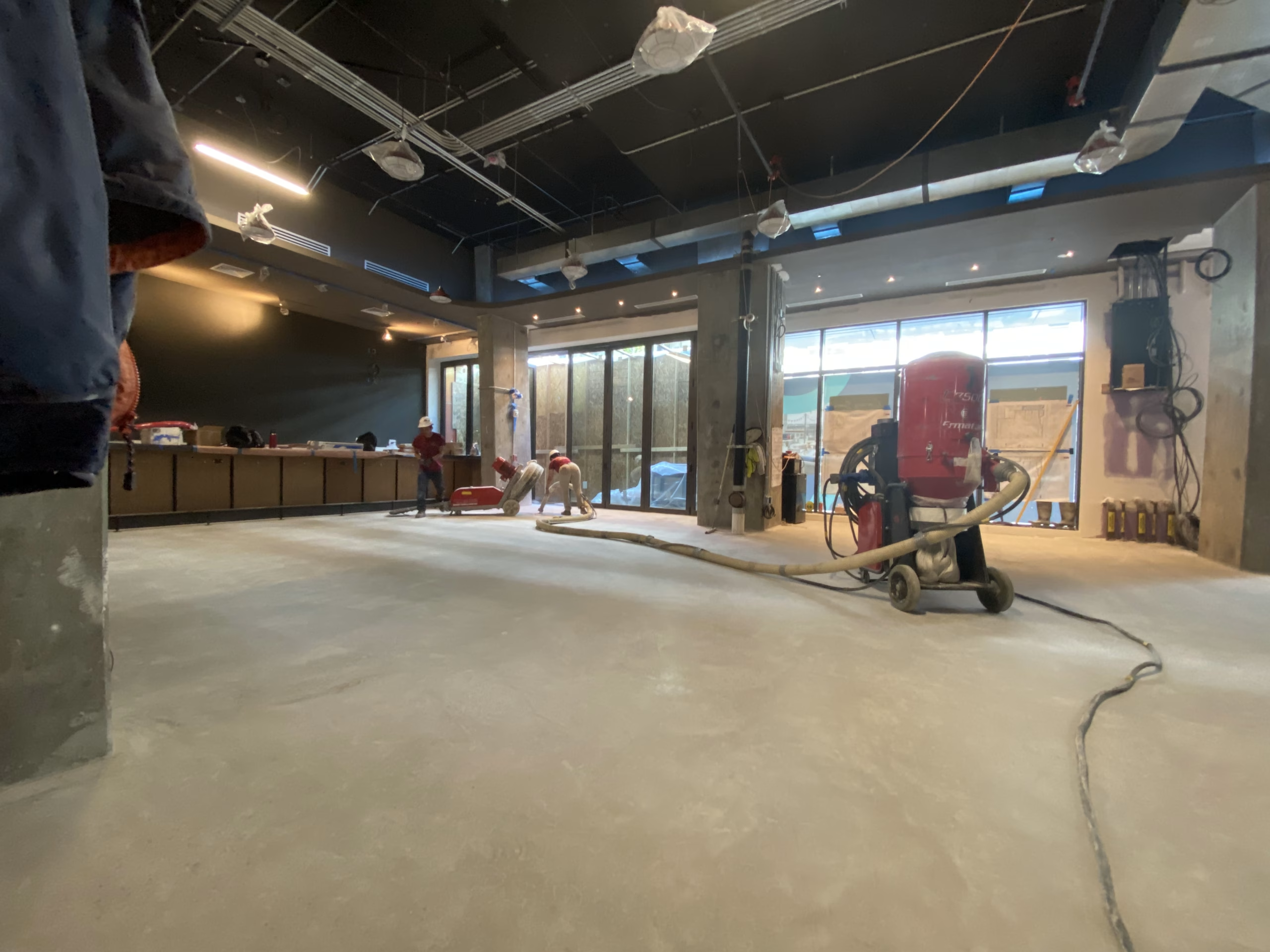
Step 5 — Grinding and Polishing: Once fully cured, the overlay surface is ground with coarse diamond tooling (typically 30 or 50 grit metal-bond) to flatten and open the surface, then progressed through finer grits to achieve the specified sheen. Densifier is applied at the appropriate stage to harden the surface and reduce porosity.
Step 6 — Sealing and Protection: A penetrating lithium silicate densifier and/or a topical guard product is applied as the final step, providing stain resistance and protecting the finished surface.
Overlay Options and Finishes
One of the most compelling aspects of polishable overlays is the breadth of aesthetic options available. Unlike direct slab polishing — where the appearance is largely determined by what is already in the concrete — overlays give designers and property owners meaningful control over the final look.
Color: Integral pigments can be added to the overlay mix in virtually any color. From warm earth tones to cool grays to bold statement colors, integral color produces a uniform appearance throughout the overlay thickness, so minor surface wear does not reveal a different underlying color.
Aggregate Seeding: Glass chips, quartz, recycled materials, or decorative stone aggregate can be broadcast into a wet overlay and then ground back to expose the aggregate at the surface — creating a terrazzo-like appearance at a fraction of the cost of traditional terrazzo.
Reactive Staining and Dyeing: After polishing, overlays accept the same acid stains, reactive metallic stains, and water-based dyes used on conventional concrete, allowing variegated, organic color effects.
Stenciling and Scoring: Patterns, logos, borders, and geometric designs can be incorporated through stenciling (applied before topcoat) or saw-cut scoring after cure, producing the appearance of tile, stone, or custom graphic elements.
Surface Texture: The polishing sequence determines final sheen — from a low-maintenance matte (400-grit) to a highly reflective mirror finish (3,000-grit). Slip resistance can be maintained at higher gloss levels through proper densification and the selection of appropriate guard products.
Frequently Asked Questions About Polishable Overlays
How much does a polishable overlay cost compared to slab replacement?
A polishable overlay system typically costs $6 to $15 per square foot installed, depending on the complexity of preparation, overlay thickness, and finish specification. Full slab removal and replacement generally runs $15 to $30 per square foot or more when you account for demolition, disposal, forming, reinforcement, and curing time. For most projects, an overlay delivers a superior finished result at 30% to 60% of the cost of replacement.
How thick does a polishable overlay need to be?
The minimum practical thickness for a polishable overlay intended to be ground and polished is approximately 1/8 inch (3mm). This provides enough material to grind flat and still leave adequate thickness for the polished surface. Microtoppings applied at less than 1/16 inch can be polished but are better suited to surfaces that are already flat. Thicker overlays (1/4 to 1/2 inch) are used when leveling is required in addition to resurfacing.
How long does a polishable overlay last?
A properly installed polishable overlay over a sound substrate will last as long as the underlying slab — effectively indefinitely with appropriate maintenance. The key variables are substrate preparation, bond quality, and ongoing care. Polished concrete surfaces maintained with periodic re-application of a penetrating guard typically show no measurable wear after 10 to 20 years of commercial use.
Can a polishable overlay be applied over any concrete slab?
Most concrete slabs are suitable candidates, but the substrate must be structurally sound, free of active moisture or vapor drive issues, and properly profiled. Slabs with ongoing structural movement, active water infiltration, or severe delamination are not good candidates without first addressing the underlying problem. Our team conducts a thorough substrate assessment before recommending any overlay system.
Does Rose Restoration International install polishable overlays in Northern Virginia, Maryland, and D.C.?
Yes. Rose Restoration International serves commercial and residential clients throughout Virginia, Maryland, and Washington, D.C., including Fairfax County, Arlington, Alexandria, Prince William County, Montgomery County, Prince George’s County, and the District of Columbia. We have been providing concrete restoration and overlay services in this region for more than 40+ years. Contact us at 703-327-7676 or use the button below to request a free estimate.
Transform Your Concrete Floor Without Tearing It Out
Underlayments and polishable overlays represent some of the most practical and cost-effective tools available for concrete floor renovation. Whether you need a flat, stable base for new flooring or a beautiful polished surface that stands on its own, Rose Restoration International has the expertise, equipment, and experience to deliver exceptional results — on time and on budget.
We serve property owners, facility managers, architects, and general contractors throughout Virginia, Maryland, and Washington, D.C.. Call us at 703-327-7676 or click below to schedule a free on-site evaluation for your project.