
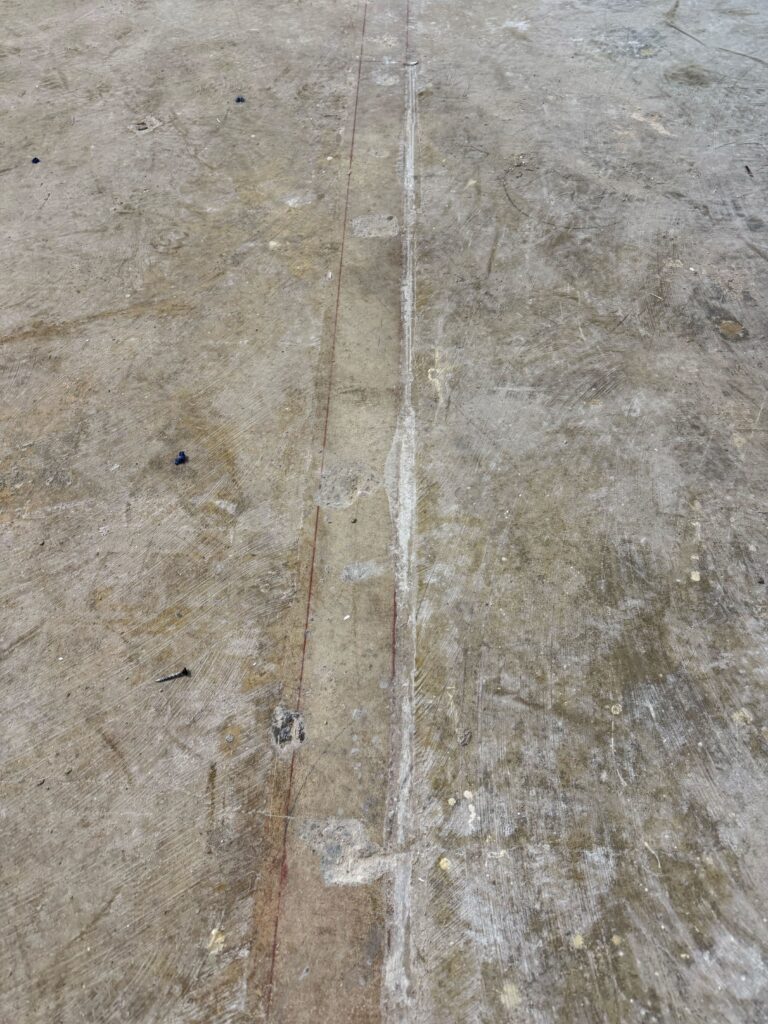
| Issue | Material / method | Timing | Notes |
|---|---|---|---|
| Surface spall / pop-out | Polymer-modified cement patching material | Before polishing or coating | Color-matched; polished flush |
| Hairline crack (<1/8") | Low-viscosity epoxy crack injection | Before or during polishing | Nearly invisible after polishing |
| Wider crack (1/8"+) | Flexible polyurea crack fill | Before polishing | Follows slab movement; prevents re-cracking |
| Control joint | Semi-rigid polyurea joint filler | After slab cure, before polish | Supports joint edges under forklift traffic |
| Construction joint | Polyurea or epoxy | After slab cure | Supports edges; flexible to accommodate movement |
| Expansion joint | Flexible caulk or backer rod + sealant | Post-installation | Remains flexible; not polished |
| Surface grouting / slurry | Cement slurry for surface imperfections | During polishing | Fills tiny voids; polished smooth |
 By Tom Kuhn, CEO, Rose Restoration
Rose Restoration has restored marble, terrazzo, concrete, and natural stone across DC, MD, and VA since 1978.
Inside the Art of Concrete Repair: Patching, Joint Filling, and Grouting
Concrete is the most widely used construction material in the world, and it is also one of the most misunderstood when it comes to repair. Property owners and facilities managers throughout Washington DC, Maryland, and Northern Virginia routinely face concrete damage — cracks in warehouse slabs, spalled loading dock surfaces, failed control joints in parking garages, deteriorating concrete in building plazas — and the decisions made in response to that damage have long-term consequences for structural integrity, appearance, and lifecycle cost.
Understanding what causes concrete to fail, which repair methods are appropriate for which failure types, and when repair is the right choice versus replacement requires specific technical knowledge. This guide covers the full scope of concrete repair: damage assessment, crack repair methods, patching techniques, joint filling materials, grouting systems, and the critical decision framework for repair versus replacement.
Concrete repair is one part of a larger floor scope. See our commercial concrete polishing and repair service for how patching, joint filling and grouting fit into a finished floor.
Understanding Concrete Damage: Types and Causes
Not all concrete damage is the same, and treating every crack or surface defect with the same approach leads to failed repairs. A proper repair begins with accurate diagnosis.
Cracks
Concrete cracks for several reasons, and each crack type requires a different response. Shrinkage cracks develop as concrete cures and loses moisture — these are typically hairline cracks in a random pattern, often shallow, and generally not structurally significant unless they provide pathways for water or contamination. Structural cracks result from settlement, overloading, subgrade failure, or inadequate reinforcement — these require careful evaluation before repair, as filling a crack without addressing its cause guarantees recurrence. Thermal cracks result from repeated freeze-thaw cycles or differential thermal expansion, common in outdoor concrete in the DC region where temperatures swing considerably through the year.
Active cracks — those that continue to move — present a particular challenge. Filling an active crack with a rigid material will result in the crack reopening beside or through the repair material. Active cracks require flexible or semi-flexible materials, and the source of movement must be understood before repair is attempted.
Spalls
Spalling occurs when a portion of the concrete surface breaks away, leaving a shallow or deep cavity. The causes include freeze-thaw cycling in the presence of moisture, corrosion of reinforcing steel causing delamination of the cover concrete, impact damage, overworked surface during placement, or use of de-icing salts that accelerate corrosion and chemical deterioration. Spalls range from cosmetic surface delamination a few millimeters deep to full-depth structural loss that exposes rebar.
Joint Failure
Control joints, expansion joints, and isolation joints are intentional breaks in concrete designed to manage movement and prevent uncontrolled cracking. When joint sealants fail — through age, UV degradation, foot or vehicle traffic, inadequate joint width, or improper original installation — the joint becomes a pathway for water, incompressibles (dirt, rock, debris), and maintenance chemicals that can accelerate deterioration of the concrete on either side. Failed joints in parking decks are among the most common causes of structural concrete damage in commercial properties.
Surface Defects
Surface defects include dusting (weak surface layer that powders under traffic), scaling (loss of thin surface layer), delamination (hollow-sounding areas where surface layer has separated from substrate), and bug holes or honeycombing (voids in formed concrete caused by inadequate consolidation). Each requires a different diagnostic and repair approach.
Crack Repair Methods
Epoxy Injection
Epoxy injection is the most effective method for structural repair of dormant (non-moving) cracks in concrete. The process involves installing injection ports at regular intervals along the crack, sealing the crack surface between ports with a rapid-setting surface paste, allowing the paste to cure, then injecting low-viscosity epoxy under controlled pressure through the ports. The epoxy wicks into the crack by capillary action and hydraulic pressure, filling the full depth of the crack, then cures to create a bond stronger than the surrounding concrete.
Epoxy injection is appropriate for structural cracks in beams, columns, slabs, and walls where load transfer across the crack must be restored. It is not appropriate for active cracks — the rigid cured epoxy will fail if the crack continues to move.
Routing and Sealing
For non-structural, non-moving cracks where appearance and waterproofing are the primary concerns, routing and sealing is the standard approach. The crack is routed (mechanically widened and shaped) with a crack chaser blade to create a uniform reservoir — typically 1/4 to 3/8 inch wide and deep — which is then cleaned and filled with a flexible sealant such as polyurethane or polysulfide. The shaped reservoir geometry ensures adequate sealant thickness for long-term performance.
Routing and sealing is appropriate for shrinkage cracks, construction cracks, and cracks in flatwork where structural load transfer is not required but waterproofing and movement accommodation are.
Polyurea for Crack Filling
Polyurea systems cure extremely rapidly — in some formulations, within seconds to minutes — making them highly practical for situations where fast return to service is required. Semi-rigid polyurea is particularly well suited to filling dormant cracks in floor slabs, providing a hard, durable fill that resists incompressible intrusion while offering slight flexibility to accommodate minor thermal movement. Polyurea joint fillers are widely used in polished concrete applications where a clean, seamless appearance is desired at crack locations.
Concrete Patching Techniques
Cementitious Patching
Portland cement-based patching mortars are the most widely available and widely used repair materials. They are appropriate for shallow to moderate-depth repairs of spalls, bug holes, and surface defects. The key to successful cementitious patching is surface preparation: the repair area must be cleaned to remove all laitance, contamination, and loose material, the concrete perimeter of the repair must be sawcut to a minimum 1/4-inch depth to create a vertical edge (preventing feathering that leads to early delamination), and the substrate must be pre-wetted to a saturated surface dry condition before patch application.
Standard Portland cement mortars have a strength and modulus of elasticity similar to the surrounding concrete, which minimizes differential shrinkage stresses at the repair interface. They require extended cure time — typically 28 days to full strength — and are not appropriate where fast return to service is needed.
Polymer-Modified Patching Mortars
Polymer-modified mortars incorporate latex or other polymer additives that improve adhesion, flexibility, and resistance to shrinkage cracking. These materials bond more aggressively to the concrete substrate, tolerate thinner application profiles, and achieve usable strength faster than unmodified mortars. They are appropriate for repairs exposed to traffic, temperature cycling, or moisture — conditions that stress the repair-substrate interface.
High-performance polymer-modified systems designed for structural repair applications can achieve compressive strengths exceeding 8,000 psi in 24 hours, allowing fast return to service even in demanding environments.
Feathered Overlays
When surface defects are widespread or when a consistent new surface profile is desired over a large area, a feathered micro-topping or overlay system may be more practical than spot patching. Self-leveling or trowel-applied overlays can be applied in thicknesses from 1/16 inch upward to resurface worn, scaled, or aesthetically compromised concrete. These systems require thorough surface preparation — typically mechanical grinding to profile the surface and remove contaminants — and appropriate primer application to ensure bond.
Joint Filling: Control Joints, Expansion Joints, and Isolation Joints
Joint maintenance is one of the most neglected aspects of concrete care and one of the most consequential for long-term performance. Understanding the different joint types and their appropriate treatment is essential.
Control Joints
Control joints are sawcut or tooled into fresh concrete to pre-establish crack locations and control shrinkage cracking. They do not fully separate the slab — reinforcement typically continues through them — but they create a weakened plane where cracking is directed. In lightly trafficked environments, control joints can be left unfilled after polishing if a hard aggregate lock has formed. In vehicular environments, the joint edges are vulnerable to spalling from wheel traffic unless filled with a semi-rigid material that supports the joint edges while accommodating movement.
Expansion Joints
Expansion joints provide a full separation between concrete sections to allow thermal expansion and contraction without inducing compressive stress. These joints must be filled with a material that remains compressible throughout the design movement range — typically a preformed foam backer rod with a flexible sealant over top. Joint width must be maintained to prevent incompressibles from locking the joint and causing blowup or buckling of the slab.
Isolation Joints
Isolation joints separate a floor slab from columns, walls, or other structural elements, preventing stress transfer that can crack the slab or damage the structure. These joints are filled similarly to expansion joints and must remain functional as the building settles and the slab continues its long-term moisture-related volume change.
Joint Filling Materials
The primary materials for joint filling in concrete floors are polyurethane sealants, polysulfide sealants, and semi-rigid polyurea or epoxy joint fillers. Polyurethane and polysulfide are appropriate for exterior joints and joints subject to significant movement — they remain flexible and bond well to concrete. Semi-rigid polyurea and epoxy systems are preferred for interior floor joints in polished or industrial environments because they cure hard enough to support adjacent slab edges under wheel loads, resist incompressible intrusion, and can be ground flush with the floor surface for a clean appearance.
Grouting: Cementitious, Epoxy, and Polyurethane Systems
Grouting in the context of concrete repair refers to the injection or pressure-filling of voids, cavities, or delaminated areas beneath or within concrete elements. It is distinct from crack injection in that it addresses larger void spaces rather than thin planar cracks.
Cementitious Grout
Non-shrink cementitious grout is used for filling voids beneath equipment bases, machine foundations, and precast elements; for filling honeycombed areas in formed concrete; and for a variety of structural filling applications. It is mixed to a pourable or flowable consistency and placed to fill the void without leaving air pockets. Non-shrink additives ensure the grout maintains its volume as it cures, providing full bearing contact.
Epoxy Grout
Epoxy grout systems are used where chemical resistance, high strength, or adhesion to contaminated surfaces is required. They are appropriate for machinery foundations in industrial environments, anchor bolt installations, and repairs where the grout will be subjected to chemical exposure that would degrade cementitious materials. Epoxy grouts have very low viscosity in their injectable form and can fill fine voids effectively.
Polyurethane Grouting for Void Filling and Slab Lifting
Expanding polyurethane foam grout is injected through small-diameter holes drilled through a concrete slab to fill voids in the subgrade caused by erosion, settlement, or organic decay. As the foam expands, it also exerts hydraulic pressure that can lift settled sections of slab back toward their original elevation — a process called slabjacking or polyurethane foam lifting. This technique is far less disruptive than slab replacement, requiring only small drill holes and a relatively quick cure time.
Repair vs. Replacement: Making the Right Decision
Repair is almost always less expensive and less disruptive than replacement — but repair has limits. The decision framework involves evaluating the extent of damage, its cause, and whether repair can restore adequate performance.
Repair is appropriate when damage is localized to less than 30 to 40 percent of the total area, when the cause of damage is understood and can be addressed (e.g., a failed joint, a drainage problem, a corrected load issue), when the concrete substrate beneath the damaged area is structurally sound, and when the repair materials can achieve compatibility with the existing concrete in strength, movement, and appearance.
Replacement becomes necessary when damage is pervasive throughout the slab, when reinforcement corrosion is extensive and cannot be remediated through repair, when the substrate has failed (poor compaction, organic content, void formation) and cannot be adequately stabilized, or when the cost of repair approaches or exceeds the cost of replacement with a longer-lasting solution.
For large commercial concrete floors, a combination approach — targeted repair of the damaged sections combined with surface restoration or coating of the overall floor — is often the most cost-effective strategy. See our concrete polishing service page and our grind and seal concrete floor page for details on surface treatment options that complement structural repair work.
Frequently Asked Questions About Concrete Repair
How do I know if a crack in my concrete floor is structural or cosmetic?
Key indicators of structural concern include vertical displacement across the crack (one side higher than the other), crack widths greater than 1/4 inch, cracks that run continuously from one end of a slab to the other or follow the location of reinforcement, cracks in elevated slabs or structural members such as beams or columns, and any crack that continues to grow or move. A qualified contractor should evaluate any crack that shows these characteristics. Narrow, random, non-displaced cracks in on-grade slabs are usually the result of normal shrinkage and are cosmetic in nature.
Can concrete cracks be repaired permanently?
Dormant cracks — those that have stopped moving — can be repaired effectively with epoxy injection or polyurea filling, and properly executed repairs can last the life of the structure. Active cracks require different treatment: the source of movement must be addressed and flexible sealants must be used to accommodate ongoing movement. No repair of an active crack will be permanent unless the cause of movement is eliminated.
What is the best filler for control joints in a polished concrete floor?
Semi-rigid polyurea joint filler is the preferred material for control joints in polished concrete interior floors. It cures quickly (typically 30 to 90 minutes), can be shaved flush with the floor surface, is hard enough to support slab edges under pedestrian and light equipment traffic, and remains stable in temperature-controlled interior environments. Two-component 100% solids polyurea systems from reputable manufacturers outperform single-component or moisture-cure products in bond strength and long-term performance.
How long does concrete patching last?
The longevity of a concrete patch depends almost entirely on surface preparation and material selection. A patch placed over properly prepared concrete with a compatible, well-bonded repair mortar can last ten to twenty years or more. A patch placed over poorly prepared concrete, without a sawcut perimeter, or with an incompatible material may fail within one to three years as differential shrinkage and bond failure cause the patch to delaminate. Professional installation with correct materials is the only way to achieve durable results.
My parking garage has deteriorating joints — is this serious?
Yes, failed parking structure joints should be addressed promptly. When joint sealants fail, water and chloride-laden snowmelt infiltrate the joint and reach the reinforcing steel below the slab. Steel corrosion expands the rebar, causing delamination and spalling of the concrete cover — a process that can progress quickly and lead to expensive structural repairs. Resealing joints before water infiltration causes corrosion is far less costly than repairing the structural damage after the fact.
Can spalled concrete near rebar be repaired without replacing the slab?
In most cases, yes. Spalled areas caused by rebar corrosion are repaired by removing all delaminated concrete to a depth of at least 3/4 inch behind the rebar, cleaning and treating the exposed steel with a corrosion inhibitor, applying a bond coat or reinforcing embedment material, and then filling with a high-performance polymer-modified repair mortar. The repair must address the full extent of corrosion — using a hammer to identify hollow (delaminated) areas around the visible spall — to prevent the damage from recurring adjacent to the repair zone.


Looking for something else?
Get a Free Assessment from Rose Restoration
Tell us about your marble, stone, terrazzo, or concrete and our senior technicians will recommend the right restoration approach. Family-run and trusted across Washington DC, Maryland, and Virginia since 1978.
Call (703) 327-7676 · Email info@roserestoration.com · schedule a time · or send us photos.
Restore. Don't replace.
48 years of polishing marble, terrazzo, concrete, and tile across Washington DC, Northern Virginia, and Maryland. IMF, Four Seasons, Smithsonian, and the Virginia State Capitol trust us — you can too.