

 By Tom Kuhn, CEO, Rose Restoration
Rose Restoration has restored marble, terrazzo, concrete, and natural stone across DC, MD, and VA since 1978.
Kitchen Countertop Stone Restoration: The Complete Guide for DC, Maryland, and Northern Virginia Homeowners
Your kitchen countertops are among the most used surfaces in your home. They absorb the impact of daily cooking, cleaning, and food preparation — and over time, they show it. Marble etches from lemon juice and wine. Granite chips at edges from heavy impacts. Quartzite dulls from abrasive cleaners. Concrete countertops develop hairline cracks and surface wear. What most homeowners do not realize is that the worn, damaged, or dull countertops they are considering replacing can, in most cases, be professionally restored to a condition that matches or surpasses their original installation — at a fraction of the cost of replacement.
This guide covers everything you need to know about kitchen countertop restoration: the common materials and their specific failure modes, the signs that restoration is needed, the restoration process for each material type, protective treatments available for countertops and other horizontal stone surfaces, and how restoration stacks up financially against replacement.
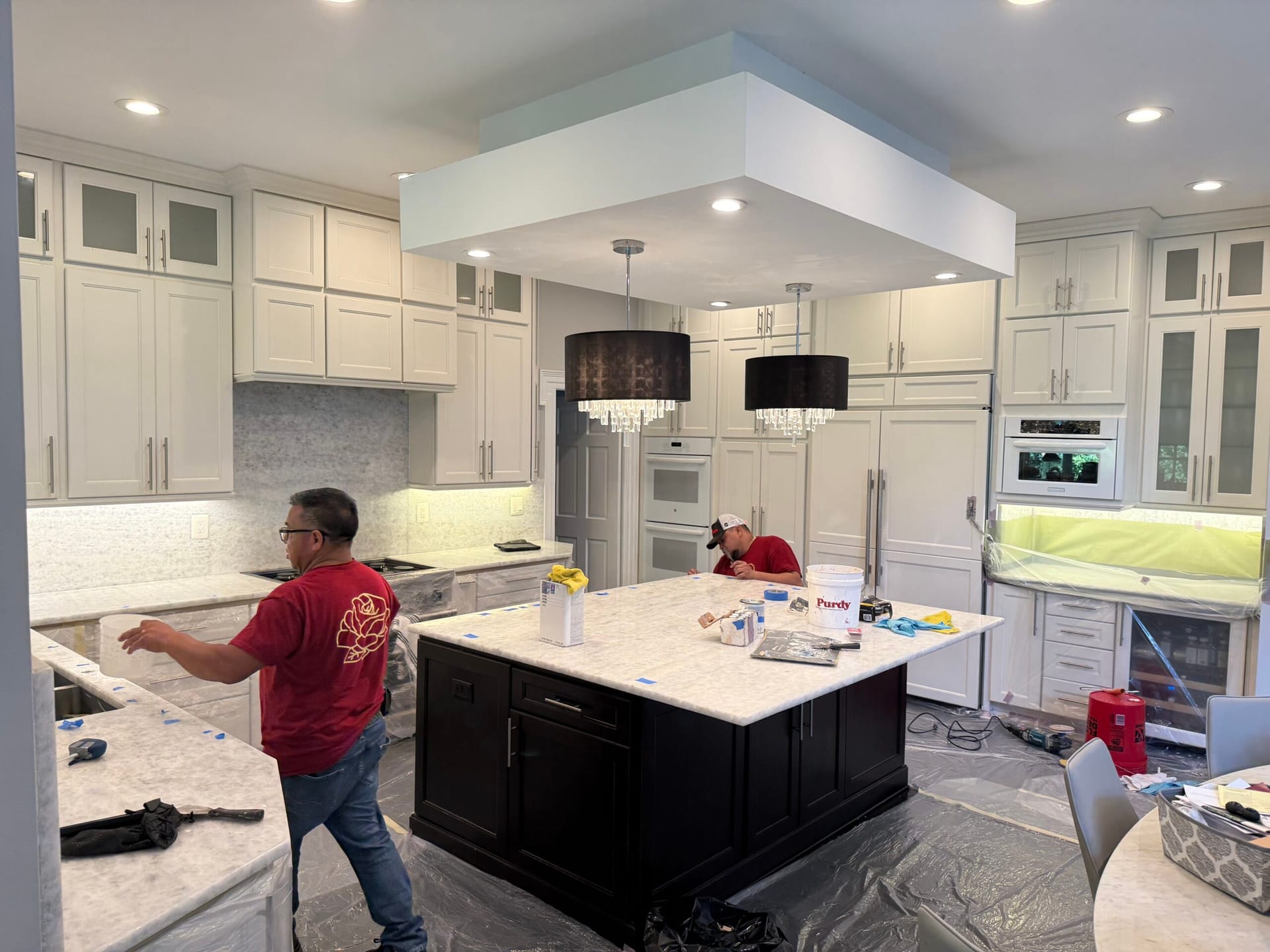
Kitchen stone takes more chemical exposure than any other surface in a home. Our kitchen stone restoration service covers countertops, islands, backsplashes and floors together, which is usually cheaper than doing them separately.
Common Kitchen Countertop Materials and Their Specific Issues
Marble Countertops
Marble is one of the most beautiful and most problematic materials for kitchen countertops. Its crystalline calcite structure gives it the distinctive veining and luminous depth that makes it irreplaceable as a design material — and its calcite chemistry makes it inherently vulnerable to acids found in virtually every kitchen environment. Lemon juice, vinegar, wine, coffee, tomato products, and even many cleaning products are acidic enough to etch marble, dissolving the polished surface layer and leaving dull, matte spots that look like cloudy rings or scratch patterns.
Beyond etching, marble is also vulnerable to staining. Its porosity means that oil-based and pigmented liquids can penetrate below the surface if left in contact long enough. And because it is a soft stone relative to granite and quartzite, it accumulates scratches from kitchen tools, cutting boards dragged across the surface, and abrasive cleaning pads.
None of this makes marble a bad choice for kitchen countertops — it just requires a different maintenance approach and periodic professional restoration. Many of the most beloved and most heavily used kitchen countertops in the world are marble, maintained by owners who understand how to care for them.
Granite Countertops
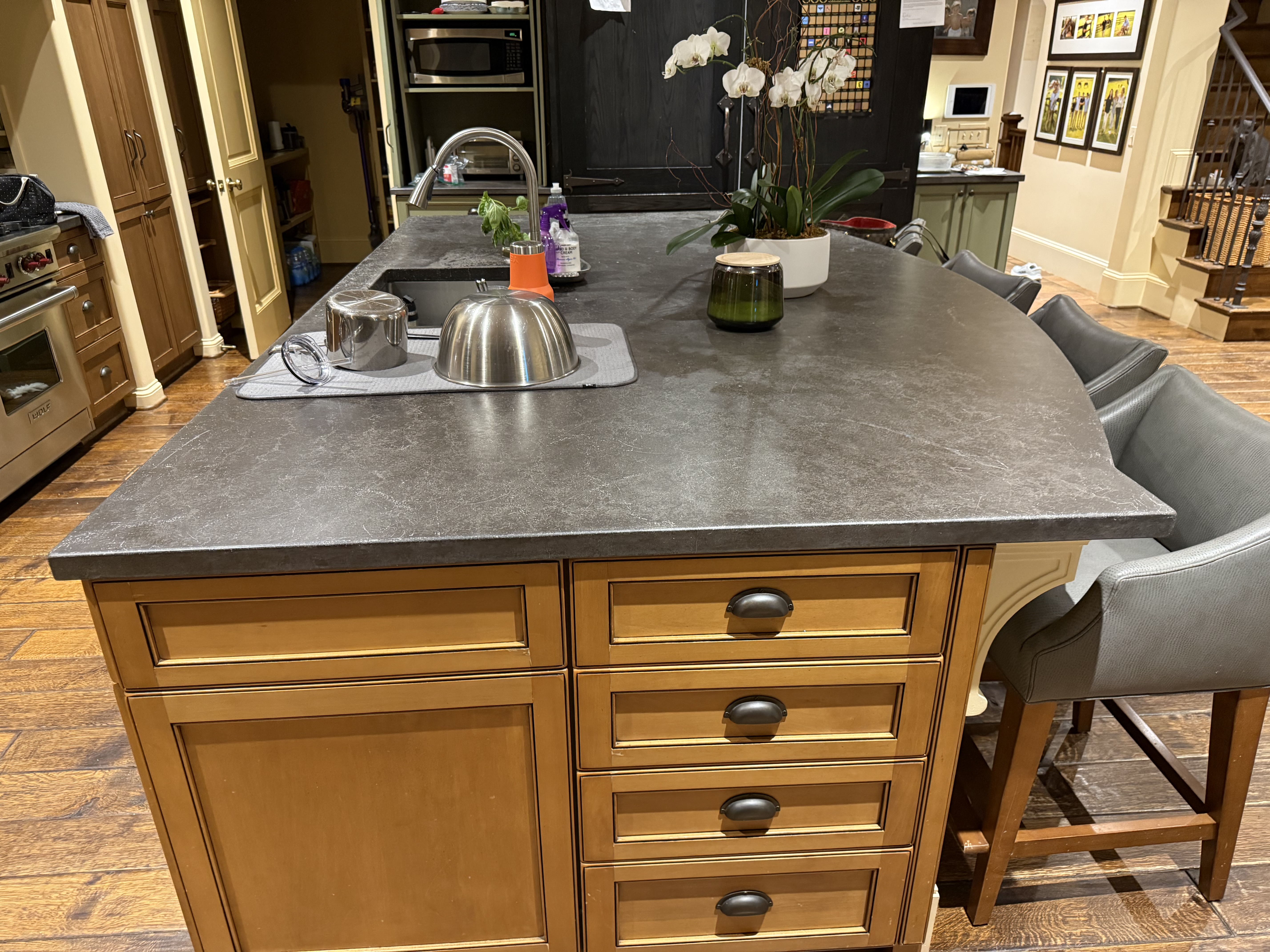
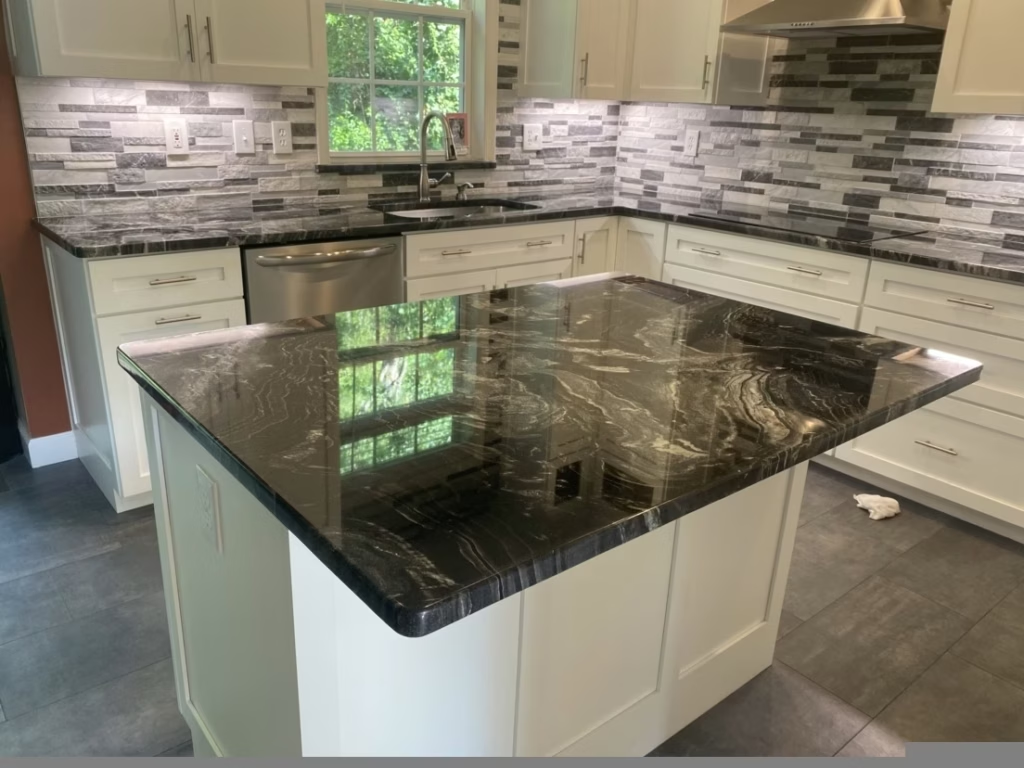
Granite is significantly harder than marble and chemically resistant to the acids that etch calcite-based stones. This makes it more forgiving in kitchen environments. The issues granite typically presents are different: chips at edges and corners from impact with heavy pots or dropped objects, scratches from cutting directly on the surface (which also damages knives), dulling from abrasive cleaners or cleaning pads, and staining of the sealer rather than the stone itself — producing a cloudy, hazy appearance over time.
Granite countertops that have lost their polish respond well to professional honing and repolishing. Edge chips can be filled with color-matched epoxy resin that is virtually invisible after grinding and buffing. Stained or depleted sealers can be stripped and replaced.
Quartzite Countertops
Quartzite (natural quartzite, not to be confused with manufactured quartz composite) is a metamorphic rock that is very hard and has good acid resistance, making it an excellent kitchen surface. However, it is often misidentified — many stones sold as quartzite are actually softer marbles or dolomitic limestones that will etch from acid exposure. True quartzite develops primarily mechanical damage: scratches, edge chips, and surface dulling from abrasive materials.
Restoration of quartzite follows a similar approach to granite — mechanical polishing to restore the surface finish, edge repair for chips, and resealing.
Concrete Countertops
Poured and finished concrete countertops became popular in the 2000s as a design material offering customizable form, color, and texture. They require more maintenance than natural stone — concrete is highly porous and must be sealed, typically with a topical sealer that creates a physical barrier between the concrete and the kitchen environment. When this sealer is not maintained, concrete countertops stain rapidly and deeply. Concrete is also subject to cracking if the substrate moves or the mix design had insufficient strength, and hairline cracks in the surface are common in older installations.
Restoration of concrete countertops involves stripping any failed sealer or topical coating, addressing surface stains and cracks, and applying a fresh sealing system appropriate to the countertop’s use environment.
Signs Your Countertops Need Professional Restoration
The indicators that restoration is needed are typically obvious once you know what to look for:
- Etching: Dull, matte spots or rings on a previously polished marble surface, usually corresponding to the locations of food and beverage spills. Etching looks similar to water staining but does not go away with cleaning because it represents actual removal of the stone surface.
- Staining: Dark or discolored areas that persist after cleaning, caused by oil, wine, coffee, or other pigmented materials that have penetrated below the sealer into the stone.
- Chips: Missing material at edges, corners, or on the countertop field, caused by impact with heavy objects. Chips range from cosmetic to significant depending on location and size.
- Dullness: A general loss of clarity and reflectance across the surface, caused by accumulated fine scratches, sealer depletion, or chemical damage to the surface layer.
- Scratches: Visible linear marks on the surface from cutting, dragging, or abrasive cleaning — particularly visible on darker stone or in raking light.
- Sealer failure: Cloudy, peeling, or patchy appearance on sealed surfaces, or water that no longer beads on the surface (indicating sealer depletion).
The Marble Countertop Restoration Process in Detail
Marble countertop restoration is the most nuanced of the common countertop restoration processes, because marble’s sensitivity to both chemical and mechanical damage requires careful sequencing of steps and precise material selection.
Surface Assessment
The first step is assessing the type and depth of damage. Etching is a surface-layer issue that can be addressed by mechanical polishing. Deep staining may require poultice treatment before or during the polishing process. Chips require repair before polishing. Scratches are addressed mechanically. The assessment determines the starting grit for the polishing sequence and identifies any preparation steps required before standard polishing can proceed.
Chip and Crack Repair
Edge chips and field cracks are repaired using color-matched stone epoxy or UV-cure adhesive systems. The repair material is applied to overfill the void slightly, cured, and then ground flush with the surrounding surface using progressively finer diamond tooling. A well-executed chip repair on marble is essentially invisible from normal viewing distances — it takes a very deliberate inspection under raking light to detect the repair location.
Mechanical Polishing
For mildly etched or dulled surfaces, polishing can begin at a relatively fine grit — 200 to 400 metal-bond diamond — and proceed through resin-bond pads to the target finish level. For heavily etched or scratched surfaces, a coarser starting grit (50 to 100) may be required to remove the full depth of damage before progressing to finer tooling.
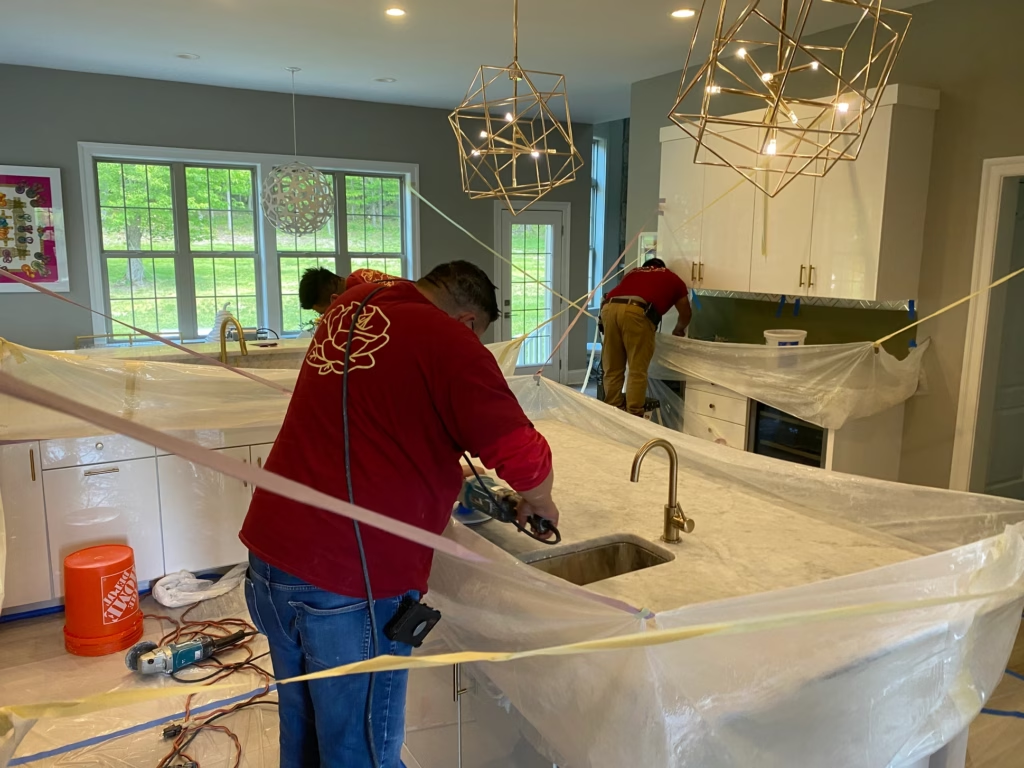
The polishing sequence for countertops uses hand-held or benchtop polishing machines rather than walk-behind floor equipment — the geometry of a countertop requires different tooling and technique than floor polishing. Edges, corners, backsplashes, and the field surface each require different tool orientations and pressure management. An experienced stone restoration technician can achieve a consistent, high-clarity polish across all surfaces and transitions of a kitchen countertop installation.
Stain Treatment
Stains that have penetrated below the surface are addressed with poultice treatments — absorbent materials mixed with chemical agents appropriate to the stain type, applied to the surface and allowed to draw the stain out of the stone as the poultice dries. Different stain types require different chemical agents: alkaline hydrogen peroxide solutions for organic stains (wine, coffee, food), acetone or mineral spirits for oil-based stains, and specialty products for rust or biological staining. Multiple poultice applications may be required for deep staining.
Sealing
After polishing and stain treatment, the countertop surface is sealed with an appropriate impregnating sealer. Impregnating sealers penetrate below the polished surface and reduce porosity without creating a topical film, meaning they do not alter the appearance of the stone or create a coating that can peel or yellow. The sealer is selected based on the stone type, porosity, and intended use environment — kitchen countertops require sealers rated for food contact and resistant to the oil-based and acidic substances they will encounter.
Granite Chip Repair: Process and Expectations
Granite edge chips are one of the most common countertop damage issues we address. The repair process for granite is similar to marble — color-matched stone epoxy is selected to match the background color of the granite, tinted if necessary to approximate the granite’s color pattern, applied to the void, and cured. Because granite has a complex mineral pattern of multiple colors and crystals, a perfect invisible repair is not always achievable, but a well-executed repair reduces the visual impact of the chip by 80 to 90 percent and is undetectable from normal viewing angles.
For large chips or missing pieces near sink cutouts — a common failure location due to the stress concentration from cutting and the frequent exposure to water — it may be necessary to use a layered fill approach with multiple applications of tinted epoxy to build up the repair in layers that approximate the granite’s visual depth.
Concrete Countertop Refinishing
Concrete countertops that have lost their sealer, developed significant staining, or show surface cracking require a more involved restoration process than natural stone. The existing sealer must be stripped or sanded away mechanically. Stains are addressed with appropriate treatments for the stain type and concrete’s reactivity. Hairline cracks are filled with flexible epoxy or polyurea systems, or for cosmetic surface cracks, with color-matched concrete repair compound. The surface is then mechanically refined to the desired finish level — from a rough cast texture to a polished aggregate exposure — and resealed with a contemporary penetrating or topical system appropriate to the countertop’s use.
Marble Armor: Advanced Protection for Countertops and Horizontal Surfaces
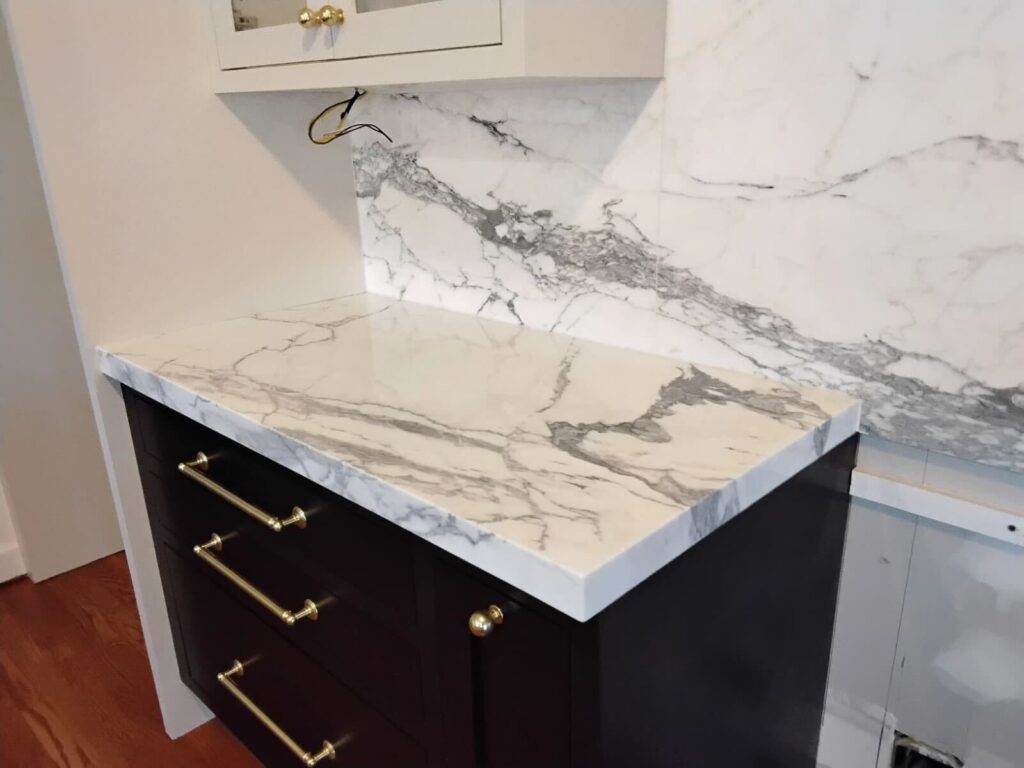
One of the most significant advances in stone protection for kitchen surfaces is Marble Armor — a high-performance protective coating specifically formulated for marble, granite, quartzite, and other natural stone countertops, vanities, tabletops, bar tops, backsplashes, and waterfall edges. Marble Armor is a countertop and surface protection system, not a floor coating — it is engineered for the specific conditions found on horizontal and vertical kitchen and bath surfaces, not for use on floors.
Marble Armor provides superior stain and etch resistance compared to standard impregnating sealers. Where a conventional sealer reduces the rate of liquid absorption but does not prevent etching from acid contact, Marble Armor creates a more robust protective layer that resists both staining and the chemical attack that causes etching in marble and limestone surfaces. For kitchen countertops — which are subject to frequent acid exposure from food preparation — this represents a significant upgrade in protection and a meaningful reduction in the frequency of professional restoration needed to maintain the surface.
Application of Marble Armor is performed after professional restoration has brought the countertop surface to a clean, polished baseline condition. It is not a substitute for restoration — applying a protective coating over a damaged or etched surface does not correct the underlying damage. The proper sequence is: restore the surface to its target finish, then apply Marble Armor to protect it going forward. Learn more on our Marble Armor page.
Cost of Restoration vs. Replacement
The financial case for countertop restoration is compelling. Consider a common scenario: a kitchen with 50 to 70 square feet of Carrara marble countertops that have been etched, stained, and scratched over 10 years of cooking use. The homeowner is considering replacing them with new marble.
| Option | Estimated Cost | Timeline | Disruption |
|---|---|---|---|
| Professional restoration | $700–$2,500 | 1 day | Minimal — kitchen unavailable for 1 day |
| New marble countertop installation | $4,500–$12,000+ | 1–3 weeks (fabrication + install) | Significant — demolition, plumbing disconnect, extended kitchen unavailability |
| New granite installation | $3,500–$8,000 | 1–2 weeks | Significant — same disruption as marble replacement |
In most cases, a countertop that is structurally sound — not cracked through its full thickness, not delaminated from substrate — can be restored to a beautiful condition for 10 to 25 percent of replacement cost. After restoration, with proper maintenance and Marble Armor protection applied to the countertop surface (again, not floors), the service interval before the next restoration is typically extended considerably.
How to Maintain Countertops After Restoration
The goal of professional restoration is to reset the countertop to a clean starting condition. Proper maintenance after restoration is what determines how long that condition is maintained before the next service interval.
For marble countertops, use only pH-neutral stone-specific cleaners. Avoid all-purpose kitchen sprays, bleach-based products, and any cleaner not specifically formulated for natural stone. Use cutting boards — always. Wipe up acidic spills (lemon, vinegar, wine, coffee) immediately rather than letting them sit. Use trivets for hot pots to prevent thermal shock.
For granite and quartzite, the same general rules apply, though these stones are significantly more forgiving of occasional acid exposure. A dedicated granite cleaner and periodic application of impregnating sealer (typically annually) will maintain protection. Avoid abrasive scrubbing pads.
For concrete countertops, maintenance depends heavily on the sealing system used. Topical sealers require periodic reapplication as they wear. Penetrating systems need less frequent attention but should be reapplied when water no longer beads on the surface. Avoid harsh chemicals and abrasives regardless of the sealing system in use.
For more information on residential stone services, visit our residential marble restoration page or our granite services page. Call Rose Restoration at 703-327-7676 to discuss your countertop restoration needs.
Frequently Asked Questions About Kitchen Countertop Restoration
Can marble countertops be restored to their original polish after etching?
Yes. Etching is damage to the surface layer of the marble — it removes the polished finish by dissolving the calcite — but this damage is limited to the near-surface zone. Professional polishing removes the etched layer mechanically through progressive diamond abrasive tooling and re-establishes the polish below the damaged zone. Even marble with heavy etching from years of kitchen use can be restored to a high-clarity polish. The key is that the restoration removes actual stone material, so the process can only be repeated a finite number of times over the life of the countertop — typically many times over a realistic ownership horizon.
Is Marble Armor available for kitchen floors as well as countertops?
No. Marble Armor is a protective coating for countertops, vanities, tabletops, bar tops, backsplashes, and waterfall edges — horizontal and vertical surfaces, not floors. It is not engineered for floor applications and should not be used on floors. For floor protection on natural stone, we use penetrating impregnating sealers appropriate to the stone type and finish level. If you have questions about what protection is right for your specific surfaces, call us at 703-327-7676.
Can a granite edge chip be repaired invisibly?
A well-executed chip repair on granite achieves a result that is undetectable from normal viewing distances — standing in front of the counter, using the kitchen. Under close examination, particularly in raking light, a repaired chip may show very slightly different texture or color than the surrounding stone, because granite’s complex multi-mineral pattern is impossible to replicate exactly with a tinted epoxy fill. For the practical purposes of kitchen use and visual appearance from normal distances, professional chip repair is essentially invisible and eliminates the sharp edge that a chip creates.
How often should kitchen countertops be professionally restored?
The service interval depends heavily on use intensity, cleaning habits, and whether the countertop is protected with an appropriate sealer or Marble Armor after restoration. Marble countertops in a heavily used kitchen with imperfect maintenance may need restoration every three to five years. The same countertop maintained with pH-neutral cleaner and protected with a quality impregnating sealer or Marble Armor may go eight to twelve years between professional restorations. Granite and quartzite countertops in kitchen environments generally require less frequent restoration — often ten years or more if properly maintained and periodically resealed.
My concrete countertop has a large hairline crack — can it be repaired?
Yes, in most cases. Hairline surface cracks in concrete countertops — those that do not go through the full thickness of the slab — can be filled with color-matched flexible epoxy or polyurea compound that is applied, cured, and ground flush with the surface. The repair is then refinished to match the surrounding concrete texture and color. Full-depth structural cracks (where one side of the crack is at a different level than the other) are more challenging and may indicate movement in the substrate — these should be evaluated by a professional to determine the cause before repair is attempted.
Should I seal my granite countertops myself after professional restoration?
After professional restoration, Rose Restoration applies appropriate sealer as part of the restoration process. For ongoing maintenance, some homeowners apply impregnating sealer themselves using consumer-grade products available at hardware stores. These products are adequate for maintenance sealing on granite and quartzite, provided they are properly selected and applied according to manufacturer instructions. For marble, and for any surface where a quality impregnating sealer and Marble Armor protection is desired on countertops, vanities, or bar tops, we recommend professional application to ensure correct product selection, coverage rate, and application technique.



Looking for something else?
Get a Free Assessment from Rose Restoration
Tell us about your marble, stone, terrazzo, or concrete and our senior technicians will recommend the right restoration approach. Family-run and trusted across Washington DC, Maryland, and Virginia since 1978.
Call (703) 327-7676 · Email info@roserestoration.com · schedule a time · or send us photos.
Restore. Don't replace.
48 years of polishing marble, terrazzo, concrete, and tile across Washington DC, Northern Virginia, and Maryland. IMF, Four Seasons, Smithsonian, and the Virginia State Capitol trust us — you can too.