
Quick Answer
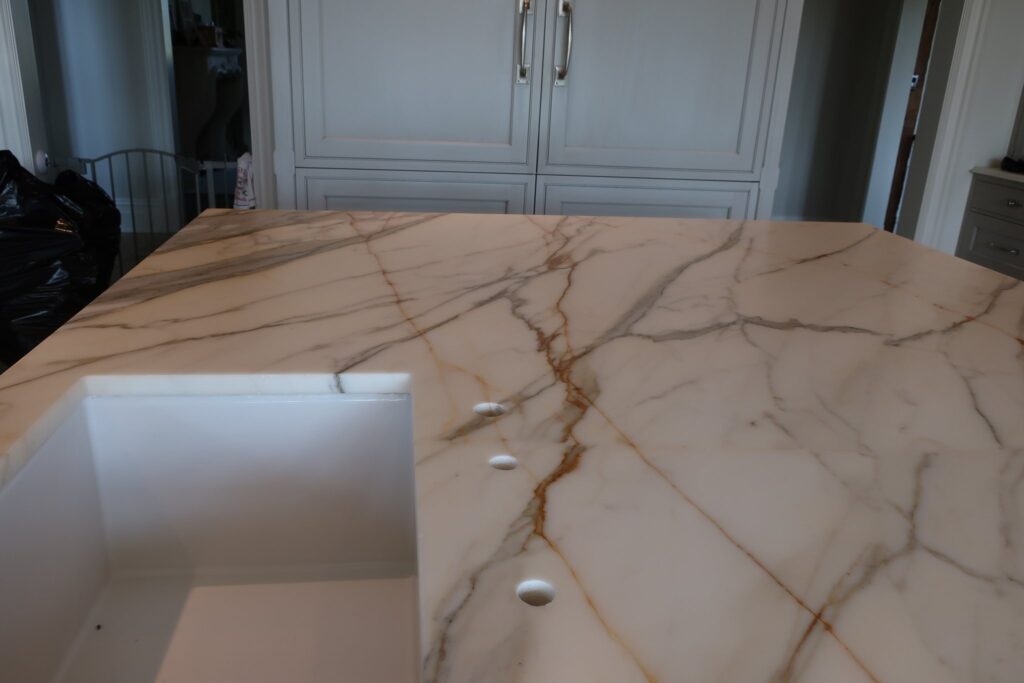
How is Calacatta marble restored when etched or dulled?
Calacatta marble restoration requires senior technician execution because the bright white background makes any technique flaws visible. Diamond honing through 400-800-1500-3000 grit, followed by chemical polishing, restores the original mirror finish. Marble Armor topical protection is recommended for high-use kitchen islands to prevent recurrence.
Calacatta marble is a luxury Italian marble quarried from the Apuan Alps near Carrara. It is recognizable by its bright white background and bold, dramatic veining — typically grey, gold, or brown veins running across a clean white field. Calacatta is one of the most expensive natural stones used in residential design and is favored for high-end kitchen countertops, master bath vanities, and statement floors. Because it is a calcium carbonate stone, Calacatta is vulnerable to etching from acids and staining from oils — issues that are completely repairable through professional restoration.
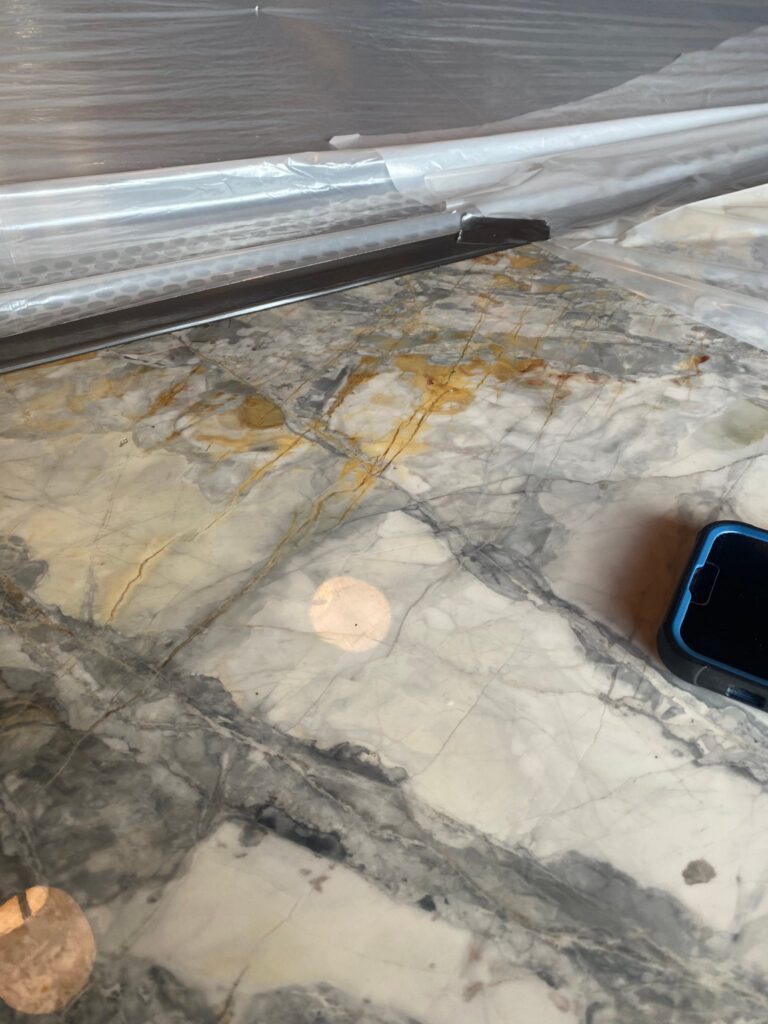
Rose Restoration restores Calacatta marble across DC, Maryland, and Virginia — for homeowners with kitchen countertops that have etched, vanities that have stained, and floors that have lost their luster. This guide covers what Calacatta is, the damage we see most often, the professional restoration process, and what restoration costs in 2026.
What is Calacatta marble?
Calacatta marble is a metamorphic stone formed when limestone is subjected to heat and pressure deep in the Earth’s crust. The resulting marble has a bright white background — significantly whiter than Carrara — with bold, contrasting veins of grey, gold, or brown that flow in dramatic patterns. Common Calacatta varieties:
- Calacatta Gold — white with warm gold veining; often used in luxury kitchens for its statement appearance
- Calacatta Borghini — bold grey veining on bright white; popular in modern kitchens and bathrooms
- Calacatta Vagli — soft grey veining; quieter but still distinctly Calacatta
- Calacatta Macchia Vecchia — pronounced taupe and grey veining; rarer and more expensive
- Calacatta Viola — dramatic purple-grey veining; specialty cuts
Calacatta is rare. Only a handful of quarries in Tuscany produce it, and individual quarry blocks vary significantly. Two slabs labeled “Calacatta Gold” from different blocks may look noticeably different — the veining pattern is essentially unique to each piece.
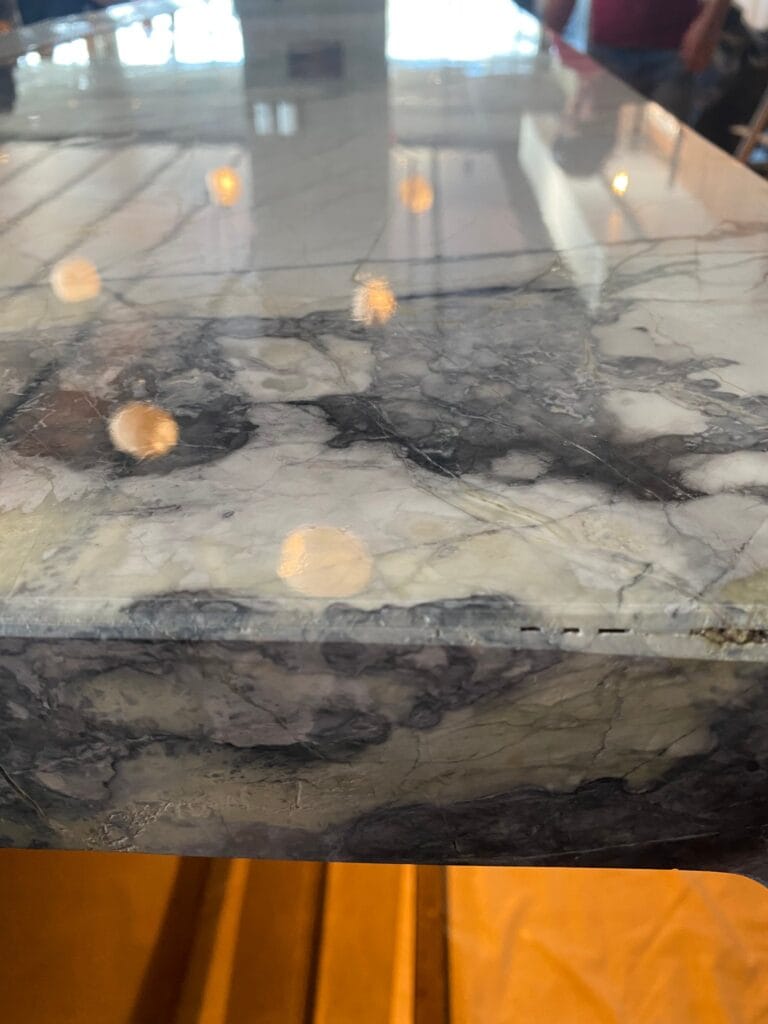
Why Calacatta marble needs restoration
Calacatta is a calcium carbonate stone, which means acid reacts with it directly. Common damage we see on residential Calacatta installations:
- Etch marks. Lemon juice, wine, vinegar, tomato sauce, citrus cleaners — any acid contacts Calacatta and within seconds creates a dull spot where the polished finish has been chemically dissolved. Etches show as cloudy or matte areas against the polished surrounding. The white background of Calacatta makes etches MORE visible than on darker marbles like Nero Marquina.
- Oil stains. Olive oil, butter, cooking grease — oils penetrate into the porous structure and leave dark patches that won’t wipe off. Common around cooktops and on islands where prep work happens.
- Organic stains. Red wine, coffee, tea, fruit juice — the pigments penetrate through the surface and stain the stone below. White Calacatta makes these stains particularly visible.
- Surface scratches. Sliding pots, ceramic, metal hardware — Calacatta is softer than granite and shows scratches more readily. Hairline scratches on a polished surface read as a cloudy line.
- Sealer breakdown / hazing. Old sealer that wasn’t properly maintained breaks down and creates a yellowing or hazing effect across the stone, particularly noticeable on Calacatta because of the bright white base color.
- Soap and limescale buildup. Bathroom Calacatta develops a milky soap-scum film over time that makes the surface look dull. Improper cleaning with abrasive or acidic cleaners makes this worse.
Calacatta restoration process
Calacatta is a softer marble than Carrara and other denser varieties — it requires careful diamond-honing technique to maintain edge clarity and avoid creating a wavy or uneven finish. The Rose process:
- Assessment. A senior technician evaluates damage type, severity, finish (polished, honed, leathered), edge profile, and the surrounding cabinetry. Calacatta near sinks, cooktops, and bar areas typically needs the most work.
- Pre-clean. Commercial pH-neutral cleaning to remove built-up residue, soap film, prior sealer, and any food contamination before diamond work begins.
- Stain extraction (if needed). Stains are extracted via poultice before any honing. Honing over a stain locks the pigment into the stone permanently.
- Diamond honing. Sequentially work the marble with progressively finer diamond abrasives — typically starting at 200 or 400 grit on heavy etch damage, finishing at 3000+ grit for a high polish. Each pass removes a microscopic layer of stone.
- Repair filling (if needed). Chips, cracks, or missing material are filled with color-matched epoxy that blends with the Calacatta veining.
- Polishing. Final high-polish passes with diamond pads to restore the original mirror finish.
- Sealing. Premium impregnating sealer to slow stain absorption. Note: sealer does not prevent etching.
- Optional Marble Armor. For high-use kitchen Calacatta, Marble Armor provides etch and stain protection that lasts 10+ years. Particularly valuable for white marble where etches are most visible.
Standard residential Calacatta restoration typically completes in a single day. Larger projects (multiple bathrooms, full-floor restorations) span 2-4 days. We schedule around your household and work in dust-controlled zones.
Cost: what Calacatta marble restoration costs in 2026
- Single Calacatta countertop (etch + polish, 30-60 sf): $850–$1,800
- Full kitchen Calacatta (perimeter + island, 60-120 sf): $1,500–$3,500
- Master bath Calacatta vanity: $700–$1,400
- Full master bath Calacatta (vanity + walls + floor): $2,800–$6,500
- Floor restoration (per sf): $14–$28/sf depending on damage and finish target
- Single etch or stain spot repair: $400–$900 per location
- Marble Armor topical protection (added to restoration): $8–$14/sf
Cost varies with damage extent, finish complexity, and whether multiple problems (etches, stains, scratches, chips) need to be addressed in the same visit.
Why restoration is almost always preferable to replacing Calacatta
Calacatta replacement is expensive and usually unnecessary. Three reasons restoration wins:
- Calacatta is rare and matching is hard. Replacement slabs may not match the existing veining pattern — even from the same quarry. The new piece will look different from the rest of the kitchen or bathroom. Restoration preserves the original installation.
- Cost. A full kitchen Calacatta replacement (slab + fabrication + installation + tear-out + dumpster + reinstall plumbing) typically runs $15,000–$40,000+. Restoration of the same kitchen is $1,500–$3,500. The math is not close.
- Original quality. Older Calacatta installations were often cut from premium quarry blocks that may not be available today. The original stone in your home may be higher quality than current production.
Where Rose restores Calacatta marble
We service Calacatta restoration projects across DC, Maryland, and Virginia, including Washington DC marble restoration, Arlington, Alexandria, Bethesda, McLean, Potomac, Chevy Chase, Vienna, Tysons, Reston, and luxury residential markets across Northern Virginia and Maryland.
Frequently asked questions
How do I know if I have Calacatta or Carrara marble?
Calacatta has a brighter, whiter base color and bolder, more dramatic veining (often with gold or warm grey tones). Carrara has a softer grey-white base with finer, more linear feathery veining. If you have the original specs from your installer, those will tell you for certain. We can also identify the variety during assessment.
Can etch marks really be removed from Calacatta?
Yes. Etches are removed via diamond honing — sequentially abrading the surface to flatten the etch and re-polish. The repair is permanent (until new etching occurs). The bright white background of Calacatta means etches are very visible, but the same color makes the restored finish very satisfying.
Will my Calacatta restoration match the rest of the kitchen?
Yes. We restore the entire piece uniformly rather than spot-treating. The polished finish, color, and reflectivity will match across the slab. Because Calacatta is so distinctive, restoring the entire piece is essential — spot-only work would create visible variation.
How often does Calacatta need to be re-sealed?
Once a year for kitchen Calacatta with daily use. Bathroom Calacatta can go 18-24 months. Marble Armor extends the protection cycle to 10+ years and adds etch resistance that sealer alone cannot provide.
Can I prevent future etching with sealer?
No. Sealers prevent staining (oil and pigment penetration) but do not prevent etching. Acid contacts the stone surface and reacts with the calcium carbonate before any sealer can stop it. Marble Armor is the only product that actually prevents etching.
What about hard water marks on bathroom Calacatta?
Hard water deposits create surface scale that can be removed with mild abrasives or specific limescale removers. Repeated buildup can lead to surface etching over time. We address both the buildup and any underlying surface damage in the same visit.
Can Calacatta floors be restored too?
Yes. Floor restoration is similar to countertop restoration but with floor-grade equipment. We address scratches, dull spots, surface staining, and grout discoloration. Per-sf pricing applies.
Should I be worried about Calacatta in a busy kitchen?
Calacatta will show wear in a busy kitchen — that is the nature of the stone. The choice is not whether you will need restoration, but how often. Marble Armor reduces the frequency dramatically. Most luxury homeowners with Calacatta restore every 5-10 years; with Marble Armor, every 10-15 years.
Schedule a free assessment
For Calacatta marble restoration in DC, Maryland, or Virginia: call 703-327-7676 or request a quote online. Senior technicians respond within 2 business hours. Most residential Calacatta restoration projects are quoted between $850 and $3,500.