
Quick Answer
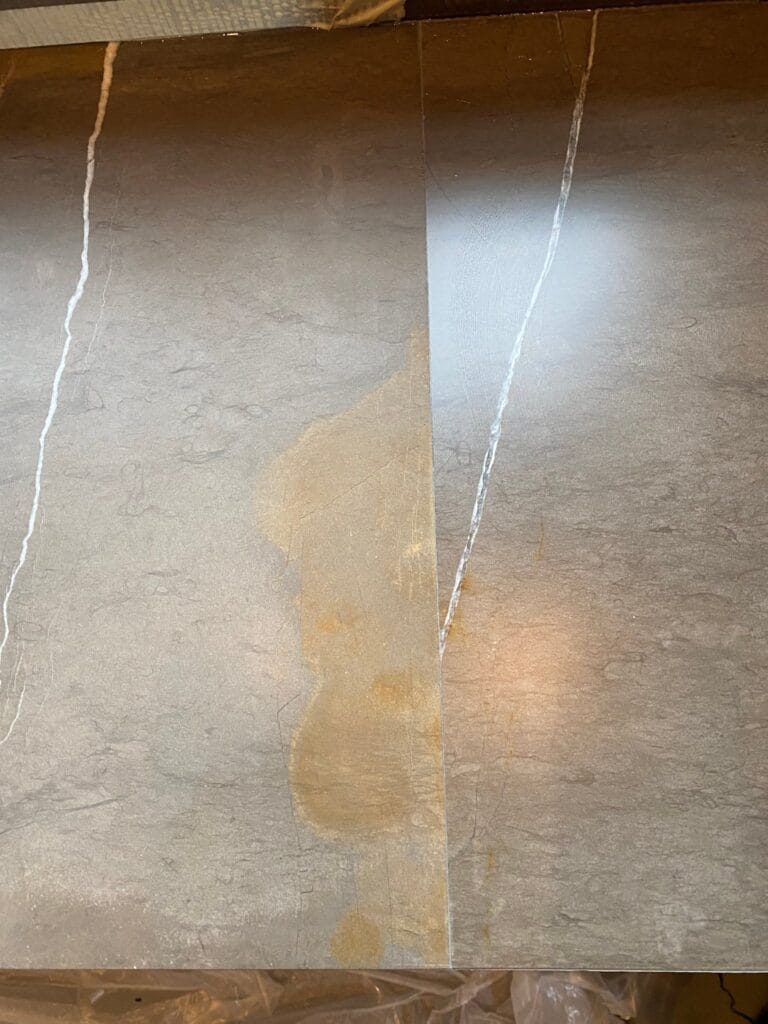
How do you remove stains from marble?
Marble stains are removed via poultice extraction — a stone-safe paste applied over the stain, covered with plastic, and left to draw absorbed pigment back out of the stone over 24-48 hours. Most stains, even ones that have been there for over a year, extract fully within 1-3 applications. The poultice chemistry depends on the stain type (oil, organic, ink).
A stain on marble is not the same thing as an etch. A stain is a discoloration — usually darker than the surrounding stone — caused by oil, pigment, or rust soaking down into the porous structure of the marble. Etches are direct acid damage to the surface; stains live below the surface. The two require completely different repair processes, and applying the wrong fix to the wrong problem is the most common reason DIY marble repair attempts fail.
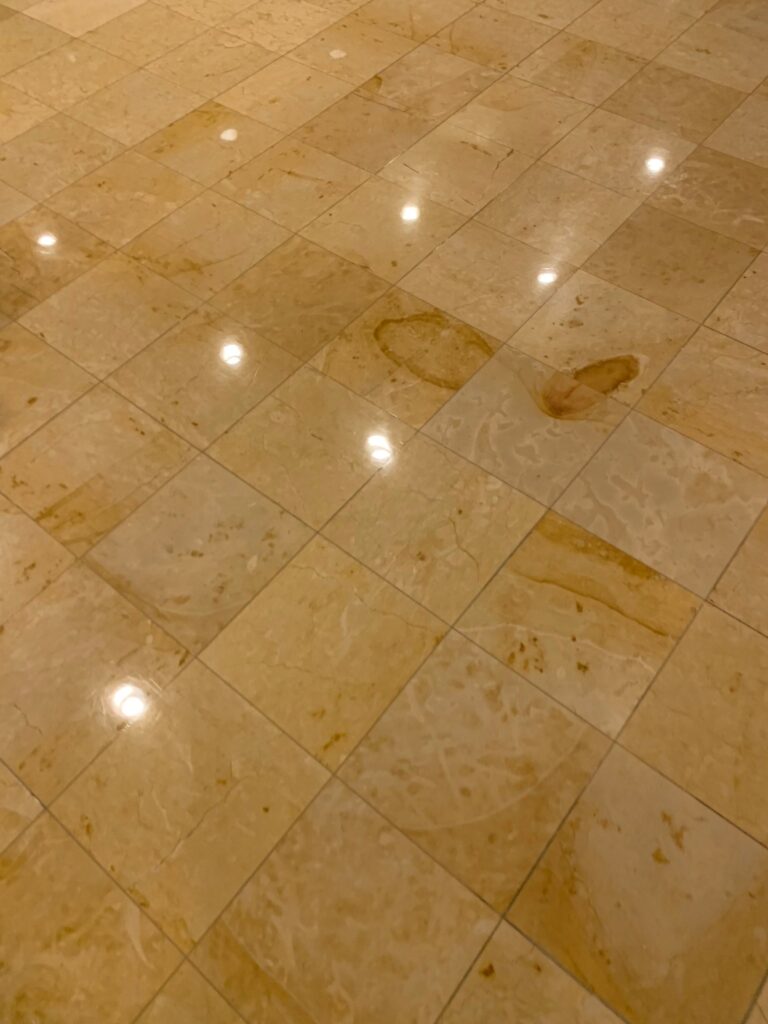
Rose Restoration removes stains from marble countertops, vanities, fireplaces, floors, and exterior stone across DC, Maryland, and Virginia. Most stains can be drawn out of the stone — even old, deep, or seemingly permanent ones — without replacing the marble. This guide explains how stain removal actually works, what you can attempt at home, and what professional stain removal costs in 2026.
Identifying what kind of stain you have
The right removal method depends entirely on what caused the stain. Common stain categories on marble:
- Oil-based stains: cooking oil, butter, salad dressing, lotions, hair products, cosmetics. These usually appear as a darker, often greasy-looking patch that may have a slight gloss.
- Organic stains: coffee, tea, wine, fruit juice, food residue, leaves and outdoor debris. Typically yellow-brown, can fade naturally over months but rarely fully disappear.
- Pigmented stains: ink, marker, dye, certain acrylic paints, food coloring. Usually colored like the source material.
- Rust stains: orange-brown, often near metal objects (planters, candle holders, plumbing fixtures, iron-rich water).
- Biological / mold stains: dark spots, often near sinks, showers, or outdoor stone. Sometimes accompanied by surface texture change.
- Efflorescence: a white powdery deposit (not technically a stain — minerals migrating to the surface). Common on new marble installations or where moisture is moving through the stone.
- Smoke / soot: on fireplace surrounds, dark grey to black, sometimes accompanied by texture loss from heat.
Identification matters because each stain category responds to a different chemical treatment. Hydrogen peroxide pulls organic stains; acetone or mineral spirits pull oil; rust requires reducing agents; biological needs an oxidizer plus prevention of regrowth. Using the wrong agent at best does nothing — at worst, it sets the stain or damages the stone.
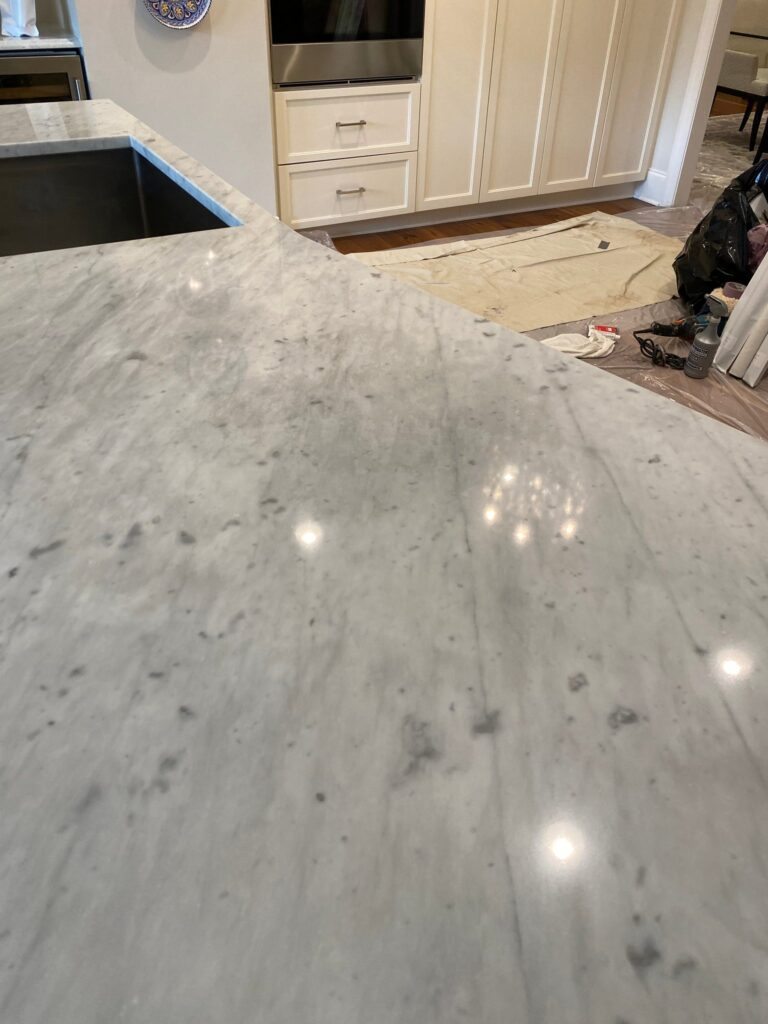
What causes stains to develop
- Marble is porous. Even the densest marble has microscopic capillaries that draw liquids inward by capillary action. Once a substance enters the pores, it can settle deep enough that surface cleaning will not reach it.
- Sealer breakdown. Stone sealers wear away — typically every 1 to 3 years on a kitchen counter, faster around faucets and high-use zones. Stains develop where sealer has worn off and the homeowner does not realize it.
- Slow leaks. Hot oils splatter and spread; coffee mug rings sit overnight; a wine drip dries before being noticed.
- Outdoor exposure. Patios, pool surrounds, exterior stone — exposed to leaves, fertilizers, lawn chemicals, rust runoff from metal fixtures.
- Construction contamination. Marble installed without protection during a renovation absorbs paint, drywall mud, contractor adhesive, joint compound — often invisible at install but appears later.
Why we do not recommend home poultice recipes
A poultice is a paste of an absorbent material and a chemistry matched to the stain. It is applied over the stain and left to draw it out as it slowly dries. The difficulty is the match: the wrong chemistry can set a stain permanently, bleach dark stone, or etch marble, which turns a stain job into a restoration job. Identifying the stain correctly is the step home recipes skip.
Some stains are hard to remove even for a professional:
- Old stains that have soaked deep into the stone, which may need several applications or may only lighten
- Mixed stains, such as red wine or oily food that also carry pigment
- Stains on dark or heavily veined marble, where any residual discoloration shows
- Large stained areas, such as a whole counter or room
- Outdoor or vertical stone, where a poultice is hard to keep in contact
Send photos and we will tell you what is likely to come out: send photos or call 703-327-7676.
How professional marble stain removal works
- Assessment and stain identification. A senior technician examines the stain, asks about likely causes, and tests on a small inconspicuous area. The right chemistry depends on knowing what the stain is.
- Surface preparation. The area is cleaned with pH-neutral cleaner. Existing sealer in the affected area is removed if it is preventing the poultice from contacting the stone.
- Targeted poultice application. Rose uses commercial-grade poultice formulations matched to the stain. Multi-component stains may receive sequential treatments — oil pull first, then organic, then pigment.
- Extended dwell. Poultices remain on the stone 24 to 72 hours under controlled humidity, drawing stain material out into the absorbent paste as it dries.
- Rinse and assess. The poultice is removed and the area inspected. Most stains require 2-4 application cycles; deep or old stains may need more.
- Diamond honing if needed. If sealer was removed during prep, or if the stain extraction process left any surface texture change, the area is re-honed and polished.
- Sealing. A penetrating impregnator is applied to slow future stain absorption.
Cost: what professional marble stain removal costs in 2026
- Single small stain (under 6 inches), residential countertop: $400–$450 for a single visit.
- Multiple stains, single counter / vanity: $400–$900 depending on stain type and count.
- Full counter / island stain remediation + re-seal: $600–$1,500.
- Bathroom stain removal (multiple surfaces): $800–$2,500.
- Marble fireplace surround stain + soot remediation: $500–$1,800.
- Marble floor stain remediation (per area): $400–$1,200 plus restoration if needed.
- Outdoor marble (patios, statuary, exterior): $400–$2,000 depending on extent.
Most residential stain removal projects complete in a single visit, but stains requiring extended poultice cycles will require a follow-up visit 2-3 days later for the final assessment.
Preventing future stains
- Maintain the sealer. Re-seal residential kitchen marble every 1-2 years. Bathroom and lower-traffic marble can go 2-3 years between sealings. Use a water-bead test: drop water on the surface — if it beads, the sealer is intact; if it absorbs within a few minutes, it is time to re-seal.
- Wipe spills immediately. Pigmented liquids (coffee, wine, juice) penetrate within minutes if the sealer is worn. Oils are even faster.
- Use coasters and trivets.
- For high-stain-risk surfaces (kitchen islands, bar tops), apply Marble Armor. The composite film provides a true non-absorbent surface that no liquid can penetrate.
- For outdoor marble, choose a penetrating sealer rated for exterior use and re-apply more frequently than indoor stone.
- Avoid acidic and alkaline cleaners. They strip sealer and leave the stone vulnerable.
Where Rose Restoration removes marble stains
We perform marble stain removal across DC, Maryland, and Virginia, including Washington DC marble restoration, Arlington, Alexandria, Bethesda, McLean, Potomac, Chevy Chase, Falls Church, Vienna, Tysons, Loudoun County, Fairfax County, and Montgomery County. Most residential stain removal projects are completed in a single visit, with extended-cycle stains requiring a brief follow-up.
Watch the work
Short videos from real Rose jobs. Tap to play.
Frequently asked questions
How long does marble stain removal take?
Initial poultice application takes 30 to 60 minutes. The poultice then sits for 24 to 72 hours drawing the stain out. Final assessment and clean-up takes another 30 to 60 minutes. Most projects span 2 to 5 days from start to completion, with most of that being passive cure time.
Can old stains that have been there for years be removed?
Usually yes, but old deep stains require more poultice cycles than fresh stains. A 10-year-old wine stain may need 5 to 8 cycles, where a 3-month-old stain might lift in 2 cycles. The success rate on properly treated marble is over 90 percent regardless of stain age.
Is stain removal the same as etch removal?
No. Stains are pigment or oil that has penetrated into the stone and require chemical extraction. Etches are surface acid damage that requires diamond honing and polishing to repair. Different problem, different fix. Some marble has both — we handle them sequentially in the same visit.
Will the stain come back after removal?
Properly removed stains do not return. New stains can develop if the sealer wears out and new staining material contacts the stone — that is a separate event, not a recurrence.
Can DIY stain removal damage marble?
Yes. Acidic rust removers etch marble. Bleach can leave faint white halos. Repeated aggressive scrubbing dulls polish. Wrong solvent on the wrong stain can fix the pigment in place permanently. If the stain is on a high-visibility surface, professional removal protects against making things worse.
Do you remove stains on outdoor marble (patios, statues, exterior)?
Yes. Outdoor stain removal uses formulations rated for exterior use and may require additional steps for biological staining, efflorescence, and rust runoff.
What about hard water stains around faucets and showers?
Hard water deposits combine staining (mineral discoloration) with etching (mineral acid damage). We remove the deposit, restore any etch damage, and re-seal. Often combined with a recommendation for a water filter or softener to slow re-formation.
Do you handle stains on slabs that someone else damaged trying to fix?
Yes. We start by neutralizing any prior chemical treatments, assess the resulting condition, and execute proper stain removal. Failed prior DIY attempts add modestly to the project cost but do not prevent a clean final result.
Schedule a free assessment
For marble stain removal in DC, Maryland, or Virginia: call 703-327-7676 or request a quote online. Senior technicians respond within 2 business hours. Most residential stain removal projects are quoted between $250 and $1,500.