
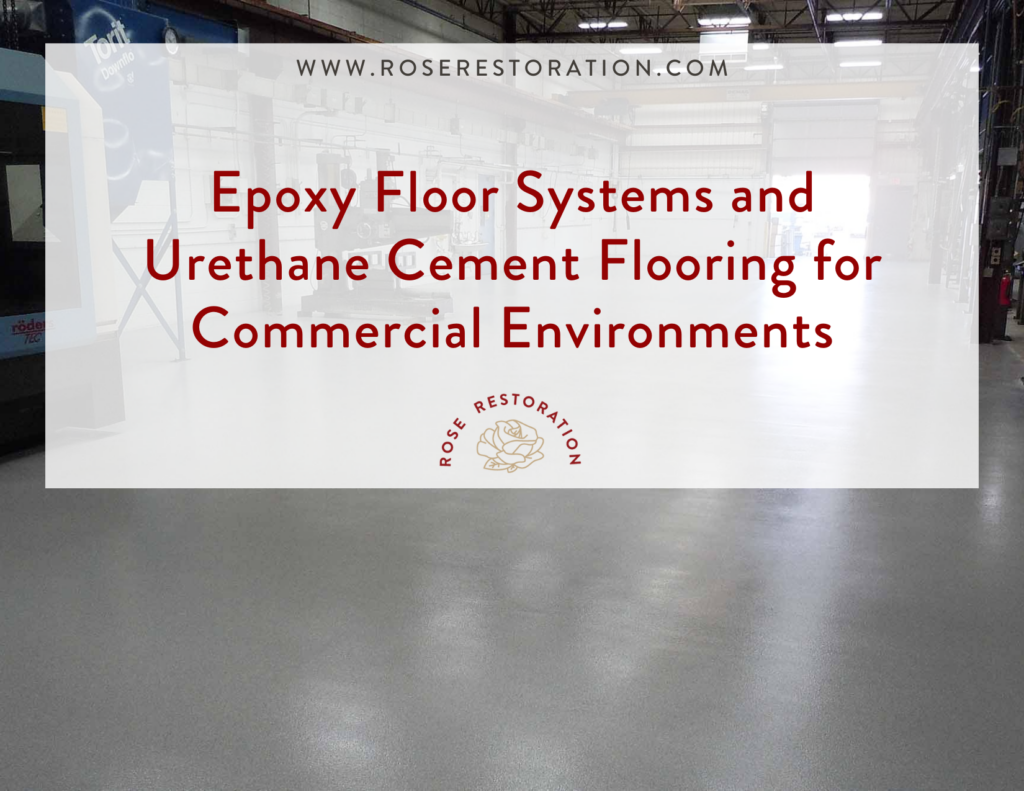
Urethane Cement vs. Epoxy Flooring: How to Choose the Right System for Your Commercial Facility
When it comes to protecting concrete floors in demanding commercial and industrial environments, two resinous systems dominate the conversation: urethane cement and epoxy. Both are proven performers. Both can transform a deteriorating slab into a durable, cleanable surface. But they are not interchangeable — and choosing the wrong one can mean premature failure, costly downtime, and a floor that has to be ripped out and replaced years ahead of schedule.
If you are a facility manager, general contractor, property manager, or operations director evaluating resinous flooring systems for a new build or renovation, this guide will walk you through the practical differences between urethane cement flooring and commercial epoxy flooring so you can make a confident, informed decision based on your actual operating conditions — not just a spec sheet.
Understanding the Two Systems at a High Level
Before diving into application-specific comparisons, it helps to understand what each system actually is and how it performs once cured.
Epoxy Flooring
Epoxy floor coatings and systems are two-component materials (a resin and a hardener) that chemically cross-link to form a hard, adhesive surface over prepared concrete. Commercial epoxy flooring has been an industry standard for decades, and for good reason: it bonds exceptionally well to concrete, resists a wide range of chemicals, and can be formulated in countless colors, textures, and build thicknesses.
Epoxy systems range from thin-mil coatings (10-20 mils) used in light-duty commercial spaces to high-build, self-leveling systems (60-125 mils or more) designed for heavy industrial traffic. They cure to a rigid, high-compressive-strength surface and are available with broadcast aggregate, quartz, or flake finishes for added slip resistance and aesthetics.
Urethane Cement (Urethane Mortar) Flooring
Urethane cement flooring — also referred to as urethane mortar flooring or cementitious urethane — is a hybrid system that combines polyurethane resin with Portland cement and graded aggregates. The result is a dense, monolithic topping (typically installed at 1/4 inch to 3/8 inch) that bonds to concrete at the molecular level and delivers properties that standard epoxy systems simply cannot match in certain environments.
Urethane cement was originally developed for the food and beverage industry, where floors endure punishing thermal cycling, caustic washdowns, and constant moisture. It has since become the go-to system in any environment where thermal shock, high humidity, or aggressive chemical exposure are daily realities.
Thermal Shock Resistance: The Single Biggest Differentiator
If there is one factor that separates urethane cement from epoxy more than any other, it is thermal shock resistance.
Epoxy flooring is a rigid thermoset material. When exposed to rapid temperature swings — such as a 200-degree steam washdown hitting an ambient-temperature floor, or a blast freezer door cycling open and shut — epoxy can crack, delaminate, or disbond from the substrate. The coefficient of thermal expansion in cured epoxy differs significantly from concrete, and when the two materials expand and contract at different rates, the bond fails.
Urethane cement has a coefficient of thermal expansion that closely matches concrete. This means the topping and the substrate move together through temperature swings rather than fighting each other. Urethane mortar flooring can withstand sustained temperatures from below freezing to well above 250 degrees Fahrenheit, and it handles rapid thermal cycling — hot washdowns, flash freezing, steam cleaning — without cracking or disbonding.
Rule of thumb: If your facility experiences temperature swings of more than 50 degrees Fahrenheit on the floor surface on a regular basis, urethane cement should be your default starting point. Epoxy will struggle in that environment regardless of how well it is installed.
Moisture Tolerance and Vapor Drive
Concrete is not a moisture barrier. In many facilities — particularly those built on grade without an effective vapor retarder — moisture vapor transmission (MVT) through the slab is a chronic issue. It is also one of the leading causes of coating failure.
Epoxy systems are generally more sensitive to moisture conditions in the substrate. Most manufacturers require the concrete to test below 3 to 5 pounds per 1,000 square feet per 24 hours (calcium chloride test) or below 75-80% relative humidity (in-situ probe test) before application. If MVT exceeds those thresholds, the epoxy can blister, bubble, or delaminate — sometimes within weeks of installation.
Urethane cement is far more forgiving. Because of the cementitious component in its chemistry, urethane mortar flooring is naturally tolerant of moisture in the substrate. It can be applied over concrete with higher moisture levels than epoxy can tolerate, and it will not blister from vapor drive after curing. This makes it an especially strong choice in facilities where the slab is on grade, where the building is in a high-water-table region, or where production schedules do not allow for extended drying and moisture mitigation before installation.
This does not mean surface preparation can be skipped — proper profiling and a clean, sound substrate are still essential. But the moisture tolerance of urethane cement eliminates one of the most common failure modes in resinous flooring.
Chemical Resistance: Matching the System to the Exposure
Both urethane cement and epoxy offer strong chemical resistance, but the specifics matter. Choosing the right system depends on what chemicals your floor will be exposed to, how concentrated they are, and how long they sit on the surface before cleanup.
- Epoxy excels against a broad spectrum of chemicals including solvents, fuels, oils, and many acids and alkalis at moderate concentrations. Novolac epoxy formulations — a specialty chemistry — provide even higher chemical resistance and are commonly specified for secondary containment areas, chemical processing plants, and battery rooms.
- Urethane cement provides excellent resistance to organic acids (lactic, citric, acetic), caustics, and CIP (clean-in-place) chemicals commonly used in food, beverage, dairy, and pharmaceutical processing. It handles the combination of heat and chemicals better than epoxy, which is critical in environments where hot washdowns with aggressive cleaning agents occur daily.
The practical takeaway: if your primary chemical exposure involves petroleum products, solvents, or concentrated industrial chemicals at ambient temperatures, a properly specified epoxy or novolac epoxy system may be your best option. If your chemical exposure involves organic acids, caustic cleaners, and hot-water washdowns — as is common in food and beverage production — urethane cement is almost always the better choice.
Impact and Abrasion Resistance
Urethane cement flooring is inherently tougher under impact. The cementitious matrix combined with graded aggregates produces a dense, thick topping (typically 1/4 inch) that absorbs impact energy without cracking. It is the system of choice in environments where heavy carts, dropped tools, pallet jacks, and forklift traffic are constant.
Epoxy systems can also handle heavy traffic, particularly when built up to higher thicknesses with aggregate reinforcement. However, at comparable thicknesses, epoxy is a harder but more brittle material. It is more susceptible to chipping under point-load impacts, and once the surface is breached, the damage tends to propagate more readily than it does in urethane cement.
Application Environments: Where Each System Fits Best
Rather than thinking in terms of “which is better,” it is more useful to think in terms of “which is right for this environment.” Here is a practical breakdown.
Urethane Cement Is Typically the Right Choice For:
- Commercial kitchens and food preparation areas
- Breweries, wineries, and distilleries
- Dairy and meat processing facilities
- Pharmaceutical and chemical manufacturing areas with hot washdowns
- Cold storage and freezer facilities
- Loading docks exposed to extreme temperature changes
- Any environment with sustained or intermittent thermal shock
- Facilities with known high moisture vapor transmission
Epoxy Is Typically the Right Choice For:
- Warehouses and distribution centers
- Automotive service and manufacturing facilities
- Aircraft hangars
- Retail and commercial showrooms
- Mechanical and electrical rooms
- Healthcare corridors and clean rooms (with appropriate topcoats)
- Secondary containment for chemical storage
- Parking structures and garages
There is overlap, of course. Some facilities benefit from a hybrid approach — for example, urethane cement in production areas where thermal shock and moisture are factors, with epoxy in adjacent dry storage and corridor areas where cost efficiency and aesthetics are higher priorities.
Surface Preparation Requirements
Both systems demand serious surface preparation. This is not negotiable, and it is where many flooring projects fail — not because the material was wrong, but because the prep was inadequate.
Epoxy typically requires a concrete surface profile (CSP) of 3 to 5, depending on the system and thickness. This is usually achieved through diamond grinding, shot blasting, or scarification. The concrete must be structurally sound, free of contaminants, and within acceptable moisture parameters. Cracks, joints, and damaged areas need to be routed and repaired before coating.
Urethane cement also requires mechanical profiling — typically to a CSP of 4 to 5 or higher, since it is installed at greater thickness and relies on a rougher profile for its mechanical bond. Because urethane mortar flooring is applied as a thicker topping, it can bridge minor surface imperfections that would telegraph through a thin-mil epoxy coating, but it still requires the underlying concrete to be sound and properly prepared.
In both cases, surface preparation typically accounts for 40 to 60 percent of the total labor on a flooring project. Any contractor who downplays or shortcuts the prep phase is a red flag — regardless of which system they are installing.
Cost Considerations
There is no getting around it: urethane cement flooring costs more than epoxy, both in material and installation. On a per-square-foot basis, urethane cement systems are typically two to three times the cost of a standard high-build epoxy system. The materials are more expensive, the application is more labor-intensive, and the skill level required for a proper installation is higher.
However, cost cannot be evaluated in a vacuum. The relevant question is not “what does the floor cost per square foot?” but rather “what does the floor cost per square foot over its expected service life, including downtime and replacement risk?”
In environments where epoxy will fail due to thermal shock or moisture — and those failures can mean production shutdowns, health-code violations, or safety hazards — the higher upfront cost of urethane cement is a sound investment. Replacing a failed epoxy floor with urethane cement after the fact is significantly more expensive than installing urethane cement correctly the first time.
Conversely, in a dry, temperature-stable warehouse or commercial space, specifying urethane cement where epoxy would perform perfectly well is an unnecessary expense. The key is matching the system to the actual demands of the environment.
Cure Times and Scheduling
Operational downtime is a real cost, and both systems differ in how quickly they return a floor to service.
- Epoxy systems typically require 24 to 72 hours of cure time before light traffic, with full chemical resistance developing over 5 to 7 days. Multi-coat systems may need 12 to 24 hours between coats, extending the total project timeline.
- Urethane cement can often accept foot traffic within 12 to 24 hours and return to full service more quickly than many multi-coat epoxy systems. This is a meaningful advantage in production environments where every day of downtime carries a direct cost.
Appearance and Aesthetics
If aesthetics are a primary consideration — as they often are in showrooms, retail spaces, lobbies, and customer-facing areas — epoxy has a clear edge. Commercial epoxy flooring is available in virtually any color and can be combined with decorative quartz, metallic pigments, flake systems, and high-gloss topcoats to produce striking finishes.
Urethane cement is more utilitarian in appearance. It is available in a range of standard colors and can be finished with a sealed or textured surface, but it does not offer the same range of decorative options. In facilities where the floor is a working surface rather than a design element, this is rarely a concern. In customer-facing spaces, it can be a factor.
Frequently Asked Questions
Can epoxy flooring be used in commercial kitchens?
It depends on the specific conditions. In a commercial kitchen that uses only moderate-temperature cleaning and does not experience extreme thermal cycling, a properly specified epoxy system can perform adequately. However, in kitchens with steam cleaning, hot oil or grease spills, and frequent high-temperature washdowns, urethane cement is the safer long-term choice. The thermal shock resistance of urethane mortar flooring is specifically designed for those conditions, and most experienced flooring contractors will recommend it for heavy-duty kitchen environments.
Is urethane cement the same as polyurethane floor coating?
No. This is a common source of confusion. Polyurethane coatings are thin-film topcoats (often applied over epoxy as a UV-stable or chemical-resistant finish layer) that are typically 3 to 8 mils thick. Urethane cement — also called urethane mortar or cementitious urethane — is a thick, aggregate-filled topping system installed at 1/4 inch or more. The two share some chemistry but are fundamentally different products with different performance profiles and applications.
How long does urethane cement flooring last compared to epoxy?
Both systems can deliver long service lives when properly specified, installed, and maintained. In an appropriate environment with normal maintenance, a quality epoxy system can last 10 to 20 years or more. Urethane cement, in the harsh environments it is designed for, can deliver comparable or longer service life — precisely because it resists the thermal, chemical, and moisture conditions that would cause epoxy to fail prematurely in those same environments. Longevity is less about the material itself and more about whether the right material was selected for the conditions.
Can you install urethane cement or epoxy over existing coatings?
In most cases, existing coatings need to be removed before installing either system. Both urethane cement and epoxy bond to concrete — not to previously applied coatings, which can become a weak link. Existing coatings are typically removed through diamond grinding, shot blasting, or scarification as part of surface preparation. There are some cases where a well-bonded existing epoxy can serve as a substrate for a new epoxy topcoat, but this requires careful evaluation and testing by the installing contractor.
How do I know which system my facility needs?
Start by honestly assessing your operating conditions: What temperatures does the floor surface experience? What chemicals or cleaning agents are used? Is there standing water or frequent washdowns? What kind of traffic and impact does the floor see? How important are aesthetics versus pure performance? A qualified flooring contractor should conduct a site evaluation and ask these questions before recommending a system. If a contractor recommends a product before understanding your environment, seek a second opinion.
Making the Right Decision for Your Facility
The choice between urethane cement and epoxy flooring is not about which product is “better.” It is about which product is right for your specific environment, your operational demands, and your long-term budget. Urethane cement costs more but is built to survive conditions that will destroy epoxy. Epoxy costs less, looks better, and performs excellently in the environments it was designed for.
The most expensive floor is the one that fails. Get the specification right the first time, and you avoid the compounding costs of removal, re-prep, downtime, and reinstallation.
Rose Restoration has been installing and specifying commercial resinous flooring systems for commercial and industrial facilities across the region. We also provide a full range of commercial restoration services for facility owners and managers who need their spaces performing at their best. If you are evaluating flooring options for an upcoming project and want an honest assessment of what your facility actually needs, contact our team or call us directly at 703-327-7676.