Concrete Patching
At Rose Restoration, we specialize in high-quality concrete patching and repair services that enhance the durability and aesthetic appeal of your concrete surfaces. Our expert team uses advanced techniques to ensure seamless repairs that stand the test of time.

Comprehensive Surface Repair
Over time, concrete can develop cracks, spalls, or other forms of damage due to various factors such as weathering, heavy use, or poor installation. Patching these damaged areas is crucial to prevent further deterioration and allow for effective concrete restoration.
High-Quality Materials
We understand that using the right materials is essential for achieving durable and aesthetically pleasing results. That’s why we have carefully curated a selection of top-notch concrete repair products that you can rely on for your concrete patching projects.

Custom Color Matching
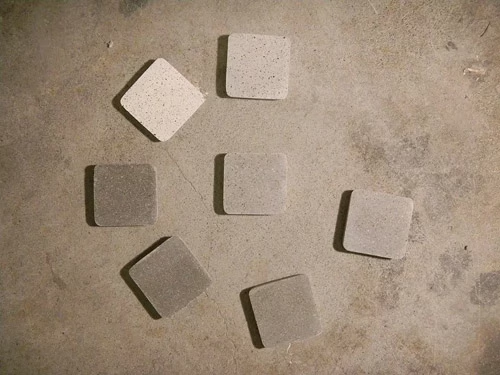
We offer custom color matching services to ensure that your concrete patch seamlessly blends with the existing surface. This process guarantees a consistent and professional finish, enhancing the overall appearance of your concrete.
tailor pricing with materials
We understand that pricing can vary depending on several factors, including the materials used for the repair and the specific requirements of the project. Our team provides tailored estimates to ensure that you receive the best value for your investment.

Why Choose Rose Restoration?
Why Choose Rose Restoration?
Time in Business: Rose Restoration has over 40 years of industry leadership and experience in the field of stone and concrete restoration. Our long-standing presence in the industry highlights the depth of expertise and reliability we have earned over the years. Showing ourselves as a trusted leader in the field, consistently delivering superior results, and earning the confidence of our clients.
Stone Professionals: Our restoration team is composed of knowledgeable technicians who are skilled in approaching various stone restoration challenges. We have the experience to handle different types of stones and are adept at finding safe and efficient ways to manage projects.
Personalized Scopes: We provide personalized scopes to our clients. Rose Restoration offers a range of services, including stone, wood, and metal restoration, one-time projects, and maintenance services. We take pride in maintaining and restoring commercial spaces and have the resources to handle projects of different scales. Whatever your stone needs, we are here to help.
Professional Concrete Patching and Repair
Concrete is the most widely used building material on the planet, and for good reason — it is strong, versatile, and cost-effective. But concrete is not indestructible. Freeze-thaw cycles, moisture intrusion, deicing chemicals, heavy loads, settlement, and simple aging all take their toll. Cracks develop. Surfaces spall. Sections delaminate. And when they do, the right repair approach — executed by skilled technicians with the right materials — is the difference between a lasting fix and a patch that fails within a year.
Rose Restoration has been repairing and restoring concrete surfaces for over 40 years, serving residential, commercial, and government clients throughout Virginia, Maryland, and the District of Columbia. Our team of 30+ technicians performs everything from small cosmetic patches on decorative concrete to large-scale structural repairs on parking structures, loading docks, and building facades. We use high-quality repair materials, proper substrate preparation techniques, and custom color matching to produce repairs that are both structurally sound and visually integrated with the surrounding surface.
Types of Concrete Damage
Effective concrete repair starts with accurately diagnosing the type of damage and understanding its cause. Treating the symptom without addressing the cause leads to recurring failure. Here are the most common concrete damage types we encounter and repair.
Spalling
Spalling occurs when the surface layer of concrete flakes, chips, or breaks away, exposing the coarser aggregate beneath. It is typically caused by freeze-thaw cycling (water enters pores and cracks, freezes, expands, and breaks the surface), corroding embedded reinforcement (rebar expansion cracks the surrounding concrete outward), or deicing chemical exposure. Spalling is both a cosmetic problem and a durability concern — once the protective surface layer is compromised, deterioration accelerates.
Pop-Outs
Pop-outs are cone-shaped depressions in the concrete surface caused by an aggregate particle near the surface that absorbs moisture and expands, breaking out a small section of the surrounding mortar. They are usually cosmetic in nature but can be numerous enough to affect the appearance and function of a floor or walkway surface.
Scaling
Scaling is the progressive flaking or peeling of the concrete surface in thin layers. It typically affects exterior flatwork — sidewalks, driveways, patios, garage floors — and is most often caused by inadequate air entrainment in the original concrete mix, premature finishing (sealing the surface before bleed water has evaporated), or repeated exposure to deicing salts. Scaling ranges from light surface roughening to severe loss of the entire surface layer.
Delamination
Delamination is a horizontal separation within the concrete slab, typically at or near the level of the reinforcing steel, or at the interface between an overlay and the original substrate. Delaminated areas sound hollow when tapped (a diagnostic technique called “chain drag” or “sounding”) and will eventually progress to full spalling if not repaired. Delamination is particularly common in parking structures, bridge decks, and balconies.
Cracks
Concrete cracks for many reasons — shrinkage during curing, settlement, thermal expansion and contraction, structural overload, or restrained movement. Not all cracks require repair, and those that do require different repair methods depending on whether the crack is active (still moving) or dormant, structural or cosmetic, and whether it allows water or contaminant infiltration. Understanding the crack’s cause and behavior is essential to selecting the right repair approach.
Joint Deterioration
Control joints, expansion joints, and construction joints are intentional features designed to manage cracking and movement. When joint sealant deteriorates, joint edges spall, or joints become filled with incompressible debris, the joint can no longer perform its function — leading to adjacent slab damage, water infiltration, and accelerated deterioration.
Repair Methods
Rose Restoration employs a range of repair methods matched to the specific damage type, location, structural requirements, and aesthetic goals of each project.
Epoxy Injection
Epoxy injection is used to repair narrow, dormant (non-moving) cracks in structural concrete. The process involves sealing the crack surface, installing injection ports at intervals along the crack, and injecting a low-viscosity structural epoxy under pressure. The epoxy fills the full depth and width of the crack, bonding the concrete back together and restoring structural integrity. Epoxy injection is commonly used on foundation walls, structural slabs, and beams where crack repair must restore load-carrying capacity.
Polyurethane Injection
For cracks that are actively leaking water or that experience ongoing movement, flexible polyurethane injection resins are used instead of rigid epoxy. The polyurethane resin reacts with water to expand and form a flexible seal that accommodates movement without re-cracking. This method is widely used in below-grade structures — basements, tunnels, parking garages — where waterproofing is the primary objective.
Polymer-Modified Patching
For spalls, pop-outs, scaling damage, and other surface defects, we use polymer-modified cementitious patching compounds. These materials bond tenaciously to properly prepared concrete substrates and provide compressive and flexural strength comparable to the original concrete. Modern polymer-modified materials are available in a range of setting times (from rapid-setting formulations that achieve service strength in hours to standard-set products for less time-sensitive applications) and can be custom-colored to match the surrounding concrete.
Full-Depth Repair
When damage extends through the full depth of a slab or structural member — or when deterioration has compromised the reinforcing steel — full-depth repair is required. This involves saw-cutting the perimeter of the repair area, removing all deteriorated concrete, cleaning and treating exposed reinforcement (or installing supplemental reinforcement if needed), and placing new concrete or high-performance repair material. Full-depth repairs are common on parking structure decks, bridge approaches, and loading dock aprons where heavy loads and deicing exposure create severe deterioration.
Overlay and Resurfacing
When surface damage is widespread but the underlying concrete is structurally sound, a bonded overlay or resurfacing system may be the most efficient and cost-effective solution. These systems apply a thin (typically 1/4 to 3/4 inch) layer of high-performance cementitious or polymer material over the existing surface, providing a new wearing surface without demolition and replacement. Overlays can also incorporate decorative finishes, color, and texture.
Substrate Preparation: Why It Matters More Than the Patch Material
The single most important factor in a successful concrete repair is substrate preparation — how the existing concrete surface is prepared before the repair material is applied. Even the best patching compound will fail if applied to a poorly prepared substrate. Our preparation process includes:
- Removal of all deteriorated concrete: Patching over deteriorated material is the most common cause of patch failure. We remove all unsound concrete to reach a solid, competent substrate.
- Saw-cutting or chipping clean perimeters: Repair perimeters are saw-cut or chipped to create clean, square edges (minimum 1/2 inch depth) that prevent feathered edges, which always fail.
- Surface profiling: The substrate surface is roughened (by chipping, grinding, or abrasive blasting) to the profile recommended by the repair material manufacturer, typically ICRI Concrete Surface Profile (CSP) 3 to 5.
- Cleaning: All dust, debris, oil, curing compounds, and contaminants are removed from the prepared surface.
- Moisture conditioning: The substrate is brought to the moisture condition recommended by the repair material manufacturer — typically saturated surface dry (SSD) — to prevent the dry substrate from pulling water out of the fresh repair material and compromising the bond and cure.
- Bonding agents (when required): For certain repair materials and applications, a bonding agent or primer is applied to the prepared substrate immediately before placing the repair material.
This preparation process takes time and adds cost compared to the shortcuts many contractors take. It is also the reason our repairs last while bargain-rate patches fail within a season.
Custom Color Matching
For exposed concrete surfaces — lobby floors, decorative flatwork, polished slabs, architectural precast — a structurally sound patch that is the wrong color is still a failed repair from the client’s perspective. Rose Restoration provides custom color matching for all visible concrete repairs. We blend integral color pigments, adjust aggregate exposure, and fine-tune surface texture to produce patches that integrate visually with the surrounding concrete. On decorative and polished concrete surfaces, we use specialized polishable repair materials that accept the same grinding, honing, and polishing process as the original slab.
Patching Before Coating Systems
Concrete patching is frequently the first step in a larger flooring or coating project. Before resinous flooring systems (epoxy, polyurethane, polyaspartic), concrete stains, or polishing can be applied, the substrate must be sound and defect-free. Spalls, cracks, divots, and surface voids all telegraph through coating systems, creating both aesthetic defects and points of future coating failure.
We routinely perform patching as part of a complete floor restoration or coating installation scope, ensuring that the substrate preparation, repair materials, and coating system are fully compatible. This integrated approach eliminates the finger-pointing that can occur when one contractor patches and a different contractor coats — if the coating fails at a patch location, who is responsible? When Rose Restoration handles both scopes, accountability is clear.
When Patching Is Appropriate vs. Full Replacement
Concrete patching is the right solution when damage is localized, the surrounding concrete is structurally sound, and the cause of damage has been addressed or can be managed. Patching is typically appropriate when:
- Spalling or surface damage affects less than 25 to 30 percent of the total surface area
- Cracks are dormant or the cause of cracking has been corrected
- The structural capacity of the member is not compromised
- The repair will be protected from the conditions that caused the original damage (e.g., drainage corrections, sealer application, removal of deicing exposure)
Full replacement may be more appropriate when damage is widespread, when the original concrete mix quality is fundamentally poor (inadequate air entrainment, reactive aggregates, excessive water-to-cement ratio), or when the cost of patching approaches or exceeds the cost of removal and replacement. We provide straightforward assessments and will recommend replacement when that is genuinely the better investment for the client.
Frequently Asked Questions
How long do concrete patches last?
A properly executed concrete patch — using appropriate materials, thorough substrate preparation, and correct installation techniques — should last the remaining service life of the surrounding concrete. We commonly see our patches performing well a decade or more after installation. The most common cause of premature patch failure in the industry is inadequate substrate preparation, not material deficiency. That is why we emphasize preparation so heavily in our process.
Can you match the color of existing concrete with patch material?
Yes. We provide custom color matching for all visible concrete repairs. By blending integral pigments and controlling surface finish, we produce patches that closely match the tone, color, and texture of the surrounding surface. An exact perfect match is difficult because original concrete color is affected by age, weathering, and exposure conditions that cannot be instantly replicated. However, our color matching produces results that are far less visible than standard gray patch material, and on most surfaces the repairs blend in well over time as the patch material weathers.
Is it better to patch a cracked concrete slab or replace it?
That depends on the extent and cause of the cracking. Isolated cracks in otherwise sound concrete are almost always better repaired than replaced — repair is faster, less expensive, and less disruptive. Widespread cracking caused by a fundamental problem with the original concrete (poor mix design, inadequate subgrade preparation, or structural insufficiency) may warrant replacement. We assess the situation and provide an honest recommendation based on long-term value, not just the cheapest short-term fix.
How soon can a patched area be used after repair?
This varies by material. Rapid-setting polymer-modified patching compounds can achieve foot traffic strength in as little as one to two hours and vehicular traffic strength within four to six hours. Standard-set materials typically require 24 hours for foot traffic and several days for full load capacity. For coating or overlay application over patches, cure times are specified by the repair material manufacturer and must be followed precisely. We select materials appropriate for the project’s timeline requirements.
Do you repair structural concrete or only surface damage?
We repair both. Our capabilities include surface-level cosmetic patching for aesthetic applications and full-depth structural repairs for load-bearing members. Structural concrete repairs, including epoxy injection for cracked beams and columns, full-depth slab repairs, and reinforcement treatment, are a regular part of our work on commercial and government projects. For structural repairs, we follow the engineer of record’s specifications and can work directly with structural engineering firms to develop repair details when needed.
Get an Expert Repair Assessment
Concrete damage rarely improves on its own. Water infiltration, freeze-thaw cycling, and continued loading all drive deterioration forward. The earlier a repair is made, the simpler and less costly it is. If you are seeing cracks, spalling, scaling, or other concrete damage on your property, contact Rose Restoration for a professional assessment.
Call 703-327-7676 or request a consultation online. We serve residential, commercial, and government clients throughout Virginia, Maryland, and the District of Columbia.