Concrete Joint Filling
At Rose Restoration, we specialize in concrete joint filling and sealing services that restore structural integrity, extend durability, and improve the overall appearance of concrete surfaces. Using advanced repair techniques and premium-grade materials, we breathe new life into worn-out joints, ensuring they remain resistant to water infiltration, uneven wear, and environmental damage.
Whether you need concrete expansion joint filler for a commercial facility, sealant for residential patios, or joint cleaning for tile and grout lines, our team delivers flawless, long-lasting results.
Joint Rebuilding
Over time, joints deteriorate due to heavy traffic, weather, and natural wear. Our concrete joint rebuilding services focus on revitalizing these areas with high-quality concrete joint sealants and expansion joint fillers.
By rebuilding and strengthening damaged joints, we:
Eliminate uneven surfaces.
Prevent water intrusion and freeze-thaw damage.
Restore seamless function and appearance.
This service is essential for commercial flooring systems, warehouses, sidewalks, and outdoor patios, where joint integrity directly impacts safety and longevity.
Joint Cleaning
Dirty or neglected joints can weaken concrete and diminish aesthetics. Our professional joint cleaning services remove embedded dirt, grime, and stains from:
Concrete joints
Tile grout lines
Decorative joint gaps
By restoring cleanliness and stability, we prepare joints for resealing while improving overall appearance. This process is particularly valuable in restaurants, retail floors, hotels, and residential driveways, where clean, well-maintained joints project professionalism and care.
Sealant Application
Our concrete joint sealant application services ensure joints remain durable and water-resistant. Using advanced methods and premium-grade concrete joint sealants and expansion joint fillers, we provide protection against:
Water infiltration and moisture damage.
Structural weakening caused by heavy loads.
Staining and discoloration in visible areas.
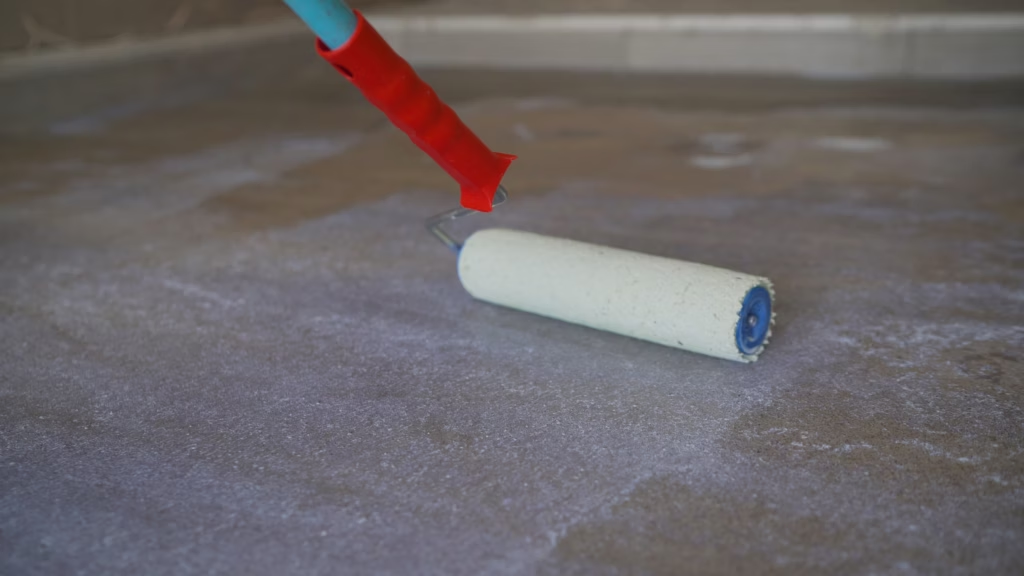
Every surface is carefully prepared before application to ensure strong adhesion and a seamless finish. This protective barrier extends the life of your surfaces and maintains their polished appearance.
For property managers searching “concrete joint repair near me” or contractors needing commercial joint sealing, Rose Restoration is the trusted partner.
Color Matching
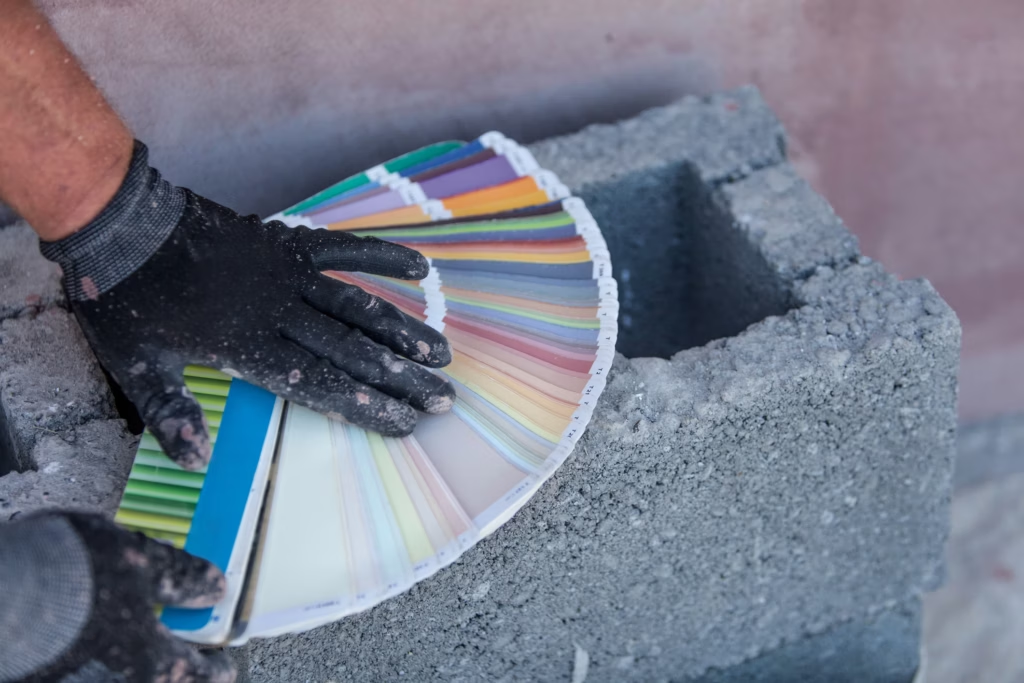
We understand that aesthetics are just as important as function. Our color-matching process ensures a perfect blend with your existing concrete surfaces. By sending samples to the manufacturer, we achieve exact color matches, creating cohesive and seamless joint repairs that look natural while performing flawlessly.
Complete Joint Filling & Sealing Solutions
Rose Restoration provides end-to-end concrete joint repair, cleaning, sealing, and rebuilding services across Washington D.C., Virginia, Maryland, and beyond. From residential driveways to commercial flooring systems, our solutions improve safety, extend durability, and enhance the overall look of your property.
Whether you’re addressing cracked joints, looking to prevent water infiltration, or upgrading with colored concrete joint fillers, Rose Restoration delivers results that stand the test of time.
Why Choose Rose Restoration?
Time in Business: Rose Restoration has over 40 years of industry leadership and experience in the field of stone and concrete restoration. Our long-standing presence in the industry highlights the depth of expertise and reliability we have earned over the years. Showing ourselves as a trusted leader in the field, consistently delivering superior results, and earning the confidence of our clients.
Stone Professionals: Our restoration team is composed of knowledgeable technicians who are skilled in approaching various stone restoration challenges. We have the experience to handle different types of stones and are adept at finding safe and efficient ways to manage projects.
Personalized Scopes: We provide personalized scopes to our clients. Rose Restoration offers a range of services, including stone, wood, and metal restoration, one-time projects, and maintenance services. We take pride in maintaining and restoring commercial spaces and have the resources to handle projects of different scales. Whatever your stone needs, we are here to help.
Concrete Joint Filling and Repair
Concrete joints are engineered features, not flaws. Every concrete slab contains joints that manage cracking, accommodate movement, and separate sections poured at different times. When these joints are properly filled and maintained, the floor performs as intended. When they are neglected, the result is progressive deterioration — crumbling edges, debris accumulation, safety hazards, and damage to wheeled equipment and vehicles.
Rose Restoration provides professional concrete joint filling services for commercial, industrial, and institutional facilities throughout Virginia, Maryland, and Washington, D.C. Our concrete restoration team works with every type of joint system and filling material, selecting the right approach for your specific floor, traffic conditions, and performance requirements.
Types of Concrete Joints
Understanding the type of joint you are dealing with is essential to selecting the correct filling material and method. Different joints serve different purposes and experience different types of movement.
Control Joints (Contraction Joints)
Control joints are the most common type of joint in concrete flatwork. They are cut or tooled into the slab to create a weakened plane that controls where the concrete cracks as it shrinks during curing and as it responds to temperature changes. Control joints are typically cut to a depth of one-quarter to one-third the slab thickness. In most commercial floors, these joints form a regular grid pattern.
Expansion Joints (Isolation Joints)
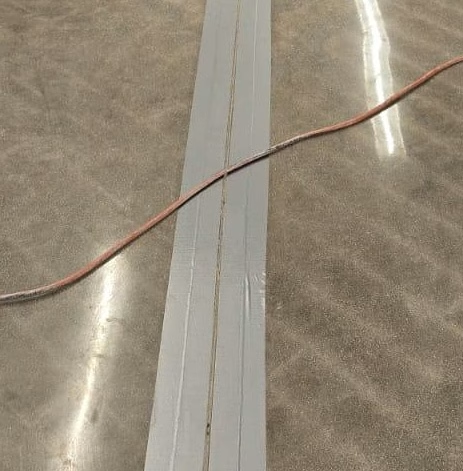
Expansion joints are placed where the concrete slab meets other structural elements — columns, walls, foundations, machine bases, or adjacent slabs. They provide a full-depth separation that allows independent movement between the slab and the adjoining structure. Expansion joints are typically wider than control joints and require flexible filling materials that can accommodate ongoing movement without failure.
Construction Joints
Construction joints occur where one concrete pour ends and the next begins. They are a practical necessity of the construction process rather than an engineered feature. Construction joints can behave differently from control and expansion joints because the bond between adjacent pours varies. These joints may require reinforcement or specialized filling approaches depending on their condition and the loads they carry.
Isolation Joints
Isolation joints separate the slab from fixed objects like columns, walls, and equipment pads to prevent stress transfer. These joints are often filled with a compressible material during construction but may need to be refilled or upgraded as the original material deteriorates or as the floor use changes.
Why Concrete Joints Fail
Joint failure is one of the most common concrete floor problems in commercial and industrial buildings. The causes of failure include:
- Original fill deterioration — many joints are filled at the time of construction with materials that have a limited service life. Caulk-type sealants dry out, crack, and pull away from the joint edges over time.
- Wheeled traffic impact — forklifts, pallet jacks, carts, and vehicles with hard wheels pound joint edges with every crossing. Without proper support from a semi-rigid fill material, the edges spall and break down progressively.
- Incompatible fill materials — joints filled with the wrong type of material for the application will fail prematurely. A rigid epoxy in a joint that experiences thermal movement will crack and debond. A soft sealant in a joint that carries hard-wheel traffic will compress and allow edge damage.
- Moisture and chemical exposure — water, oils, cleaning chemicals, and process fluids can degrade joint fill materials and the concrete itself, particularly if the fill material allows liquid penetration.
- No fill at all — in some facilities, joints were never filled after the saw cuts were made. Open joints accumulate dirt and debris, provide entry points for moisture, and allow unprotected edges to deteriorate under traffic.
Joint Filling Materials
Selecting the correct filling material is the most critical decision in any joint filling project. The right material depends on the joint type, the expected movement, the traffic type, and the facility’s operating conditions.
Semi-Rigid Polyurea
Semi-rigid polyurea is the most widely specified joint fill material for commercial and industrial floors that carry wheeled traffic. Polyurea fills provide edge support that protects joint edges from spalling under forklifts and hard-wheeled carts, while retaining enough flexibility to accommodate minor thermal movement. Polyurea cures rapidly — often within an hour — allowing joints to be returned to traffic quickly. This fast cure time is a significant advantage in facilities that cannot afford extended downtime.
Semi-Rigid Epoxy
Epoxy-based joint fills provide excellent edge support and chemical resistance. They are a good choice for joints in environments with chemical exposure, such as manufacturing plants, laboratories, and food processing facilities. However, epoxies cure more slowly than polyurea, typically requiring several hours to overnight before traffic can resume. Epoxies are also more rigid than polyurea and are best suited for joints with minimal movement.
Flexible Polyurethane Sealants
For joints that experience significant movement — expansion joints, isolation joints, and joints in exterior concrete — a flexible polyurethane sealant is appropriate. These materials stretch and compress with joint movement without losing adhesion. They do not provide the edge support of semi-rigid materials, so they are not appropriate for joints subject to hard-wheel traffic.
Silicone Sealants
Silicone sealants offer excellent flexibility, UV resistance, and temperature tolerance. They are primarily used for exterior joints and specialty applications where exposure to sunlight and extreme temperatures is a factor. Silicone does not accept coatings or toppings, which limits its use in interior floors that may be coated or polished later.
Hybrid and Specialty Materials
Certain applications call for specialty fill materials — conductive fills for ESD-sensitive environments, chemical-resistant fills for specific industrial exposures, or fire-rated fills for joints that must maintain a fire barrier rating. We select and install specialty materials as required by the project specifications.
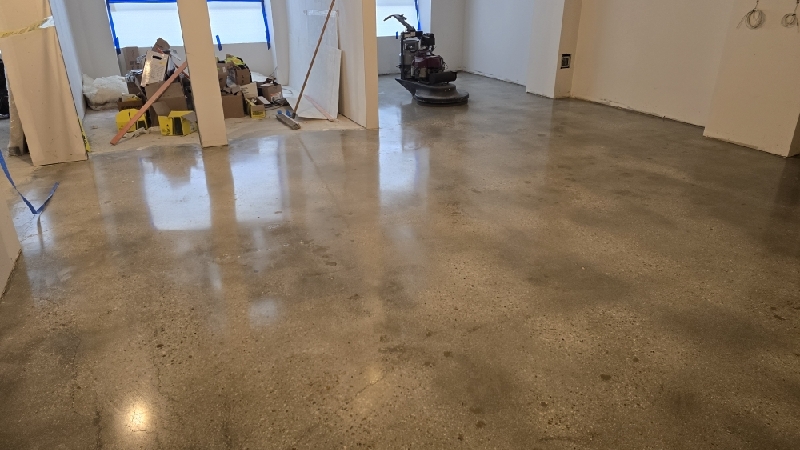
Joint Filling for Polished Concrete
Polished concrete floors present unique joint filling requirements. The joint fill must be flush with the floor surface, resistant to the grinding and polishing process, and aesthetically appropriate for an exposed decorative floor. Color matching is often important — gray, charcoal, tan, and custom colors are available in most polyurea and epoxy fill systems.
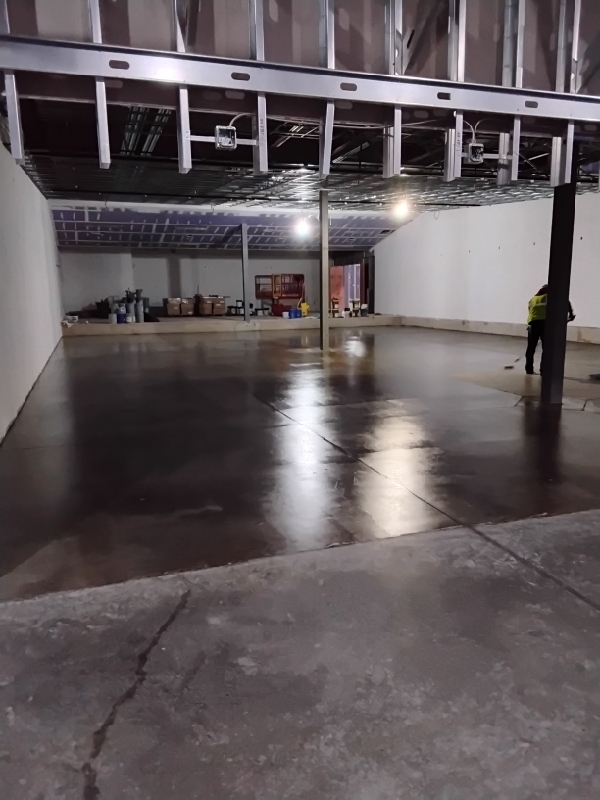
When joint filling is performed as part of a concrete polishing project, the sequence and timing are critical. Joints are typically filled after the initial grinding passes have established the floor profile and before the finer polishing steps. This allows the fill to be ground flush with the floor and polished to a consistent finish.
Joint Preparation Before Coatings
If your concrete floor will receive an epoxy coating, urethane coating, or other floor topping, the joints must be properly prepared and filled before the coating is applied. Unfilled or improperly filled joints will telegraph through coatings, creating weak points that crack and peel under traffic.
Joint preparation for coatings involves:
- Removing any existing failed fill material
- Cleaning the joint of debris, dust, and contaminants
- Filling the joint with a material compatible with the coating system
- Allowing full cure before coating application
- Ensuring the fill is flush or slightly recessed per the coating manufacturer’s requirements
Warehouse and Industrial Joint Filling
Warehouse and industrial floors place the highest demands on joint fill systems. Heavy forklift traffic, pallet jack wheels, automated guided vehicles (AGVs), and heavy rolling loads punish joint edges relentlessly. In these environments, a semi-rigid fill is essential — not optional.
Key considerations for warehouse and industrial joint filling include:
- Load rating — the fill material must have sufficient compressive strength to support the wheel loads crossing the joint
- Cure time — production facilities often need joints returned to service the same day; polyurea systems can meet this requirement
- Chemical compatibility — the fill must resist any chemicals, oils, or cleaning agents used in the facility
- Temperature range — cold storage facilities, loading docks, and outdoor-exposed areas require fill materials rated for the full temperature range
- Joint width and depth — wider and deeper joints may require backer rod installation and multiple fill passes to achieve proper fill depth without material shrinkage
Joint Width and Depth Considerations
Not all concrete joints are the same size. Standard saw-cut control joints may be as narrow as one-eighth inch, while expansion joints can be one inch or wider. The width and depth of the joint dictate the filling approach:
- Narrow joints (under 1/4 inch) — may be filled in a single pass with low-viscosity materials that flow into tight spaces
- Medium joints (1/4 to 1/2 inch) — the most common size range, filled with standard semi-rigid or flexible materials in one or two passes
- Wide joints (over 1/2 inch) — typically require a backer rod installed at the appropriate depth to control the fill depth and support the sealant. Multiple passes may be needed to build up the fill without excessive shrinkage.
- Deep joints — joints deeper than the recommended fill depth for the selected material require a backer rod or sand fill to establish the correct depth-to-width ratio for optimal performance
Our Joint Filling Process
Rose Restoration follows a systematic process for every joint filling project:
- Assessment — we evaluate the joint types, widths, depths, condition of existing fill, traffic patterns, and facility operating requirements
- Material selection — we recommend the appropriate fill material based on the assessment findings and project goals
- Joint preparation — existing fill material is removed, and joints are cleaned using mechanical methods (routing, sawing) and vacuuming to ensure clean, sound joint walls for bonding
- Backer rod installation — where required for depth control and proper sealant performance
- Fill application — material is dispensed into the joint using calibrated equipment, filled flush or slightly proud of the surface depending on the application
- Finishing — excess material is shaved or ground flush after curing to create a smooth transition with the surrounding floor surface
- Inspection — completed joints are inspected for proper fill depth, adhesion, and surface finish
Frequently Asked Questions
How do I know if my concrete joints need to be refilled?
Signs that your joints need attention include: visible crumbling or chipping along joint edges, fill material that is cracked, missing, or pulling away from the joint walls, debris accumulating in open joints, or rough joint crossings that you can feel when rolling carts or equipment across the floor. If you notice any of these conditions, the joints are already deteriorating and will continue to worsen without intervention.
Can you fill joints in a facility that operates 24/7?
Yes. Polyurea joint fill systems cure within approximately one hour, allowing us to work in sections and return each section to traffic quickly. We routinely perform joint filling in operating warehouses, retail facilities, and manufacturing plants with minimal disruption to ongoing operations. We work with your operations team to develop a phased plan that keeps your facility running.
What is the difference between joint filling and joint sealing?
Joint filling typically refers to installing a semi-rigid material that provides structural support to the joint edges, protecting them from traffic damage. Joint sealing refers to installing a flexible sealant that accommodates movement and prevents liquid penetration but does not provide edge support. The correct approach depends on the joint type and the traffic conditions. Many projects involve both — semi-rigid fill in traffic joints and flexible sealant in expansion joints.
How long does concrete joint filling last?
A properly installed semi-rigid joint fill in an interior commercial floor typically lasts five to ten years or more before it needs replacement, depending on the intensity of traffic and the operating environment. Expansion joint sealants may need replacement sooner due to the ongoing movement they must accommodate. We can assess the expected service life for your specific conditions during the proposal process.
Should joints be filled before or after a concrete coating is applied?
Joints should be filled before a coating is applied. The coating system is designed to bridge over properly filled joints, creating a continuous, sealed surface. If joints are left unfilled, the coating will crack at the joint locations under traffic and thermal movement. However, the fill material must be compatible with the coating system — we coordinate material selection with the coating specification to ensure compatibility.
Get Your Joints Assessed
Concrete joint filling is one of the most cost-effective investments you can make in your floor’s longevity and performance. Rose Restoration provides expert joint assessment, material selection, and professional installation for facilities of any size.
Call 703-327-7676 or contact us online to schedule a concrete floor evaluation.