DIY vs. Professional Concrete Polishing: What You Need to Know Before You Start
Concrete polishing has become one of the most popular flooring choices in the DC, Maryland, and Northern Virginia region — for warehouses, retail spaces, garage floors, restaurant interiors, and upscale residential applications. The appeal is real: polished concrete is durable, low-maintenance, visually striking, and cost-effective over its lifespan. Naturally, property owners and contractors looking to save money often ask whether they can handle the polishing themselves.
The short answer is: sometimes, on a limited scale, with realistic expectations. The longer answer requires understanding what concrete polishing actually involves, what equipment is required to do it properly, where DIY attempts typically fail, and how the cost comparison between DIY and professional work actually breaks down. This guide covers all of it honestly, so you can make an informed decision for your project.
What Concrete Polishing Actually Involves
Concrete polishing is not sanding wood. It is a multi-stage mechanical process that uses progressively finer diamond abrasive tooling to cut and refine the concrete surface, combined with chemical densification to harden the concrete matrix, and optionally sealing or guard treatments to protect the finished surface.
A proper polishing sequence on a medium-hardness concrete slab typically involves eight to twelve passes with different tooling — beginning with coarse metal-bond diamonds at 30 or 50 grit to open the surface or remove existing coatings, transitioning through intermediate metal-bond and resin-bond pads (100, 200, 400 grit), and finishing with fine resin-bond pads (800, 1500, 3000+ grit) to develop the reflectance level. Between the coarse and fine tooling stages, a chemical densifier — typically a lithium or sodium silicate solution — is applied to react with the calcium hydroxide in the concrete and harden the surface for better polishability and durability.
At each stage, the operator must make judgment calls: Is the scratch pattern from the previous grit fully removed? Is the machine speed and head pressure appropriate for this concrete hardness? Are there aggregate pops or voids that need attention before moving to a finer tool? These are not decisions a checklist can make for you — they require experience reading concrete surfaces.
What DIY Concrete Polishing Actually Requires
If you want to attempt concrete polishing yourself, here is what you are taking on:
Equipment Rental
Consumer-grade angle grinders and oscillating polishers are not appropriate for concrete floor polishing — the surface area they cover is too small, the machine weight is insufficient to produce consistent diamond contact, and the speed controls are not designed for floor applications. At minimum, you need a single-head or dual-head walk-behind floor grinder with appropriate planetary or direct-drive head geometry.
Most tool rental centers stock single-head 10-inch or 17-inch concrete grinders for around $150 to $300 per day. These are entry-level machines — typically older Edco or similar units — that are adequate for surface preparation work but not for achieving a high-clarity polish. They have fixed-speed motors, limited head weight, and minimal vibration dampening, all of which affect finish quality.
You will also need a wet/dry vacuum or dust extraction system rated for concrete dust. Concrete grinding generates fine crystalline silica dust, which is a serious respiratory hazard. OSHA has specific requirements for silica dust exposure control, and working without adequate dust collection is both a health risk and, in commercial settings, a compliance violation.
Diamond Tooling and Chemicals
Diamond pads for a rental grinder are purchased separately — rental centers may offer a basic set, or you can purchase pads at a flooring supply house. A basic grit sequence starter kit for a small residential project might cost $150 to $400 depending on pad quality and the number of grits included. Low-cost pads from general supply sources often have inconsistent bond hardness, which produces uneven scratch patterns and wastes material.
Densifier chemicals are available through flooring supply distributors and some big-box stores. Plan on $0.15 to $0.40 per square foot for densifier on a standard project. A basic sealer or guard product for a low-sheen finish adds another $0.20 to $0.50 per square foot in materials.
Time Investment
For a 500-square-foot garage floor, a first-time DIYer should expect to invest an entire weekend — or more, if problems arise. That estimate assumes a floor in reasonable condition without significant coatings to remove, extensive cracking, or hard aggregate that slows diamond progression. Factor in equipment pickup, return, and cleanup time as well.
Common DIY Failures in Concrete Polishing
Concrete polishing DIY attempts fail in predictable patterns. Understanding these failure modes before you start can help you decide whether to proceed or hire professionals.
Uneven Finish and Machine Marks
The most common DIY outcome is a floor with visible machine marks — circular swirl patterns, overlapping arcs, or straight-line tracks that become apparent when light hits the surface at a low angle. These marks are caused by inconsistent machine overlap, incorrect machine speed, or moving through grits too quickly before the previous scratch pattern is fully abraded away. Experienced operators develop a feel for when to move on and how to pattern their passes to avoid visible marks. This feel takes time to develop.
Edge and Corner Problems
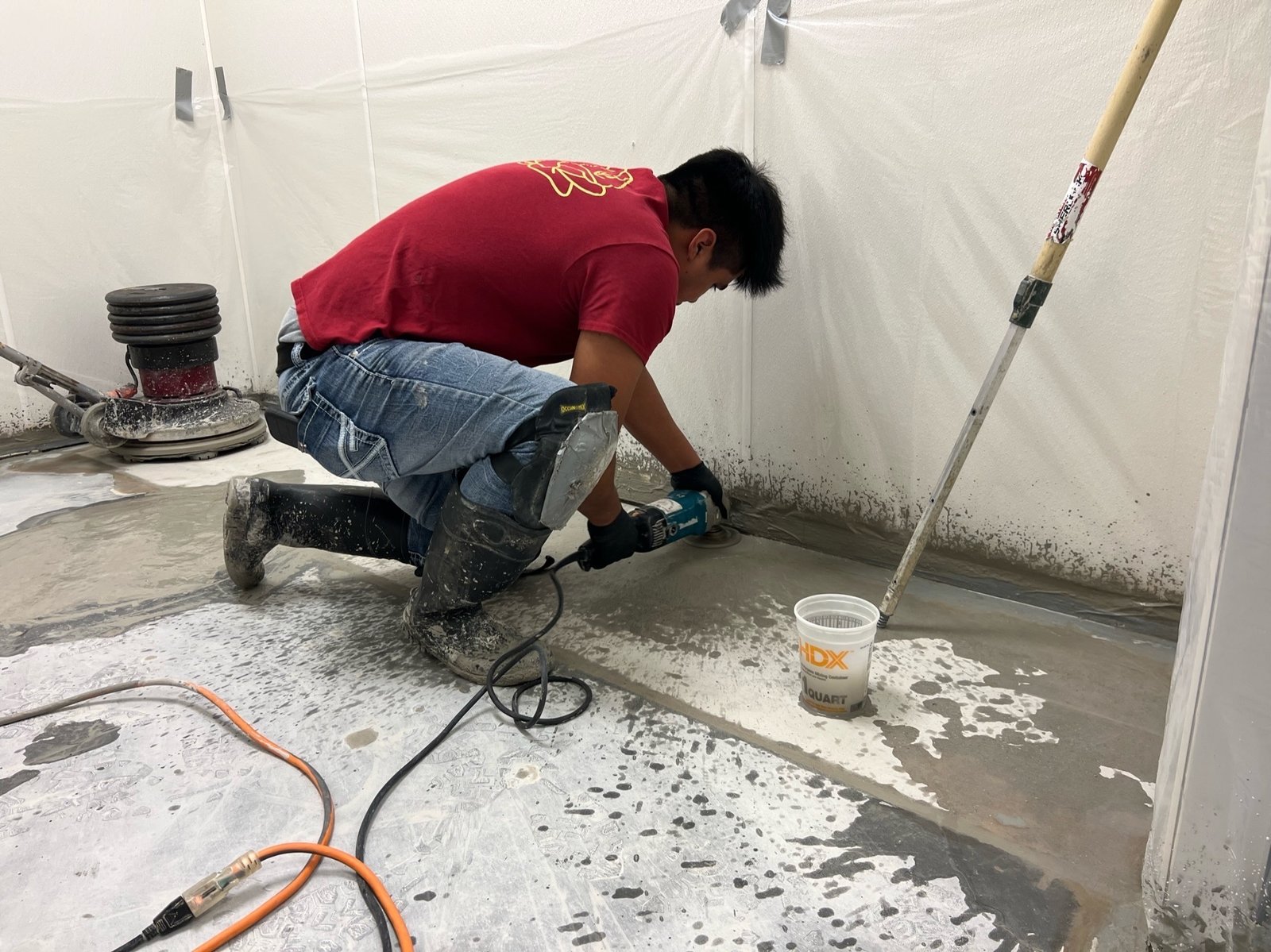
Walk-behind grinders cannot reach within several inches of walls, columns, or other obstructions. Edges and corners require hand-held angle grinders with matching diamond tooling — a separate skill, with separate equipment, and a separate grit sequence. Many DIY projects show a clear “halo” around the perimeter where the finish changes character, because the edge work was done with different equipment, different pressure, or was simply skipped.
Wrong Grit Sequence or Skipped Grits
Skipping a grit step to save time — jumping from 100 to 400, for example, instead of running 100, 200, 400 — leaves scratches from the coarser grit that finer pads cannot fully remove. The result is a surface that appears to polish but shows a milky or hazy quality rather than a clear, deep reflectance. At that point, you either accept the substandard finish or grind back down and start over, costing additional time and material.
Incorrect Densifier Application
Applying densifier too early (before the surface is open enough to absorb it), applying too much (leaving residue that interferes with polishing), or applying too little (under-hardening the surface) all compromise the final result. Densifier application is not complicated, but it requires understanding what the product is doing chemically and reading the surface’s absorption behavior — which varies by concrete mix design, age, and porosity.
Underestimating Coating Removal
Many existing concrete floors have residual paint, adhesive, curing compound, or sealer that must be fully removed before polishing can begin. Rental grinders with basic diamond tooling may struggle to remove thick or stubborn coatings efficiently. What looks like a one-day project can expand significantly when coating removal takes longer than expected.
Professional Concrete Polishing: What You Get
A professional concrete polishing crew brings industrial-grade equipment, calibrated process knowledge, and accountability for results. Here is what that difference looks like in practice:
Industrial Equipment Performance
Professional crews operate planetary grinders from manufacturers like HTC and Husqvarna — machines with three or four satellite heads rotating on a central plate, each applying independent pressure and movement. This geometry produces a far more consistent scratch pattern than single-head machines and eliminates the swirl marks common to rental equipment. These grinders weigh 300 to 600 pounds, providing the head pressure needed to work efficiently on hard concrete. They run at variable speeds calibrated to the tooling and surface.
Production rates on a commercial project using professional equipment can reach 2,000 to 4,000 square feet per day per machine — vastly higher than what rental equipment achieves. For a large warehouse or retail space, this difference in efficiency is also a difference in labor cost and project duration.
Calibrated Grit Sequences and Tooling Selection
Professional contractors carry complete tooling inventories — metal-bond diamonds in multiple bond hardnesses matched to the Mohs hardness of the concrete, resin-bond pads in fine grits, transition pads, and burnishing tools. Tooling selection is made based on the actual concrete, not based on what the rental counter had in stock.
Consistent, Repeatable Results
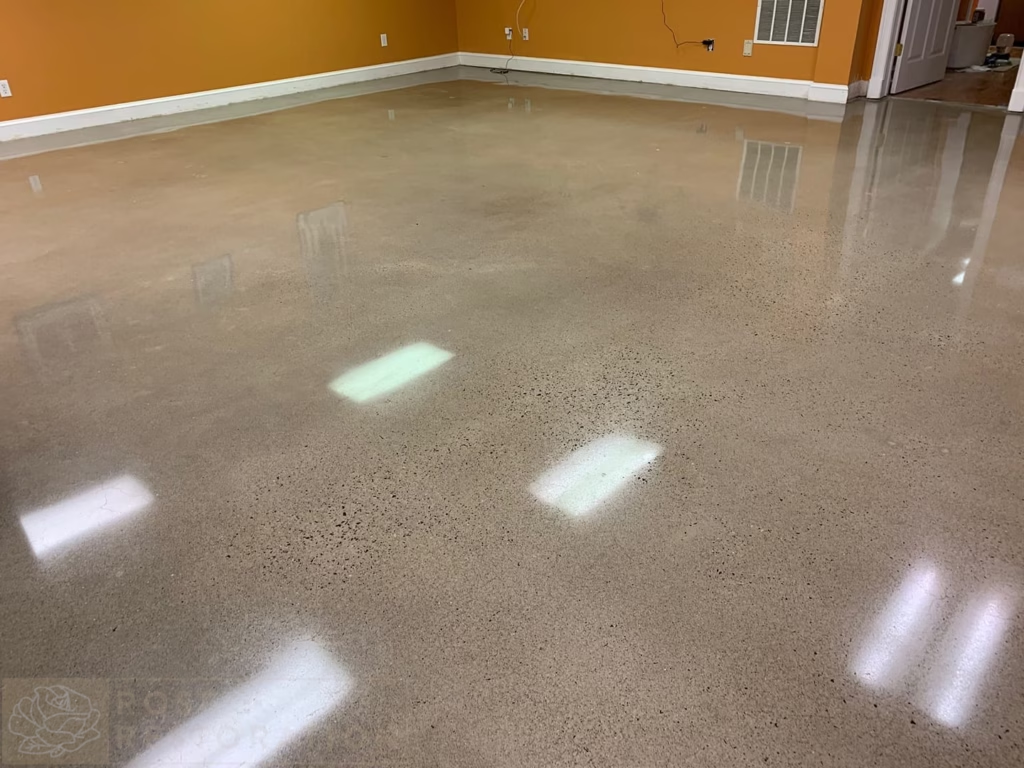
Professional operators produce floors with consistent sheen level, clear aggregate exposure (when desired), and edge finishes that blend seamlessly with the field. The finish holds up over time because the process was done correctly — the concrete is properly densified, the scratch patterns are fully removed at each stage, and the sealer or guard is appropriate for the use environment.
Cost Comparison: DIY vs. Professional Concrete Polishing
Here is an honest breakdown for a 500-square-foot residential garage floor:
| Item | DIY Estimate | Professional |
|---|---|---|
| Equipment rental (2 days) | $300–$600 | Included |
| Diamond tooling (multi-grit set) | $150–$400 | Included |
| Densifier chemical | $75–$200 | Included |
| Sealer or guard product | $100–$250 | Included |
| Dust extraction (rental or purchase) | $75–$200 | Included |
| Your labor (2 full days) | Not costed | Not applicable |
| DIY Total Materials/Rental | $700–$1,650 | — |
| Professional Total (installed) | — | $1,500–$3,500 |
The gap between DIY and professional narrows considerably when you account for the full cost of materials, rental, and the real risk of a poor outcome requiring rework. For commercial spaces or larger residential projects, the professional cost per square foot decreases as area increases, while the DIY cost and complexity both scale upward.
For an alternative to polished concrete, see our epoxy flake garage floor systems, which offer a different aesthetic with high durability. For a full overview of professional concrete polishing options, visit our concrete polishing service page.
When DIY Makes Sense — and When It Does Not
DIY concrete polishing may be a reasonable choice if you are working on a small area (under 200 square feet) with relatively uniform concrete in good condition, you are targeting a low-sheen grind-and-seal finish rather than a high-clarity polish, you have prior experience with power tools and floor machines, and you have adequate dust control equipment and proper respiratory protection.
DIY is not a good choice for floors with significant coatings to remove, hard aggregate concrete that resists standard rental tooling, large commercial areas where production speed matters, applications where a consistent high-reflectance finish is the goal, historic or specialty applications where mistakes are difficult or impossible to reverse, and any occupied commercial space where dust, noise, or project duration affects operations.
If you are uncertain which category your project falls into, the most cost-effective first step is to call Rose Restoration at 703-327-7676 for a professional assessment. We will give you an honest recommendation — and if we believe a DIY approach is viable for your situation, we will tell you that too.
Frequently Asked Questions: DIY vs. Professional Concrete Polishing
Can I rent the same equipment professionals use?
No. Industrial planetary grinders from HTC, Husqvarna, and similar manufacturers are not available at general equipment rental centers. Specialty tool rental companies occasionally offer commercial-grade equipment, but the cost is significantly higher and the machines require experience to operate effectively. What most rental centers offer is entry-level preparation equipment, not polishing machines.
How many grit stages does a proper polish require?
A full polish from bare concrete to a high-reflectance finish typically requires eight to twelve passes across four to six grit levels, plus a densification step in the middle of the sequence. A low-sheen or matte finish requires fewer steps but still demands proper surface preparation through at least three or four grit levels before sealing. Skipping steps compromises the finish and the durability of the result.
What is a concrete densifier and do I really need it?
A densifier is a reactive chemical — typically a lithium or sodium silicate solution — that penetrates the concrete surface and reacts with free calcium hydroxide to form calcium silicate hydrate, which fills pores and hardens the surface matrix. Densification is not optional for a durable polished finish. Without it, the surface remains soft and porous, wears faster, and cannot achieve high reflectance levels. It is a critical step in any legitimate polishing process.
What finish level should I target for a garage floor?
For a residential garage, a grind-and-seal or low-sheen polish (roughly 400 to 800 grit finish sealed with a penetrating sealer or topical guard) is practical and durable. High-reflectance polishes in the 1500 to 3000 grit range are beautiful but may show tire marks and scuffs more readily in a working garage environment. An epoxy flake coating system may also be worth considering depending on your use case and aesthetic preference.
Is concrete polishing safe to do in an occupied home?
DIY concrete polishing in an occupied home presents significant challenges. Concrete grinding produces fine silica dust that can infiltrate HVAC systems and distribute throughout the living space. Proper containment, dust extraction, and respiratory protection are required. Professional crews use HEPA-filtered extraction systems and can work with occupants in mind — this is much more difficult to manage safely as a DIYer.
How long does polished concrete last compared to other floor finishes?
Properly polished and densified concrete is one of the most durable floor surfaces available. Maintained correctly with a neutral cleaner and periodic burnishing or re-guard application, a professionally polished floor can hold its finish for ten to twenty years or more in commercial applications. DIY floors that lack proper densification or were polished with insufficient tooling progression tend to show accelerated wear and surface degradation within two to five years.