Every durable concrete floor system starts the same way: with the concrete itself properly prepared. It does not matter whether the finished system is a high-gloss polished concrete floor, an epoxy broadcast coating, a decorative acid stain, or a microtopping overlay — if the concrete surface beneath it is not properly ground and profiled, the system will fail. Coatings will peel. Stains will blotch. Overlays will delaminate. The work and material cost are wasted, and the floor has to be done again.
Surface preparation is not the glamorous part of a flooring project. It does not make for dramatic before-and-after photos. But it is the single most important variable in determining whether a floor system performs as intended for years or fails within months. Experienced floor contractors know this. Clients who have been burned by cheap prep know it too.
Rose Restoration uses industrial planetary grinding equipment on every concrete project, from single-car residential garages to 100,000-plus square foot commercial and industrial facilities. Our crews are trained in the specific preparation requirements of every floor system we install, and we do not cut corners on a step that determines everything that comes after it. This guide explains what concrete floor grinding is, why it matters, what it removes, how it works, and why investing in proper surface preparation is the most cost-effective decision you can make for any concrete floor project.
What Is Concrete Floor Grinding?
Concrete floor grinding is the mechanical process of abrading the surface of a concrete slab using diamond tooling mounted on rotating grinding heads. The diamond segments are bonded to metal or resin matrices and are selected based on the hardness of the concrete, the condition of the surface, and the profile required for the intended floor system. As the machine passes over the concrete, the diamonds cut into the surface, removing material at a controlled rate and leaving behind a clean, profiled substrate.
The machines used for floor grinding are typically planetary grinders — multi-head machines in which several grinding discs rotate simultaneously on a central plate that also rotates. This planetary motion ensures even material removal across the width of the machine and prevents the swirl marks and uneven profiles that single-head machines can produce. Industrial planetary grinders range from compact units suitable for residential garages and tight spaces to ride-on machines capable of covering thousands of square feet per shift in open commercial and industrial facilities.
Grinding is distinct from scarifying and shot blasting, though all three are surface preparation methods. Scarifying uses rotating cutting wheels to aggressively mill the concrete surface and is typically reserved for removing thick coatings or creating very aggressive profiles on heavily contaminated slabs. Shot blasting propels steel shot at the surface at high velocity to create a textured, uniform profile and is commonly used for large industrial and warehouse floors. Grinding offers the greatest control over material removal rate and profile consistency, making it the method of choice for polished concrete, thin coatings, and decorative floor systems where surface flatness and finish quality are critical.
For most residential, commercial, and light industrial applications, diamond floor grinding is the preferred and most versatile surface preparation method. Rose Restoration uses grinding as the primary preparation method for the majority of its concrete floor projects.
Why Surface Preparation Is the Most Important Step

The flooring industry has a saying that is worth taking seriously: the coating is only as good as what it bonds to. Every epoxy, polyurethane, polyaspartic, and decorative coating system relies on mechanical adhesion to perform. Mechanical adhesion means the coating penetrates into the microscopic pores and peaks of the concrete surface and locks in as it cures. Without that profile — without open, clean, properly textured concrete — adhesion is superficial and temporary.
Concrete surfaces fresh from a pour typically have a layer called laitance — a weak, dusty film of cement paste, water, and fine particles that migrates to the surface during curing. Laitance looks like concrete but has almost no structural strength. Applying a coating to laitance is equivalent to applying it to powder: it may look fine initially, but it will delaminate under stress. Grinding removes laitance entirely, exposing the dense, strong aggregate-rich layer below.
Beyond laitance, real-world concrete floors accumulate decades of contamination: motor oil in garage floors, cleaning chemicals and food service residue in commercial kitchens, forklift tire marks in warehouses, old paint and adhesive in renovated spaces. These contaminants are often invisible to the eye but act as bond breakers between the coating and the concrete. Grinding removes the contaminated surface layer, exposing clean, uncontaminated concrete that will accept and hold a coating system.
Industry data from coating manufacturers and flooring associations consistently identify inadequate surface preparation as the leading cause of premature coating failure — responsible for more than 80% of flooring failures in some analyses. The lesson is clear: investing in thorough surface preparation is not optional. It is the foundation on which everything else depends.
What Concrete Grinding Removes
One of the reasons concrete grinding is so widely used as a surface preparation method is its ability to address a broad range of surface conditions and contaminants in a single operation. Here is what grinding removes and why each matters:
Old Coatings (Epoxy, Paint, Urethane): Failed or incompatible existing coatings must be fully removed before a new system can be applied. Grinding through old coatings with appropriate diamond tooling removes them mechanically without the use of chemical strippers. This is critical because even partial coating removal — leaving ghost residue or thin areas — will create bond failures in the new system.
Adhesive Residue (Carpet Glue, Tile Mastic): When carpet, vinyl tile, or ceramic tile is removed from a concrete slab, it almost always leaves adhesive residue behind. This residue is sticky, soft, and completely incompatible with coating adhesion. Specific diamond tooling and grinding techniques are used to cut through and remove adhesive residue, leaving clean concrete behind. Some adhesive types require heat or chemical pre-treatment before grinding can be fully effective.
Surface Contaminants (Oil, Grease, Curing Compounds): Oil and grease from vehicles, machinery, or food service penetrate into the concrete surface and create a hydrophobic barrier that repels water-based and solvent-based coatings alike. Curing compounds applied during concrete placement serve their purpose but must be fully removed before any subsequent treatment. Grinding removes the contaminated surface layer, but heavily oil-saturated concrete may require degreasing and multiple grinding passes to fully address contamination.
High Spots and Lippage: Concrete slabs are rarely perfectly flat. Settlement, form deflection, and curing variation create high spots, ridges, and lippage (height differences at construction joints or between adjacent slabs). Grinding reduces high spots and improves overall flatness, which is critical for polished concrete and thin coating systems where surface irregularities will be visible in the finished floor.
Laitance and Weak Surface Layer: As described above, laitance is the weak top layer that forms on virtually every concrete slab. It must be removed entirely before any coating or treatment. Grinding removes laitance efficiently and reveals the underlying concrete’s true condition — including any cracks, spalls, or aggregate issues that need to be addressed before the floor system proceeds.
Grinding for Different Floor Systems
Not all concrete floor systems require the same surface preparation. The profile, depth of grind, and tooling selection vary significantly depending on the finish system being installed. Understanding these differences is a key part of planning any concrete floor project correctly.
Polished Concrete: Polished concrete is achieved through a progressive sequence of grinding and honing passes using increasingly fine diamond tooling, starting with coarse grits (typically 16 to 50) for initial surface reduction and working up through 100, 200, 400, 800, 1500, and 3000 grit or finer for the finished polish. The preparation phase for polished concrete is inseparable from the polishing process itself — the two are one continuous operation. A densifier is applied mid-sequence to harden the surface and improve the final polish. The result is a durable, low-maintenance, high-gloss floor that improves with proper maintenance over time. See our detailed guide on polished concrete vs. grind-and-seal to understand the differences.
Epoxy and Polyurethane Coatings: Epoxy and polyurethane systems require a concrete surface profile (CSP) of 2 to 3 as defined by the International Concrete Repair Institute (ICRI). This is roughly equivalent to medium-grit sandpaper in texture — coarse enough for the coating to mechanically lock into, but not so aggressive that it creates voids that trap air bubbles. Achieving a consistent CSP 2-3 profile requires the right diamond tooling and the right number of passes, adjusted for the hardness and condition of the specific slab.
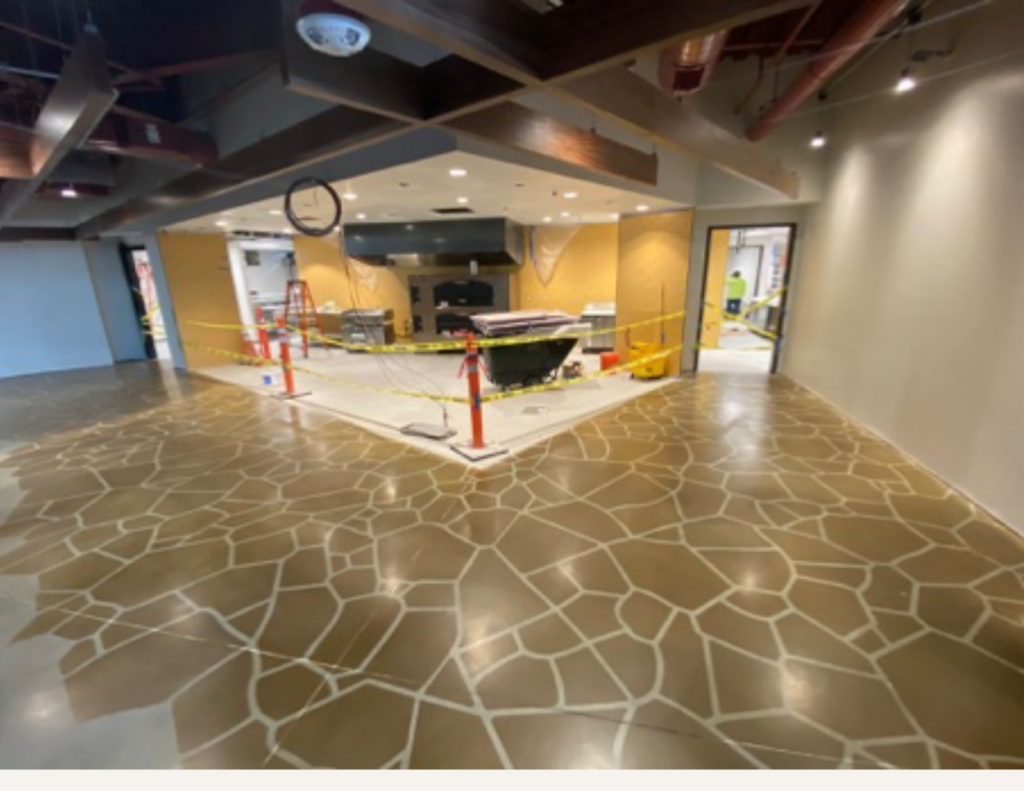
Stained Concrete: Acid stains and water-based stains penetrate into the concrete pores to create their color, rather than forming a film on the surface. This means the pores must be open and uncontaminated for the stain to achieve even penetration and consistent color. Grinding opens the pores by removing surface laitance and contamination, but the grind should not be so aggressive that it removes the surface cream where much of the staining reaction occurs. The finish of the grind also affects the final appearance — a finer grind produces a smoother, more uniform stain result.
Overlays and Microtoppings: Thin overlay and microtopping systems are applied in thicknesses of 1/16 inch to 1/4 inch or less and rely entirely on bond to the substrate for their structural integrity. These systems require an aggressive CSP 3 to 4 profile to achieve adequate adhesion. A primer is almost always required, but the profile is the foundation. Any area with insufficient profile is a future delamination point.
Equipment and Process
Rose Restoration uses commercial-grade planetary grinding equipment on all concrete floor projects. Our equipment inventory includes machines suited to a range of project sizes, from compact units for tight residential spaces to large-format commercial grinders for open warehouse and commercial floors. Edging machines and hand grinders are used along walls, in corners, and around columns where floor machines cannot reach — ensuring consistent preparation across the entire surface, not just the open field.
Dust Containment: Concrete grinding generates significant dust. Uncontrolled dust is a health hazard, a nuisance to building occupants and adjacent spaces, and a contamination risk for the floor system being installed. Rose Restoration connects industrial HEPA vacuum extraction systems directly to grinding equipment, capturing the vast majority of dust at the point of generation. Additional perimeter containment is used on projects in occupied buildings. Our dust containment protocols meet OSHA silica dust standards and protect both our crew and building occupants.
Multiple Passes and Inspection: Proper surface preparation rarely happens in a single pass. Multiple passes are made at different angles, with different tooling, to ensure consistent coverage and adequate material removal across the entire surface. After grinding, our crew inspects the prepared surface for remaining contamination, soft spots, cracks, and surface irregularities that need to be addressed before the floor system proceeds.
Moisture Testing: Before any coating or treatment is applied, Rose Restoration performs moisture testing on the prepared concrete surface. Excess moisture vapor transmission is a leading cause of coating failure, particularly with epoxy systems. We use calcium chloride tests and relative humidity probes to verify that moisture levels are within the acceptable range for the specified system before proceeding.
Residential vs. Commercial Surface Preparation

While the principles of concrete surface preparation are the same regardless of project size, the practical realities of residential and commercial projects differ in important ways, and Rose Restoration’s approach is adapted accordingly.
Residential Projects: Most residential concrete floor projects involve garage floors, basements, and utility spaces. These spaces are smaller and typically have lower ceiling heights that limit equipment size. They often have existing belongings that need to be moved and protected. Rose Restoration uses compact planetary grinders scaled for residential spaces, coordinates with homeowners on access and scheduling, and takes care to protect vehicles, storage items, and finished areas adjacent to the work zone. Our most popular residential application is epoxy flake garage floor systems — durable, attractive, and fully prepared using the same diamond grinding methods we use on commercial projects.
Commercial Projects: Commercial surface preparation projects involve larger equipment, larger crews, and more complex logistics. Large-area planetary grinders and ride-on machines are deployed where ceiling height and layout permit. Phased scheduling is common — large floors are divided into zones to allow work to proceed while adjacent areas remain in use. Off-hours scheduling (evenings, nights, weekends) is standard on occupied commercial properties. Rose Restoration coordinates directly with facilities managers and general contractors to integrate our work schedule with the broader project timeline and minimize disruption to building operations.
How Surface Preparation Saves Money Long-Term
The most common objection to proper surface preparation is cost. A more thorough grind takes longer and costs more than a perfunctory surface scuff. When two bids are compared and one is lower because it includes less prep, the lower bid can look attractive. This is one of the most expensive mistakes a property owner can make.
A coating system applied to properly prepared concrete — with full laitance removal, contaminant elimination, and the correct CSP profile — will typically perform for 10 to 20 years or more with normal maintenance. A coating applied to inadequately prepared concrete may begin showing signs of failure within months: bubbles from outgassing, peeling at edges and joints, delamination in high-traffic areas. When a coating fails, the floor has to be stripped — which requires more aggressive preparation than the original install — and recoated. The total cost of a failed installation followed by a redo is almost always higher than the cost of doing it right the first time.
Proper surface preparation also protects the value of adjacent work. When a floor fails, the damage is rarely contained to just the coating. Delaminating epoxy can damage walls at transition points. Failed overlays can create trip hazards and liability exposure. Moisture that was trapped under an improperly applied coating continues to damage the slab and adjacent materials. The cost consequences of cutting corners on prep extend well beyond the floor itself.
Rose Restoration’s commitment to thorough surface preparation is not just a technical standard — it is a practical guarantee that the work we do will last. We stand behind our installations because we control the most critical variable: the foundation they are built on.
Frequently Asked Questions
How much does concrete floor grinding cost?
The cost of concrete floor grinding depends on the size of the area, the condition of the existing surface, the amount of contamination or coating removal required, and the profile specification for the floor system being installed. For residential garage floors, surface preparation is typically included in the overall floor installation quote. For commercial and industrial projects, surface preparation may be quoted separately. Rose Restoration provides free on-site assessments and detailed proposals — call 703-327-7676 or visit our contact page to schedule yours.
How long does concrete surface preparation take?
Preparation time depends on square footage, surface condition, and the degree of contamination or coating removal required. A typical two-car garage floor can be fully ground and prepared in a single day. Larger commercial projects may require multiple days of surface preparation before coating installation begins. Projects with heavy coating removal, significant contamination, or complex layouts take longer than straightforward preparation on clean concrete. Rose Restoration will provide a realistic timeline as part of your project proposal.
Can old epoxy or paint be removed from concrete?
Yes. Diamond grinding is one of the most effective methods for removing old epoxy, paint, urethane coatings, and other surface treatments from concrete. The appropriate tooling and technique depend on the type and thickness of the existing coating. Failed or peeling coatings are generally easier to remove than intact, well-bonded systems. Rose Restoration assesses the existing coating during our pre-project evaluation and selects the appropriate removal approach to achieve a clean, properly profiled substrate for the new system.
Is concrete grinding dusty?
Concrete grinding generates significant silica dust if performed without dust control. Rose Restoration uses HEPA vacuum extraction systems connected directly to grinding equipment to capture the vast majority of dust at the source, in compliance with OSHA silica dust exposure standards. For projects in occupied buildings, additional containment measures are used to protect adjacent spaces. Our dust containment protocols make concrete grinding practical in occupied homes, commercial buildings, and healthcare facilities.
Do I need to grind concrete before applying epoxy?
Yes, for any epoxy system intended to perform long-term. Epoxy requires a properly profiled concrete surface — typically CSP 2-3 per ICRI guidelines — to achieve adequate mechanical adhesion. Applying epoxy to unground, contaminated, or laitance-covered concrete is the single most common cause of epoxy floor failure. Even on seemingly clean concrete, the surface layer must be ground to open the pores, remove weak material, and create the profile the epoxy needs to bond. Rose Restoration grinds every surface before epoxy application, without exception.
What is the difference between grinding and shot-blasting?
Grinding uses rotating diamond tooling to mechanically abrade the concrete surface, offering precise control over material removal depth and profile consistency. It is the preferred method for polished concrete, thin coatings, decorative systems, and areas where surface flatness is critical. Shot blasting propels steel shot at the surface at high velocity, creating an aggressive, uniform texture rapidly across large open areas — making it efficient for warehouse and industrial floors receiving heavy coatings. Both methods are legitimate; the choice depends on the floor system, the substrate condition, and the geometry of the space. Rose Restoration uses grinding as our primary preparation method, with shot blasting and scarifying available for specific project requirements.
Does Rose Restoration provide concrete grinding services near me?
Rose Restoration provides concrete floor grinding and surface preparation services throughout Northern Virginia, Maryland, and Washington DC. Our service area includes Fairfax, Arlington, Alexandria, McLean, Tysons, Reston, Ashburn, Leesburg, Bethesda, Rockville, Silver Spring, Columbia, and all of Washington DC, as well as surrounding areas within approximately 100 miles of Fairfax, VA. Call 703-327-7676 or contact us through our website to confirm service availability and schedule a free assessment.
Schedule a Free Surface Preparation Assessment
Whether you are planning a new garage floor coating, a commercial epoxy system, a polished concrete floor, or a decorative overlay for a residential or commercial space, proper surface preparation is the foundation that makes everything else work. Rose Restoration’s experienced crews use industrial diamond grinding equipment and proven preparation protocols to ensure that every floor system we install has the best possible chance of performing at its full potential for years to come.
Contact Rose Restoration today to schedule your free, no-obligation on-site assessment. We will evaluate your concrete, identify any surface conditions that need to be addressed, and provide a detailed proposal covering both preparation and the floor system of your choice. Serving Northern Virginia, Maryland, Washington DC, and surrounding areas. Call 703-327-7676 or submit your project details online.