
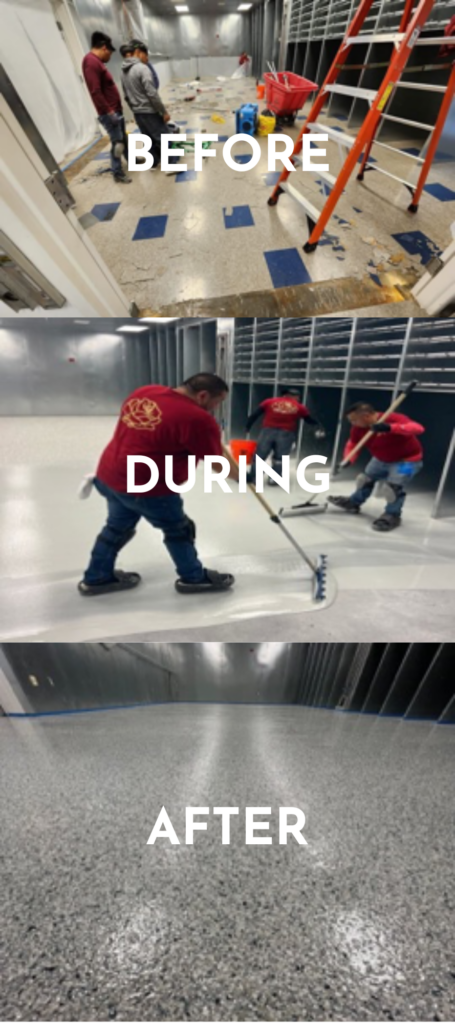
Epoxy Garage Floor Cost: What to Expect in 2026
A professional epoxy garage floor coating for a typical residential garage in the Washington DC, Maryland, and Northern Virginia area costs $2,500 to $5,500 for a 400 to 600 square foot space — with decorative flake systems representing the most popular choice. That range covers surface preparation, materials, and labor. Pricing varies based on the system type you choose, the current condition of your concrete, and whether moisture mitigation or crack repair is needed before coating. This guide breaks down every cost variable so you can budget accurately and evaluate quotes with confidence.
Epoxy Garage Floor Cost Per Square Foot by System Type
The single largest driver of price is the coating system itself. Professional-grade garage floor systems are not all the same product. Each system differs in thickness, durability, appearance, and installation complexity. Below is a pricing reference for the DC metro market in 2026.
| System Type | Cost Per Square Foot | Best For | Typical Lifespan |
|---|---|---|---|
| Solid Color Epoxy | $4 – $8 | Budget-conscious upgrades, utilitarian spaces | 5 – 10 years |
| Decorative Flake (Chip) | $6 – $12 | Residential garages, workshops, most popular finish | 10 – 15 years |
| Metallic Epoxy | $10 – $18 | Showrooms, upscale garages, statement finishes | 10 – 15 years |
| Polyaspartic Coating | $8 – $14 | Fast-cure needs, UV stability, high-traffic spaces | 15 – 20 years |
Solid color epoxy is the entry-level professional option. It provides a clean, uniform appearance and solid protection against chemical staining and abrasion. However, solid color coatings show tire marks and surface scratches more readily than flake systems, and they are the thinnest option in terms of mil build.
Decorative flake epoxy — also called broadcast flake or chip systems — is by far the most popular choice for residential garages in Northern Virginia, Maryland, and the DC area. Vinyl color chips are broadcast into a wet epoxy base coat, then locked in with one or two polyaspartic or urethane topcoats. The flake texture hides minor imperfections, improves slip resistance, and holds its appearance for a decade or more with basic maintenance. See our full guide to epoxy flake garage floors for a deeper look at this system.
Metallic epoxy uses metallic pigment particles suspended in epoxy resin to create swirling, three-dimensional effects. Installation requires significant skill to achieve consistent results. The higher cost reflects both material expense and the labor intensity of working with metallic systems. This option is best suited to homeowners who want a true showroom-quality finish.
Polyaspartic coatings are aliphatic polyurea systems that cure faster than standard epoxy, resist UV yellowing, and offer excellent chemical and abrasion resistance. Many contractors now use polyaspartic as the topcoat layer over an epoxy base. A full polyaspartic-only system (base and topcoat both polyaspartic) carries a premium price but delivers the longest service life and best UV performance — important for garages with windows or doors that receive direct sunlight.
Total Project Cost Examples
To put per-square-foot rates in context, here are realistic all-in project costs for common garage sizes in the DC metro region.
| Garage Size | Square Footage | Decorative Flake Cost | Polyaspartic Cost |
|---|---|---|---|
| Single car (1-car) | 200 – 280 SF | $1,400 – $3,400 | $1,800 – $3,900 |
| Standard 2-car | 400 – 500 SF | $2,500 – $6,000 | $3,200 – $7,000 |
| Large 2-car / tandem | 500 – 650 SF | $3,000 – $7,800 | $4,000 – $9,100 |
| 3-car garage | 650 – 900 SF | $3,900 – $10,800 | $5,200 – $12,600 |
Minimum project charges apply with most professional contractors. In the DC metro market, expect a minimum of $1,200 to $1,800 even for very small spaces. This reflects mobilization, prep equipment, and the fixed cost of a professional crew.
Cost Factors That Move the Final Number
Garage Size and Square Footage
Per-square-foot rates generally decrease slightly as the project grows larger. A 900 square foot three-car garage will carry a lower unit cost than a 250 square foot single-car garage because setup, equipment, and minimum labor costs are spread across more area. When budgeting, use the higher end of the per-square-foot range for smaller garages and the midpoint for larger ones.
Surface Condition and Required Prep
Surface preparation is the most labor-intensive part of any garage floor coating project. Diamond grinding is the industry standard method to profile the concrete and ensure mechanical adhesion. On a clean, flat slab in good condition, prep might represent 25 to 30 percent of total cost. On a floor with heavy oil contamination, existing coatings to remove, or significant cracking, prep costs can climb to 40 to 50 percent of the total.
Specific conditions that add cost:
- Existing paint or coating removal: Add $0.75 – $2.00 per SF for mechanical removal of failed existing coatings
- Oil and grease contamination: Deep oil saturation may require degreasing treatments or, in severe cases, partial slab repair
- Crack repair: Hairline cracks filled with epoxy injection are typically included; structural cracks or wide joints requiring caulk or polyurea filler may be quoted separately at $2 – $5 per linear foot
- Spalling and pitting: Surface repairs using skim coats or patch materials add $1 – $3 per SF depending on severity
- Control joint treatment: Saw-cut control joints must be either filled (rigid) or treated with flexible caulk — typically $1 – $3 per linear foot
Moisture Testing and Mitigation
Moisture vapor transmission is a leading cause of epoxy coating failure. A reputable contractor will perform moisture testing before installation. In the DC metro area — where high humidity and older slab construction are common — elevated moisture readings are not unusual. When moisture vapor emission rates exceed safe thresholds, a vapor-barrier primer or dedicated moisture mitigation system is required. This adds $1.50 – $3.00 per SF to the project cost but is not optional if the readings warrant it.
Number of Coats
Professional systems typically involve three to four coat applications: a primer or base coat, one or two intermediate coats (with flake broadcast if applicable), and one or two topcoats. Low-cost installers frequently skip the primer coat or apply a single thin topcoat. The number of coats and the total dry film thickness (measured in mils) directly determine durability and service life. Ask any contractor to specify total dry film thickness in their proposal. A quality decorative flake system should deliver 20 to 30 mils total thickness.
Geographic Location and DC Metro Pricing
Labor rates in Washington DC, Northern Virginia (Fairfax, Arlington, Loudoun, Prince William counties), and Montgomery and Prince George’s counties in Maryland are among the highest in the Mid-Atlantic region. Expect to pay 15 to 25 percent more than national average pricing for the same scope of work. This premium reflects higher wages, insurance costs, and overhead in a high cost-of-living market.
Epoxy vs. Other Garage Floor Options: Full Cost Comparison
| Option | Cost Per SF | Durability | Maintenance | Appearance |
|---|---|---|---|---|
| Decorative Flake Epoxy | $6 – $12 | High | Low | Decorative, hides imperfections |
| Polished Concrete | $5 – $12 | Very High | Low to Moderate | Sleek, reflective, permanent |
| Grind-and-Seal | $3 – $6 | Moderate | Moderate | Natural concrete look with sheen |
| Bare Concrete (untreated) | $0 | Low (stains, dusts) | High (staining, dusting) | Utilitarian |
| Interlocking Tiles (PVC/rubber) | $2 – $6 | Moderate | Low | Modular, easy to replace sections |
Polished concrete is the closest competitor to epoxy in terms of durability and professional appearance. It is mechanically ground and densified rather than coated, making it a permanent upgrade with no risk of peeling or delamination. For garages with flat, structurally sound concrete slabs, polished concrete is an excellent long-term investment. See our concrete polishing service page for more detail.
Grind-and-seal is the most economical professional option. It uses the same diamond grinding process but finishes with a penetrating or topical sealer rather than a full coating system. The result is a natural-looking, protected surface that costs less but offers less chemical resistance than epoxy. It is a practical choice for budget-conscious homeowners who want a professional result. Learn more about our grind-and-seal concrete floor service.
DIY vs. Professional Epoxy: Honest Cost and Risk Comparison
DIY Epoxy Costs
Box-store epoxy kits — the kind sold at home improvement retailers — typically cost $100 to $250 for a two-car garage. Professional-grade materials ordered from a coating supplier run $400 to $900 for the same area. Add equipment rental (floor grinder: $100 – $200 per day, wet vacuum, edge tools) and miscellaneous supplies, and a realistic DIY project budget is $500 to $1,500 in materials and rental costs. That does not account for your time, which is typically a full weekend or more.
Why DIY Epoxy Frequently Fails
The failure rate of DIY garage floor coatings is high — not because homeowners lack ability, but because the process is less forgiving than it appears. The most common reasons professional contractors see failed DIY epoxy jobs:
- Inadequate surface preparation: Acid etching (the DIY standard) does not profile the concrete as effectively as diamond grinding. Without sufficient profile, adhesion fails and the coating peels within months.
- Moisture not tested: Moisture vapor pushes up from below, causing bubbling, fisheyes, and delamination. Most DIY kits do not include moisture testing instructions.
- Wrong product used: Consumer-grade water-based epoxy has dramatically lower solids content than professional systems. It looks similar in the can but performs very differently over time.
- Application in wrong conditions: Epoxy is temperature and humidity sensitive. Applying outside the recommended window leads to poor cure and adhesion failure.
- Hot tire pickup: Consumer epoxy is particularly susceptible to hot tire transfer, where tire marks permanently bond to the coating surface. Most box-store coatings lack the topcoat necessary to resist this.
When Professional Installation Is the Right Choice
If your goal is a coating that will hold up for 10 or more years, look good throughout its service life, and resist the real-world demands of a garage — vehicle traffic, oil drips, salt and sand in winter, temperature cycling — professional installation is the economically sound choice. The cost premium over DIY materials pays for equipment, expertise, professional-grade products with higher solids content, and warranty backing.
The Professional Installation Process
Step 1: Surface Inspection and Moisture Testing
A thorough inspection identifies cracks, spalling, oil contamination, existing coatings, and high or low spots. Moisture vapor emission rate (MVER) testing determines whether a standard primer or a moisture mitigation primer is required. This step is not optional on quality jobs.
Step 2: Diamond Grinding
Industrial diamond grinders profile the concrete surface to a medium sandpaper-like texture (ICRI Concrete Surface Profile 3 or 4 is standard for epoxy adhesion). Grinding also removes laitance — the weak surface layer that forms as concrete cures — ensuring the coating bonds to structurally sound material. Edge work is completed with hand grinders.
Step 3: Crack, Joint, and Spall Repair
Control joints are routed, cleaned, and either filled with semi-rigid epoxy filler or treated with flexible polyurea caulk depending on whether movement is anticipated. Surface cracks are filled with low-viscosity epoxy injection. Spalled or pitted areas are patched with epoxy mortar or resurfacing compound.
Step 4: Primer or Base Coat Application
The primer coat penetrates and seals the concrete, enhances adhesion of subsequent coats, and in moisture-mitigation systems creates a vapor barrier. On porous or older concrete, a dedicated penetrating primer is especially important. This coat is typically thin and dries in two to four hours.
Step 5: Base Coat and Decorative Broadcast
For flake systems, a pigmented epoxy base coat is applied and vinyl color chips are broadcast into the wet material — either partially or at full broadcast (saturation) coverage depending on the desired look. Full broadcast systems cover the base coat completely, creating a uniform, chip-dominant appearance with good texture and excellent slip resistance.
Step 6: Topcoat Application
One or two topcoats of clear polyaspartic or urethane are applied over the cured base and flake layer. The topcoat is responsible for chemical resistance, abrasion resistance, UV stability, and sheen level. Two topcoat layers are standard on quality systems and are particularly important for high-traffic garages.
How Long Does Epoxy Garage Floor Coating Last?
A professionally installed decorative flake epoxy system in a residential garage should last 10 to 15 years before any significant maintenance or recoating is needed. Polyaspartic systems can extend that to 15 to 20 years. The actual service life depends on:
- Traffic volume and weight (one car vs. multiple vehicles vs. heavy equipment)
- Chemical exposure (motor oil, brake fluid, battery acid, road salt)
- Whether the floor was properly prepared at installation
- Routine maintenance practices
Maintenance and What Voids the Warranty
Epoxy garage floors are low-maintenance relative to other surfaces, but they are not zero-maintenance. To maximize service life:
- Sweep or dust mop regularly to prevent abrasive grit from scratching the topcoat
- Clean oil and chemical spills promptly — prolonged contact with certain solvents and brake fluid can soften the coating
- Use a pH-neutral cleaner for wet mopping; avoid harsh acids or bleach-based products at high concentrations
- Do not drag heavy metal objects across the surface
- Place rubber mats or furniture pads under heavy storage equipment that will not be moved
Most professional warranties are voided by inadequate surface prep (if the homeowner misrepresented the condition of the slab), application of incompatible chemicals, physical damage from impact or dragging, and water intrusion from a failed perimeter or drain that saturates the slab from below.
Getting an Accurate Quote
To get a reliable quote for your garage floor coating project, be prepared to share the approximate square footage, the current condition of your slab (including any known cracks, oil stains, or existing coatings), and what system type interests you. Reputable contractors will want to visit the site before providing a final price — any quote given without a site inspection should be treated as a rough estimate only.
Rose Restoration serves Washington DC, Maryland, and Northern Virginia. Call us at 703-327-7676 or Get a Free Quote to schedule an on-site assessment and receive a detailed written proposal.
Frequently Asked Questions
How much does epoxy garage floor coating cost for a 2-car garage in Northern Virginia or Maryland?
For a standard two-car garage of 400 to 500 square feet, expect to pay $2,500 to $6,000 for a professional decorative flake epoxy system in the DC metro market. Polyaspartic systems in the same space run $3,200 to $7,000. Pricing varies based on slab condition, system type, and the amount of prep work required. Garages with significant cracking, oil contamination, or an existing failed coating will fall toward the higher end of the range.
How long does it take to install an epoxy garage floor?
Most residential garage floor coating projects are completed in one to two days. Day one covers surface preparation — grinding, crack repair, and primer. Day two covers base coat, flake broadcast, and topcoat application. Some systems require an additional day for a second topcoat. The total installation window is typically 24 to 48 hours from start to finish, not including cure time before vehicle use.
How long after installation before I can park my car on the new floor?
Light foot traffic is typically safe within 24 hours of the final topcoat. Vehicle parking is generally permitted after 72 hours for standard epoxy systems. Polyaspartic systems cure faster and may allow vehicle traffic within 24 hours. Your contractor will give you specific guidance based on the products used and ambient temperature and humidity conditions during installation. Driving on an under-cured surface is one of the most common causes of early coating failure.
Is DIY epoxy coating worth it, or should I hire a professional?
For a temporary or low-expectation solution, a box-store DIY kit can be adequate — but the failure rate is high. Consumer-grade water-based epoxy products have significantly lower solids content than professional systems, and acid etching (the DIY prep method) does not achieve the concrete profile that diamond grinding produces. If your goal is a coating that holds up for 10 or more years without peeling, bubbling, or developing hot tire marks, professional installation is the better investment. The math changes quickly once you account for materials, equipment rental, your time, and the cost of removing and redoing a failed DIY job.
What is hot tire pickup, and how do I avoid it?
Hot tire pickup occurs when vehicle tires — heated by friction from driving — bond to an epoxy coating surface and pull up chips of the coating when the car is moved. It is most common with thin, single-layer consumer epoxy products and in garages that receive direct summer sun, which softens the coating. Professional systems with a polyaspartic or urethane topcoat are significantly more resistant to hot tire transfer. Parking on the floor immediately after a long drive compounds the risk, particularly in summer. Quality professional installations include a heat-resistant topcoat as standard and are far less susceptible to this problem.
Can epoxy garage floors be recoated when they start to wear?
Yes. When a professionally installed epoxy floor eventually shows wear — typically dullness in high-traffic areas, minor surface scratches, or loss of sheen — the topcoat can be reapplied without removing the entire system. Recoating is significantly less expensive than a full new installation because the base coat and flake layer remain intact. The surface is lightly abraded, cleaned, and a fresh topcoat is applied. Expect to pay roughly $1.50 to $3.50 per square foot for a topcoat refresh on a floor in otherwise good condition. Full system replacement is only necessary if the base coat has delaminated or the slab has been significantly damaged.