
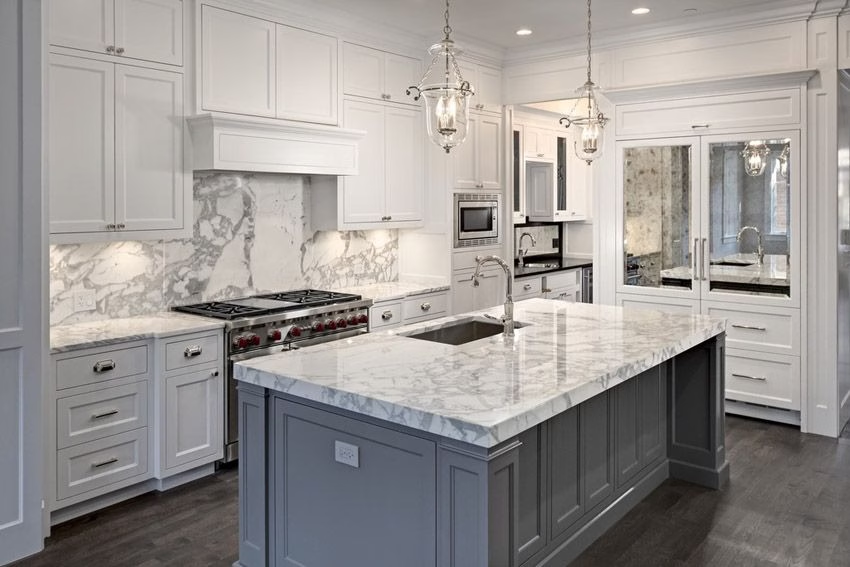
Marble vs. Granite Countertops: Care, Maintenance, and Restoration Compared
Marble and granite are the two most recognized natural stone countertop materials in American residential design, and they are frequently evaluated against each other in kitchen and bathroom renovation decisions. They share the distinction of being genuinely beautiful, genuinely durable, and genuinely natural — but they are fundamentally different materials with different mineral compositions, different hardness levels, different vulnerabilities, and different long-term care requirements. Understanding those differences before installation — or before developing a maintenance program for countertops you already have — is the foundation of informed ownership.
This guide provides a detailed comparison of marble and granite from a care and maintenance perspective, drawing on years of stone restoration experience serving homeowners, designers, and property managers throughout Washington DC, Maryland, and Northern Virginia.
Mineral Composition: Why It Matters for Maintenance
Marble: Calcium Carbonate
Marble is a metamorphic rock composed primarily of calcite or dolomite — crystalline forms of calcium carbonate. It forms when limestone is subjected to intense heat and pressure over geological time, recrystallizing the original sedimentary material into the interlocking crystalline structure that gives marble its characteristic translucency and veined appearance.
The calcium carbonate composition of marble is the central fact of its maintenance requirements. Calcium carbonate reacts chemically with acids — including mild organic acids found in common household substances — producing carbon dioxide gas and dissolving the surface of the stone. This reaction, called etching, is irreversible without mechanical refinishing. It is the primary maintenance challenge of marble ownership in kitchen and bathroom environments.
Granite: Silicate Minerals
Granite is an igneous rock composed of silicate minerals — primarily quartz, feldspar, and mica — that crystallized from cooling magma. The silicate mineral family is chemically stable and highly resistant to acid attack. This fundamental chemical difference is why granite does not etch and marble does. A drop of lemon juice left on a polished marble countertop for 30 minutes produces a visible etch mark. The same lemon juice on granite has no effect on the polish.
Granite’s vulnerability is not acid sensitivity but porosity. Many granites — particularly those with open, coarse crystalline structures — are moderately porous and will absorb oils and pigmented liquids if not sealed. A dark oil stain on an unsealed granite countertop is a slow-developing problem that requires poultice treatment and may not fully resolve without professional intervention.
Hardness Comparison
On the Mohs hardness scale, marble typically rates 3 to 4 and granite rates 6 to 7. This is a significant difference with practical implications.
Marble can be scratched by harder materials — knives, cast iron cookware, ceramic dishes, and even some countertop hardware can leave marks on a polished marble surface. In a kitchen, this is a real concern on actively used prep areas. Granite, by contrast, cannot be scratched by kitchen knives (steel rates approximately 5.5 on the Mohs scale) and resists surface scratching from normal kitchen use without special precautions.
Marble’s relative softness is also what makes it restorable. Diamond polishing equipment can refinish a scratched or etched marble surface because the stone yields to abrasive tooling. Granite’s hardness makes it more difficult and expensive to refinish when damage does occur, though granite’s resistance to the types of damage common in kitchen use means professional refinishing is needed far less frequently.
Etching: The Central Issue for Marble Countertops
Etching deserves extended treatment because it is so frequently misunderstood by marble countertop owners and is the leading cause of dissatisfaction with marble in kitchen applications.
An etch mark is not a stain. It is not removed by cleaning. It is a chemical change to the surface of the stone — the acid has dissolved a microscopic layer of calcium carbonate, permanently altering the surface texture in that area. On a highly polished marble, the etch appears as a dull, hazy area because the micro-texture of the etched surface scatters light rather than reflecting it uniformly. On a honed marble, etching is less immediately visible because the surrounding surface is already non-reflective, but the texture change is still present and visible under raking light.
In a kitchen, the list of substances that will etch marble on contact is long: lemon juice, lime juice, orange juice, tomato juice, vinegar, wine, sparkling water, coffee, tea, most sodas, mustard, ketchup, many salad dressings, citrus rinds left on the counter, and most commercial kitchen cleaners. Even brief contact — a lemon wedge placed on the counter for a few minutes while cooking — is sufficient to produce a visible etch.
Granite does not etch. Period. This single characteristic is the primary functional advantage of granite over marble in kitchen countertop applications.
Staining Vulnerability
Both marble and granite can stain, but through different mechanisms and with different probabilities.
Marble’s vulnerability to staining is compounded by its reactivity. An oil-based stain on marble may be accompanied by surface etching from any acidic component of the staining substance, making the mark both a stain (subsurface discoloration) and an etch (surface texture change). Marble is generally considered more susceptible to staining than granite in comparable porosities because its calcium carbonate matrix interacts with a wider range of staining agents.
Granite is less reactive but still porous in most varieties. Olive oil, red wine, dark fruit juices, and coffee can stain unsealed granite — particularly around sinks and prep areas where repeated small spills accumulate over time. A properly maintained sealing program dramatically reduces staining risk in granite, as it does in marble.
Daily Cleaning: What to Use and What to Avoid
Cleaning Marble Countertops
Daily cleaning of marble countertops should use only pH-neutral, stone-safe cleaners — or simply warm water and a soft cloth. The following are the most important items to avoid:
- Vinegar-based cleaners in any concentration
- Products containing citric acid, lactic acid, or other organic acids
- Bleach and bleach-based cleaners (these both etch and bleach marble)
- Bathroom tile cleaners and general-purpose kitchen sprays
- Abrasive scrubbing pads or powders that will scratch the polished surface
- Dish soap in large quantities or left to sit — many formulas contain additives that dull stone over time
For daily practice, the most important habit is prompt cleanup of any spill before it has time to etch or penetrate the sealer. A ten-second response to a lemon juice spill will prevent a mark that otherwise requires professional refinishing to remove.
Cleaning Granite Countertops
Granite cleaning is more forgiving. Standard pH-neutral or mildly alkaline kitchen cleaners are appropriate for granite, and brief contact with acidic foods does not damage the surface. The primary cleaning guidance for granite is to avoid harsh abrasives, to clean up oil-based spills promptly before they have time to penetrate the sealer, and to avoid leaving wet items in place for extended periods that can cause moisture-related staining or mineral deposits around drains and fixtures.
Sealing Frequency
Both marble and granite benefit from regular sealing with a penetrating impregnating sealer, but the sealing program serves different purposes for each material.
For marble, sealing reduces the rate at which staining agents penetrate the stone — it provides a buffer that gives time for cleanup before a stain sets. Sealer does not prevent etching. No sealer currently on the market prevents the acid etching reaction on calcium carbonate stone. A sealed marble countertop will etch just as quickly from acid contact as an unsealed one — the sealer protects against staining, not against chemical surface damage.
For granite, sealing reduces porosity and protects against oil and liquid penetration. Many granites have lower porosity than marble and may require less frequent sealing — some dense granites test well enough that sealing is minimally beneficial, though it remains good practice.
A practical sealing schedule for DC area countertops:
- Kitchen marble countertops: seal every 6 to 12 months with a premium penetrating sealer
- Bathroom marble vanities and countertops: seal every 12 to 24 months
- Kitchen granite countertops: seal every 12 to 24 months depending on the stone’s porosity
- Bathroom granite surfaces: seal every 2 to 3 years in most cases
The water bead test is a reliable field check: apply a small amount of water to the surface and observe whether it beads up or begins to absorb and darken the stone. If the water darkens the stone within 10 minutes, sealing is overdue.
Marble Armor: Advanced Protection for Marble Countertops
For marble countertops, vanities, tabletops, bar tops, backsplashes, and waterfall edges — surfaces subject to frequent spills and acid contact — Marble Armor provides a professional-grade nano-coating that significantly enhances etch and stain resistance. The coating bonds at the molecular level to the stone surface and creates a barrier that reduces the reactivity of the calcium carbonate to acidic contact.
Marble Armor is applied after professional honing and polishing, ensuring the stone surface is in optimal condition before the coating is installed. It is appropriate for marble countertops, marble vanities, marble tabletops, marble bar tops, marble backsplashes, and marble waterfall edges. It is not appropriate for floors, where foot traffic would abrade the nano-coating and reduce its effectiveness.
Granite does not require Marble Armor or comparable coatings — its silicate composition already provides the acid resistance that the coating is designed to simulate on marble. Sealing with a quality penetrating impregnating sealer is sufficient protection for granite countertops in normal use.
Restoration Process and Cost: Marble vs. Granite
Marble Countertop Restoration
Because marble is softer and more susceptible to etching and scratching, marble countertop restoration is more commonly needed and is a well-established professional service. The standard process involves:
- Assessment of the extent and depth of etch damage, scratching, and staining
- Stain treatment if subsurface staining is present, using appropriate poultice materials
- Diamond honing through a sequence of grits appropriate to the damage severity
- Final polishing to the specified sheen level
- Sealing and, if applicable, Marble Armor application
A typical kitchen marble countertop restoration in the DC metro area costs $300 to $800 for a standard-sized kitchen, depending on the square footage, the severity of the damage, and whether stain treatment is required. For more information, see our kitchen countertop stone restoration guide.
Granite Countertop Restoration
Granite countertop restoration is less commonly needed but is appropriate when the surface has been mechanically damaged — deep scratches from abrasive materials, chips from impact, or surface dullness from improper cleaning over many years. Granite polishing is more equipment-intensive than marble polishing because of the stone’s hardness, requiring more aggressive diamond tooling and more time to progress through the grit sequence.
Stain removal from granite typically involves poultice treatment — applying a poultice mixed with a solvent or oxidizing agent appropriate to the stain type, covering it to prevent drying, and allowing the poultice to draw the stain out of the stone over 24 to 48 hours. Multiple poultice applications may be needed for deep or set stains.
Ten-Year Cost of Maintenance: Marble vs. Granite
| Maintenance Item | Marble (10 years) | Granite (10 years) |
|---|---|---|
| Sealer product (DIY) | $150 – $300 | $75 – $150 |
| Professional restoration (1-2 times) | $600 – $1,600 | $0 – $800 |
| Marble Armor application (once) | $400 – $800 | N/A |
| Estimated 10-year maintenance cost | $1,150 – $2,700 | $75 – $950 |
These figures assume a standard kitchen countertop installation, attentive daily care, and the DC metro area pricing environment. Marble maintenance costs are higher primarily because of the greater likelihood of etch damage requiring professional refinishing.
Which Is Better for Kitchens, Bathrooms, and High-Use Areas?
Kitchens
From a purely functional standpoint, granite is the more forgiving kitchen countertop material. Its acid resistance eliminates the primary maintenance challenge of marble, and its hardness resists the scratching that kitchen use produces. For homeowners who use their kitchens actively and want a durable natural stone surface without special precautions, granite is the lower-maintenance choice.
Marble in a kitchen is entirely viable with the right expectations and habits. Many of the most beautiful and celebrated kitchen designs in the DC area feature white Carrara or Calacatta marble — the material is genuinely exceptional in that setting. The key is understanding that marble in a kitchen will develop a patina over time, that etching is likely to occur regardless of care, and that this patina — a kind of earned character that European farmhouse kitchens have embraced for centuries — is either a feature or a problem depending on the homeowner’s aesthetic values and tolerance for imperfection.
Bathrooms
In bathrooms, the acid exposure profile is lower than in kitchens, making marble more manageable. The primary risks are bathroom product etching, which can be minimized with careful product selection and prompt cleanup, and mineral deposit buildup from hard water. A marble bathroom that is well-maintained provides a level of beauty and refinement that is difficult to match with other materials. Granite in bathrooms is also excellent but less commonly specified in high-end residential design.
High-Use Commercial Areas
For commercial applications — reception desks, bar tops, hotel room surfaces, restaurant host stands — granite is generally more appropriate than marble where the surface will be used actively by people who may not be attentive to marble’s specific care requirements. Where the marble aesthetic is essential to the design intent and the surface can be maintained by trained staff or professionally restored on a regular schedule, marble remains a viable option for commercial settings.
Rose Restoration serves residential and commercial clients throughout Washington DC, Maryland, and Northern Virginia. Visit our residential marble restoration page and our granite services page for more information.
Frequently Asked Questions
Does marble etch faster than granite?
Granite does not etch at all under normal conditions. Etching is a reaction between acid and calcium carbonate — granite contains no calcium carbonate, so the reaction does not occur. Marble etches because it is composed almost entirely of calcium carbonate. Even mildly acidic substances like lemon juice, vinegar, wine, and many soaps will etch polished marble on contact. This is the fundamental maintenance distinction between the two materials.
Can I use the same cleaner on both marble and granite?
A pH-neutral stone cleaner is safe for both materials. The important difference is what you must avoid on marble: acidic cleaners, vinegar-based products, citrus-based cleaners, and most general-purpose kitchen and bathroom sprays will etch marble. These same products will not damage granite. If you have both marble and granite in your home, a single pH-neutral cleaner used consistently on all stone surfaces is the safest approach.
How often should marble countertops be professionally restored?
In an actively used kitchen, most marble countertops benefit from professional honing and polishing every 3 to 7 years, depending on the level of use and the care practices of the household. Light surface honing can be performed more frequently — annually in some cases — to maintain a consistent finish. Bathrooms with marble surfaces typically need professional attention every 5 to 10 years with consistent daily maintenance. Marble Armor application after restoration extends the interval between refinishing visits.
Is Marble Armor worth the investment?
For marble countertops and vanities in active use, Marble Armor provides meaningful protection against the etch and stain damage that drives most restoration costs. The coating significantly reduces the reactivity of the stone surface to acidic contact and extends the interval between professional refinishing. It is particularly valuable in kitchen settings where daily acid exposure is unavoidable. The investment typically pays back in reduced restoration frequency over the first three to five years of use.
Which stone holds its value better in a home resale?
Both marble and granite are recognized quality materials that signal investment and craftsmanship to prospective buyers. Marble in kitchens and bathrooms has strong appeal in the DC area luxury residential market and can command a premium with the right buyer. Granite reads as a quality standard in middle to upper-middle market residential settings. The condition of the stone at the time of sale matters as much as the material — a freshly restored marble countertop presents significantly better than a dull, etched surface, and the cost of restoration before a sale is typically recovered many times over in the selling price.
Does granite ever need professional restoration?
Less commonly than marble, but yes. Granite can develop deep oil stains that require professional poultice treatment. Mechanical damage from impact — chips at edges or around cutouts — can be filled and refinished by a professional stone restoration technician. Surface dullness from long-term use of improper cleaning products, or from years of acidic contact that has accumulated minor surface degradation, can be addressed through diamond polishing. Call Rose Restoration at 703-327-7676 to discuss the condition of your granite countertops.