
For general contractors managing commercial, institutional, or government construction projects in Virginia, Maryland, and DC, masonry restoration is one of the highest-risk specialty scopes on the schedule. The work looks straightforward from a distance—remove old mortar, install new mortar—but the technical requirements are exacting, the inspection standards are strict, and the consequences of using the wrong subcontractor are severe.
A failed masonry mock-up means lost time. Mortar that does not meet the project specification means rejected submittals, rework, and change orders. Repointing that damages historic brick means liability exposure that no GC wants on a federal or state preservation project. The wrong masonry sub can turn a routine scope item into a project-threatening problem.
Rose Restoration International has partnered with general contractors on federal, state, municipal, and commercial masonry projects throughout the DC metro area for more than 40 years. We understand the documentation requirements, the specification language, the SHPO process, and the field execution standards that professional project management demands. We show up on time, produce required submittals, maintain daily logs, and deliver the quality that passes inspection.
This article is written specifically for project managers, estimators, and site superintendents who need to understand what professional masonry restoration subcontracting looks like—what to specify, what to require in submittals, how to schedule the work, and what red flags to watch for when evaluating bids.
Why Masonry Restoration Requires a Specialty Subcontractor
Masonry restoration is not a general labor scope. It is a technical discipline that requires knowledge of material science, historic preservation standards, and regulatory compliance that most general construction workers—and most general masonry contractors—do not possess.
The core technical challenge is mortar chemistry. Mortar must be compatible with the existing masonry in terms of compressive strength, vapor permeability, and thermal expansion coefficient. On modern commercial construction, the specification will define the mortar type (typically ASTM C270 Type N or S) and the GC can hold the sub to that standard. On historic buildings—which constitute a significant share of the government project market in the DC area—the requirements are more complex. The mortar must match the original material in strength, composition, and appearance. Getting this wrong means damaging irreplaceable historic fabric.
Many GCs make the mistake of allowing their general masonry sub or their concrete sub to self-perform repointing on a historic building. This almost always ends badly. The sub uses off-the-shelf Type S mortar because it is readily available and easy to apply. The inspector rejects the work. The hard mortar has already been packed into historic joints. Now someone has to remove it without damaging 150-year-old brick—which is slow, expensive, and sometimes impossible without causing additional damage.
SHPO (State Historic Preservation Office) review on government projects adds another layer of complexity. Any masonry restoration work on a listed or eligible historic property that involves federal or state funding must comply with the Secretary of the Interior’s Standards for the Treatment of Historic Properties. A specialty contractor who does not understand these standards cannot produce compliant submittals, cannot pass SHPO review, and cannot execute the work correctly in the field.
The right specialty subcontractor brings documented experience on comparable projects, knowledge of ASTM and SHPO requirements, the ability to produce technically correct submittals, and the field craft to execute repointing correctly at production rates that keep the schedule moving.
Mortar Selection for Commercial and Government Projects
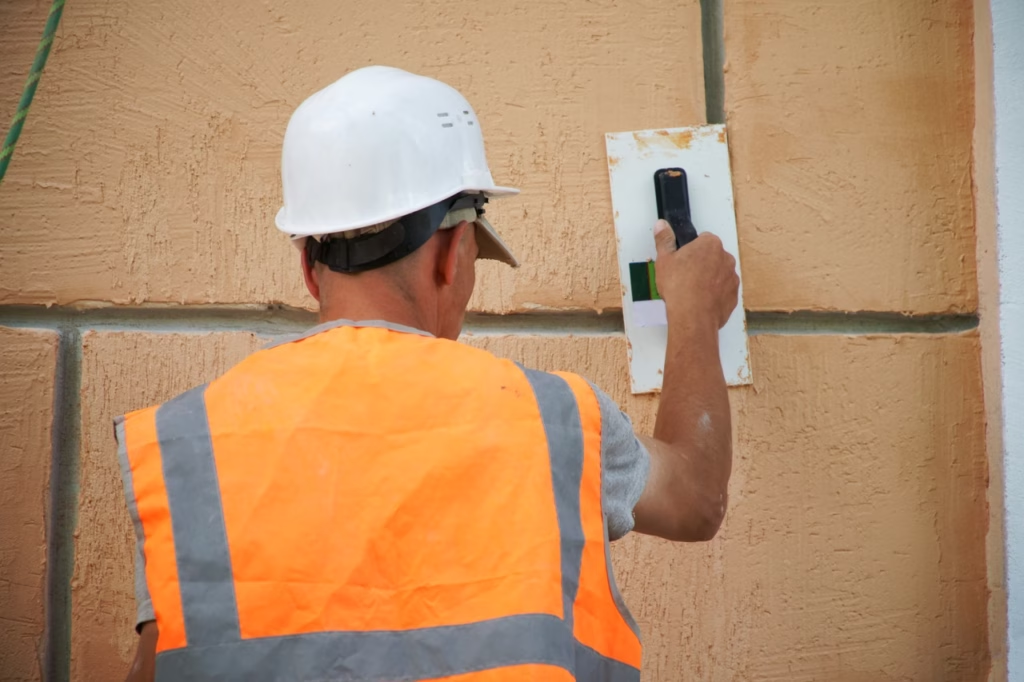
Commercial and government masonry specifications typically reference ASTM C270, the standard specification for mortar for unit masonry. GCs and their masonry subs need to understand the two methods of specifying mortar under C270: the proportion specification and the property specification.
Proportion Specification: Defines the ratio of cement, lime, and aggregate by volume. It is simpler to specify and enforce in the field. Most commercial projects use proportion specifications for standard mortar types (N, S, O). The advantage is predictability—if the sub follows the proportions, the mortar type is defined.
Property Specification: Defines minimum compressive strength, water retention, and air content requirements that must be verified by laboratory testing. Property spec is more common on government projects and historic preservation work, where performance requirements must be documented. It requires mortar samples to be submitted for testing, which adds cost and lead time.
For above-grade commercial repointing on standard masonry, Type N is most commonly specified. Type S is appropriate for below-grade applications and load-bearing structural masonry. On historic buildings in the DC area—where the majority of government masonry projects are located—the specification will typically require lime-based or lime-rich mortars compatible with the original material. This often means custom-mixed mortars that do not correspond to a standard ASTM type.
GCs should require mortar submittals early in the project—before mobilization. The submittal should include mix design, material data sheets for all components, and test results if property spec is in use. Mock-up panels should be required on any project where color matching is critical or where the specification requires SHPO review. Allow at least 28 days for mock-up panels to cure before evaluation.
A masonry sub that cannot produce a complete mortar submittal is not qualified for the scope. This is a non-negotiable baseline.
Repointing Protocols That Meet Specification
The field execution of repointing is where qualified subs distinguish themselves from unqualified ones. Here are the key protocol elements that should be in your specification and that your QC process should verify:
Joint Preparation — Depth Requirements: ASTM C270 and most project specifications require a minimum joint removal depth of 3/4 inch, measured from the masonry face. Many specs require 1 inch. Insufficient depth means the new mortar does not have enough depth to develop adequate bond and will debond prematurely. Joint depth should be spot-checked by the GC’s QC inspector, not just assumed.
Joint Preparation — No Power Saws on Historic Masonry: Angle grinders and circular saws are prohibited on historic masonry repointing projects. They are difficult to control, routinely overcut the joint and damage brick edges, and produce joints that are too wide. The Secretary of the Interior’s Standards prohibit their use. Compliant joint removal requires hand chisels, pneumatic chisels, or oscillating multi-tools—which are slower and more expensive but produce joints that are clean, correctly sized, and undamaged. If you see an angle grinder on a historic repointing job, stop the work.
Mortar Placement — Packing in Lifts: Mortar must be applied in multiple lifts of approximately 1/4 inch each, not in a single application. Each lift must be allowed to stiffen before the next is applied. Single-application mortar shrinks, cracks, and loses density. Multi-lift application produces dense, crack-resistant joints with full contact to both masonry faces.
Joint Tooling — Profile Matching: The tooled joint profile must match the original or the specified profile. Common profiles include concave (the most common and most weather-resistant), flush, struck, and weathered. The profile should be established in the mock-up panel and verified throughout production work. Tooling also compresses the mortar surface, improving density and weather resistance.
Curing and Protection: Freshly pointed masonry must be protected from direct sun, rain, and temperatures below 40°F for a minimum of 48–72 hours. On government projects, a curing plan should be part of the submittal package. Inadequate curing is a common cause of premature mortar failure and is difficult to attribute after the fact.
Mortar Matching on Visible Masonry
On public-facing buildings—government facilities, institutional campuses, historic commercial districts—mortar color matching is not a cosmetic preference. It is a specification requirement and, on historic properties, a preservation standard.
The color matching process for commercial and government work follows the same principles as residential but with more rigorous documentation requirements. The masonry sub should provide a written mortar analysis describing the existing joint material: sand color and gradation, Portland cement content estimate, lime content estimate, and any pigmentation. This analysis forms the basis for the proposed mix design.
Sample panels are mandatory on any project with color matching requirements. The panel—typically a minimum of 4 square feet—must be evaluated after full cure (28 days minimum) and must be approved by the owner’s representative and, if applicable, the SHPO reviewer before production work begins. The approved panel becomes the field standard for the duration of the project.
Sand sourcing documentation should be part of the submittal package. The sub should be able to identify the sand supplier and aggregate source, and provide a sample for the project file. This is important for matching future repairs and for SHPO documentation.
For projects where new construction masonry must match existing historic material—additions to historic buildings, for example—the challenge is even more complex. Rose Restoration has extensive experience producing mortar matches for projects subject to rigorous historic review in Virginia, Maryland, and DC. See our companion resource for homeowners who want to understand the process: Mortar Types Explained: How We Match Color, Sand, and Strength for Masonry Repointing.
Coordination and Scheduling for GCs
Masonry restoration has specific scheduling constraints that GCs need to understand and plan for. Ignoring them leads to schedule compression, quality problems, and disputes.
Weather windows: Repointing cannot proceed in freezing temperatures (below 40°F ambient or surface), in heavy rain, or in direct sun on hot days (above 90°F) without special precautions. In the DC metro area, this limits productive work windows to roughly April–October for outdoor repointing, with winter work requiring heated enclosures and additional cost. Build weather contingency into your schedule for masonry scopes.
Mock-up lead time: If the specification requires a mock-up panel (and it should), build in a minimum of 28 days for cure before evaluation, plus the time required for owner/SHPO review and approval. Starting mock-up work immediately after subcontract award is not too soon. Waiting until mobilization to start the mock-up is almost always too late.
Scaffolding coordination: Repointing is a scaffolding-intensive scope. Coordinate scaffold erection and strike with the masonry sub’s production schedule. Scaffolding that is struck before all work areas are complete forces remobilization and schedule disruption. If multiple subcontractors share scaffolding, establish a clear priority schedule in writing.
Adjacent trade protection: Freshly cleaned masonry and fresh mortar require protection from other trade activity. Coordinate with window and door installers, painters, caulking contractors, and waterproofing applicators to ensure masonry work is complete and cured before adjacent trades work in the same areas.
Access requirements: Historic masonry restoration often requires unusually close access—within 12 to 18 inches of the wall face—because the work is hand-tool intensive. Ensure your access plan accommodates this. Pump jack systems and swing stages that position workers too far from the wall face reduce quality and production rates.
Documentation and Closeout
A professional masonry restoration subcontractor should deliver a complete documentation package. GCs should require this in the subcontract and track it through the project. Here is what to expect:
- Submittals: Mortar mix design, material data sheets, aggregate source documentation, mock-up proposal, and (if required) laboratory test results. These should be submitted and approved before any production work begins.
- Daily logs: Date, crew size, areas worked, approximate quantity of linear feet pointed, weather conditions, temperature at start and end of shift, and any notable observations. Daily logs are essential for resolving disputes about when work was performed under what conditions.
- Progress photos: Dated, geotagged photos documenting pre-work conditions, joint preparation, mortar application, tooled joints, and cured finished work. Minimum frequency: daily during active production. Photos should be organized by area/elevation and linked to an as-built drawing.
- Mock-up / test panel record: Documentation of when the panel was installed, when it was evaluated, by whom, and the approval decision. Include photos of the approved panel and retain a physical sample if possible.
- Warranty documentation: Most commercial masonry contracts require a written warranty of one to two years on workmanship. The warranty document should specify what is covered, what is excluded, and the process for submitting a warranty claim. Rose Restoration provides written warranties on all commercial project work.
GCs should establish submittal requirements and closeout documentation requirements in the subcontract—not as an afterthought at project completion. Chasing documentation after the crew has demobilized is time-consuming and often incomplete.
For a broader discussion of working with specialty restoration subcontractors on government and commercial projects, see: Working with a Specialty Restoration Subcontractor on Government and Commercial Projects.
Frequently Asked Questions
What qualifications should a masonry restoration subcontractor have?
At minimum, a qualified masonry restoration subcontractor should hold a valid contractor’s license in the state where the work is performed, carry adequate general liability and workers’ compensation insurance, and be able to provide verifiable references from comparable projects (similar building type, similar masonry material, similar scope). For historic work, look for documented experience on projects that involved SHPO review or Secretary of the Interior’s Standards compliance. For government projects, verify that the sub is not on any debarment lists and has the bonding capacity required by the contract. Ask for sample submittals from recent projects and evaluate the quality of the documentation—a contractor who produces professional submittals is far more likely to perform professional field work than one who cannot produce basic paperwork.
How is repointing different from tuckpointing?
The terms are often used interchangeably, but they technically describe different things. Repointing is the process of removing deteriorated mortar from masonry joints and replacing it with new mortar of a compatible composition and color. Tuckpointing, in its original British usage, is a decorative technique in which a base mortar colored to match the masonry is applied, and a thin line of contrasting white mortar (the “tuck”) is inserted to simulate fine, precise joints. True tuckpointing is rarely performed in the United States today. In American trade usage, “tuckpointing” has evolved to mean essentially the same thing as repointing—and most contractors in the DC area use both terms interchangeably to mean mortar joint repair and replacement. When evaluating bids, do not assume that a contractor who says “tuckpointing” means something different from one who says “repointing.” Ask what they mean and what the proposed process is.
What mortar types are required for historic government buildings?
Historic government buildings in the DC area were typically constructed before the widespread adoption of Portland cement, using natural cement or lime-putty mortars that are softer and more permeable than modern Portland-based products. The Secretary of the Interior’s Standards require that replacement mortar be compatible with the original material in strength, composition, and appearance—which means using lime-rich or custom-formulated mortars rather than standard ASTM Type N or S. Project specifications for historic government work typically require a mortar analysis of the existing joints, a proposed mix design based on that analysis, and a sample panel approved by the SHPO reviewer before production begins. Rose Restoration has performed this process on federal and state historic masonry projects throughout Virginia, Maryland, and DC and is well-versed in the documentation and approval workflow.
How long does commercial masonry repointing take?
Production rates for commercial repointing vary significantly based on joint depth, mortar hardness, scaffold configuration, and the degree of hand-tool requirement. On standard commercial masonry with accessible scaffolding and machine-mixed mortar, an experienced crew of three can repoint roughly 150–250 linear feet of joint per day. On historic masonry requiring hand-tool joint removal and multi-lift placement, production rates drop to 50–100 linear feet per day. For estimating purposes, it is far more useful to think in terms of square feet of wall area, with typical production rates of 50–150 square feet per crew-day depending on joint frequency and complexity. Rose Restoration provides detailed production rate estimates for each project based on a site visit and mortar condition assessment. Do not accept a lump-sum time estimate without understanding what production assumptions it is based on.
Can repointing be done in cold weather?
Yes, with proper cold-weather procedures—but at additional cost. ASTM C270 and most project specifications prohibit application of mortar when the air or surface temperature is below 40°F or when temperatures are expected to fall below 40°F within 48 hours of application. Cold temperatures dramatically slow mortar curing, and freezing before sufficient cure strength is reached causes mortar failure. Cold-weather repointing typically requires heated enclosures (temporary shelter structures around the work area), supplemental heating to maintain minimum temperatures, extended cure time protection, and additional labor for setup and monitoring. GCs pricing winter masonry restoration in the DC area should budget for cold-weather protection measures and should extend the curing protection window. Rose Restoration has successfully executed cold-weather masonry projects using heated enclosures when project schedules require winter work.
Does Rose Restoration work as a masonry subcontractor for GCs in VA, MD, and DC?
Yes. Subcontracting to general contractors on commercial, institutional, and government projects is a core part of Rose Restoration’s business. We have served as the masonry restoration sub on federal GSA projects, state facilities projects, municipal contracts, and private commercial work throughout Virginia, Maryland, and the Washington DC metro area for over 40 years. We are experienced with government subcontracting documentation requirements, certified payroll for Davis-Bacon projects, and the SHPO submittal and approval process. We carry the insurance and bonding coverage required for public sector work and can provide letters of bondability and insurance certificates on short notice. To discuss your project, call us at (703) 327-7676 or visit our contact page. See also our article for homeowners on mortar types and repointing: Mortar Types Explained: How We Match Color, Sand, and Strength for Masonry Repointing.
Partner with Rose Restoration on Your Next Masonry Project
Masonry restoration is a small but high-stakes scope on most commercial and government projects. Done correctly, it protects the building envelope, satisfies inspection requirements, and closes out cleanly. Done incorrectly, it creates schedule disruptions, change orders, liability exposure, and—on historic buildings—permanent damage to irreplaceable material.
Rose Restoration International brings 40-plus years of masonry restoration expertise to every project we work on. We understand the specification language, the regulatory environment, and the field craft required to deliver compliant, high-quality repointing on any building type in the DC metro area. We produce professional submittals, maintain complete documentation, and stand behind our work with written warranties.
If you are a general contractor looking for a qualified masonry restoration subcontractor for a project in Virginia, Maryland, or DC, we would welcome the opportunity to bid. Call us at (703) 327-7676 or use the button below to get in touch. We are also happy to provide references from comparable projects, sample submittals from recent government work, and proof of insurance and bonding capacity. Let us help you close out your masonry scope on time, on spec, and without surprises.