
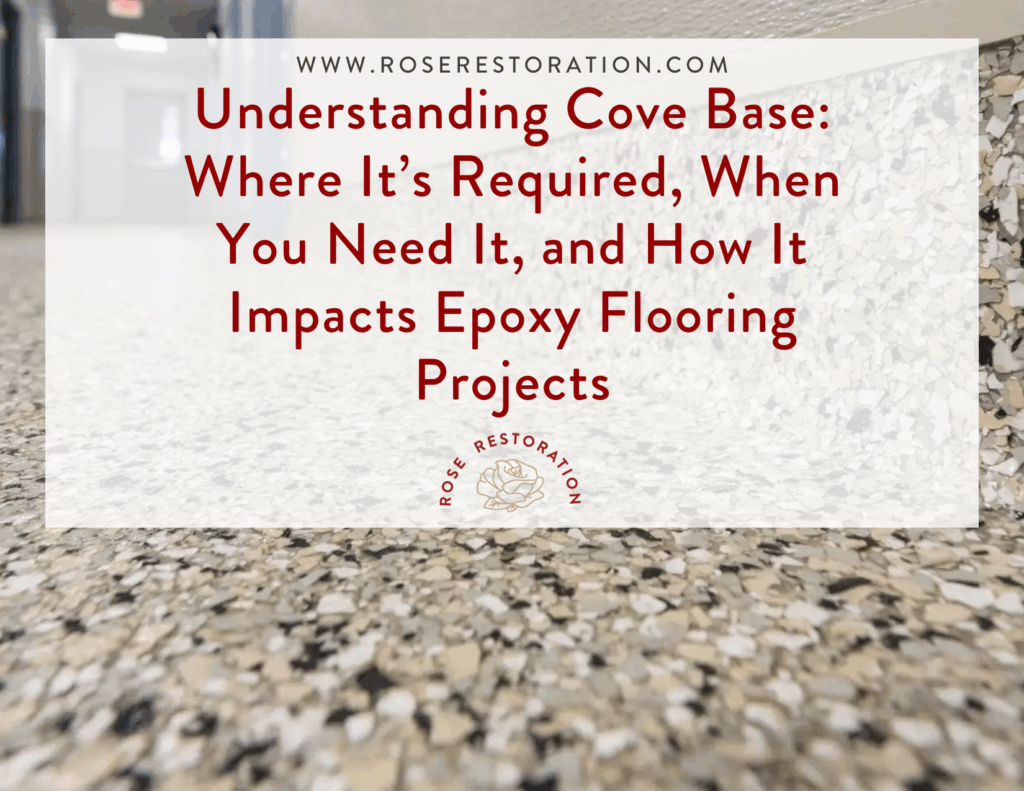
Cove base is a curved transition between the floor and wall that creates a seamless, sanitary junction — eliminating the 90-degree corner where dirt, moisture, and bacteria collect. It is required by health codes in commercial kitchens, food processing facilities, pharmaceutical clean rooms, and healthcare environments. When specified as part of an epoxy or urethane cement flooring system, cove base becomes an integral, monolithic extension of the floor — not a separate material glued to the wall — providing a continuous, cleanable surface from floor to wall transition.
At Rose Restoration International, cove base installation is a standard component of most commercial epoxy and urethane cement flooring projects we complete for clients throughout Virginia, Maryland, and Washington, D.C. Understanding the requirements, options, and installation process helps facility managers, food service operators, and healthcare administrators make informed decisions — and avoid the costly compliance failures that result from improper or missing cove base.
What Is Cove Base?
Cove base — sometimes called a coved base, sanitary cove, or floor cove — is a concave radius transition material installed at the junction of the floor and wall. Instead of meeting at a sharp 90-degree angle (which is nearly impossible to clean thoroughly and provides a natural trap for moisture, food particles, and microbial growth), the coved profile creates a smooth, curved transition that can be wiped, scrubbed, or pressure washed completely clean.
The profile typically consists of a gradual curve with a radius of 3/4 inch to 1.5 inches, rising vertically up the wall to a height of 4 inches or 6 inches above the finished floor surface. The cove meets the wall at a clean, straight top edge that can be feathered into a coating or left as a defined termination line.
Materials used for cove base in commercial flooring include:
- Integral epoxy cove base: Mixed from the same epoxy system as the floor coating and troweled in place as a monolithic extension of the floor. Provides the most seamless, chemically bonded, and durable solution available.
- Urethane cement cove base: Applied from a urethane cement mortar similar to the floor system. Exceptionally resistant to thermal shock, steam cleaning, and the chemical environments found in food processing and brewery applications.
- Pre-formed vinyl cove base: A separate product adhered to the wall above a vinyl or resilient flooring system. Easier and less expensive to install but does not create a monolithic, seamless system — the adhesive joint at the floor remains a potential moisture and contamination pathway.
For regulated commercial environments — food service, healthcare, pharmaceutical, animal care — integral epoxy or urethane cement cove base is the appropriate specification. Vinyl cove base does not meet the intent of most health and safety codes for these applications.
Where Cove Base Is Required by Code
Cove base is not universally required — but in any regulated commercial environment where food safety, infection control, or contamination prevention is a concern, it is either explicitly required or strongly implied by the relevant code or standard. Facility owners who skip cove base in these environments routinely face inspection failures, corrective action requirements, and potential regulatory sanctions.
Commercial Kitchens and Food Service: The FDA Food Code (Section 6-201.13) requires that floors in food preparation areas, walk-in refrigerators, and warewashing areas be coved to a height of at least 3/8 inch radius at the floor-wall junction, and that the cove be sealed to prevent moisture penetration. Most state and local health departments enforce this provision during routine inspections. Restaurants, commissaries, cafeterias, and food trucks operating out of commercial kitchens are all subject to this requirement.
Food and Beverage Manufacturing: FDA 21 CFR Part 117 (Current Good Manufacturing Practice for human food) and USDA regulations for meat and poultry processing facilities require cleanable, sealed floor-wall junctions. The FSMA (Food Safety Modernization Act) has sharpened enforcement of these environmental controls. Breweries, wineries, dairy processors, and bakeries operating under these frameworks should assume cove base is required.
Pharmaceutical and Biotech Facilities: FDA 21 CFR Parts 211 and 600 (cGMP for finished pharmaceuticals and biologics) require that floors, walls, and junctions be constructed to facilitate cleaning and sanitation. Cove base is standard practice in any GMP-regulated manufacturing area, laboratory, or clean room.
Healthcare Environments: The Facility Guidelines Institute (FGI) Guidelines for Design and Construction of Hospitals specify coved, seamless flooring systems in operating rooms, sterile processing departments, soiled utility rooms, and procedure rooms. The Joint Commission surveys healthcare facilities against these guidelines.
Animal Care and Veterinary Facilities: USDA Animal Welfare Act regulations and state veterinary facility licensing requirements typically require cleanable, sealed floor-wall junctions in animal housing, treatment, and surgical areas.
Types of Cove Base Systems
Selecting the right cove base system requires matching the material to the floor coating system, the chemical and thermal environment, and the regulatory requirements. At Rose Restoration International, we install all three principal types of commercial cove base as part of our broader epoxy and urethane cement flooring systems.
Integral Epoxy Cove Base: The most common specification for commercial kitchens, warehouses, and light industrial environments. The cove is formed from the same epoxy mortar or broadcast system used on the floor, creating a chemically bonded, monolithic wall-to-floor transition. Because the cove and floor are the same material, there is no seam, no adhesive joint, and no color mismatch. The topcoat is applied continuously across the floor and up through the cove, providing a single sealed surface.
Urethane Cement Cove Base: The preferred specification for environments with extreme thermal cycling, steam cleaning, heavy chemical exposure, or drainage trenches where thermal shock resistance is critical. Urethane cement cove base expands and contracts with the substrate without debonding — a significant advantage over epoxy in environments like commercial dishwashing areas, brewery production floors, and commercial laundries where hot water and steam are routine.
Troweled Cove Base (Independent of Coating System): In some applications, a cementitious cove base mortar is installed as a base layer independently of the coating system — typically using a pre-formed metal cove former as a template — and the coating is then applied over both floor and cove continuously. This approach gives installers flexibility to achieve consistent radius geometry even on irregular wall surfaces before the coating system is applied.
Pre-Formed Vinyl Cove Base: Appropriate for non-regulated environments where the goal is a clean, finished appearance rather than a hygienic, monolithic seal. Pre-formed vinyl is significantly less expensive and faster to install but is not suitable for applications requiring a seamless, inspectable floor-wall junction. It should not be specified in any environment regulated for food safety, pharmaceutical manufacturing, or healthcare infection control.
Cove Base Installation Process
Proper cove base installation is a skilled trade operation that requires careful attention to surface preparation, geometry, and material handling. When cove base fails — typically through delamination, cracking at the cove-to-floor junction, or inconsistent radius — it almost always traces back to errors in one of the following steps.
Step 1 — Wall and Floor Preparation: The wall surface in the cove zone must be clean, sound, and free of paint, efflorescence, or contamination that would prevent bonding. Concrete block, CMU, drywall, and plywood walls each require different preparation approaches. The floor slab in the cove zone must also be properly prepared and profiled — the cove base is installed after floor prep but before floor coating application.
Step 2 — Cove Former Installation: A pre-formed metal or plastic cove former (radius template) is fastened to the floor at the base of the wall, establishing the geometry of the finished cove. The cove former ensures consistent radius throughout the installation and serves as a screed edge for the mortar application. Proper alignment of the cove former is critical — misalignment creates wavy, inconsistent cove profiles that are difficult to correct after mortar cure.
Step 3 — Material Application: The epoxy or urethane cement mortar is mixed to specification and troweled into the cove zone, packing tightly against the wall, filling the cove former, and feathering to the floor surface at the toe of the cove. The top termination of the cove is finished to a clean, straight line at the specified height (4 or 6 inches). Air pockets and voids must be eliminated — they become failure points.
Step 4 — Curing: The cove mortar must cure to the manufacturer’s specification before topcoat application. Applying topcoat over incompletely cured cove mortar is a common error that leads to outgassing, blistering, and adhesion failure.
Step 5 — Topcoat Integration: The coating system is applied continuously from the floor surface up through the cove and to the top termination line, creating the monolithic, seamless surface. Color and texture should be consistent between floor and cove. A final inspection of the cove-to-floor radius, top edge termination, and coating continuity is performed before the project is accepted.
Cove Base Height and Profile Options
Cove base specifications vary by application, regulatory requirement, and facility preference. Understanding the options available helps facility managers and designers make the right specification decision upfront — changes after installation are expensive.
Standard 4-Inch Height: The most common specification for commercial kitchens, retail preparation areas, and light manufacturing. The FDA Food Code minimum radius requirement is met at this height, and 4-inch cove is adequate for most wet cleaning and pressure washing applications where water is not projected forcefully at the base of the wall.
6-Inch Height: Specified in environments with high-pressure cleaning, floor drain trench areas, or where health codes specifically require a taller cove. Food and beverage processing plants, brewery production floors, and commercial laundry facilities frequently specify 6-inch cove. Some state health departments have adopted 6-inch as their minimum for licensed food establishments.
Custom Heights (8 to 12 inches): In pharmaceutical clean rooms, sterile processing departments, and specialized containment environments, cove heights of 8, 10, or 12 inches are sometimes specified to maximize the zone of continuous, monolithic coating coverage and reduce the number of material transitions at the base of the wall.
Radius Profile — Tight vs. Gradual Curve: The standard cove radius for most commercial applications is 3/4 inch to 1 inch. Tighter radii (smaller number) are harder to clean thoroughly by hand but may be required to accommodate tight floor plans or existing millwork. Gradual radii (1.5 inch and larger) are easier to clean and provide a smoother visual transition, but require more material and more skilled troweling to execute without voids or flat spots in the curve.
Color Matching: Integral epoxy and urethane cement cove base can be color-matched to the floor coating system for a seamless visual transition, or specified in a contrasting color as a visual boundary or safety feature. Custom color matching is available for most epoxy and urethane cement systems.
Frequently Asked Questions About Cove Base
How much does integral epoxy cove base cost?
Integral epoxy or urethane cement cove base typically costs $8 to $18 per linear foot installed, depending on height, material system, substrate condition, and project complexity. This cost is usually included as a line item in the overall flooring project estimate rather than bid separately. Pre-formed vinyl cove base is significantly less expensive ($1 to $4 per linear foot) but is not appropriate for regulated commercial environments. We provide detailed estimates after a site walkthrough.
Is cove base required by law in commercial kitchens?
Yes, in virtually all U.S. jurisdictions. The FDA Food Code — which has been adopted in some form by all 50 states — requires coved and sealed floor-wall junctions in food preparation, storage, and warewashing areas. Local health departments enforce this requirement during routine inspections. Failure to have compliant cove base is a corrective action item that must be remediated before a facility can pass inspection. We strongly recommend confirming the specific requirements of your local health department before specifying a cove base system.
What is the difference between epoxy cove base and vinyl cove base?
Epoxy cove base is integral to the floor coating system — it is formed from the same material as the floor, applied by the flooring contractor as part of the installation, and topcoated continuously with the floor. There are no seams, no adhesive joints, and no separate materials. Vinyl cove base is a pre-formed rubber or vinyl strip adhered to the wall above the finished floor with contact cement. It is a separate product with an adhesive seam at the floor junction — a potential moisture and contamination pathway that is not acceptable in food service, healthcare, or pharmaceutical environments.
What height cove base do I need for my commercial kitchen?
Most commercial kitchen health codes require a minimum 3/8-inch radius cove at 4 inches height, but many jurisdictions are moving to 6-inch minimums. We recommend confirming with your local health department before construction or renovation. If you are unsure, specifying 6-inch cove base future-proofs the installation against more stringent local requirements and provides additional protection against water intrusion at the base of the wall.
Does Rose Restoration International install epoxy cove base in Virginia, Maryland, and D.C.?
Yes. Rose Restoration International installs integral epoxy and urethane cement cove base as part of complete commercial flooring projects throughout Virginia, Maryland, and Washington, D.C., including Fairfax County, Prince William County, Arlington, Alexandria, Montgomery County, Prince George’s County, and the District of Columbia. We work with restaurant operators, food manufacturers, healthcare facilities, breweries, and pharmaceutical companies to deliver compliant, durable, and cleanable floor systems. Call us at 703-327-7676 or use the button below to request a free site visit.
Get the Cove Base Right the First Time
Cove base is a small detail with large consequences. Specified and installed correctly, it is a seamless, durable, and compliant feature of your commercial floor system. Specified incorrectly or skipped entirely, it becomes a recurring source of health code violations, maintenance problems, and facility downtime.
Rose Restoration International has been installing commercial epoxy and urethane cement flooring systems — including integral cove base — for more than 40+ years. We understand the code requirements, the material options, and the installation discipline required to get it right the first time. Contact us at 703-327-7676 or click below to schedule a free estimate for your commercial kitchen, food processing facility, brewery, or healthcare environment.