
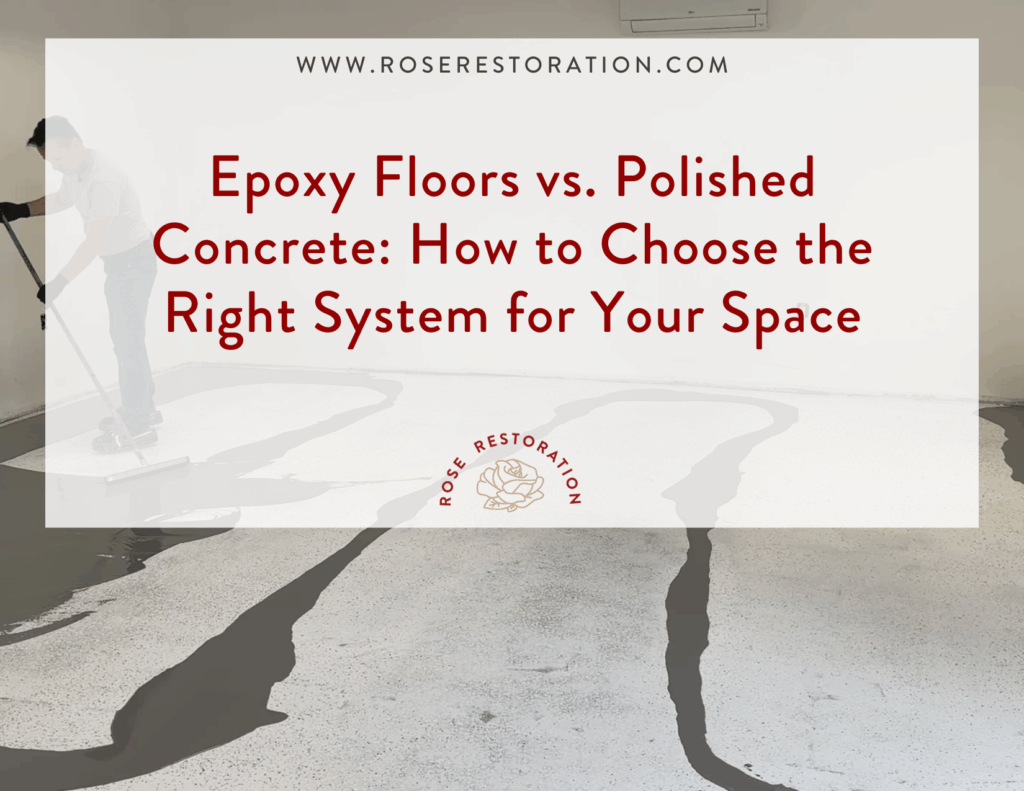
Epoxy floors and polished concrete are two of the most popular concrete finishing systems used in homes, commercial buildings, warehouses, showrooms, and industrial facilities. Both offer durability and long-term performance, but they serve different purposes and are installed differently. Choosing between them depends on your concrete condition, design goals, maintenance expectations, and budget.
At Rose Restoration, we help homeowners, general contractors, and property managers decide which system best fits their project. This guide breaks down the key differences, benefits, and ideal use cases for epoxy flooring versus polished concrete.
What Is an Epoxy Floor?
Epoxy flooring is a resinous coating system applied to prepared concrete. It creates a seamless, customizable surface that protects the concrete from stains, chemicals, and wear.
Epoxy systems include:
• Solid-color epoxy floors
• Decorative flake systems
• Quartz broadcast floors
• Urethane cement systems for commercial kitchens
• High-build industrial coatings
Epoxy is ideal for spaces needing chemical resistance, waterproofing, color uniformity, or a dust-free finish.
Common uses:
• Residential garages and basements
• Commercial kitchens and food prep areas
• Warehouses and distribution centers
• Veterinary clinics and medical facilities
• Auto shops and mechanical rooms
• Retail spaces and showrooms
What Is Polished Concrete?
Polished concrete is a mechanical refinement of the concrete slab using industrial grinders and progressively finer diamond abrasives. Instead of coating the surface, polishing exposes and smooths the concrete itself, creating a natural, reflective finish.
Polished concrete can be:
• Matte, satin, or high-gloss
• Densified for hardness
• Dyed for color
• Patterned or scored
• Finished with stain-guard protection
Common uses include:
• Hotel lobbies and retail stores
• Office buildings
• Restaurants
• Residential basements
• Warehouses
• Museums and public spaces
Key Differences: Epoxy vs. Polished Concrete
Understanding the functional differences makes choosing the right floor much easier.
Appearance
Epoxy creates a consistent, customizable surface. You can choose any color, design, or broadcast texture.
Polished concrete highlights the natural variation of the slab, offering an organic, architectural look.
Durability
Epoxy provides excellent chemical resistance, stain resistance, and waterproofing.
Polished concrete is extremely abrasion-resistant but not designed for chemical-heavy environments unless properly sealed.
Maintenance
Epoxy is easy to clean with routine sweeping and mopping, but still needs re-topcoating over time depending on traffic.
Polished concrete requires the least maintenance of any concrete finish and holds up well long-term with periodic burnishing and cleaning.
Slip Resistance
Epoxy floors can be customized with non-slip additives, flake, or quartz.
Polished concrete can be slippery when wet unless treated with a traction-enhancing guard.
Moisture Resistance
Epoxy requires moisture testing before installation. Moisture-mitigating primers may be necessary.
Polished concrete handles moisture better because it is breathable, making it a strong choice for basements and older slabs.
Installation Timeline
Epoxy requires several days for prep, coating, curing, and topcoat application.
Polished concrete is typically faster for large open spaces but takes time for multi-grit refinement.
When to Choose Epoxy Flooring
Epoxy flooring is the better choice when you need:
• A waterproof, sealed surface
• Protection against chemicals or oils
• Uniform color and appearance
• Non-slip texture
• USDA or code-compliant flooring for commercial kitchens
• Easy sanitation for medical, food service, or lab environments
Best epoxy applications:
• Garages and workshops
• Commercial kitchens
• Auto shops and aviation facilities
• Manufacturing plants
• Retail stores needing color or branding
• Facilities requiring cove base
Epoxy also allows creative design options such as safety striping, color zoning, or decorative flake.
When to Choose Polished Concrete
Polished concrete shines when you want:
• A natural, architectural finish
• Maximum durability with minimal maintenance
• A cost-effective, long-lasting floor
• High reflectivity to brighten large spaces
• A breathable system for moisture-prone areas
Best polished concrete applications:
• Basements and residential interiors
• Retail stores
• Office buildings
• Hotels and restaurants
• Museums and galleries
• Large warehouses
For property managers, polished concrete delivers excellent longevity and very low life-cycle cost.
Residential Considerations
Homeowners may choose epoxy for garages, utility rooms, and workshops due to its stain resistance and cleanability. Polished concrete is often preferred for modern basements, open living spaces, and contemporary designs.
Commercial and Industrial Considerations
Commercial clients typically choose based on code requirements, traffic levels, and design intent.
Epoxy is chosen for:
• Kitchens
• Wet rooms
• Labs
• Medical facilities
• Food production areas
Polished concrete is chosen for:
• Retail and hospitality
• Offices
• Museums
• Public spaces
• Large warehouses
We help general contractors interpret project specifications and choose systems that meet performance requirements and budgets.
Which One Costs More?
Pricing varies depending on slab condition, prep needs, and system thickness.
Epoxy costs increase with:
• Heavy prep
• Cove base
• Moisture mitigation
• Industrial-grade coatings
• Multi-layer systems
Polished concrete costs increase with:
• Extensive patching
• Multiple dye colors
• High-gloss finishes
• Intricate scoring or sawcut patterns
Both systems offer excellent long-term value when installed correctly.
Final Thoughts
Epoxy floors and polished concrete each bring unique advantages depending on the space, the performance requirements, and the aesthetics you want to achieve. Epoxy is ideal for seamless, protective, and highly customizable surfaces. Polished concrete is best for natural beauty, low maintenance, and unmatched durability.
If you’re deciding between epoxy and polished concrete, Rose Restoration can evaluate your slab, explain the pros and cons for your specific space, and recommend the system that will deliver the best performance and longevity.
Related: Learn more about our epoxy garage floor coatings for residential and commercial clients in Washington DC, Maryland, and Northern Virginia.